Best Cars with Advanced Driver Assists: Features Worth Paying for
Pay for adaptive cruise control with stop-and-go, lane centering, blind-spot monitoring with rear cross-traffic alert, and automatic emergency braking; skip extra driver aids until those four are included, then compare price. Poorly chosen assist packages can add cost without cutting fatigue, parking stress, or collision risk. This guide ranks the features that matter most in daily driving and explains which ones are worth the money on new cars.
Top pick: the best all-around ADAS setup
A strong all-around driver-assist setup for many shoppers is the trim or package that combines adaptive cruise control, lane centering, blind-spot monitoring, rear cross-traffic alert, and automatic emergency braking. That bundle gives you the biggest daily payoff on highways and in parking lots without paying for niche features that only work in limited conditions.
Why this feature bundle wins for most shoppers
Adaptive cruise control cuts workload in traffic by managing speed and following distance, while lane centering helps keep the car placed within lane markings. Blind-spot monitoring and rear cross-traffic alert matter during lane changes and backing out of spaces. Automatic emergency braking is the safety net that should be built into the car, not sold as an upgrade.
Which trims usually bundle it?
On many mainstream models, adaptive cruise control and lane centering often move from a base safety suite into midlevel or upper trims. Blind-spot monitoring is often standard only once you reach a higher trim or a package. Rear cross-traffic alert is often tied to the same package as blind-spot monitoring, while automatic emergency braking is often standard across the lineup, though the pedestrian or cyclist versions can still vary by trim.
Common examples of trims worth cross-shopping include the Toyota Camry XLE, Honda CR-V EX-L, Hyundai Tucson Limited, and Subaru Outback Limited. Exact availability changes by model year, so check the manufacturer’s listing for your trim before you assume a feature is included.
What makes it better than a bare-bones safety suite
A bare-bones suite may include automatic emergency braking and lane departure warning, but that leaves you to manage most highway fatigue and parking stress yourself. The stronger bundle does more in the situations where most drivers spend time: stop-and-go commuting, crowded lane changes, and awkward parking exits. That is where the value shows up.
Quick picks
- Best for highway commuting: Honda Accord EX-L with adaptive cruise control and lane centering, if your target trim includes both. Those two features do the most work in traffic and long interstate stretches.
- Best for city parking: Hyundai Tucson Limited with surround-view camera and parking assist. Tight spaces and poor sight lines make camera coverage more useful than extra highway aids.
- Best if you want the least-expensive useful package: Toyota Corolla Cross or Subaru Crosstrek trim that includes adaptive cruise control, lane centering, blind-spot monitoring, and rear cross-traffic alert without a subscription.
- Best if you want hands-free driving: Ford Mustang Mach-E or GMC Sierra with the brand’s hands-free system, but only if your routes match the mapped roads and you accept subscription or package costs.
Which driver-assist features are worth paying for?

The short answer: pay for features that cut workload in your actual driving, not for features that sound advanced but rarely help. Adaptive cruise control, lane centering, blind-spot monitoring, rear cross-traffic alert, and a clear surround-view camera usually earn their keep. Traffic sign recognition and hands-free driving are more conditional.
Adaptive cruise control versus lane centering
Adaptive cruise control maintains a set speed and following distance. Lane centering adds steering help to keep the vehicle positioned within lane markings. They work best together on highways, especially in traffic that keeps speeding up and slowing down.
Adaptive cruise alone helps if you want less throttle and brake work. Lane centering is the feature that reduces steering effort. If you commute on marked highways, both together are worth paying for. If you mostly drive local streets with frequent turns and faded paint, lane centering loses value fast.
Blind-spot monitoring and rear cross-traffic alert
Blind-spot monitoring detects vehicles in adjacent lanes and is useful for city and highway lane changes. Rear cross-traffic alert helps when backing out of parking spaces, especially in SUVs and vehicles with poor rear visibility. These features are often bundled together, and that bundle is usually worth it on larger vehicles.
Do not assume rear cross-traffic alert watches for every hazard. Many systems are tuned primarily for vehicles moving across your rear path, not pedestrians stepping behind the car. That limit matters in school lots, alley exits, and busy apartment garages.
Automatic emergency braking and its pedestrian or cyclist variants
Automatic emergency braking can detect an impending frontal collision and apply braking if you do not react in time. It should be standard on any new car you buy, but the exact tuning and detection set vary by vehicle and trim. Pedestrian detection is common now; cyclist detection is also available on some models.
Pay extra only if a lower trim leaves you without the feature or if the higher trim meaningfully improves detection. Do not pay a premium just because a brochure adds a longer list of objects the system may recognize.
Traffic sign recognition and parking cameras
Traffic sign recognition reads posted speed-limit or warning signs and can supplement your attention, especially on unfamiliar roads. It is not a replacement for watching the road. Accuracy can fall off in heavy rain, glare, faded signs, and construction zones with temporary signage.
Parking assist and surround-view cameras are among the most useful low-speed tools. They help in tight urban parking, but camera resolution and angle coverage matter more than the badge on the trim. A blurry top-down view is less useful than a clean rear camera with wide coverage.
Highway driver assists
On highways, the strongest value usually comes from adaptive cruise control and lane centering. They reduce constant speed corrections, make traffic easier to manage, and help keep the car centered when lane markings are clear. Hands-free systems can go further, but only under tighter limits.
Adaptive cruise control on long commutes
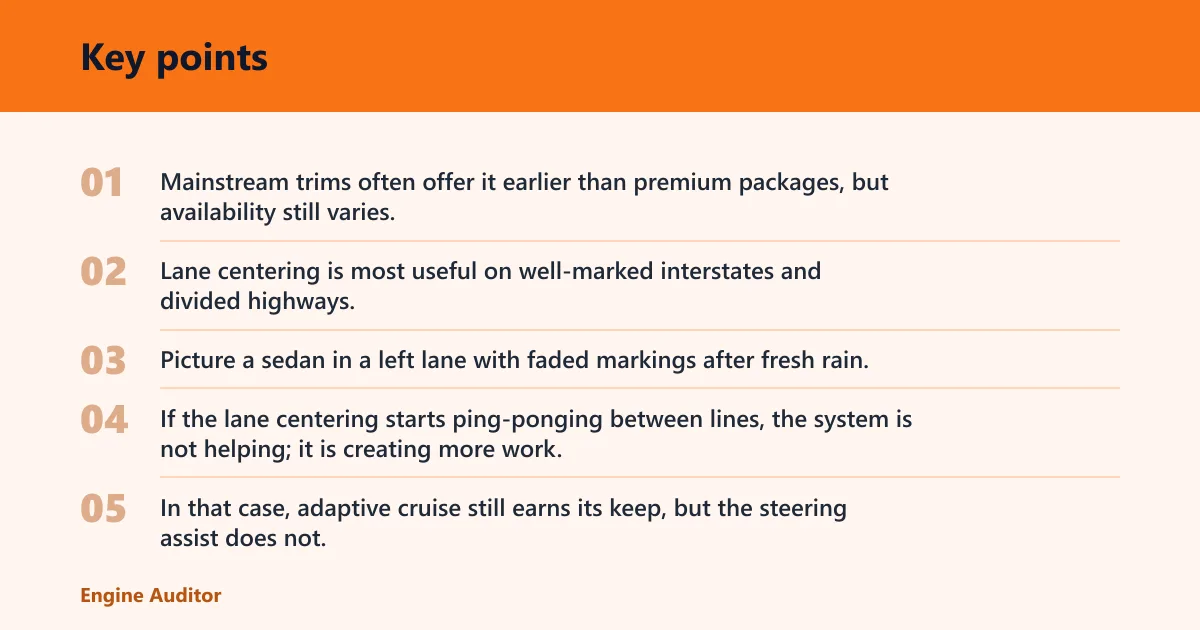
Adaptive cruise control is the first highway feature to pay for because it works in the widest range of traffic patterns. Stop-and-go tuning matters if your commute includes congestion, because the system should follow smoothly without lurching at each restart. Mainstream trims often offer it earlier than premium packages, but availability still varies.
Lane centering on marked highways
Lane centering is most useful on well-marked interstates and divided highways. It is less helpful on roads with faded paint, complex lane splits, or temporary construction striping. If the car wanders within the lane or gives up too early, the system is poorly tuned even if the feature list looks long.
Picture a sedan in a left lane with faded markings after fresh rain. If the lane centering starts ping-ponging between lines, the system is not helping; it is creating more work. In that case, adaptive cruise still earns its keep, but the steering assist does not.
Hands-free systems, subscriptions, and map limits
Hands-free driving systems require driver supervision. They are limited by road coverage, map dependence, and brand rules about when they can operate. Some are bundled into a higher trim or a package, then require a subscription after a trial period.
That makes them hard to justify for most shoppers. If your daily route sits outside the mapped roads or includes frequent construction, the value drops further. These systems are best viewed as convenience extras for a narrow set of highways, not as a core safety upgrade.
Where these systems struggle in rain, snow, and construction
Heavy rain, snow, glare, and construction zones are the common failure cases. Lane markings disappear under slush or temporary pavement, cameras can wash out in bright glare, and radar or camera logic can misread cones, barriers, or shifted lanes. A good system should hand control back early and clearly when it loses confidence.
Which features matter most in the city?
In city driving, blind-spot monitoring, rear cross-traffic alert, and parking cameras tend to matter more than lane centering. Stop-and-go traffic also makes adaptive cruise useful, but the biggest gains come when you are changing lanes, backing out, or squeezing into narrow parking spaces.
Blind-spot monitoring for lane changes
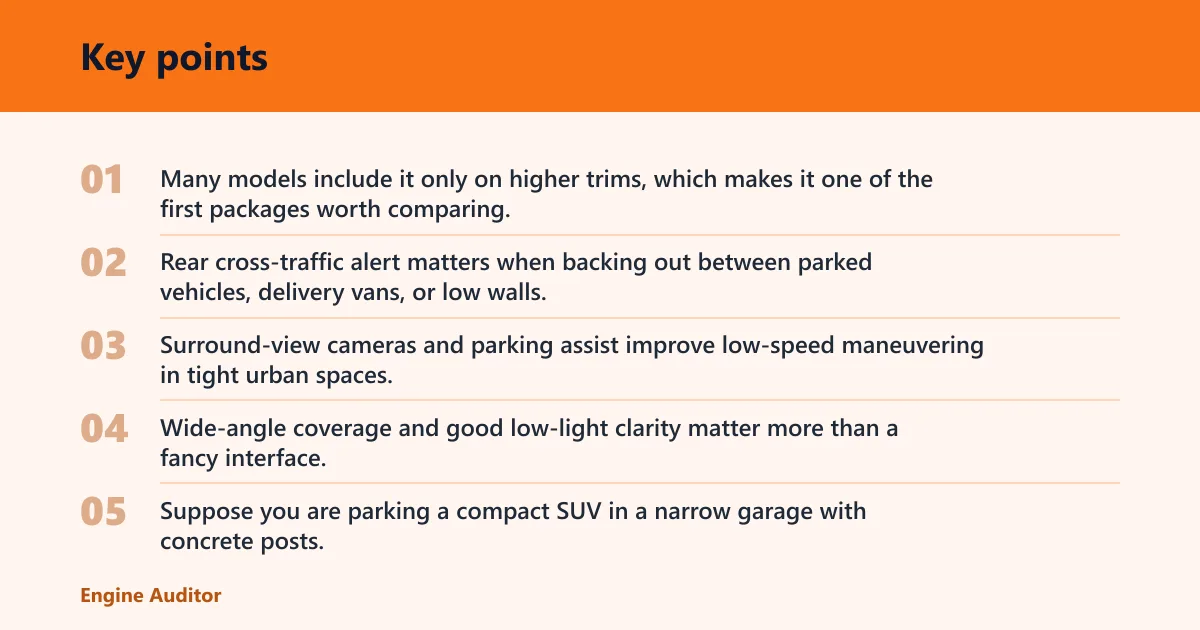
Blind-spot monitoring is valuable in dense traffic because it adds a second check when mirrors miss a fast-approaching vehicle. It is especially useful on taller crossovers and SUVs with wider blind zones. Many models include it only on higher trims, which makes it one of the first packages worth comparing.
Rear cross-traffic alert for backing out of parking spaces
Rear cross-traffic alert matters when backing out between parked vehicles, delivery vans, or low walls. It is important for SUVs and vehicles with poor rear visibility because those designs create larger blind zones behind the car. It is usually bundled with blind-spot monitoring, and that bundle is worth paying for on family vehicles.
Surround-view cameras and parking assist
Surround-view cameras and parking assist improve low-speed maneuvering in tight urban spaces. They are most useful when the camera feed is clear and the stitched image includes enough of the front corners to judge curb distance. Wide-angle coverage and good low-light clarity matter more than a fancy interface.
Suppose you are parking a compact SUV in a narrow garage with concrete posts. A clear surround-view camera can prevent slow, expensive scrapes. If the image is grainy or the guidelines lag behind steering input, the system is too crude to justify much extra cost.
What poor rear visibility changes about the value
Cars with high rear decks, thick rear pillars, or small back windows get more value from cameras and rear alert systems than sedans with easy sight lines. The worse the rear visibility, the more a useful camera package moves from nice-to-have to worth paying for. That does not make cameras a substitute for mirrors or attention.
How do you judge a good driver-assist system?
A good system is not the one with the longest feature list. It is the one that behaves calmly, gives timely warnings, and hands control back in a way you can predict. Test the tuning, the camera view, and the takeover behavior before you sign.
- Check warning timing. Ask the salesperson to demonstrate lane, blind-spot, and collision alerts on a short drive. Warnings should arrive early enough to help, but not so early that they become background noise.
- Test lane markings. Drive over faded paint, a merge, and a construction zone if the route allows it. A strong system should degrade gracefully instead of tugging at the wheel or giving up without notice.
- Review camera clarity. Use the rear and surround-view displays in daylight and shade. Look for usable detail at the edges of the frame, because that is where curbs, posts, and traffic usually appear.
- Observe takeover behavior. Let the system ask for driver input, then see how clearly it signals the handoff. A good system gives a clear prompt and enough lead time; a poor one waits too long or interrupts too abruptly.
One common first-timer mistake is judging driver-assist tech only on a smooth suburban road. That misses the real test. The better check is a route with a faded lane line, a parking lot exit, and one abrupt merge, because those are the places the system either earns trust or wastes it.
Cars table
| Feature | Everyday benefit | When it is worth paying for | Common failure case | Final judgment |
|---|---|---|---|---|
| Adaptive cruise control | Maintains set speed and following distance | Worth paying for on highway commuting and stop-and-go traffic | Can brake or accelerate awkwardly in cut-in traffic or on steep grades | Insist standard |
| Lane centering assist | Keeps the vehicle positioned within lane markings | Worth paying for with adaptive cruise on marked highways | Struggles with faded paint, complex lane splits, and construction zones | Pay extra |
| Blind-spot monitoring | Detects vehicles in adjacent lanes | Worth paying for on SUVs, crossovers, and heavy lane-change traffic | Can miss fast-approaching vehicles if you rely on it alone | Pay extra |
| Rear cross-traffic alert | Warns when backing out of parking spaces | Worth paying for on vehicles with poor rear visibility | Often misses pedestrians and depends on cross traffic moving into its field of view | Pay extra |
| Automatic emergency braking | Can brake for an impending frontal collision | Worth paying for only if it is not already standard on the trim | Can be limited by heavy rain, glare, and unusual obstacles | Insist standard |
| Pedestrian detection | Adds protection in urban traffic and parking lots | Worth paying for if it is a meaningful upgrade over basic AEB | Can have trouble in darkness, poor weather, or occluded crossings | Pay extra |
| Cyclist detection | Helps detect bikes in the car’s path | Worth paying for in bike-heavy cities if offered separately | Performance can vary with angle, speed, and visibility | Pay extra |
| Traffic sign recognition | Reads posted speed or warning signs | Worth paying for only as a convenience add-on | Accuracy varies with weather, glare, and temporary construction signs | Skip |
| Parking assist | Helps with tight low-speed maneuvering | Worth paying for if you park in cramped city spaces often | Slow response or weak curb detection can limit usefulness | Pay extra |
| Surround-view camera | Shows a top-down view for parking and low-speed positioning | Worth paying for if the image is sharp and the coverage is wide | Grainy resolution, blind spots at the corners, and glare reduce value | Pay extra |
How to choose
Start with the features that change your daily driving: adaptive cruise control, lane centering, blind-spot monitoring, rear cross-traffic alert, and automatic emergency braking. Then decide whether your routes justify parking cameras, parking assist, or hands-free driving. Do not pay for tech you will rarely use.
Compare the next trim up against the base trim plus the package you actually want. If a higher trim bundles useful driver-assist features with other equipment you would buy anyway, the upgrade may be worthwhile. If it mainly adds traffic-sign reading or a hands-free trial, the package is harder to defend.
Always check whether the feature is standard, tied to a package, or limited to a subscription after purchase. That difference affects long-term value as much as the sticker price does.
Frequently asked questions
Which advanced driver assistance features are actually worth paying for?
Adaptive cruise control, lane centering, blind-spot monitoring, rear cross-traffic alert, and parking cameras are the most useful buys for most drivers. Automatic emergency braking should be standard rather than optional. Traffic sign recognition and hands-free systems are more situational and usually lower on the value list.
What is the difference between adaptive cruise control and lane centering?
Adaptive cruise control manages speed and following distance. Lane centering helps keep the car placed within lane markings. The first reduces pedal work, while the second reduces steering effort. They work best together on highways, especially in traffic that keeps changing speed.
Do blind-spot monitoring and rear cross-traffic alert come standard on new cars?
Sometimes, but not always. Many new cars include them only on higher trims or in safety packages. Automatic emergency braking is more likely to be standard, while blind-spot monitoring and rear cross-traffic alert often arrive later in the trim ladder.
Is hands-free driving worth it for daily commuting?
Usually not unless your commute matches the system’s mapped roads and you are comfortable with ongoing subscription or package costs. Hands-free systems still require supervision and often lose coverage in construction, bad weather, or on roads the maps do not support.
Which safety features make the biggest difference on highways?
Adaptive cruise control and lane centering make the biggest difference on highways because they reduce constant speed and steering corrections. Blind-spot monitoring also helps during lane changes. These features matter more on long commutes than traffic sign recognition or parking aids.
How can I tell if a car’s driver assist system is good or just marketing?
Test it on faded lane markings, in a merge, and in a parking lot exit. A good system gives clear alerts, predictable takeover behavior, and stable lane tracking. If it hesitates, overcorrects, or drops out too quickly, the feature list is better than the tuning.
Are more expensive driver assistance packages worth the money?
Only when the package adds features you will use often and cannot get lower in the trim ladder. If the package mainly adds hands-free driving, traffic sign recognition, or a subscription trial, the cost may not match the benefit. Compare package price against daily usefulness, not option count.
Which ADAS features are most useful for first-time buyers?
First-time buyers should focus on automatic emergency braking, blind-spot monitoring, rear cross-traffic alert, and adaptive cruise control. Those features are easy to understand, useful in common driving situations, and less likely to feel gimmicky. Lane centering is a strong next step if highway commuting is part of the routine.
Products related to this article
Sponsored / affiliate links. As an Amazon Associate I earn from qualifying purchases. I may earn additional commission from eligible campaigns.