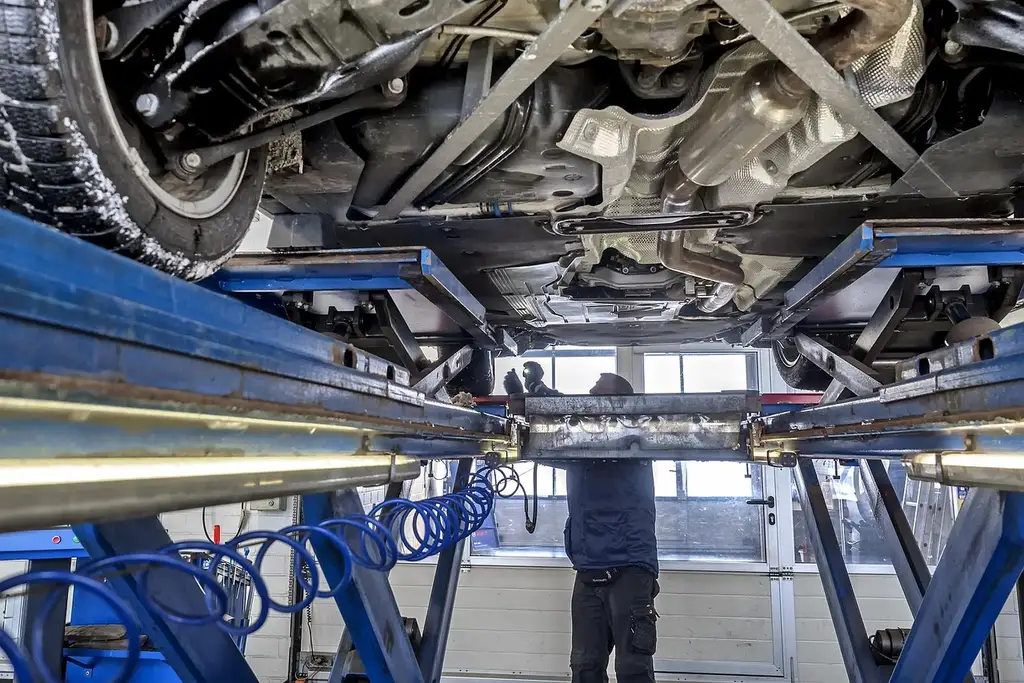
Why Does My Car Clunk When Turning?
A clunk while turning most often points to a worn CV joint, tie-rod end, ball joint, or strut mount; if it changes with braking or bumps, the fault shifts to brakes or suspension hardware. Ignoring it can wear tires, loosen steering, or lead to a part failure that makes the car unsafe. This guide maps the sound pattern to the most likely source and tells you when to stop driving.
Why timing and direction matter more than the sound
When a clunk shows up only as you turn the wheel, the turning load helps expose play in a steering or suspension part. The sound alone does not name the bad part. What matters most is whether it happens at low speed, in one direction only, with braking, or over bumps.
Why the timing matters more than the noise name
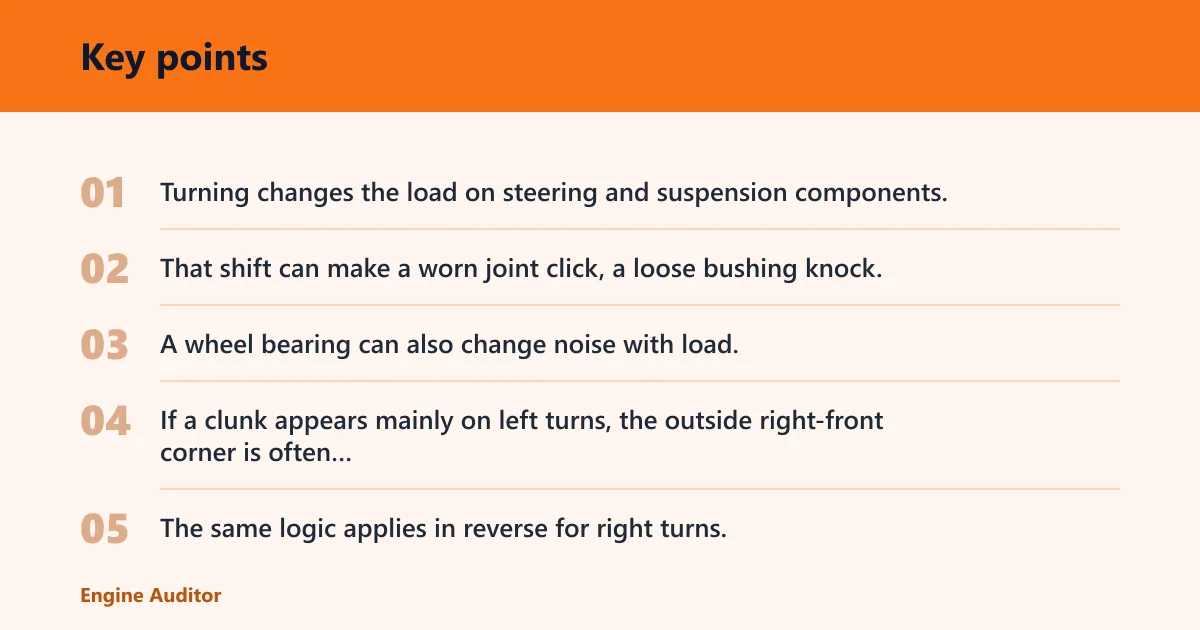
Turning changes the load on steering and suspension components. That shift can make a worn joint click, a loose bushing knock, or a brake pad shift in its bracket. A wheel bearing can also change noise with load, but it usually hums or growls instead of clunking.
What left-turn versus right-turn noise can tell you
One-direction noise is a useful clue. If a clunk appears mainly on left turns, the outside right-front corner is often carrying more load, so a worn part there may speak up first. The same logic applies in reverse for right turns. That asymmetry narrows the search fast.
What kind of turn noise is it?
Different sounds point to different failure modes. A rhythmic click in a tight parking-lot turn leans toward a CV joint. A single knock or thud under steering load leans more toward a ball joint, tie rod end, or strut mount. A rattle over rough pavement points elsewhere.
Clunk, click, pop, rattle, growl, or grind
A rhythmic clicking or popping in tight turns is most likely a worn CV joint. A clunk is usually a looser part shifting under load. A rattle often comes from small stabilizer links or brackets. A growl or hum is more typical of a wheel bearing than a suspension joint.
What to note before you inspect anything
Write down the speed, steering angle, road surface, and whether braking changes the noise. Also note which direction makes it worse. That record matters more than guessing from the sound name. It can point you toward the front axle, steering linkage, brake hardware, or sway bar parts.
| When it happens | Likely component | What the noise usually sounds like | Safe to keep driving? |
|---|---|---|---|
| Tight low-speed turns | Outer CV joint / CV axle | Rhythmic click or pop that speeds up with wheel rotation | Monitor if mild; book soon if it gets louder; tow now if the axle is binding or the car starts to lose drive |
| One-direction turns | Ball joint, tie rod end, or side-specific CV joint wear | Single clunk, knock, or repeated pop under load on one side | Book soon; tow now if steering feels loose or the wheel does not track straight |
| Turning plus braking | Brake hardware, control arm bushing, or caliper movement | Click, clunk, or shift that changes as the brake load changes | Book soon; tow now if braking feels unstable or the noise comes with pulling or loss of control |
| Clunking over bumps | Sway bar link, sway bar bushing, strut mount, or control arm bushing | Sharp knock or rattle over washboard, potholes, or speed bumps | Book soon; monitor only if the noise is light and handling is unchanged |
Which parts are most likely?
The most likely part depends on when the clunk appears. A CV joint usually acts up on tight turns. A ball joint or tie rod end shows steering-related looseness. A control arm bushing or strut mount often complains when the suspension compresses. Sway bar parts usually rattle over rough pavement.
CV axle and CV joint
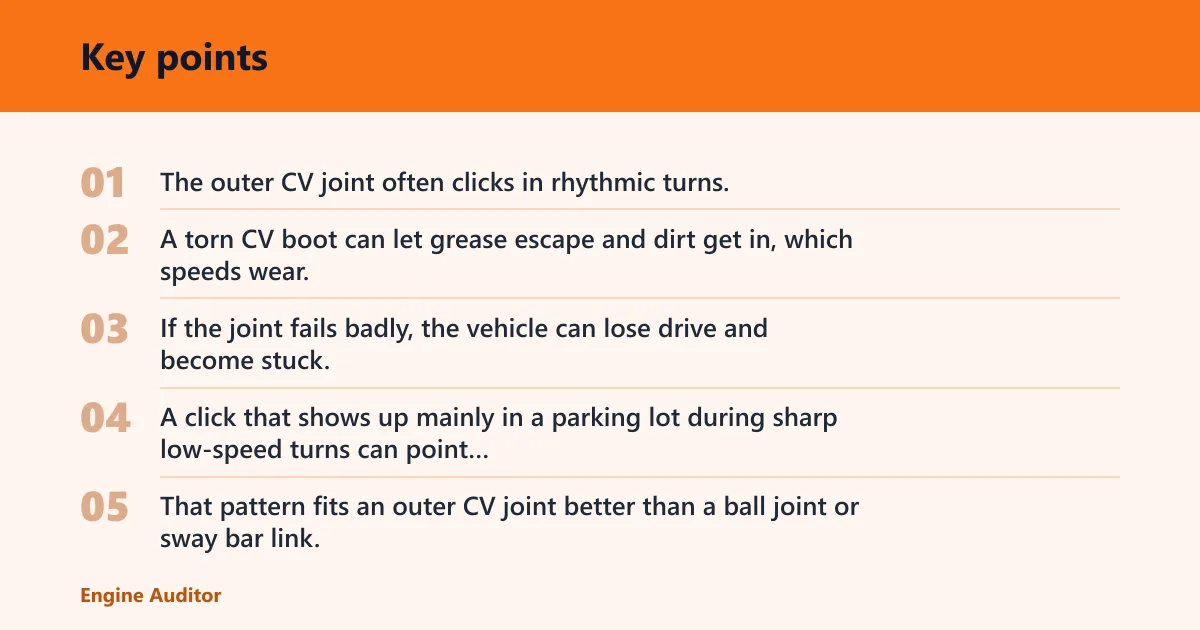
The outer CV joint often clicks in rhythmic turns, especially at low speed and full steering lock. A torn CV boot can let grease escape and dirt get in, which speeds wear. If the joint fails badly, the vehicle can lose drive and become stuck.
A click that shows up mainly in a parking lot during sharp low-speed turns can point more toward an outer CV joint than toward a ball joint or sway bar link. That pattern fits an outer CV joint better than a ball joint or sway bar link. If you can see grease flung around the inside of the wheel, the boot is already suspect.
Ball joint and tie rod end
A ball joint can clunk or knock under steering and suspension load. It is safety-critical because separation can let the wheel fold under the car. The sound may be felt through the steering wheel or floor. A tie rod end wears differently, but it also creates looseness and clunking while steering.
Loose tie rod ends often cause vague steering or drifting, and replacement usually calls for a wheel alignment afterward. A bad ball joint may sound like a dull knock when the front end loads up in a turn or when a wheel moves over uneven pavement.
Control arm bushing and strut mount
Cracked or softened control arm bushings can clunk under braking or bumps, and they can disturb alignment stability. Uneven tire wear often shows up alongside that wear. A strut mount, shock, or strut assembly can clunk when the suspension compresses or when steering input is applied.
Those parts are easy to confuse because they all move when the front end loads and unloads. Extra bouncing, nose dive, or poor body control makes a strut or shock more suspect. A control arm bushing tends to announce itself more with braking dips and road impact than with a pure steering click.
Sway bar link, sway bar bushing, and wheel bearing
Sway bar links and bushings are common sources of clunks over uneven pavement. Their small joints wear and rattle over washboard, patchy roads, or speed bumps. A wheel bearing is less likely to clunk than other parts here. It more often hums or growls, though turn load can change the noise.
What else can mimic a turning clunk?
Brake hardware can click or clunk when the car shifts direction, and that can sound like a suspension problem. Loose caliper hardware is a common mimic. Exhaust hangers and underbody shields can also tap the body or subframe and make owners chase the wrong corner of the car.
Brake hardware and caliper movement
Brake pads, anti-rattle clips, and caliper hardware can move when you brake, reverse, or shift turning direction. That click can seem tied to steering because the front suspension loads at the same time. If the noise changes when you lightly apply the brake, the brake side rises on the list.
Exhaust hangers, shields, and wheel hardware
Loose exhaust hangers or underbody shields can knock when the body rolls in a turn or when the car crosses a driveway edge. Loose lug nuts and damaged wheel-related hardware need immediate attention because they can create dangerous looseness. A wheel-related clunk should never be brushed off.
A common first-timer mistake is assuming every turn noise comes from the steering rack. Suppose the clunk happens only when backing out of a driveway and disappears after the first brake application. That pattern points more toward brake hardware shift than toward a CV joint.
Is it safe to keep driving?
Safety depends on the pattern. A light click from a CV joint can often be driven for a short time while you arrange repair, but a loud clunk with loose steering is a tow-now situation. If the wheel feels unstable, do not keep experimenting on the road.
Tow now signs
Tow now if the steering feels loose, the clunk is loud, the car pulls suddenly, or the wheel seems to shift in relation to the body. A separated ball joint can let the wheel fold under the car. A failed CV axle can also leave the vehicle stuck.
APEX says a loud clunk with loose steering is a tow-now situation. That is the right line when the noise comes with obvious play, grinding, or steering that no longer feels predictable.
Book soon signs
Book soon if the clunk is repeatable but the car still steers normally. That includes a rhythmic click in turns, a one-side knock, or a bump clunk with no major handling change. These faults usually worsen with time, and some create alignment problems or uneven tire wear.
Monitor only signs
Monitor only when the noise is faint, rare, and does not change steering feel, braking feel, or tire tracking. Even then, keep a close eye on it. If the sound starts happening more often or gets louder, move it into the book-soon category.
What to inspect on the ground
A quick visual check can narrow the fault before any parts are replaced. Look for torn boots, loose joints, cracked bushings, leaking struts, loose hardware, and damaged shields or hangers. The goal is to match the symptom pattern to a visible wear point.
- Look behind the front wheels for a torn CV boot or grease sling.
- Check for play in tie rod ends, ball joints, and control arm bushings.
- Inspect struts for wet leakage, broken mounts, or top-end movement.
- Check sway bar links and bushings for cracked rubber or loose joints.
- Look at brake pads, caliper hardware, shields, and dust covers for looseness.
- Check exhaust hangers and underbody panels for contact marks or broken retainers.
Repair cost and alignment clues
The same source says CV axle replacement typically runs roughly $200 to $450 per axle. A tie rod end replacement runs roughly $150 to $350 per side, including alignment. That alignment step matters because steering geometry can shift after the part is changed, especially with tie rod work.
Ball joint, control arm, and strut-related repairs often cost more when the part is integrated into a larger assembly or when more labor is needed to separate rusted fasteners. If the repair affects steering angle or ride height, an alignment check is usually part of the job plan.
Frequently asked questions
Why does my car clunk when turning?
A clunk while turning most often points to a worn CV joint, ball joint, tie rod end, control arm bushing, or strut mount. The key clue is when it happens, not the sound name. Tight low-speed turns, one-direction turns, braking, and bumps each point to different parts.
Why does my car pop when turning?
A pop in a tight turn is often a CV joint, especially if it repeats in rhythm as the wheel turns. A single pop can also come from a tie rod end, ball joint, or brake hardware shifting. Left-turn and right-turn differences help narrow which side is worn.
What does a bad ball joint sound like?
A bad ball joint can sound like a clunk, knock, or dull pop when steering or when the suspension loads up over a bump. The noise may be felt through the floor or steering wheel. Because separation can let the wheel fold under the car, treat it as safety-critical.
What does a worn control arm bushing sound like?
A worn control arm bushing often sounds like a clunk under braking, a knock over bumps, or a shift when the front end changes direction. It can also show up with uneven tire wear or a wandering feel. The rubber may look cracked, soft, or torn during inspection.
How long can you drive with a clicking CV joint?
A clicking CV joint can sometimes be driven for a short period if the noise is mild and steering still feels normal, but it should not be ignored. A torn boot can let grease escape and dirt enter, and a failed joint can leave the vehicle stuck. Book repair soon.
Why does my car clunk when I stop?
A clunk when stopping often points to brake hardware, control arm bushings, or a strut or suspension part shifting as weight transfers forward. If it happens at the same time as turning, the load shift matters even more. A brake-related clunk often changes when you lightly apply the pedal.
Products related to this article
Sponsored / affiliate links. As an Amazon Associate I earn from qualifying purchases. I may earn additional commission from eligible campaigns.