Why Does My Power Steering Pump Whine?
Power steering pump whine usually comes from low or aerated fluid, a slipping belt, a leaking hose, or a worn pump. If the noise changes with steering load, start with fluid level and air in the system. Ignoring it can leave you with heavy steering, shredded belts, and pump or rack damage that turns a minor fix into a bigger bill. This guide separates whine, groan, and squeal by symptom pattern so you can narrow the fault before you replace parts.
Differentiating whines, groans, and belt squeals
A steering whine usually means the hydraulic system is struggling to move fluid cleanly under load. In hydraulic power steering, the pump, reservoir, hoses, and rack work together. If any part lets in air, loses fluid, or restricts flow, the noise can rise when you turn the wheel. A whine is not proof the pump is finished. Most OEM owner manuals and service procedures direct you to confirm the correct fluid level/spec and check for aeration before condemning the pump; for example, Ford owner manuals and service information cover fluid checks and bleeding procedures, and Honda service materials give stop-to-stop bleeding steps for hydraulic systems. [Ford Owner Manuals] | [Honda Service Express]
Whine, groan, or squeal: what each sound suggests
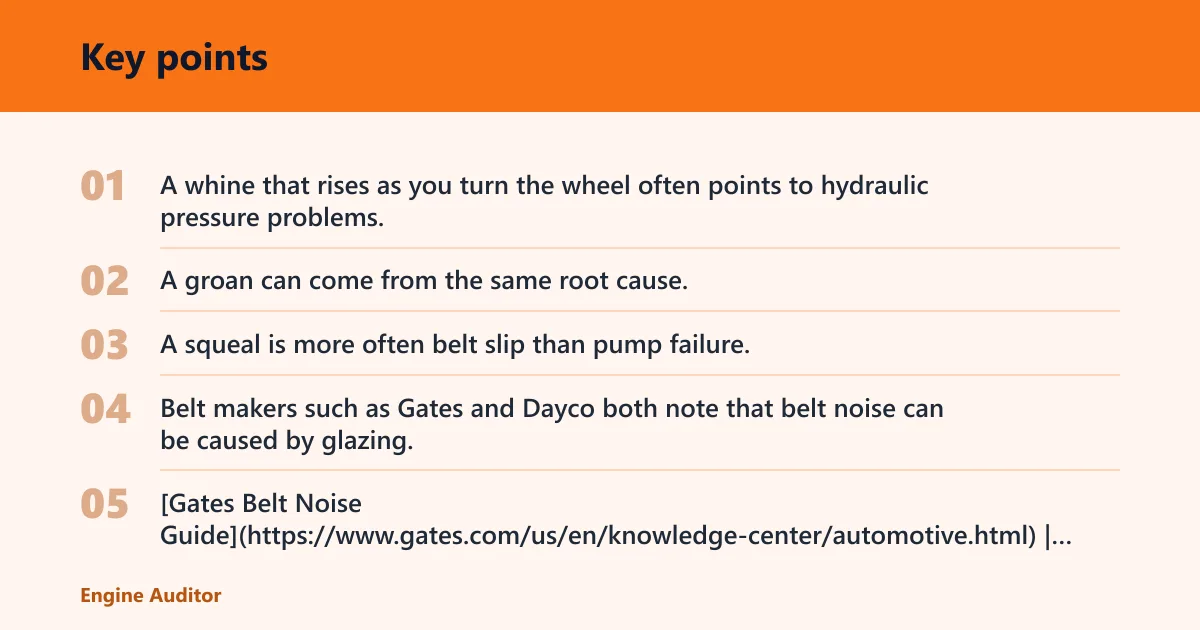
A whine that rises as you turn the wheel often points to hydraulic pressure problems, low fluid, or pump wear. A groan can come from the same root cause, especially if the fluid is foamy or the steering feels heavy. A squeal is more often belt slip than pump failure, so do not treat every noise as the same fault. Belt makers such as Gates and Dayco both note that belt noise can be caused by glazing, contamination, tensioner weakness, and pulley misalignment, which is why squeal should be separated from hydraulic whine early. [Gates Belt Noise Guide] | [Dayco Belt Noise Diagnosis]
Hydraulic vs electric vs electro-hydraulic steering
Many newer vehicles use electric power steering and have no pump. Electric power steering uses an electric motor instead of a pump, so a hydraulic whine is not the usual failure pattern there. Electro-hydraulic systems combine an electric motor and hydraulic pump; they can leak fluid and can also set electrical faults. Trusted repair-data sources distinguish these systems because the driving risk is different: hydraulic loss can produce heavy steering, while EPS faults may trigger warning lights and reduced assist without fluid-related noise. [ALLDATA Repair] | [Mitchell 1 ProDemand]
Power steering whine triage
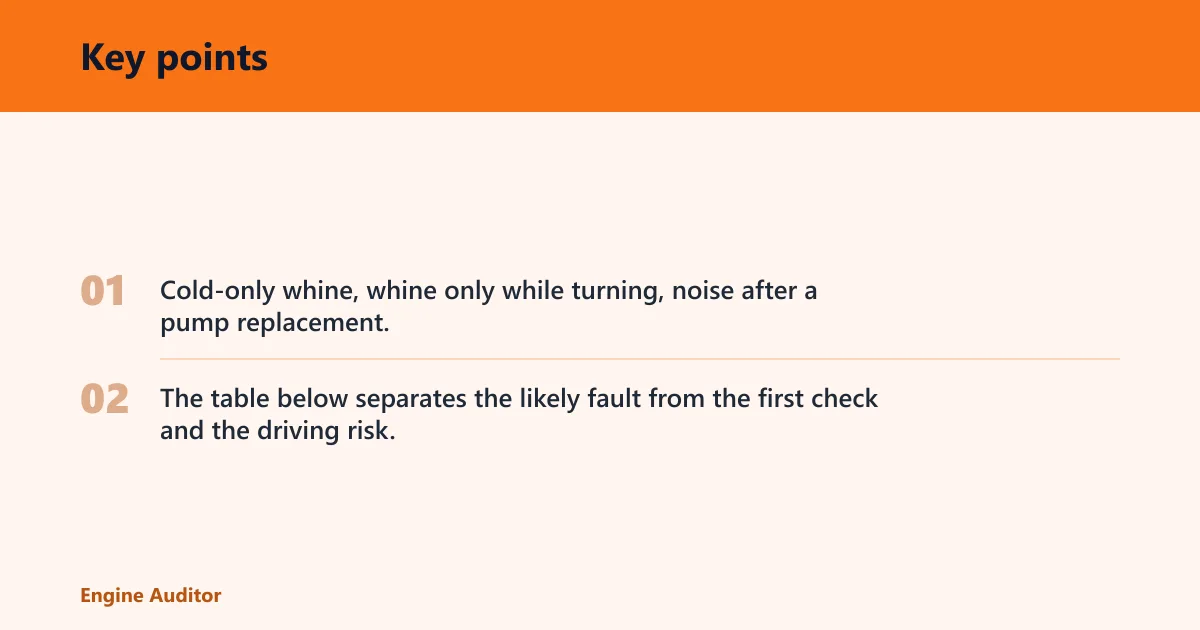
Use the noise pattern before you buy parts. Cold-only whine, whine only while turning, noise after a pump replacement, and heavy steering do not point to the same cause. The table below separates the likely fault from the first check and the driving risk.
| Symptom pattern | Steering feel | Fluid appearance | Likely system type affected | Most likely cause | What to check first | Next action | Whether driving is okay |
|---|---|---|---|---|---|---|---|
| Cold-only whine | Normal to slightly stiff at startup | Clear to lightly tinted, may show a few bubbles after start | HPS, sometimes EHPS | Low or foaming fluid, restricted hose, or a pump that is wearing | Fluid level, foam, smell, and the suction-side hose | Top up only with the specified fluid if level is low, then inspect for air entry | Usually short trips only if steering is normal and the noise fades |
| Whine only while turning | Normal at center, louder under parking-lot load | May turn foamy or show tiny bubbles after steering input | HPS, sometimes EHPS | Hydraulic pressure demand exposing air, leak, belt slip, or pump wear | Fluid condition, belt, pulley alignment, and leaks at the rack or hoses | Inspect the suction side and belt drive before replacing the pump | Drive only if steering effort is normal and fluid is stable |
| Noise after a pump replacement | May be normal or intermittently heavy | Foamy, aerated, or level that keeps dropping after bleed attempts | HPS or EHPS | Trapped air, wrong fluid, bad hose, or incomplete bleeding | Reservoir level, foam, hose routing, clamp condition, and fluid spec | Bleed again per OEM procedure and recheck suction-side sealing | Usually avoid driving until the cause is checked |
| Foamy or milky fluid | May feel jerky, notchy, or inconsistent | Visible foam, milkiness, or a frothy top layer | HPS or EHPS | Air in the hydraulic system | Reservoir, cap seal, suction hose, O-rings, and low fluid | Find the air entry point before continuing to drive | Short movement only; fix the air entry point soon |
| Low fluid | May be normal at first, then heavier on turns | Low level, possibly darkened if the leak has been present | HPS or EHPS | Leak or consumption from a failing seal, hose, rack, or pump | Find the leak before topping off again | Repair the leak and then bleed the system | Not ideal; fluid loss can accelerate damage |
| Heavy steering with or without warning lights | Very stiff or inconsistent assist | May be normal on EPS, or low/empty on HPS/EHPS | EPS, EHPS, or HPS | Loss of assist, pump failure, belt issue, or electronic fault on EHPS | Check steering effort, belt drive, fluid, and warning lamps | Use scan data and system identification before further driving | Stop driving if steering effort is very high or warning lights are active |
Check the fluid first
Start at the reservoir. Most power-steering noise begins with air in the fluid or fluid that no longer meets spec. Check level, color, smell, and foaming. Fluid that has gone dark gray or glitters with metal suggests internal wear, and foaming or milky fluid indicates air in the hydraulic system. OEM procedures typically specify checking the level with the engine off or at a prescribed temperature/idle condition, then bleeding the system if air is present. [Toyota Owner’s Manuals] | [GM Owner Center Manuals]
How to inspect the fluid the same way each time
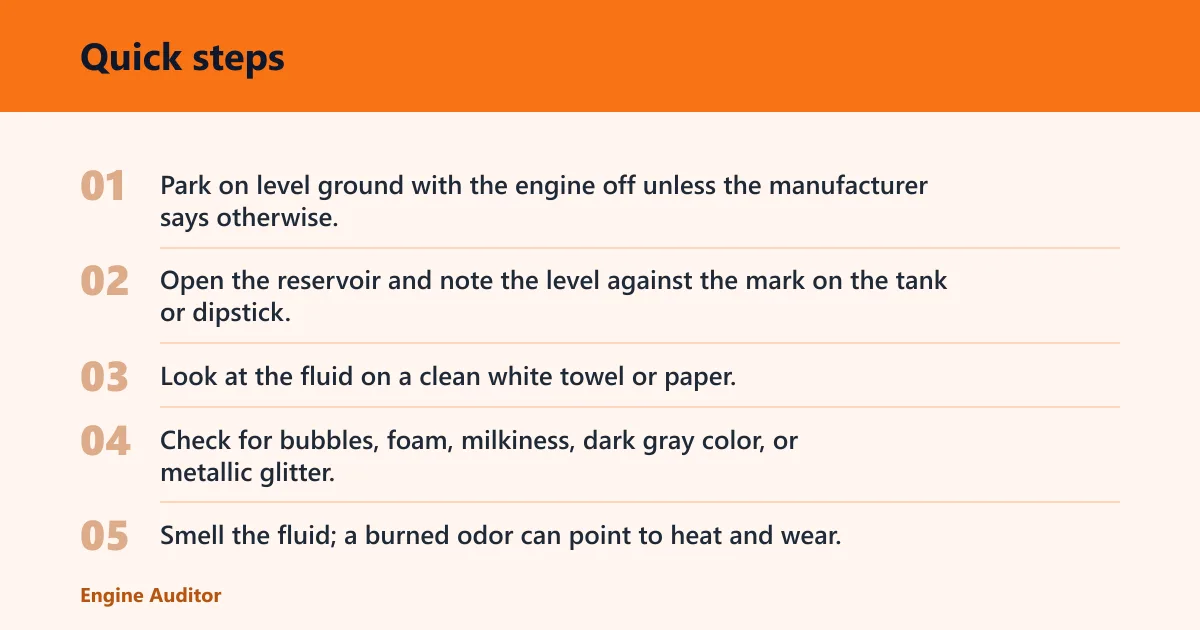
- Park on level ground with the engine off unless the manufacturer says otherwise.
- Open the reservoir and note the level against the mark on the tank or dipstick.
- Look at the fluid on a clean white towel or paper.
- Check for bubbles, foam, milkiness, dark gray color, or metallic glitter.
- Smell the fluid; a burned odor can point to heat and wear.
Wrong fluid and mixed fluid problems
Use the manufacturer-specific fluid specification, not a random universal fill, unless the label clearly lists compatibility. Wrong fluid can damage seals and shorten component life. Mixed fluid can change viscosity, attack seals, and leave the system noisy even after you top it off. OEM service information is the safest source for the exact fill; where a vehicle calls for a specific PS fluid or ATF type, that spec matters more than color alone. [Honda Service Express] | [Ford Owner Manuals]
Say your reservoir is half an inch below the mark, and the fluid looks tan with a few bubbles after a normal left turn. That pattern points more toward air entry or a small leak than a dead pump, so inspect the hose joints and cap seal before replacing the pump.
Reservoir cap and reservoir cracks
A bad cap seal can introduce problems, and a cracked reservoir can cause foaming. That matters because the pump may be blamed for a noise that starts where the fluid is being drawn in. A weak cap seal or cracked tank can pull air into the system during engine vacuum changes or steering load. If you are seeing the same symptom pattern repeatedly, focus on power steering reservoir cap seal symptoms before assuming the pump is the root cause.
Where leaks usually start
Leaks often start at the pump, hoses, seals, reservoir, or rack. The source matters because a leak on the suction side can draw air without leaving a big puddle, while a pressure-side leak usually shows wetness, spray, or a low reservoir. A tired hose can be the actual source of the noise.
Pump body and shaft seal
The pump can leak at the shaft seal or body seam. A leaking shaft seal can cause the system to ingest air, which often shows up as foam and a whine that changes with steering effort. The pump may also wear internally, with vane wear or bearing noise that gets louder under load.
High-pressure line and hose fittings
The high-pressure line and its fittings are common leak points. Look for seepage at crimps, cracks near bends, and wet fittings where the hose meets the pump or rack. A leak there can mimic pump failure because pressure demand rises during turns.
Steering rack and rack bellows
The steering rack, or steering gear, can leak internally. Fluid may appear in the rack bellows, and a worn rack can feel notchy or wander. If the steering effort changes and the rack boots are wet, do not assume the pump is the only problem.
Suction-side hose and clamp leaks
The suction-side hose is a common place for hidden air entry. A hardened O-ring can let the system draw in air, and a tired hose can do the same even if it does not drip. Clamps that are loose, rusted, or installed at the wrong angle can let in air without obvious external leakage.
Suppose the whine is worst on cold starts, and the hose near the reservoir feels slightly damp but not wet enough to drip. That can still be enough for air ingestion, because suction-side leaks often pull air in before they leak fluid out.
Step-by-step fault flow
Work in order. Each step removes a common cause before you move to the next one. That keeps you from replacing a pump when the real problem is an air leak, belt slip, or an EPS/EHPS fault.
- Identify the steering type. Check whether the vehicle uses HPS, EHPS, or EPS. If there is no hydraulic reservoir or belt-driven pump, the diagnosis changes immediately.
- Check warning lights and stored faults. A steering or battery/charging warning can point to assist control problems on EPS or EHPS vehicles.
- Inspect the fluid. Verify level, color, smell, and aeration in the reservoir.
- Inspect the suction-side hose, O-rings, and cap seal. Small air leaks on the inlet side are a frequent cause of whine and foam.
- Inspect the belt and pulley alignment. Look for glazing, cracking, looseness, contamination, and a crooked pulley or weak tensioner.
- Judge the pump and rack last. Only after the first five checks pass should you suspect internal pump wear or rack failure.
Is the pump actually bad?
Not always. The pump can wear bearings or vanes and make a steady whine, but low fluid, contamination, or cavitation can produce the same noise. Whine, leaks, and stiff wheel are common hydraulic steering complaints, so judge the pump by the whole symptom pattern, not by noise alone.
Bearing noise and vane wear
A worn bearing often adds a growl or whine that tracks engine speed even with little steering input. Worn vanes can make the pump noisy when pressure rises, especially at parking-lot speeds or at full lock. If the noise is present with normal fluid, good belt tension, and no air, pump wear becomes more likely.
Low fluid, contamination, and cavitation
Low fluid can let the pump suck air. Contamination can score internal parts and raise the noise level. Cavitation, which is the collapse of vapor pockets in the fluid, can sound like a harsh whine and can leave the steering jerky. Fluid that is dark gray or glittery makes internal wear more likely.
When replacement makes sense
Replace the pump when the fluid is correct, the belt and pulley checks pass, the system is fully bled, and the pump still whines or leaks. If the steering is heavy, the fluid level keeps dropping, or the pump shaft area is wet, replacement can be justified. Otherwise, the noise may be coming from air, a hose, or the rack. Repair-data guidance also treats persistent heavy steering or active steering warnings as a reason to stop guessing and verify the system with the proper diagnostic path for that steering type. [ALLDATA Repair] | [Mitchell 1 ProDemand]
Could the belt or pulley be the noise?
Yes. A serpentine belt can squeal when turning, and that noise is related to the steering load but not the same as pump whine. A loose tensioner, worn pulley, or misalignment can let the belt slip only when the pump is asked to work harder.
Serpentine belt slip under steering load
If the sound is a sharp squeal rather than a smooth whine, start with the belt. Check glazing, cracks, contamination, and tension. When the belt slips, the steering pump may not spin fast enough, which can create heavy steering and a brief noise during turns. Gates and Dayco both emphasize checking belt condition, tension, pulley condition, and contamination before condemning the pump, because belt-driven accessory noise can mimic hydraulic failure. [Gates Belt Noise Guide] | [Dayco Belt Noise Diagnosis]
Pulley misalignment or a loose tensioner
A pulley that sits crooked can scrub the belt and make a noise that changes with engine speed. A weak tensioner can let the belt flutter when the steering load increases. That noise often appears only during turns or at idle, which makes it easy to blame the pump.
How belt noise differs from pump whine
Belt noise tends to be sharper and may come and go with throttle changes. Pump whine is usually tied to hydraulic demand and often rises as you turn the wheel. If the noise happens when the wheel is held near full lock, check the fluid and pump before replacing the belt, but do not ignore the belt if it looks worn.
What to do after a pump replacement
Noise after a pump replacement often points to trapped air, wrong fluid, a bad hose, or an unbled system. A new pump can be noisy if the system is not fully purged or if the reservoir, cap seal, or suction hose still draws air. Replacement alone does not prove the rest of the system is healthy.
Bleed trapped air
Bleeding the system matters because trapped air can foam the fluid and make the pump whine. Follow the vehicle procedure for turning the wheel from stop to stop, checking the reservoir, and rechecking for bubbles. If the noise drops after bleeding, the pump was not necessarily the original fault. OEM procedures commonly require the engine-off or low-speed steering sweep method, then a recheck after the fluid settles. [Ford Owner Manuals] | [Honda Service Express]
Confirm hose routing and clamp condition
After replacement, inspect hose routing, clamp position, and any O-rings that were disturbed. A hose that rubs on a bracket or sits under tension can leak or draw air. A clamp that looks tight can still be wrong if it is on the flare or damaged section of the hose.
Recheck reservoir level and fluid spec
Verify the fluid type again. A wrong fill can keep the system noisy and can affect seals. Recheck the reservoir after the engine has run and the wheel has been turned several times, because the level can change as air clears from the circuit.
When it is safe to drive and when it is not
A noisy system is one thing. Very heavy steering is another. If the wheel suddenly becomes stiff, the fluid is disappearing fast, or a warning light appears on an EHPS vehicle, do not keep driving as if nothing happened. Steering loss at low speed can turn into a control problem in a parking lot or at an intersection. Repair-data references treat loss of assist, active steering warnings, or sudden heaviness as a serious condition, especially when the system is hydraulic or electro-hydraulic. [ALLDATA Repair] | [Mitchell 1 ProDemand]
Heavy steering with a flashing or steady steering warning light deserves prompt attention. If the wheel still turns normally and the noise is mild, you may be able to drive carefully to a repair point, but only after confirming the fluid level and belt condition.
Frequently asked questions
Why is my power steering pump whining?
A whining pump usually points to low fluid, air in the hydraulic system, belt slip, hose leakage, or pump wear. The strongest clue is how the noise changes. If it rises as you turn the wheel, start with fluid condition and suction-side air entry before you assume the pump has failed.
Why power steering pump making noise?
Noise can come from the pump itself, but it can also come from the belt, pulley, hose fittings, reservoir cap seal, or steering rack. That is why a visual check matters. Foam, low level, or dark contaminated fluid shift suspicion toward the hydraulic system, while a squeal points more toward the belt.
Why do power steering pumps whine?
Pumps whine when they are asked to move fluid under pressure and the flow is disturbed. Air in the fluid, restricted hoses, or worn internal parts can all create that sound. A whine that gets louder while turning is common, but it is not automatic proof that the pump must be replaced.
Why does my power steering whine or groan when I turn?
Turning raises hydraulic demand, so hidden problems show up then. Low fluid, foaming, a leaking hose, or a worn pump can all make the noise rise during steering input. If the wheel also feels heavy or jerky, the fault is more serious than a nuisance noise.
Why is my power steering pump whining when cold?
Cold fluid moves less freely, so a weak pump, sticky valve, or small air leak can sound worse at startup. If the whine fades as the vehicle warms, that pattern points to fluid condition or suction-side air entry more than a hard pump failure. Check the fluid before parts replacement.
Does my car even have a power steering pump?
Some vehicles do not have a power steering pump. Many newer vehicles use electric power steering and have no pump. Some use electro-hydraulic steering, which still has hydraulic fluid but uses an electric motor to drive the pump. The steering layout determines the diagnosis, so identify the system before chasing a hydraulic whine.
Can I keep driving if the steering still feels normal?
If the steering feel is normal, the noise is mild, and the fluid level is stable, short careful driving may be possible while you arrange a repair. If the steering gets heavier, the fluid drops, or a warning light comes on, stop and diagnose the system first.
What is the fastest first check for a steering whine?
Check the fluid level and appearance first, then confirm whether the vehicle has HPS, EHPS, or EPS. That immediately separates a hydraulic noise problem from an electrical assist fault.
What does foamy fluid mean?
Foamy or milky fluid usually means air is entering the hydraulic system. The most common entry points are the reservoir cap seal, suction-side hose, O-rings, or a low fluid level.
Products related to this article
Sponsored / affiliate links. As an Amazon Associate I earn from qualifying purchases. I may earn additional commission from eligible campaigns.