Why Is My Car Heater Blowing Cold Air in Winter?
If your heater blows cold in winter, begin with engine temperature, coolant level, and blower output. If the gauge stays low, suspect a thermostat or coolant-flow fault before you replace the heater core. Ignoring it can leave the windshield fogged or iced over, and it can hide an overheating engine. This guide sorts cold heat into coolant, airflow, or engine-temperature faults so you can narrow the cause before replacing parts.
This guide is part of our Car Heater and Defrost Problems in Winter: Causes and Fixes series.
Cold heat patterns


Read the symptom pattern first. “Cold all the time” points somewhere different from “cold only at idle” or “hot for a few minutes, then cold again.” That split matters because coolant loss, trapped air, a stuck-open thermostat, and blend door faults do not behave the same way.
Heater cold-air matrix
| Symptom pattern | Likely cause | Quick driveway check | Safe to drive? | Next best repair step |
|---|---|---|---|---|
| Cold at idle | Weak coolant circulation, air in the system, blend door fault, or heater control valve issue | Watch the temperature gauge and raise engine speed briefly; see whether heat returns | Maybe, if the gauge stays normal and there is no leak or overheating | Check coolant level, then inspect air bleeding, valve operation, and blend door control |
| Cold only on highways | Thermostat stuck open or engine running too cool | See whether the gauge sits below normal at speed and takes too long to warm up | Usually yes for a short trip, but the fault should be repaired | Test the thermostat and confirm proper engine temperature |
| Hot then cold | Low coolant, air pockets, heater core restriction, or intermittent blend door movement | Check whether heat changes with turns, bumps, or coolant top-off | Use caution; a leak or overheating issue may be present | Inspect for coolant loss, bleed trapped air, then check heater core flow |
| No heat plus overheating | Cooling-system leak, major coolant loss, circulation problem, or severe heater core flow failure | Look for a low reservoir, steam, sweet odor, or coolant on the ground | No, not until the leak and overheating source are found | Stop driving if the gauge rises; inspect for leaks and circulation problems |
| Heat loss after coolant top-off | Air trapped in the cooling system or an underlying leak | Recheck the level after a full heat cycle and look for bubbling in the reservoir | Maybe, if temperature stays normal and no leak appears | Bleed the system; if the level keeps dropping, trace the leak |
Why is my car heater blowing cold air?
The shortest answer is that the cabin is not getting hot coolant, hot coolant is not reaching the heater core, or the HVAC box is routing air around the heat source. Start with coolant level and engine temperature before you replace heater parts. That order catches the most common faults first.
Check coolant before HVAC parts
Low coolant is the most common cause of a car heater blowing cold air. Check the coolant reservoir only when the engine is cool, and compare the level to the MIN and MAX marks. A low level can block hot fluid from reaching the heater core and can introduce air bubbles or air pockets.
A low reservoir is not just a “top it off” problem. It may point to a cooling-system leak, and a leak can also introduce air into the system. If the level dropped once, check again after a drive and look for damp hoses, crusty residue, or a wet spot under the car before assuming the heater core failed.
Use the temperature gauge as a clue
The engine temperature gauge tells you whether the engine is actually warming up. A thermostat stuck open can keep the engine from reaching working temperature, and a stuck-open thermostat can keep the engine too cool and reduce cabin heat. If the gauge stays below normal after several miles, overcooling is a stronger clue than a failed heater core.
Say your sedan gives warm air for five minutes, then turns cold on the freeway while the gauge sits lower than usual. That pattern points more toward a thermostat stuck open than toward a clogged heater core, because the whole engine is running too cool. The cabin loses heat because the source heat never fully develops.
Could a stuck thermostat cause cold heat?
Yes. A stuck-open thermostat can keep the engine from reaching working temperature, and that delayed warm-up usually shows up as weak cabin heat and a low or slow-moving temperature gauge. If the engine never settles near its normal range, the heater core has less hot coolant available to transfer into the cabin.
How a stuck-open thermostat affects the cabin
When the thermostat stays open, coolant circulates too early through the radiator. The engine takes longer to warm up, and in cold weather it may never get fully warm at all. That can leave the vents blowing lukewarm or cold air even though the blower fan sounds normal.
The heater core’s main job is to move heated coolant into the cabin. If that coolant never reaches the right temperature, the cabin air will not warm properly. A thermostat fault is especially likely when heat is weak on the highway and the gauge never climbs to normal.
What the temperature gauge should do
On a healthy system, the gauge should rise to normal operating temperature and stay there. A persistent low reading signals overcooling. If the gauge is low, do not start with the heater core or the blend door. Fix the engine-temperature problem first, because the rest of the heating system depends on hot coolant.
If the gauge behaves normally but the vents still blow cold, the fault shifts toward airflow control, heater core flow, or air trapped in the cooling system. That is the point where the symptom pattern matters most.
Why heat can fade while driving
Heat that starts strong and then fades often suggests that flow is changing over time. Air trapped in the cooling system can move around and block heater-core flow, a heater core can be restricted by rust or debris, and a heater control valve can stick or limit hot coolant flow. A simple “replace the heater” guess can miss the real fault.
Air trapped in the cooling system
Air inside the cooling system can make the heater blow cold air. Airlocks can get stuck in the heater core, where they block hot coolant from passing through. This often happens after a low-coolant event or a repair, and it often needs bleeding or burping the system to restore flow.
Do not treat bleeding as a universal fix. It is the better next step when the problem began after coolant loss, hose replacement, thermostat replacement, or another cooling-system repair. It is less likely to help when the engine temperature stays low all the time or when the heater changes only because of vent-position changes.
Heater core restriction or clogging
A clogged heater core can cause the entire heating system to fail. Rust or debris can restrict flow through the core, and a heater core can also leak. A heater core problem may show up as fog inside the car, and a sweet odor can be a sign of heater core trouble.
If one heater hose feels much hotter than the other after the engine is warm, the core may be restricted. That is a better clue than simply saying “no heat.” A blocked core limits flow even when the coolant level is correct and the thermostat is working.
Heater control valve and heater controls
A heater control valve, or some older heater controls with cable linkages and plastic parts, may stick, break, or limit hot coolant flow. On some cars, that valve controls how much hot coolant reaches the heater core. If it closes when it should be open, the cabin gets cold even though the engine is warm.
Suppose a compact car blows hot air at first, then loses heat after a turn or a bump. That kind of intermittent behavior can fit a sticking valve or a loose cable more than a thermostat fault. The key clue is that engine temperature remains normal while cabin heat comes and goes.
Why is my car heater blowing cold air when stopped?
When the heater turns cold at idle but warms up while driving, the issue is often related to coolant flow or air routing rather than the engine itself. Idle reduces pump speed and airflow through the radiator, so weak circulation, air in the heater core, or a blend door problem can show up more clearly while stopped.
Idle airflow versus coolant-flow clues
If heat improves with engine speed, coolant circulation is a prime suspect. Mechanical water pump problems can reduce coolant circulation, and low coolant can also make the heater weak at idle before it fails everywhere else. If the gauge stays normal but cabin heat drops only at idle, look at flow changes before replacing major HVAC parts.
A cold heater at stoplights can also point to a partially restricted heater core. At idle, there is less pressure and less flow through a marginal system, so weak spots show up first. If heat returns on the road, that pattern is a clue, not a contradiction.
Blend door actuator faults on newer cars
Broken heater flaps or actuator faults can stop warm air from reaching the cabin. On newer cars, the blend door actuator may fail electrically or mechanically, and diagnosis may require a scan tool. If the HVAC commands change but the air temperature does not, the problem may be inside the dash rather than in the cooling system.
Check whether the temperature setting changes the air only on one side of the cabin, or whether the sound behind the dash clicks or skips when you move the controls. Those clues favor an actuator or flap issue. On many newer systems, guessing is slower than reading the HVAC fault data first.
No heat and overheating together
That combination points beyond the heater itself. No heat plus overheating often means a cooling-system leak, major coolant loss, or poor circulation. A heater can go cold because the engine has lost coolant or because the system has so much air that hot fluid cannot reach the heater core. That is a warning sign, not a comfort complaint.
Leak checks before short-distance driving
Check the reservoir only when the engine is cool and compare it to the MIN and MAX marks. If it is low, top-off alone is not the whole answer. Low coolant may indicate a leak, and a leak can create air pockets that cause both overheating and weak cabin heat.
Look for dripping at hose joints, radiator end tanks, the water pump area, and the firewall where the heater hoses enter the cabin. A sweet odor, damp carpet, or fogged windows can also point toward heater core trouble. Do not ignore these signs and keep driving if the temperature gauge rises.
When to stop driving and inspect
If the gauge climbs toward hot, the cabin heat disappears, and the reservoir is low, stop and inspect before driving farther. The cooling system may not have enough coolant left to protect the engine, and continuing to drive can turn a simple leak into a larger repair. Defrost performance matters too; if heat is gone, windshield clearing suffers.
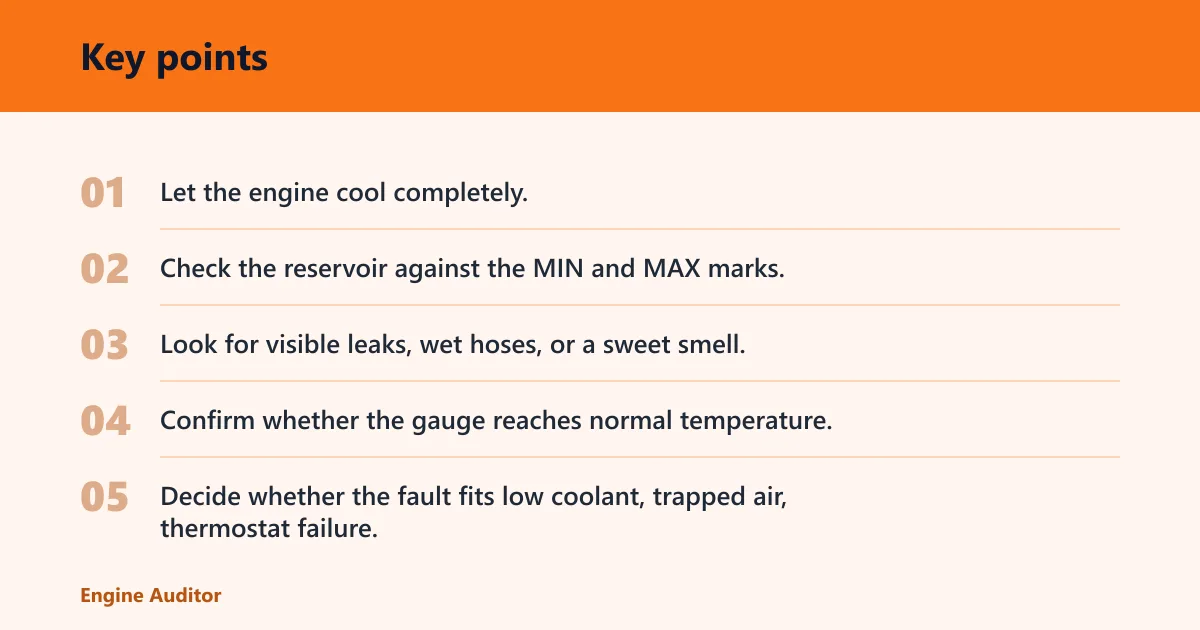
- Let the engine cool completely.
- Check the reservoir against the MIN and MAX marks.
- Look for visible leaks, wet hoses, or a sweet smell.
- Confirm whether the gauge reaches normal temperature.
- Decide whether the fault fits low coolant, trapped air, thermostat failure, or airflow control.
Check coolant level first
Yes. Check coolant when the heater stops working, but only when the engine is cool. Compare the reservoir to the MIN and MAX marks, because a low level can block hot fluid from reaching the heater core and can also create air bubbles or air pockets. If the level is below MIN, look for a leak before driving far.
The correct order matters. Coolant loss can look like a heater failure, but the heater core is only the last part in the chain. If the engine is low on coolant, fixing the HVAC box will not bring the heat back.
Frequently asked questions
Why does my car heater blow hot then cold?
That pattern often means air pockets, a low coolant level, or a heater core that is partly restricted. It can also point to a heater control valve that sticks open and closed. If the temperature gauge stays normal while the cabin heat changes, focus on coolant flow through the heater core and the control hardware.
Can low coolant cause no heat in the car?
Yes. Low coolant can block hot fluid from reaching the heater core, and it can also introduce air bubbles or air pockets. Check the reservoir only when the engine is cool and compare the level to the MIN and MAX marks. If the level is low, check for a cooling-system leak before driving much farther.
Could a stuck thermostat cause my heater to blow cold air?
Yes. A thermostat stuck open can keep the engine from reaching working temperature, which leaves too little heat for the cabin. The clue is a temperature gauge that stays low or takes too long to rise. That pattern fits overcooling better than a clogged heater core or blend door fault.
How do I know if my heater core is clogged?
A clogged heater core can cause the entire heating system to fail, and it often shows up as weak or absent heat even when the engine is warm. A sweet odor, fog inside the car, or one heater hose much hotter than the other are common clues. Rust or debris inside the core can restrict flow.
Should I check coolant when the heater stops working?
Yes, and do it only when the engine is cool. Check the reservoir against the MIN and MAX marks, because low coolant is a common cause of cold cabin air and may signal a leak. If the coolant level is low, do not assume the problem is only inside the dash.
Why does my car overheat and the heater blow cold air?
That combination usually points to a cooling-system leak, major coolant loss, trapped air, or poor coolant circulation. It is more serious than a simple heater fault because the engine may be at risk. Stop and inspect the system before driving farther, especially if the reservoir is low or the gauge keeps climbing.
Products related to this article
Sponsored / affiliate links. As an Amazon Associate I earn from qualifying purchases. I may earn additional commission from eligible campaigns.