Why Is My Transmission Whining? Causes and Checks
Transmission whine usually points to low fluid, bearing wear, or pump wear. If the noise changes with gear selection or gets louder under load, stop driving and inspect it soon. Ignoring it can turn a repair that starts with fluid or a solenoid into a transmission rebuild or complete failure. This guide shows how to separate transmission whine from wheel, tire, and power steering noise by when it happens, how it changes, and what each pattern means for urgency.
Why is my transmission whining?


A new whine usually points to a problem that affects lubrication, hydraulic pressure, or rotating parts inside the transmission. Automatic units rely on hydraulic pressure and electronic control, so low fluid, dirty fluid, pump wear, torque converter trouble, filter restriction, or internal wear can all produce a similar sound.
The first clue is pattern. A whine that begins softly as a faint humming or high-pitched whirring sound, then grows louder during gear changes or highway speeds, deserves attention. A noise that changes with engine RPM often points more toward the pump or engine-driven components than toward the differential.
Say your sedan starts whining only after a long uphill merge, then the sound fades when you lift off the throttle. That pattern fits a load-related transmission issue better than a constant wheel-bearing hum. A whine that appears at idle in Park or Neutral is a different clue and can point to the pump or torque converter.
How to judge urgency from the noise pattern
Use the operating state before you guess at the part. A whine in Reverse, a whine only under acceleration, or a whine that changes as the fluid warms up can point to different failures. If the sound is paired with slipping, delayed engagement, or shuddering, treat it as a higher-risk symptom.
When a whine means stop driving
Stop driving if the whine is sudden and severe, if the transmission slips, if engagement is delayed, or if the sound is joined by burnt-smelling fluid, harsh shifts, or loss of drive. Severe internal wear can spread debris through the unit fast, and continued driving can raise the repair cost sharply.
Whine triage matrix
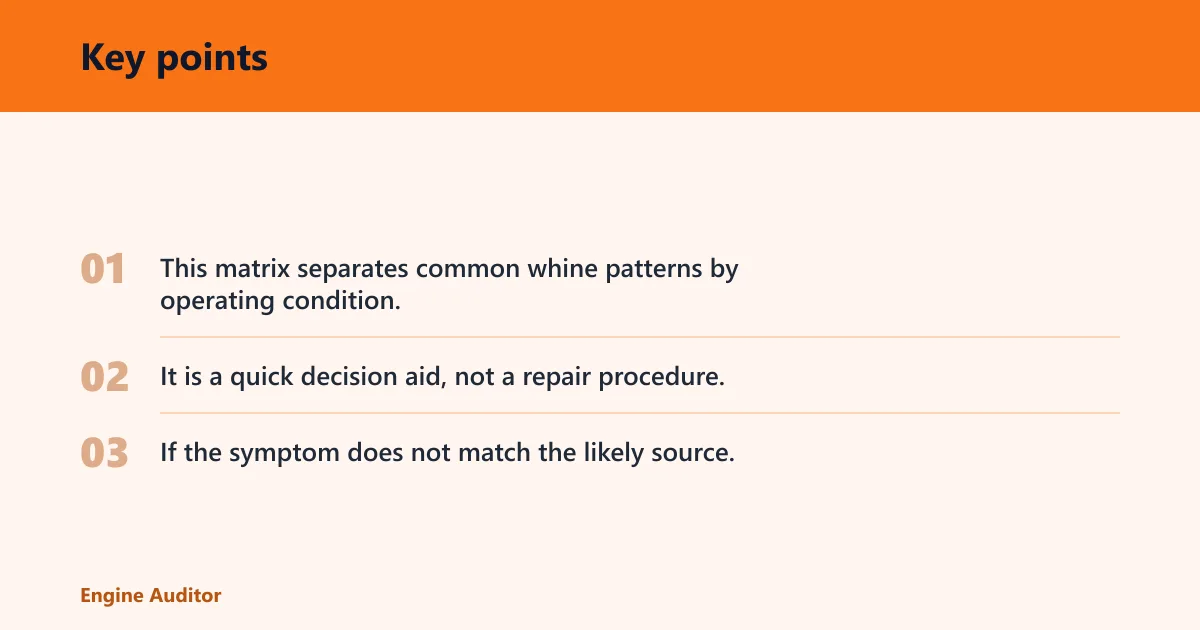
This matrix separates common whine patterns by operating condition. It is a quick decision aid, not a repair procedure. If the symptom does not match the likely source, or if the vehicle needs a specific fluid-temperature or gear-position check, follow the service procedure for that model.
| Operating condition | Likely source | Quick driveway check | Risk level | Next action |
|---|---|---|---|---|
| Cold start, then noise fades hot | Low or dirty fluid, pump wear | Check fluid level and look for brown or burnt fluid | Book soon | Verify level and service history, then schedule inspection |
| Hot stop-and-go driving | Fluid breakdown, pump strain, overheating | See whether the whine rises after traffic or heat soak | Book soon to tow | Limit driving and inspect cooling, fluid condition, and leaks |
| Acceleration only | Low or dirty fluid, worn pump, planetary gear wear | Lift off the throttle and note whether the whine drops | Book soon | Check fluid and schedule a transmission diagnosis |
| Coast only | Drivetrain noise, differential, wheel bearing | Listen for road-speed tracking versus engine-speed tracking | Book soon | Test drivetrain sources before assuming transmission damage |
| Drive only | Torque converter, pump, internal hydraulic issue | Compare with Park and Neutral at idle | Book soon to tow | Have the unit checked before the symptom spreads |
| Reverse only | Internal gear wear, clogged filter, pump issue | Note whether engagement is delayed or harsh | Tow if severe | Do not keep forcing reverse if the sound is heavy |
| Park or Neutral at idle | Torque converter, transmission pump | Compare the noise with engine RPM changes | Book soon | Check fluid and inspect for pump or converter noise |
| CVT under steady throttle | Low fluid, belt or chain wear, bearings, valve body issues | Note whether the whine rises and falls with speed changes | Book soon to tow | Use the model-specific CVT service procedure and scan for updates |
| Manual transmission under load | Bearings or gear wear | See whether clutch pedal position changes the sound | Book soon | Have the gearbox and clutch-related parts inspected |
What causes automatic transmission whine?
Automatic transmission whine usually comes from fluid problems, pump wear, torque converter trouble, or restriction inside the hydraulic circuit. Modern automatic transmissions rely on hydraulic pressure and electronic control, so anything that lowers pressure or starves rotating parts can create a whine that rises with RPM or load.
Low or dirty automatic transmission fluid
Low transmission fluid is one of the most common reasons for transmission whining. Fluid supports lubrication, cooling, and hydraulic pressure. Loss can happen from leaking seals, cracked cooler lines, pan gasket leaks, or damaged pans, and dirty fluid can stop the system from working quietly and smoothly.
Burnt or brown fluid is a warning sign. If the level is low, the unit may whine, slip, or delay engagement. If the fluid is full but dark, contaminated, or smells burnt, the problem may be more than a simple top-off.
Transmission pump wear
A worn transmission pump may create a whining sound that changes with engine RPM. That pattern matters because the pump drives hydraulic pressure. If the whine follows engine speed even in Park or Neutral, the pump becomes a strong suspect, especially if the fluid is contaminated or the transmission has overheated.
Torque converter issues
The torque converter connects the engine to the automatic transmission and transfers rotational force using fluid pressure. It can create whining when in gear, and problems may come with shuddering or a noise that resembles pump wear or internal damage. That overlap is why pattern checks matter.
Filter restriction and hydraulic pressure loss
A transmission filter can clog with metal particles. That can reduce flow and hydraulic pressure, which may lead to delayed engagement and whining. Serviceability depends on transmission design, so some units have a serviceable filter while others need more involved work to reach it.
A common first-timer mistake is to blame every whine on low fluid, then skip the rest of the pattern. Suppose the level is correct, but the noise rises with engine RPM in Park. That pattern points away from a simple refill and toward pump or converter noise.
How do you tell if it is transmission or differential?
Road speed is the key clue. Differential noise usually tracks vehicle speed more than engine RPM, while transmission whine often changes with throttle, gear selection, or engine load. A rear-mounted source points toward the drivetrain, not automatically the transmission itself.
Why road speed matters
If the sound stays steady as road speed rises and falls, but the engine RPM does not change much, the differential or a wheel bearing moves higher on the list. If the whine changes when you shift from Drive to Neutral at speed or when the engine revs in Park, the transmission is more likely.
Quick checks that separate drivetrain sources
Listen in Park, then in Neutral, then in Drive at idle if the model allows it safely. Note whether the whine changes with steering angle, because a power steering pump can sound similar and often changes when turning the wheel. That cue can prevent a wrong transmission diagnosis.
- Check whether the sound follows engine RPM or road speed.
- Note whether it changes in Park, Neutral, Drive, or Reverse.
- Turn the steering wheel slightly and listen for a change.
- Watch for shuddering, delayed engagement, or slipping.
- Inspect fluid level and condition using the correct procedure for the vehicle.
Why does my CVT make a whining noise?
A CVT can whine because of low transmission fluid, a worn belt or chain, or bad bearings. CVT units also use pulleys and electronically controlled hydraulic parts, so valve body issues can affect the noise. Some vehicles also respond to software updates that change how the unit behaves under certain loads.
Belt or chain wear
In a CVT, the belt or chain and pulley system can create a distinct whine as wear increases. That sound may rise with throttle and steady-speed cruising rather than with fixed gear changes, because the unit does not shift in the same way as a stepped automatic.
Low fluid, bearings, or valve body issues
Low fluid can cause a CVT to whine just as it can in other transmissions. Bearing wear is another common source. Valve body faults can also affect hydraulic control and create noise-related symptoms, especially when the unit starts behaving differently under the same driving conditions.
Why software updates can change symptom behavior
Some CVT complaints change after control software updates because the unit may hold different ratios, pressures, or shift logic under load. That does not mean software alone makes the whine. It means the update can change when the sound appears or how clearly it shows up.
Can a manual transmission whine?
Manual transmissions can whine from bearing wear or gear wear, and the sound pattern can differ from that of an automatic unit. The noise may change with clutch pedal use, but that change is only a clue. It does not identify the exact bearing or gear without further inspection.
Bearing and gear wear clues
If a manual transmission whines in one specific gear, that can point to wear in that gear set. If the sound changes with vehicle speed and load rather than engine RPM alone, the gearbox or related driveline parts deserve attention. A persistent whine can mean the unit needs inspection before damage spreads.
What clutch pedal position can tell you
Clutch pedal position can help narrow the source, but it is not a diagnosis by itself. A noise that changes when the pedal is pressed or released may involve input shaft bearings, release bearing parts, or other drivetrain components. Use the pattern as a clue, then inspect the system.
What should you check first?
Check the fluid level and condition first, but use the correct procedure for the vehicle. Some transmissions need the vehicle warm, some need a certain fluid temperature, and some require a specific gear position or service procedure. The exact check varies by model, especially on sealed units and many CVTs.
How to inspect fluid level and condition safely
Look for the specified dipstick or service port, then follow the manufacturer procedure. If the fluid is low, correct the leak source before assuming the whine is solved. If the level is correct, the sound still matters, because a transmission pump, torque converter, or internal wear issue can remain.
What burnt or brown fluid means
Burnt, brown, or contaminated fluid is a warning sign. It can mean overheating, wear, or debris in the system. Since fluid supports lubrication, cooling, and hydraulic pressure, bad fluid can cause whining, delayed engagement, and broader transmission stress.
When a filter or service issue is possible
If the whine began after a fluid change and the level is correct, the filter, fluid type, or fill procedure may be part of the problem. If the noise persists after a fluid change, do not assume the service fixed the root cause. A full but whiny unit still needs diagnosis.
Do not keep driving if the noise is loud in Reverse, if it appears in Park or Neutral with a rising RPM, or if it comes with shuddering and delayed engagement. Picture a crossover that starts whining only after the fluid gets hot in city traffic. That pattern points to a pressure or wear problem that deserves prompt inspection.
Frequently asked questions
Why does a transmission whine?
A transmission whines when fluid pressure, lubrication, or rotating parts inside the unit are not working as they should. Low fluid, dirty fluid, worn bearings, pump wear, or internal gear damage can all make a similar sound. The exact pattern usually tells you more than the noise alone.
What makes a transmission whine?
Low fluid, a worn transmission pump, a clogged filter, torque converter trouble, and internal wear can all make a transmission whine. The sound may rise with engine RPM, get louder under load, or change in a specific gear. Those clues help separate the likely source.
Why is my transmission whining when I accelerate?
A whine during acceleration may point to low or dirty fluid, a worn pump, or planetary gears. If the sound gets louder under load and eases when you lift off, the transmission deserves attention. Severe cases can progress from noise to slipping or complete failure.
Is transmission whining caused by low fluid?
Yes, low transmission fluid is one of the most common reasons for transmission whining. Fluid loss can come from leaks at seals, cooler lines, the pan gasket, or a damaged pan. If the level is low, check for the leak source and the fluid condition right away.
Can a whining transmission be driven safely?
Maybe, but only if the noise is mild, the transmission still shifts normally, and there is no slipping, shuddering, or delayed engagement. If the whine is loud, sudden, or tied to Reverse, Park, or Neutral, stop driving and have it checked before the damage spreads.
How do I tell if the noise is transmission or differential?
Watch whether the noise tracks engine RPM or road speed. Transmission whine often changes with gear selection, throttle, or idle in Park and Neutral. Differential noise usually follows road speed more closely and may sound like it comes from the rear of the vehicle.
Can a clogged transmission filter cause whining?
Yes. A clogged transmission filter can reduce hydraulic pressure and may cause whining, delayed engagement, or other shift problems. Metal particles in the filter are a warning sign. If the filter is restricted, the transmission may need more than a fluid refill.
Does a whine in reverse mean internal transmission damage?
Not always, but it can. A whine only in reverse can indicate internal gear wear, a clogged filter, or a pump issue. If reverse engagement is delayed, harsh, or slipping, treat it as a serious symptom and get the transmission inspected soon.
What makes a transmission whine?
What makes a transmission whine is usually a pressure or wear problem inside the unit. The common causes are low fluid, dirty fluid, pump wear, torque converter trouble, filter restriction, or internal damage. The way the sound changes often matters more than the sound itself.
Why does a transmission whine: why a transmission whines comes?
Why a transmission whines comes down to how the noise behaves. A whine that rises with RPM points toward the pump or internal wear. A whine that appears only in one gear, in Reverse, or at idle in Park or Neutral gives a different clue.
Products related to this article
Sponsored / affiliate links. As an Amazon Associate I earn from qualifying purchases. I may earn additional commission from eligible campaigns.