Why Does My Exhaust Pop When I Let Off the Gas?
Light popping on throttle lift-off can be normal deceleration crackle on some cars, but loud repeated bangs, a fuel smell, or a check-engine light are reasons to inspect the exhaust for soot marks, loose joints, cracked flex sections, signs of raw fuel, or a possible misfire fault. Ignoring it can waste fuel, damage the catalytic converter, and mask a larger engine problem. This guide shows how to sort normal decel noise from faults, with a fast checklist to narrow it down.
Exhaust crackle causes and manual transmission effects

- Reads check-engine codes and clears CEL
- Shows more live parameters than basic scanners
- Works with popular diagnostic apps and platforms
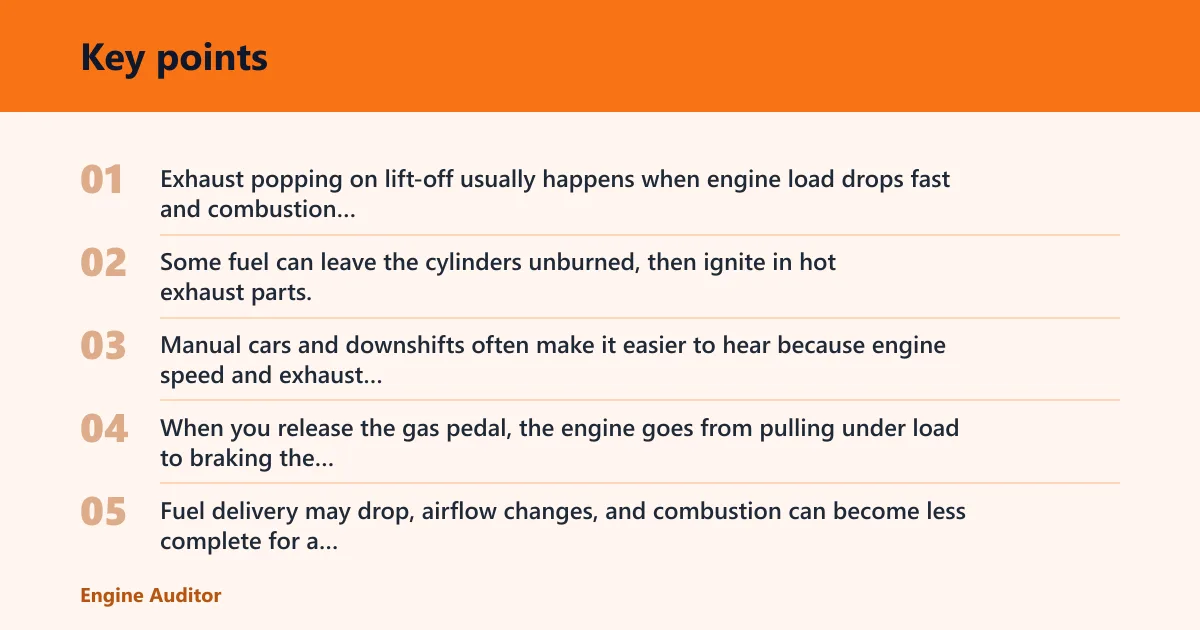
Exhaust popping on lift-off usually happens when engine load drops fast and combustion changes during overrun or coast-down. Some fuel can leave the cylinders unburned, then ignite in hot exhaust parts. Manual cars and downshifts often make it easier to hear because engine speed and exhaust flow change more sharply.
What happens during throttle lift-off
When you release the gas pedal, the engine goes from pulling under load to braking the car. Fuel delivery may drop, airflow changes, and combustion can become less complete for a moment. That transition is why some cars crackle only during deceleration, not at steady throttle.
Why unburned fuel can ignite in the exhaust
If a small amount of fuel-air mixture reaches the exhaust without fully burning in the cylinders, hot pipes, manifolds, or the catalytic converter can light it off. That ignition is what makes a pop, crackle, or a short bang. Repeated events matter more than a single light crackle.
Why downshifts can make the sound louder
Downshifts raise engine speed while load falls, so the transition can make decel popping more noticeable. Manual transmissions often draw attention to it because the driver is matching revs and letting off the throttle in steps. A freer-flowing exhaust can also make the same event easier to hear.
Say your manual hatch pops once or twice every time you lift off in second gear at 3,000 rpm, but never idles rough and never shows a warning light. That pattern points more toward normal overrun crackle or an exhaust note that has been amplified by the exhaust system than toward a hard engine fault.
Exhaust pop decision table
Use the first clue that fits. Start with when the pop happens, then check for a warning light, smell, rough running, or a leak sound. The goal is to separate normal overrun noise from leak-driven popping and from fuel or ignition faults that need diagnosis.
| When the pop happens | Check-engine light? | Exhaust odor | Misfire or rough idle? | Leak sound? | Most likely cause | First test | Safe to drive short term? | What to inspect first |
|---|---|---|---|---|---|---|---|---|
| Only on lift-off, light crackle, no other symptoms | No | None or mild | No | No | Normal overrun crackle or tune | Confirm whether the car has an intentional overrun tune | Usually yes, if it stays mild | ECU tune and exhaust modifications |
| Only on lift-off, louder pop near the rear of the car | No or maybe | Sometimes exhaust smell | No | Tick, crack, or puff | Exhaust leak before the muffler | Inspect joints, flex pipe, clamps, and hangers for soot or movement | Short term only if noise is mild | Exhaust joints and flex sections |
| Lift-off plus rough idle or power loss | Often yes | Fuel smell or sharp exhaust odor | Yes | Maybe | Ignition misfire | Read codes and inspect plugs and coils | Use caution; avoid hard driving | Spark plugs, ignition coils, stored codes |
| Decel popping with a strong rich smell | Maybe | Strong fuel smell | Maybe | No | Rich air-fuel mixture | Check fuel trims, injector leaks, and sensor data | Not ideal for long use | Fuel trims, injectors, oxygen sensors |
| Only when slowing after a long coast-down | No or maybe | Sometimes | No | Maybe | Vacuum leak affecting decel fueling | Check hoses, PCV lines, intake boots, and brake booster hose | Often yes, but fix soon | Vacuum hoses and intake ducting |
| Repeated bangs under load transition, then lift-off | Often yes | Fuel smell | Yes | No | Misfire or injector problem | Scan for misfire counts and inspect plug condition | Use caution | Ignition system and injector balance |
| Mostly after a tune or exhaust swap | No or maybe | Mild | No | No | Intentional overrun popping or louder exhaust note | Compare the current tune and exhaust to stock settings | Usually yes if performance is normal | Tune file, muffler, resonator, and tips |
| Pop grows louder over time and emissions worsen | Often yes | Fuel smell or hot-metal smell | Maybe | Maybe | Catalytic converter affected by repeated raw-fuel events | Check converter temperature, smell, and efficiency codes | No if the popping is heavy or constant | Catalytic converter and upstream fault source |
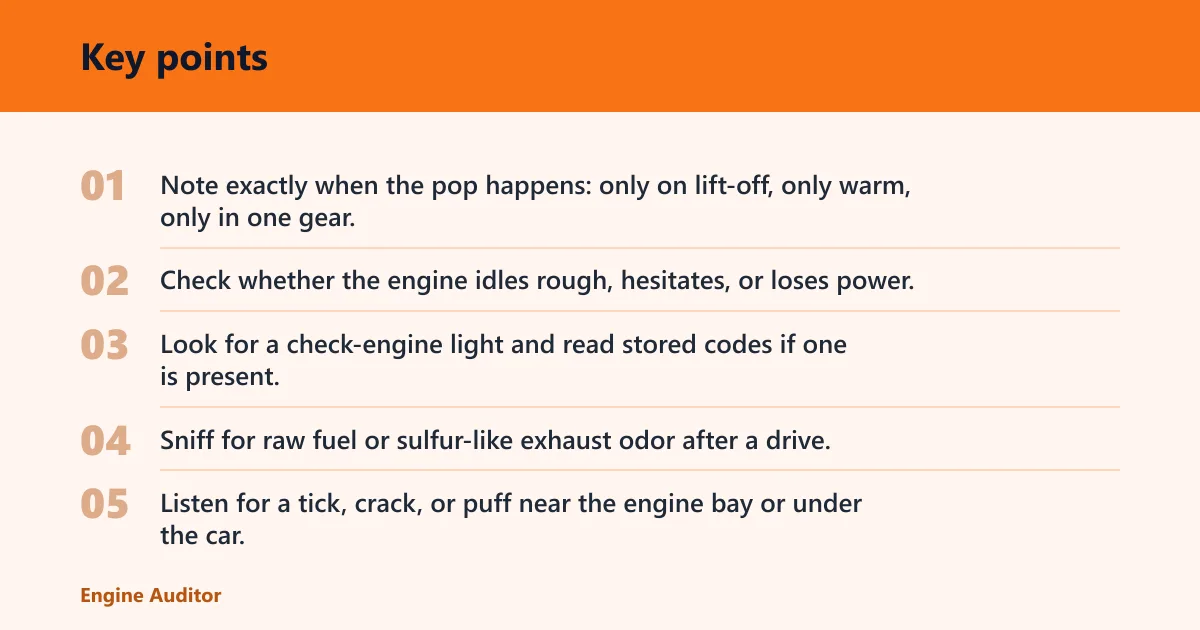
- Note exactly when the pop happens: only on lift-off, only warm, only in one gear, or only on downshift.
- Check whether the engine idles rough, hesitates, or loses power.
- Look for a check-engine light and read stored codes if one is present.
- Sniff for raw fuel or sulfur-like exhaust odor after a drive.
- Listen for a tick, crack, or puff near the engine bay or under the car.
- Inspect spark plugs, coils, hoses, clamps, and exhaust joints before replacing parts at random.
Is the popping normal?
Yes, some light crackle on deceleration can be normal, especially on a stock car with a freer exhaust or a calibration that allows overrun noise. It becomes a concern when the popping is loud, frequent, accompanied by a fuel smell, or paired with a check-engine light, rough idle, or power loss.
Stock exhaust versus modified exhaust
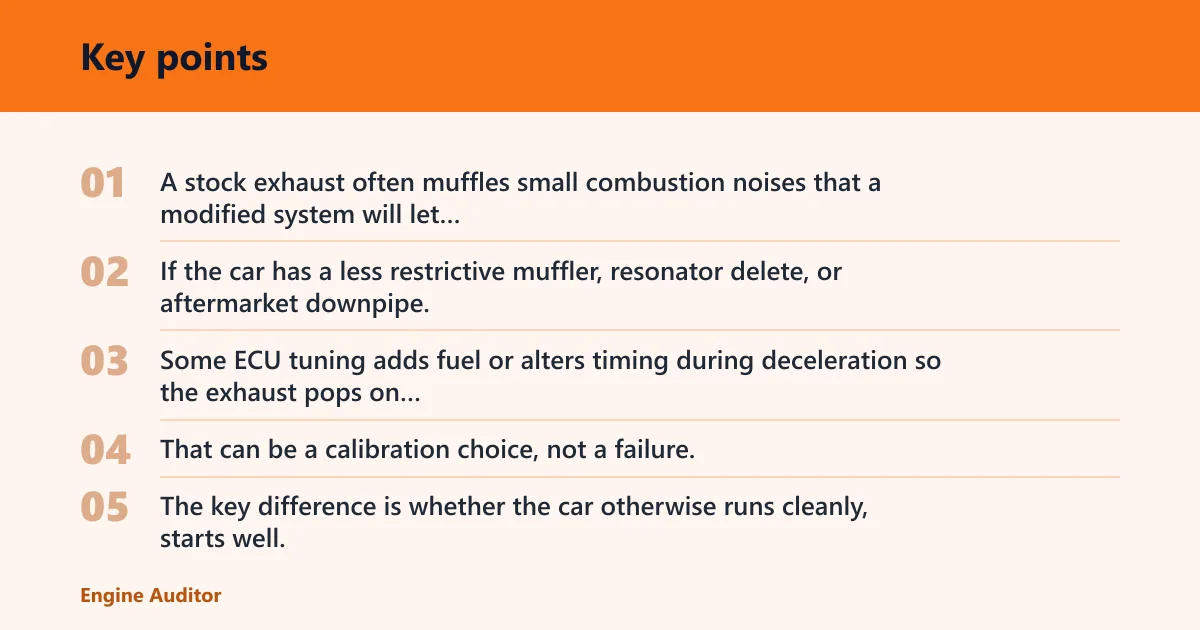
A stock exhaust often muffles small combustion noises that a modified system will let through. If the car has a less restrictive muffler, resonator delete, or aftermarket downpipe, normal overrun crackle may sound much louder. The noise itself does not prove a fault. The rest of the symptoms matter.
Intentional overrun popping from tuning
Some ECU tuning adds fuel or alters timing during deceleration so the exhaust pops on purpose. That can be a calibration choice, not a failure. The key difference is whether the car otherwise runs cleanly, starts well, idles smoothly, and shows no leak, misfire, or rich-running signs.
When normal crackle becomes a concern
Normal crackle should stay light and predictable. If the sound changes from occasional popping to repeated bangs, or if you notice hot metal smell, fuel odor, poor fuel economy, or a warning light, the problem has moved beyond normal overrun noise. At that point, diagnosis comes first.
Suppose a sedan with an aftermarket cat-back exhaust starts popping only during aggressive lift-off, but it still idles smoothly and shows no fault codes. That may be normal amplified crackle. If the same car later begins stalling at lights, the explanation shifts toward a fuel or ignition problem.
Can a leak cause it?
Yes. An exhaust leak before the muffler can pull in oxygen, and that oxygen can ignite unburned fuel in the pipe during deceleration. The result can sound like a pop, tick, or sharp crack. Leak-driven popping is common near joints, flex pipes, clamps, and cracked manifolds.
How an exhaust leak creates decel noise
On throttle lift-off, exhaust flow and pressure change. If there is a leak upstream, fresh air can enter and mix with hot exhaust gases or leftover fuel. That extra oxygen makes ignition inside the pipe more likely, especially during coast-down when exhaust pulses are uneven.
Where to look first under the car
Start at the exhaust manifold, gasket area, flex pipe, pipe joints, clamps, and welds. Look for black soot, loose hardware, broken hangers, or a puffing sound during cold start or decel. A small leak near the front of the system can make a much bigger noise than its size suggests.
What a leak sounds like compared with misfire
An exhaust leak usually sounds closer to a tick, chuff, or crack from one spot. A misfire more often comes with rough running, stumble, or uneven power, and the noise may not be localized to one exhaust joint. If the engine itself feels off, think fuel or spark first.
Can a fuel or spark fault cause it?
Yes. A rich mixture or ignition misfire can send unburned fuel into the exhaust, where it may ignite in hot components. Worn spark plugs, weak ignition coils, injector faults, and some sensor problems can all lead to decel popping. A check-engine light, rough idle, or power loss makes this branch more likely.
Rich mixture and excess fuel in the exhaust
Too much fuel relative to air can leave extra fuel to burn later in the exhaust. Sensor faults, injector issues, or a tune that adds fuel on decel can create that condition. A fuel smell at the tailpipe or a black, sooty exhaust tip points in this direction.
Misfire from plugs or coils
Worn spark plugs or weak ignition coils can leave part of the mixture unburned in the cylinder. That fuel then burns where it should not. Misfire-related popping is more likely to come with rough idle, hesitation, a flashing or steady check-engine light, or a noticeable drop in power.
Injector problems and fuel trim clues
A leaking or stuck-open injector can enrich one cylinder or the whole engine, which may create pops on decel. Diagnosis often needs fuel trim data, injector balance testing, or a pressure leak test. Uneven spark plug color can help point to a single-cylinder issue.
Can a vacuum leak cause exhaust popping?
Yes. A vacuum leak can upset fueling on throttle lift-off and create lean conditions or unstable idle, which may contribute to popping. Unmetered air entering the engine changes the air-fuel balance, especially when the throttle closes and control strategies switch to deceleration behavior.
How unmetered air affects throttle lift-off
When extra air enters downstream of the air meter, the engine management system does not account for it correctly. That can distort decel fueling and make the engine act lean. Lean conditions may not always create a loud pop, but they often disturb idle and throttle response first.
Idle quality clues that point to a vacuum leak
Look for a fast or hunting idle, hiss from the intake, brake booster issues, or a trim reading that suggests the engine is correcting for extra air. Common leak points include intake boots, PCV hoses, vacuum lines, and the brake booster hose. A smoke test is often the cleanest check.
Catalytic converter risks
Repeated popping can overheat the catalytic converter if raw fuel burns inside it. That can shorten converter life, change exhaust smell and note, and hurt emissions performance. One or two light crackles usually do not equal converter damage, but repeated raw-fuel events deserve attention.
Why repeated raw-fuel events heat the converter
The converter is designed to clean up normal exhaust, not to repeatedly burn extra fuel from misfire or rich running. If raw fuel enters it often, temperature rises fast. Excess heat can damage the substrate and reduce its ability to process emissions.
Signs the converter may be affected
Watch for loss of power at higher rpm, a rotten-egg smell, rattling from the converter case, or efficiency-related fault codes. A converter that has been overheated may also change the sound of the exhaust. If popping has become frequent, the converter is part of the inspection, not an afterthought.
Why is my exhaust popping when I let off the gas in one specific gear?
If the pop happens only in one gear, the gear itself is rarely the root cause. That gear may simply put the engine in a speed and load range that makes overrun noise easier to hear, or it may line up with a downshift, rev match, or a transition that exposes a weak tune, leak, or misfire.
Why gear-specific popping matters
Gear-specific popping often points to engine speed, load, and exhaust tone rather than the transmission itself. In a manual car, second or third gear may create the cleanest example because decel happens in a more audible range. If the pop follows the same rpm every time, note that pattern.
What to check first in a gear-specific case
Compare the noise in the same gear at different speeds, then compare that to other gears at the same rpm. If the sound follows rpm, think tune, exhaust flow, or engine fault. If it follows one shift event only, look at decel fuel cut, exhaust resonance, and driver input.
Frequently asked questions
What causes popping in the exhaust on deceleration?
Deceleration popping usually comes from unburned fuel igniting in the exhaust during throttle lift-off. Common causes include a rich mixture, ignition misfire, exhaust leaks that pull in oxygen, vacuum leaks, or an aggressive tune that adds overrun crackle. The surrounding symptoms tell you which branch fits best.
What makes an exhaust pop after I release the throttle?
When you release the throttle, engine load drops and combustion changes quickly. If some fuel survives the combustion chamber, or if air leaks into the exhaust, that mixture can ignite in hot pipes or the converter. A louder exhaust or modified tune can make the same event easier to hear.
Can a rich fuel mixture cause exhaust popping?
Yes. Too much fuel can send excess fuel into the exhaust, where it ignites in hot components. Rich running can come from sensor faults, tuning, or injector problems. Fuel smell, sooty tailpipes, and poor fuel economy are common clues that the mixture is too rich.
Does exhaust popping mean my car is misfiring?
Not always. A misfire can cause popping, but so can a normal overrun tune, an exhaust leak, or a rich mixture. If the popping comes with rough idle, power loss, or a check-engine light, misfire moves up the list. Without those signs, look at exhaust and calibration first.
Why do exhausts pop when I downshift?
Downshifts can make popping more obvious because engine speed rises while load falls. That can expose overrun crackle, a marginal spark issue, or a tune that adds fuel on decel. Manual cars often make the sound more noticeable because the driver is changing gears and rpm in steps.
Products related to this article
Sponsored / affiliate links. As an Amazon Associate I earn from qualifying purchases. I may earn additional commission from eligible campaigns.