What Is a One-Pedal Driving Mode in EVs?
One-pedal driving in an EV is a drive-mode setting that makes lifting off the accelerator trigger strong regenerative braking, often enough to slow or stop the car without touching the brake pedal. Used badly, it can make low-speed traffic jerky and leave you unsure which hold, creep, or roll behavior your car is using. This guide explains how one-pedal works, which brands offer it, and when to turn it up or back down.
How one-Pedal driving differs from normal modes
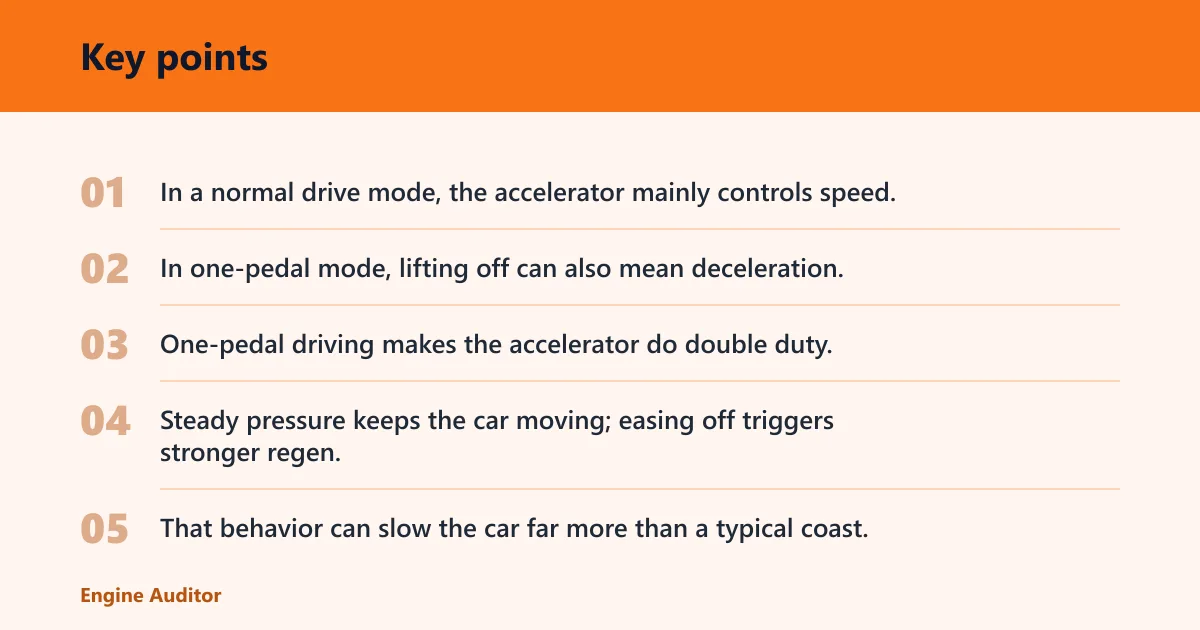
It changes what your right foot does. In a normal drive mode, the accelerator mainly controls speed. In one-pedal mode, lifting off can also mean deceleration, because the car uses regenerative braking to slow itself.
What the mode changes at the accelerator pedal
One-pedal driving makes the accelerator do double duty. Steady pressure keeps the car moving; easing off triggers stronger regen. That behavior can slow the car far more than a typical coast, so the driver uses one pedal for both acceleration and deceleration.
That is why the setting feels different from a gasoline car. It is not a single fixed feature. Automakers tune how quickly the car slows, whether it can creep, whether it rolls freely, and whether it holds itself still at the final stop.
How it differs from a normal drive mode
In a normal EV mode, lifting off the accelerator may produce only light regen, or it may let the car coast. In one-pedal mode, the car usually slows much more aggressively. Some systems stop at zero and then hold. Others still need a brake-pedal press to finish the stop.
That final stop logic matters in traffic and on hills. A car that merely slows to zero can roll again if the road slopes downhill. A car with hold logic stays put without brake input.
Why EV makers give it different names
Automakers use different labels for similar behavior. Nissan calls its version e-Pedal. Hyundai, Kia, and Genesis use i-Pedal. Ford uses One-Pedal Drive. Tesla often pairs strong deceleration behavior with Hold logic. GM may use Regen on Demand on some models.
The name matters less than the behavior. Some current systems slow strongly but still need the brake pedal to settle fully at zero, while others stop and hold without extra input.
📊 Regenerative braking can recover some energy during deceleration, but the amount varies by route, speed, temperature, traffic, and vehicle. Source: Thedrive.
How one-pedal driving works
One-pedal driving works by turning the traction motor into a generator when you lift off the accelerator. That regenerative braking slows the car and sends electricity back to the battery. Friction brakes still exist, and they still do the heavy work for hard stops and emergency braking.
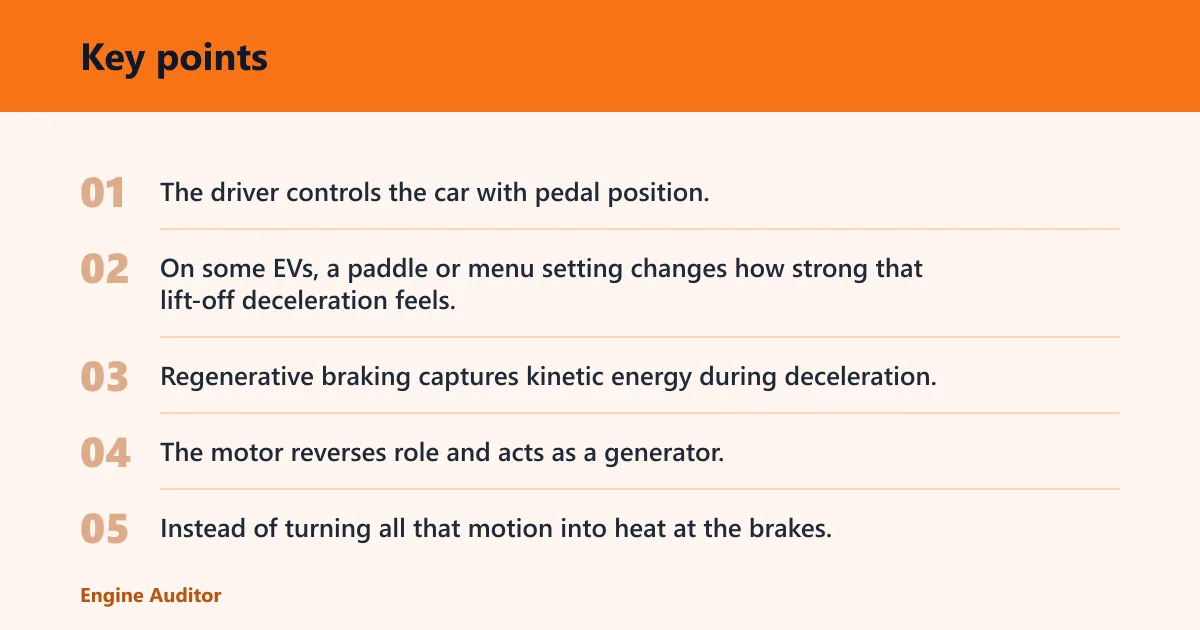
The driver controls the car with pedal position. More pedal means more drive. Less pedal means more slowdown. On some EVs, a paddle or menu setting changes how strong that lift-off deceleration feels.
Regenerative braking in plain terms
Regenerative braking captures kinetic energy during deceleration. The motor reverses role and acts as a generator. Instead of turning all that motion into heat at the brakes, the system sends some electricity back to the battery.
That is not the same as friction braking. Friction brakes use pads and rotors to create stopping force. Regen slows the car through the motor. The two systems often blend together near the end of a stop.
What happens when you lift off the accelerator
When you lift off, the car begins to decelerate. In strong one-pedal settings, that deceleration can be enough to bring the vehicle to a full stop. In milder settings, the car may slow but keep rolling until you press the brake pedal.
Think of the accelerator as both speed control and deceleration control. Steady input keeps speed up. Lifting off asks the car to harvest energy and slow down at the same time.
Where friction brakes still take over
Friction brakes are still required for hard braking, emergency stops, and many low-traction situations. Regen is limited by speed, battery state, traction, and the vehicle’s tuning. At very low speeds, most systems also hand off to friction braking for the final stop.
That handoff is one of the biggest differences between models. Some EVs feel as if they stop by regen alone. Others slow hard, then need a firmer pedal press to settle fully at zero.
What is the difference between one-pedal driving and regenerative braking?
Regenerative braking is the energy-recovery method. One-pedal driving is the driving behavior that uses that method strongly enough to replace much of the brake pedal’s normal job. You can have regen without full one-pedal driving, but you cannot have one-pedal driving without regen doing the slowing work.
That difference is why two EVs can feel very different. One may coast lightly and recover modest energy. Another may slow sharply on lift-off, then hold at a stop with almost no brake-pedal use.
Why regen can exist without full one-pedal stop behavior
Many EVs use regenerative braking in every drive mode. Even if the car coasts more like a normal vehicle, regen may still recover energy during deceleration. One-pedal mode simply turns that behavior up and makes it more noticeable to the driver.
Some brands also separate deceleration strength from stop behavior. A model may offer strong regen but still roll unless the brake pedal is pressed. Another may stop itself and hold after lift-off.
Why some EVs slow more aggressively than others
Automakers tune the lift-off feel differently. The Nissan Leaf Plus can decelerate up to 0.20 g in ePedal mode. The Chevrolet Bolt can reach up to 0.22 g in L mode. Hyundai’s Kona Electric can cycle through four regenerative braking levels and maxes out regen at 0.25 g. (Motortrend)
Those numbers help explain why one EV feels calm while another feels abrupt. The setting is not just a label. It changes how quickly the car sheds speed when you lift off.
Which EVs have one-pedal driving?
Many EVs offer some form of one-pedal driving, but the control location and stop behavior vary. Tesla, Ford, and many other brands place the setting in a vehicle menu. Chevy Bolt and Bolt EUV have a one-pedal driving button near the gear selector. Some GM models use a steering-wheel paddle for added regen.
Brand names also differ. Nissan uses e-Pedal. Hyundai, Kia, and Genesis use i-Pedal. Ford uses One-Pedal Drive. Tesla often ties strong stop behavior to Hold mode. GM may use Regen on Demand on some EVs.
Tesla Hold mode
Tesla Hold mode is a one-pedal-style stopping behavior. It can bring the car to a stop and keep it there. That makes final stop logic part of the drive mode, not just a separate parking-brake concern.
Nissan e-Pedal
Nissan’s e-Pedal is the brand name for its one-pedal driving setup. It allows slow-to-stop behavior, and the exact final stop logic depends on the model. The key point is that lift-off can produce strong deceleration without immediate brake-pedal use.
Hyundai i-Pedal
Hyundai, Kia, and Genesis use the i-Pedal branding for one-pedal driving. On some models, it can be enabled with steering-wheel paddles. It uses strong regenerative braking and may also be paired with multiple regen levels on vehicles that support finer tuning.
Ford One-Pedal Drive
Ford One-Pedal Drive is usually found in the vehicle settings menu. It changes lift-off behavior so the car slows more strongly without a separate brake press. Ford also lets some drivers tune or switch the setting as conditions change.
GM regen on Demand
GM Regen on Demand uses a steering-wheel paddle to add regen boost on some EVs. It can assist the automatic one-pedal feel or substitute for it in models that split deceleration control between the pedal and the paddle. That makes it useful when you want more slowdown without a full mode change.
One-pedal behavior matrix
This matrix helps you compare the main stop behaviors, not just the brand label. Check whether your EV slows to zero, holds at a stop, still creeps, or rolls after lift-off. Those details matter more than the name on the screen.
| Mode type | Accelerator lift-off feel | Stops to zero | Holds on hill | Brake pedal needed for final stop | Creep/roll availability | Best use case |
|---|---|---|---|---|---|---|
| Strong one-pedal with hold | Sharp slowdown as soon as you lift off | Usually yes | Yes | Usually no for normal stops | Usually no creep; roll is limited | Dense city traffic, frequent stoplights |
| Strong regen without hold | Strong slowdown, then fade near zero | May slow to zero but not stay there | No or limited | Yes, for the last bit or to stay stopped | May roll when the road slopes | Drivers who want regen but prefer a familiar stop |
| Mild regen or default drive | Light slowdown or near-coast | No | No | Yes | Often creep is available | Parking lots, long highway stretches |
| Pedal plus paddle regen | Normal lift-off, extra slowdown when requested | Depends on the model | Depends on the model | Usually yes | Often retained | Drivers who want manual control over deceleration |
Use the matrix this way: choose hold if you want the car to stay stopped without brake input; choose milder regen if you want more creep or roll; choose paddle-based regen if you want a middle ground. That decision changes how the car behaves in traffic, on hills, and during parking.
Say your EV is set to strong one-pedal mode and you are easing into a downhill stoplight on a wet street. The car may slow hard on lift-off, then hold at zero. If the same setting is used on glare ice, the abrupt deceleration can feel too aggressive, so a milder mode may be safer.
Does one-pedal driving work on hills and in traffic?
Yes, but the experience changes by road surface and stop behavior. On hills, hold logic matters because some cars will stay stopped while others may creep or roll. In traffic, strong one-pedal driving can reduce brake-pedal use, but it can also feel abrupt if the driver is constantly modulating speed.
The best setup depends on how the vehicle handles the handoff from lift-off deceleration to a full stop. That handoff is what separates smooth city driving from a jerky one.
Hill starts and stoplights
On an incline, a true hold mode prevents rollback. A slow-to-zero system without hold may move again unless the brake pedal stays engaged. That is why you need to know whether your car holds, creeps, or rolls after regen fades out.
For stoplights on hills, hold is the cleaner setting. It reduces foot movement and makes the final stop more predictable.
Stop-and-go traffic
One-pedal driving can help in traffic because the accelerator becomes the main speed control. That can reduce brake use and keep the driver’s right foot busier with one motion instead of two. It may also improve city-driving efficiency, and regen can recover more energy in stop-and-go conditions than in steady cruising.
Range effects vary with route, speed, temperature, traffic, terrain, battery state, and vehicle tuning. The biggest gains usually show up in city driving, not as a fixed percentage added to every trip.
Low-traction and winter limits
Low-traction roads call for more caution. Strong lift-off deceleration can unsettle the car on snow, slush, or ice. In those conditions, a lighter regen setting or conventional drive mode can make the vehicle easier to control.
Brake lights should illuminate during strong deceleration, but the exact trigger depends on vehicle tuning. That matters for safety and legality, because following drivers need a clear signal when the car is slowing hard on regen alone.
When should you turn it down or off?
Turn one-pedal driving down when you need more creeping, less abrupt slowdown, or more predictable low-speed control. Parking, tight maneuvering, slippery roads, and drivers prone to motion sickness are the main cases where a milder setting is easier to live with.
That does not mean abandoning regen. It means choosing the version of regen that fits the road and the driver.
Parking and tight maneuvering
In a garage or crowded lot, strong lift-off deceleration can make tiny speed changes harder. A milder mode that allows creep or gentle roll is often easier for backing into a space or edging around a bollard.
Picture a narrow parking aisle with a child crossing behind the car. A gentler setting gives you more room to inch forward without repeated stop-start motion from the accelerator.
Slippery roads and snow
On slippery roads, less regen usually means more stability. Sudden deceleration can reduce tire grip and make the car feel nervous. If the vehicle offers a winter or low-regen mode, that is the safer starting point.
Use the owner’s manual to confirm how your model behaves, because some systems change by drive mode, battery temperature, or menu setting.
Drivers who dislike strong lift-off deceleration
Some drivers find strong one-pedal deceleration tiring or motion-sickening. For them, the right answer is not to force the setting. Lower regen, a different stop mode, or a more conventional drive mode can make the car easier to drive every day.
The useful rule is simple: if the car keeps surprising you at lift-off, turn the decel down until the response feels predictable.
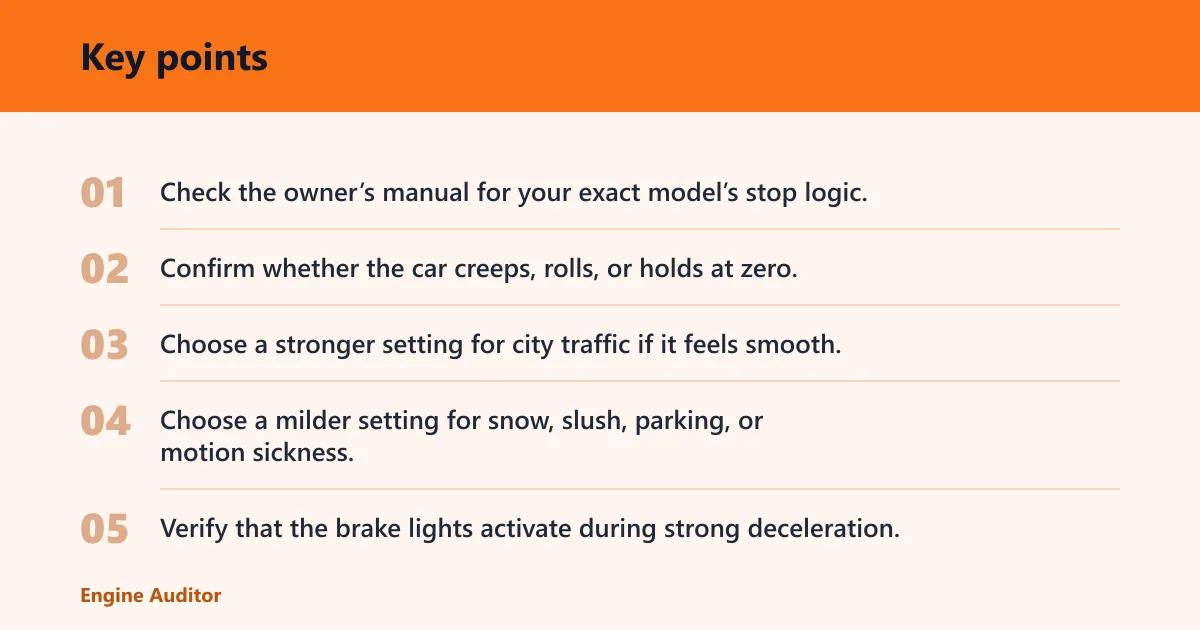
- Check the owner’s manual for your exact model’s stop logic.
- Confirm whether the car creeps, rolls, or holds at zero.
- Choose a stronger setting for city traffic if it feels smooth.
- Choose a milder setting for snow, slush, parking, or motion sickness.
- Verify that the brake lights activate during strong deceleration.
Frequently asked questions
What is one pedal driving in EVs?
One-pedal driving is a drive-mode setting that lets you accelerate and slow the car with the accelerator pedal. Lifting off triggers stronger regenerative braking. Depending on the vehicle, that slowdown may stop the car, hold it at zero, or still require a brake press for the final stop.
How does one pedal driving work?
It works by turning the motor into a generator when you lift off the accelerator. The car slows as it recovers energy and sends electricity back to the battery. Friction brakes still handle emergency stops, hard braking, and many low-speed handoff moments near zero.
Does one-pedal driving fully stop the car?
Sometimes. Some systems slow to zero and then hold the vehicle without brake input. Others stop the car but still need a brake press to stay there, or they roll slightly on hills. The owner’s manual is the only reliable source for that final-stop behavior.
Can you still use the brake pedal in one-pedal mode?
Yes. You should. The brake pedal still matters for emergency stops, hard braking, and low-traction situations. One-pedal driving reduces how often you need it in normal traffic, but it does not replace it.
Products related to this article
Sponsored / affiliate links. As an Amazon Associate I earn from qualifying purchases. I may earn additional commission from eligible campaigns.