Why Is My Car Thumping at Low Speed?
A low-speed thump usually points to a tire, wheel, suspension, brake, or driveline fault; if it changes with wheel speed, vehicle load, or steering angle, you can narrow it fast. Ignoring it can turn a small wear problem into a safety hazard or a much larger repair bill. This guide shows road-test patterns that separate wheel-speed, load-speed, and turn-dependent faults.
What a low-speed thump usually points
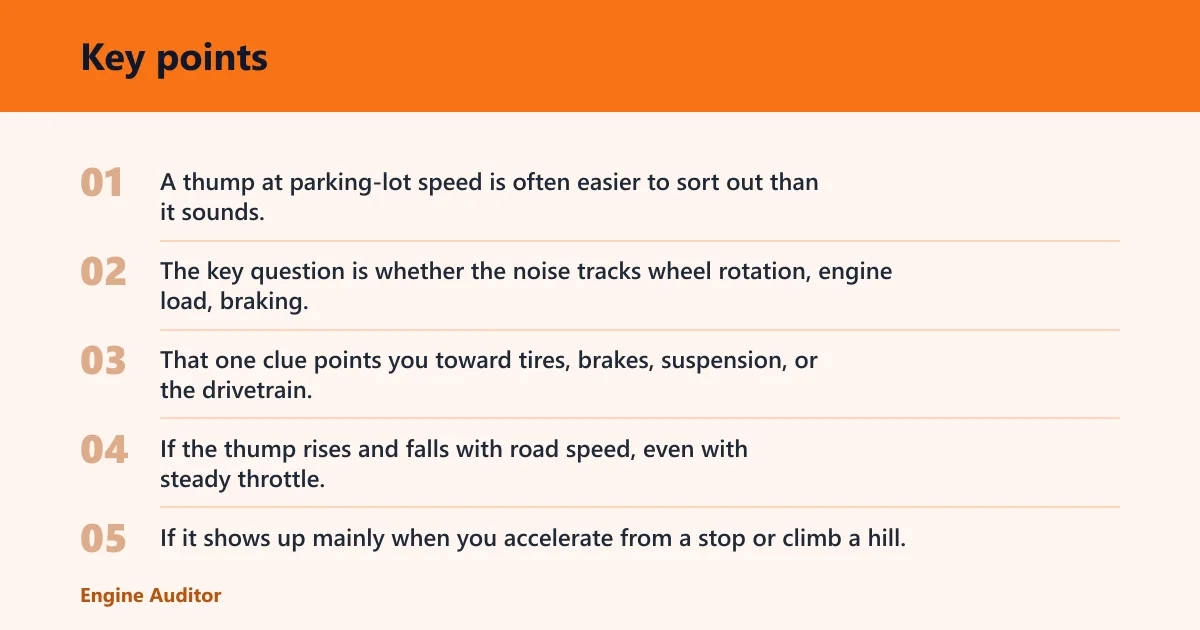


A thump at parking-lot speed is often easier to sort out than it sounds. The key question is whether the noise tracks wheel rotation, engine load, braking, or steering input. That one clue points you toward tires, brakes, suspension, or the drivetrain.
Wheel-speed clues vs engine-load clues
If the thump rises and falls with road speed, even with steady throttle, think rotating parts first: tire defects, wheel bearing issues, loose hardware, or drivetrain joints. If it shows up mainly when you accelerate from a stop or climb a hill, the load is changing and axle, engine-mount, or driveline parts move higher on the list.
A wheel-speed thump stays tied to how fast the wheels turn. A load-speed thump often changes with throttle, gear, or weight transfer. That difference matters more than the sound itself.
Front, rear, left, or right: why location matters
The location of the noise matters because different parts fail in different corners. Front thumps often point to CV axles, steering-related suspension wear, or front brakes. Rear thumps more often point to rear bearings, rear suspension, or rear driveshaft and differential parts on rear-wheel-drive and AWD vehicles.
One-sided noise that gets louder when turning can point to the outside wheel under higher load. A left turn tends to load the right side, and a right turn tends to load the left side.
When a thump is intermittent after parking or a pothole
An intermittent thump after parking can come from a tire flat spot, a small rock in the tread, or debris trapped in the wheel well. After a pothole, a bent wheel, shifted dust shield, or damaged tire may only show up at low speed or on rough pavement.
Say your car is quiet on smooth streets but thumps every few wheel turns after sitting overnight. That pattern fits a temporary tire flat spot far better than a bad bearing, which usually does not come and go that neatly.
Low-speed thump diagnosis matrix

This table helps you separate the common patterns before you open the hood. Read across each row: the more columns that match, the stronger the clue. Start with the speed, turn, brake, and acceleration pattern, then use the likely axle location and urgency.
| Symptom pattern | Speed dependence | Turn dependence | Braking dependence | Acceleration dependence | Likely axle location | Urgency |
|---|---|---|---|---|---|---|
| Flat spot after parking | Strong at first, then fades | None | None | None | Any wheel | Low unless severe vibration |
| Separated tread or belt separation | Follows wheel speed | May change with load | None | None | Any wheel | High |
| Out-of-round tire | Follows wheel speed | Usually none | None | None | Any wheel | Medium to high |
| Loose wheel or lug nut | Rapidly worsens with speed | May change as load shifts | May worsen under braking | May thump on launch | Any wheel | Immediate stop |
| Wheel bearing wear | Low-speed rumble or thump | Often louder on one turn | Usually none | Usually none | Any corner | High if play is present |
| Brake pad hardware movement | Often at low speed | Usually none | Changes when lightly braking | Usually none | Front or rear brakes | Medium |
| Loose dust shield | Can scrape or thump at wheel speed | Sometimes changes on turns | May change with brake use | None | Front or rear brakes | Low to medium |
| Outer CV joint wear | May click more than thump | Worse on tight turns | Usually none | Usually none | Front axle, some AWD | Medium |
| Inner CV joint wear | May thump or vibrate | Usually little change | Usually none | Worse on acceleration | Front axle, some AWD | Medium to high |
| Control arm bushing wear | Often over small bumps | Worse with steering load | Worse with braking load | May shift on launch | Front or rear suspension | Medium |
| Ball joint play | Clunk at low speed | May change when turning | May change when braking | Usually none | Front suspension most common | High |
| Driveshaft or U-joint wear | Tracks vehicle speed | Usually little change | Usually none | May show on launch | Rear of car, RWD or AWD | High |
| Differential issue | Tracks vehicle speed | May change under load | Usually none | May worsen on throttle | Rear axle or center driveline | High |
| Debris in wheel well | Intermittent | May move with steering angle | Usually none | Usually none | Any wheel well | Low to medium |
How to read the matrix
Start with the most repeatable clue. If the thump matches wheel speed, focus on the tire, wheel, brake hardware, or a rotating driveline part. If it changes most on turns, look at load-sensitive parts like bearings, CV joints, bushings, or ball joints.
A rear thump on a rear-wheel-drive or AWD vehicle deserves extra attention because it may come from the driveshaft, U-joint, or differential, not only rear suspension parts. That distinction saves time and points the inspection in the right direction.
Could a tire cause the thumping?

Yes. Tires are a common source of low-speed thumping, especially when the noise repeats at the same interval as wheel rotation. Flat spots, separated tread, bulges, belt separation, and out-of-round tires can all make a thump that sounds like suspension trouble.
Flat spots after parking
A flat spot often shows up after the car sits in one place, especially in cold weather or after long storage. The first few blocks may sound thumpy, then the noise fades as the tire warms and rounds out again.
If the thump disappears as the tire warms, that points away from bearing or drivetrain damage. If it stays constant, the tire may be damaged or out of round instead.
Separated tread, bulges, and belt separation
A separated tread or a bulge in the sidewall is more serious. The sound may be a thump, shudder, or heavy rhythmic bump that follows wheel speed. Belt separation often creates a repeating noise that is easy to miss at first but gets worse quickly.
Visible sidewall swelling, cord exposure, or a tread section that looks lifted from the carcass is a do-not-drive condition.
Out-of-round tires and uneven wear
An out-of-round tire can make a steady thump even if the tread looks acceptable. Uneven wear from alignment issues, suspension wear, or improper inflation can create a repeated bump at low speed that becomes more noticeable on smooth pavement.
Suppose the thump shows up at 10 to 20 mph on smooth asphalt but gets hidden on rough pavement. That often means the road surface is masking a wheel-speed problem rather than causing it.
Does the sound change when you turn?
Turn changes are one of the fastest ways to separate bearings, CV joints, and suspension wear from tires or brakes. If the sound gets louder on one turn and softer on the other, the loaded side of the car becomes the main suspect.
Wheel bearing clues on left and right turns
A worn wheel bearing can make a low-speed rumble or thump that changes as weight shifts across the axle. If a left turn loads the right side and the noise gets louder, the right bearing moves higher on the list. The reverse pattern points left.
Bearings often show play or roughness when inspected with the wheel off the ground. Any looseness, notchiness, or grinding is not normal.
CV joint patterns on acceleration and steering lock
Front-wheel-drive cars and many AWD cars use CV axles that can thump, vibrate, or click when worn. The outer joint usually clicks on tight turns. The inner joint is more likely to thump or shake under acceleration from a stop or a slow roll.
Torn boots and grease loss matter because the joint wears once contamination starts. If the boot is split and grease is flung around the wheel well, the joint deserves close inspection.
Load transfer from bushings and ball joints
Control arm bushings and ball joints can clunk or thump when the suspension shifts over small bumps, during braking, or during a turn at low speed. The sound comes from load transfer, not engine speed.
A worn ball joint can also make the steering feel vague or pull slightly as the tire changes angle. That is a repair-first symptom, not a noise to ignore.
Brake and wheel hardware checks
Brake parts can thump at low speed when hardware is loose, a shield touches the rotor, or rust and debris move with wheel rotation. These noises often change when the brake pedal is applied lightly, which makes them easier to separate from tire and suspension problems.
Warped rotor, pad hardware, and dust shield contact
A warped rotor usually produces pulsation under braking, but loose pad hardware can create a knock or thump at crawl speed. A bent dust shield may rub or tap the rotor as the wheel turns.
If the noise changes when braking lightly, the brake system needs attention first. That pattern is different from a tire defect that stays steady whether you touch the pedal or not.
Rust scale and debris trapped near the rotor
Rust scale, gravel, and other debris can lodge near the rotor or shield and tap once per revolution. The sound may show up after rain, after driving through slush, or after a pothole event that dislodges material.
A quick visual check through the wheel opening can reveal shiny rub marks, bent shields, or a pebble wedged between the rotor and backing plate.
Loose wheel, lug nut, and wheel stud warning signs
A loose wheel or loose lug nut is an urgent safety issue. The thump can start small, then worsen quickly as the wheel moves on the hub. Damaged studs, shiny lug seats, or a visible wobble mean the car should not keep driving.
Check wheel torque with the correct pattern if the wheel was recently removed. If a wheel feels loose by hand, or the steering wheel shakes with the thump, stop and inspect before driving farther.
Rear thump causes and urgency
A rear thump is not automatically a rear suspension problem. On rear-wheel-drive and AWD vehicles, a rear-of-car noise can come from the driveshaft, U-joint, or differential. Those parts can create a thump that tracks vehicle speed rather than engine rpm.
Driveshaft, U-joint, and differential clues
A worn U-joint can thump once per shaft rotation, especially on launch or at very low speed. A differential issue may sound like a thump, clunk, or repeated knock that grows worse under throttle. Joint play or binding are red flags.
If the noise comes from the rear and follows road speed in every gear, drivetrain parts deserve attention before the problem spreads.
Rear suspension parts that clunk over small bumps
Rear control arm bushings, trailing arm bushings, and rear sway bar hardware can clunk over small bumps at low speed. The sound often shows up in parking lots, driveway entries, or when one rear wheel drops into a shallow dip.
That pattern points to suspension movement under load, not a tire defect alone.
When a rear thump points to immediate service
If the rear thump comes with wheel wobble, driveline vibration, a burning smell, or fluid leakage near the differential, service is urgent. A rapidly worsening thump on a rear-wheel-drive or AWD vehicle can point to a part that may fail soon.
Do not keep testing a rear thump on the road if the car pulls, shakes hard, or feels unstable on acceleration.
When should I stop driving and get the car checked?
Stop driving if you see visible tire damage, wheel movement, a wobbling wheel, a rapidly worsening thump, or steering pull that was not there before. A thump that comes with a warning light, brake warning, or strong vibration also deserves immediate inspection.
- Check whether the noise changes with speed, turning, braking, or acceleration.
- Look for tire bulges, tread separation, missing wheel weights, or debris in the wheel well.
- Inspect each wheel for looseness, fresh lug damage, or obvious wobble.
- Note whether the sound is front, rear, left, or right.
- Arrange professional inspection if the noise persists, grows louder, or comes with instability.
A common mistake is to assume a low-speed thump is harmless and keep rolling even though a loose wheel weight or worn suspension part may be getting worse. A loose wheel, separated tire, or failing bearing can feel acceptable for a short distance and still be unsafe. If the symptom worsens during the drive, end the test.
Frequently asked questions
Why is my car thumping at low speed?
A low-speed thump usually comes from a tire, wheel, brake, suspension, or driveline problem. The fastest way to narrow it is to watch whether the sound follows wheel speed, steering angle, braking, or acceleration. That pattern is more useful than the sound alone.
Can bad tires cause a thumping sound while driving?
Yes. Flat spots, out-of-round tires, separated tread, and belt separation can all thump at a rhythm that matches wheel rotation. If the noise stays tied to road speed and changes little with braking or turning, the tire is a strong suspect.
Could a wheel bearing make a thumping noise at low speed?
Yes. A worn wheel bearing can make a low-speed rumble or thump that gets louder on one turn and softer on the other. Play, roughness, or grinding when the wheel is lifted is a strong clue that the bearing needs attention.
Why does the thumping get louder when I turn left or right?
A turn shifts vehicle load onto one side of the car. That extra load can make a worn wheel bearing, ball joint, or bushing noisier. The louder side on the turn is often the side carrying more weight, so the sound direction matters.
Why does my car thump when accelerating from a stop?
Acceleration from a stop points toward load-related faults such as an inner CV joint, driveline joint, differential issue, or worn suspension bushing. If the noise is strongest only when throttle is applied, that is less consistent with a simple tire defect.
Could a loose wheel or lug nut cause a thumping noise?
Yes, and it is an urgent safety problem. A loose wheel or lug nut can create a thump that worsens quickly, followed by vibration or wobble. If you suspect this, stop driving and check the wheel torque and stud condition right away.
Products related to this article
Sponsored / affiliate links. As an Amazon Associate I earn from qualifying purchases. I may earn additional commission from eligible campaigns.