Why Is My Car Clicking When I Turn?
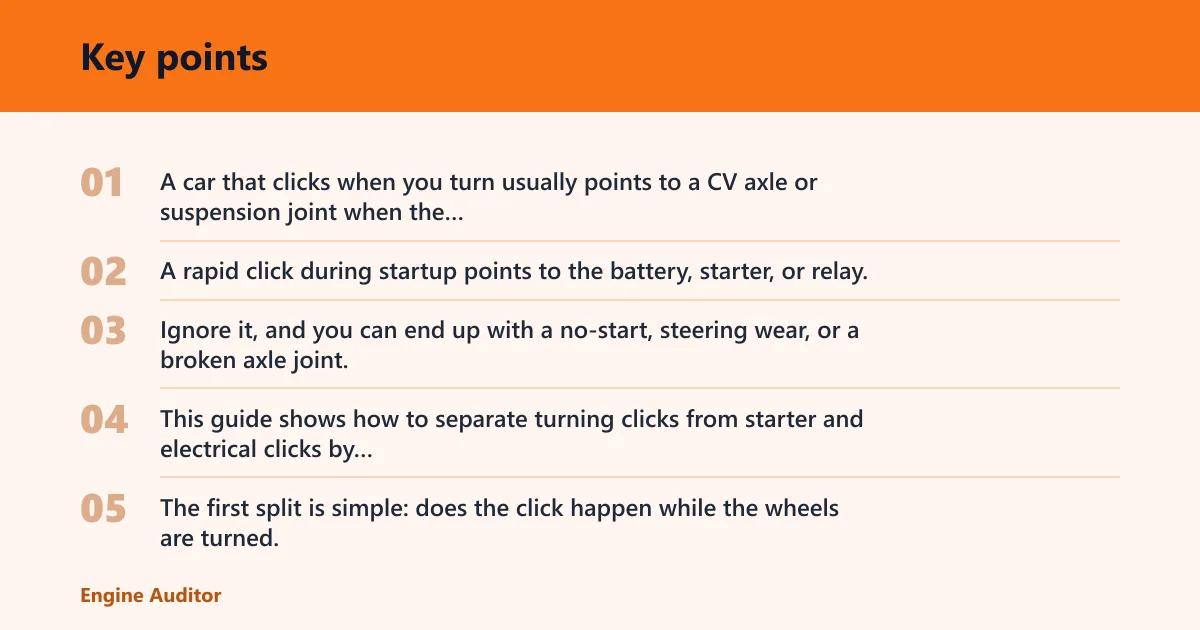
A car that clicks when you turn usually points to a CV axle or suspension joint when the sound changes with steering load. A rapid click during startup points to the battery, starter, or relay. Ignore it, and you can end up with a no-start, steering wear, or a broken axle joint. This guide shows how to separate turning clicks from starter and electrical clicks by the moment the sound begins.
This guide is part of our Car Noise Diagnosis by Symptom: Where the Sound Comes From and How Serious It Is series.
The first split is simple: does the click happen while the wheels are turned, while the engine is starting, or only when another load is added? That timing usually separates drivetrain noise from steering, brake, and electrical causes before you touch any parts.
Clicking noise symptom guide

- Tests battery, charging, and starter systems
- Works on 6V and 12V vehicles
- Simple analog meter with color-coded clamps
Tight turn versus gentle curve
A tight parking-lot turn tells you more than a gentle curve. A clicking sound in a parking lot often shows up during tight turns, and a rhythmic click that speeds up with vehicle speed often points to an outer CV joint. A gentle curve that stays quiet makes the outer joint less likely and shifts attention toward lighter steering load, brake hardware, or a joint that only complains at a sharper angle.
Rolling versus stationary
If the click appears only when the car is rolling, focus on CV axles, wheel-end parts, and brake hardware. If it happens with the steering wheel turned while stationary, look harder at steering joints, strut mounts, and power steering load. A true turning click usually changes with vehicle motion; a starter-style click does not.
Turning versus starting
Turning clicks and starting clicks are different problems. Clicking while turning is usually tied to wheel angle and load transfer, while rapid clicking during startup points to battery voltage, starter engagement, or a relay issue. Do not let the sound mislead you just because both noises are described as clicking.
Left turn, right turn, and full lock
Left and right turns help, but direction alone does not prove which side failed. A left-turning click can indicate a bad outer CV joint on the right axle, and vice versa, yet that clue still needs a confirming inspection. Full steering lock is useful because many joint and steering noises become louder at maximum angle.
Why is my car clicking when I turn?
Most turn-related clicking comes from CV axles, steering joints, suspension joints, and brake hardware. The outer CV joint carries the turning angle, so a damaged outer joint often makes a metallic click-click-click while the wheel is loaded in a turn. A torn CV boot is one common reason a CV joint starts clicking.
Front-wheel-drive and all-wheel-drive vehicles are common places where this noise is reported, since the axle joints can work harder there. If the click speeds up with vehicle speed, the outer CV joint moves higher on the list. If it is a single click or pop, a loose joint or mount becomes more plausible.
Outer CV joint and axle clues
Look for a rhythmic, metallic click that follows wheel speed. If the sound gets louder while accelerating through a turn, that strongly fits a CV axle problem. A torn CV boot can leave grease splattered inside a wheel or on suspension parts, and the missing grease plus dirt inside the joint can start the noise.
Steering and suspension joint clues
Ball joints, tie rod ends, sway bar links, and strut mounts can click or pop under steering load. These noises are often less rhythmic than a worn outer CV joint. A single pop when the steering wheel loads the front end, especially at low speed, can point to one of these joints or mounts.
Brake hardware clues
Brake hardware can click if pads are shifting in their brackets, or if pad clips and caliper hardware are loose. This is more likely when braking while turning. If the click appears only with the brake pedal applied, do not assume an axle problem before checking the brake hardware.
When the noise is less likely to be a bearing
Wheel bearings are more likely to hum or growl than click. Their noise changes more with speed than with steering angle, though load shifts during turns can make the sound change. If the noise is clearly a click-click-click in a turn, a bearing is lower on the list than a CV joint or steering joint.
What the click pattern means
Pattern matters as much as location. A rhythmic click that follows wheel speed, a single pop, a click only with braking, and a click only at full lock usually point to different parts. That pattern often tells you whether you are chasing an axle, a joint, a brake component, or a steering-load issue.
Rhythmic clicks that follow wheel speed
A steady rhythmic click often points to an outer CV joint. The sound usually becomes faster as road speed rises, and it often gets louder when the vehicle accelerates through the turn. That combination is one of the clearest clues in the whole diagnosis.
Single pop during steering load
A single click or pop can point to a loose joint or mount. That includes a worn ball joint, a loose tie rod end, a worn sway bar link, or a strut mount that shifts under load. If the noise happens once as the wheel is first turned, then disappears, that pattern deserves attention soon.
Click only while braking and turning
If the click appears when you brake and turn together, brake hardware climbs the list. Pads shifting in their brackets can click, and loose pad clips or caliper hardware can do the same. The steering angle matters, but the brake pedal may be the real trigger.
Click only at full steering lock
A click only at full lock often means a part is reaching the limit of its travel or load. That can be an outer CV joint, a steering joint, or a power steering complaint that changes when the system is working hardest. On hydraulic systems, a groan or whine at full lock points more toward fluid or pump issues than a clicking axle.
Turning symptoms by condition
The same noise can mean different things depending on when it appears. Cold starts, wet roads, reversing, and heavy throttle all change joint load and can expose a fault that stays quiet otherwise. That is why intermittent clicking should be treated as a pattern, not ignored as random noise.
Tight left turn versus tight right turn
Turn direction can help, but it should not be used alone to name a side. A left-turning click can indicate a bad outer CV joint on the right axle, and the opposite can be true in a right turn. Confirm with the sound pattern, boot condition, and whether the noise grows with speed or throttle.
Backing up and low-speed parking lot tests
Backing up in a tight space can load joints differently than driving forward. If the click appears in reverse, that still fits an axle, steering joint, or brake hardware issue. Use a parking lot test at low speed because it combines tight steering angle, light throttle, and easy listening.
Say your compact SUV clicks only when backing out of a parking space with the wheel near full lock. That pattern makes an outer CV joint or a steering-load joint more likely than a wheel bearing, especially if the sound gets quicker as the car rolls faster.
Cold mornings and wet weather
If the click shows up only cold or wet, the joint may be near the edge of failure. Cold grease can mask a weak joint one day and expose it the next. Wet weather can wash dirt into a torn CV boot or change how a loose joint shifts under load.
Accelerating, coasting, and load changes
If it is a CV axle, drivers often notice it more when accelerating through a turn. A click that fades when coasting but returns with throttle adds weight to the axle diagnosis. If the same turn is quiet while coasting and loud under load, do not ignore that split.
Clicking when starting: what changes
Starting noise is a separate branch. A click when you turn the key, a rapid clicking sound, or a crank-no-start condition usually points to battery voltage, starter engagement, or a relay issue rather than a steering problem. That distinction keeps you from chasing the wrong system.
Turn the key or press start and hear a click
A single click at key-on or when the start button is pressed can mean the starter or its circuit is not engaging fully. If the engine does not crank, the problem is usually electrical or starter-related, not CV or suspension related. Do not treat that as a turning noise unless the click happens only with steering input.
Engine cranks but will not start
If the engine cranks normally but will not fire, the click is not the same as a turn-related axle click. At that point, the no-start problem is moving into fuel, ignition, sensor, or battery-state territory. The steering wheel angle is usually irrelevant unless the click also appears while turning.
Rapid clicking versus a single click
Rapid clicking during startup often points to battery voltage being too low for the starter to stay engaged. A single click can still be a starter solenoid, relay, or connection issue. That sound is different from the rhythmic metal click-click-click of a turning CV joint.
Why starter and battery issues are different from turning noise
Starter and battery faults happen while the car is stationary and the ignition is being used. Turning noise happens when the steering and wheel-end parts are loaded. If the noise appears both while starting and while turning, treat that as two separate symptoms until proven otherwise.
Turn noise decision table
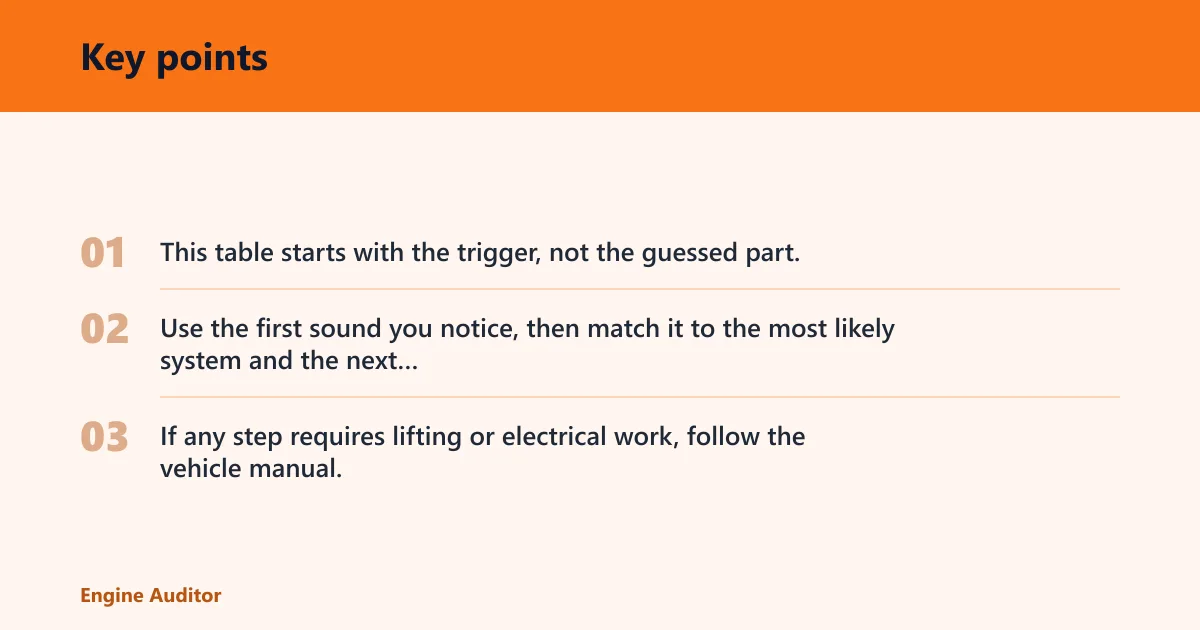
This table starts with the trigger, not the guessed part. Use the first sound you notice, then match it to the most likely system and the next safe step. If any step requires lifting or electrical work, follow the vehicle manual, never work under a vehicle held only by a jack, and check local laws.
| Exact trigger | Most likely system | Key confirming clue | Safe next step |
|---|---|---|---|
| Tight left turn | Outer CV joint or axle | Rhythmic click-click-click that speeds up with vehicle speed | Inspect the CV boot and axle area soon |
| Tight right turn | Outer CV joint or steering joint | Noise grows at low-speed parking lot turns | Check boots, joints, and nearby hardware soon |
| Backing up | CV axle, brake hardware, or steering joint | Noise appears only when the wheel is loaded in reverse | Have the front end inspected before the noise spreads |
| Full steering lock | CV joint or power steering system | Clicking or a groan appears only at maximum wheel angle | Reduce lock-to-lock parking maneuvers and inspect soon |
| Turning the key | Starter, battery, or relay | Single click or rapid click without steering input | Follow the manual for battery and starter checks |
| Engine cranks but no start | Fuel, ignition, or sensor issue | The starter spins the engine, but it does not fire | Do not assume a turning-related fault; diagnose no-start separately |
| AC on | Power steering load or idle control issue | Noise changes when accessory load is added | Inspect belts, fluid level on hydraulic systems, or electric assist faults soon |
| Cold start | Tired CV joint or loose suspension part | Noise shows up on cold mornings, then fades later | Inspect soon before the part fails under warmer load |
| Wet weather | Torn CV boot or loose joint | Grease splatter or water exposure changes the sound | Look for grease on the inner wheel or suspension parts |
| Accelerating through a turn | Outer CV joint | The click is louder on throttle than at coast | Inspect the axle and boot soon |
| Coasting through a turn | Steering or suspension joint | Noise stays even when throttle is lifted | Check tie rods, ball joints, sway bar links, and strut mounts soon |
| While braking and turning | Brake hardware | Pads or clips may be shifting in the bracket | Have the brakes inspected before the next long drive |
How urgent is the repair?
Severity depends on what changes with the noise. A quiet, light click that only appears in tight turns is often a soon inspection item. A click that turns into a clunk, a loud grind, or a loss of steering feel needs faster action. If the sound changes suddenly, treat that as a warning sign.
Safe to drive for now
If the noise is mild, limited to low-speed turns, and does not affect steering feel or braking, you may be able to drive carefully for a short time. Keep speeds down, avoid full lock, and do not load the vehicle harder than needed. That is a short-term choice, not a fix.
Inspect soon
Inspect soon if the click is rhythmic, gets louder in turns, or appears with acceleration, reverse, or braking. A torn CV boot, grease loss, or a loose steering joint can worsen without warning. A common mistake is assuming a brief clicking noise during turns will disappear on its own instead of checking for a worn CV joint or loose suspension part.
Stop driving now
Stop driving now if the click becomes a clunk, steering feel changes, the wheel shakes hard, or the car pulls sharply while turning. A failed axle joint or loose suspension part can create a control problem. If the vehicle will not start and only gives rapid clicking, handle that as a no-start diagnosis instead of a turn issue.
What changes make the noise higher risk
More load usually means more risk. A click that appears only when accelerating through a turn, at full lock, or after wet weather can indicate a part that is moving from noise into failure. A torn CV boot with grease splatter on the wheel or suspension deserves attention even if the click is still intermittent.
Frequently asked questions
Why is my car clicking when I turn the steering wheel?
That usually points to a CV axle, steering joint, suspension joint, or brake hardware if the noise appears only with steering input. A rhythmic click-click-click that speeds up with vehicle speed fits an outer CV joint well. A single pop points more toward a loose joint or mount.
Why is my car clicking when I turn right?
Right turns can load a worn axle, steering joint, or brake part enough to make it click, but direction alone does not identify the failed side with certainty. Use the sound pattern, the steering angle, and the acceleration cue. A parking lot test is more useful than guessing the side from turn direction alone.
Why is my car clicking when I turn left?
A left-turn click can still come from the axle, steering joints, suspension joints, or brakes. The side diagnosis is not automatic because load can shift across the front end in ways that are not obvious from the seat. Look for grease splatter, boot damage, or a click that speeds up with road speed.
Why is my car clicking when I turn the wheel?
If the click happens while turning the wheel but the car is barely moving, steering and suspension parts move higher on the list. Ball joints, tie rod ends, sway bar links, and strut mounts can click or pop under steering load. If the noise only appears when rolling, a CV axle or brake hardware becomes more likely.
Why is my car making clicking noises when I turn it on?
A click at startup usually points to battery, starter, or relay trouble, not a steering issue. Rapid clicking is especially common when voltage is low and the starter cannot stay engaged. That sound is different from the rhythmic metallic click of a turning axle joint.
Why is my car popping when I turn it on?
A pop at start-up can be a starter engagement issue, a relay event, or another component shifting under load. If it happens only when the key or start button is used, the steering system is usually not the first suspect. If the same sound also appears while turning, treat the two symptoms separately.
Products related to this article
Sponsored / affiliate links. As an Amazon Associate I earn from qualifying purchases. I may earn additional commission from eligible campaigns.