Ford Fusion Hybrid vs Toyota Camry Hybrid: Which Is Better?
For used-hybrid shoppers, the Ford Fusion hybrid is the cheaper cabin-first buy, while the Toyota Camry hybrid is the better long-term choice if you want lower ownership risk and stronger resale. Buy the wrong one, and the savings can disappear in depreciation, repairs, or cramped seating. This guide compares price, reliability, fuel economy, cabin space, and trim-level differences so you can pick the right used hybrid.
| Decision factor | Ford Fusion hybrid | Toyota Camry hybrid | Winner |
|---|---|---|---|
| Purchase price, 2020 used | $12,326 to $22,980 | $16,900 to $28,990 | Ford Fusion hybrid |
| Fuel economy | 42 MPG combined | 52 MPG combined | Toyota Camry hybrid |
| Depreciation and retained value | 54 percent five-year depreciation; 7.5/10 retained value | 39 percent five-year depreciation; 8.5/10 retained value | Toyota Camry hybrid |
| Reliability and quality | 7.6/10 overall quality; 7.2/10 reliability | 8.2/10 overall quality; 8.1/10 reliability | Toyota Camry hybrid |
| Cabin space | More interior volume | Less interior volume | Ford Fusion hybrid |
| Best overall fit | Best for lower entry price and roomier feel | Best for lower-risk ownership and efficiency | Toyota Camry hybrid |
Ford Fusion hybrid vs Toyota Camry hybrid: quick take
For the 2020 figures used here, the Ford Fusion hybrid is the lower-entry-value pick, while the Toyota Camry hybrid is the safer all-around used buy. The Ford costs less, gives you more cabin volume, and still returns solid efficiency. The Camry answers with better MPG, stronger retained value, and better reliability scores.
That split matters. If you buy on monthly budget and want a bigger-feeling cabin, the Fusion makes sense. If you buy on total ownership cost and want the easier long-haul bet, the Camry is the cleaner choice.
Who each car fits best
The Ford Fusion hybrid fits a tight-budget shopper who wants the lower ask and a more spacious cabin. The Toyota Camry hybrid fits a commuter or owner planning to keep the car longer, because the fuel savings, reliability score, and resale numbers all favor it.
Used price and new MSRP
For 2020 examples, the Ford Fusion hybrid is cheaper on the used market, with a range of $12,326 to $22,980. The Toyota Camry hybrid sits higher, at $16,900 to $28,990. New, their starting MSRPs were close: about $28,000 for the Fusion and about $28,400 for the Camry.
What the price gap means
The Fusion’s lower used range gives you more room to buy a cleaner example for less cash. That matters if you need to protect room in the budget for tires, brakes, registration, or a prepurchase inspection.
The Camry’s higher entry price makes sense only if you plan to keep the car long enough for the resale and fuel savings to matter. Otherwise, the purchase gap can feel steep on day one.
How do Ford Fusion hybrid and Toyota Camry hybrid compare on gas mileage?
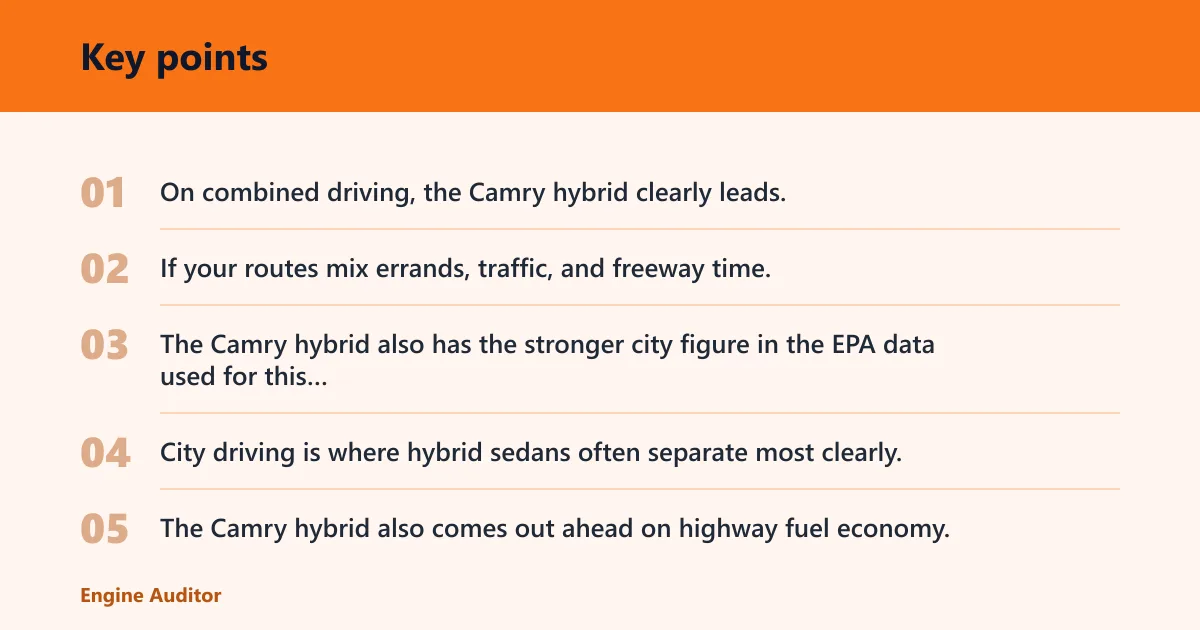
The Toyota Camry hybrid is the efficiency winner, with 52 MPG combined versus 42 MPG combined for the Ford Fusion hybrid. That is a large gap for a used sedan comparison, and it matters most to drivers who pile on miles every week. The Camry also leads in city and highway fuel economy in the EPA figures tied to this comparison.
Combined MPG
On combined driving, the Camry hybrid clearly leads. If your routes mix errands, traffic, and freeway time, the extra miles per gallon can turn into real fuel savings over a year of ownership.
City MPG
The Camry hybrid also has the stronger city figure in the EPA data used for this comparison. City driving is where hybrid sedans often separate most clearly, so this is the more important number for commuters who spend time in stop-and-go traffic.
Highway MPG
The Camry hybrid also comes out ahead on highway fuel economy. If your commute includes longer freeway runs, that advantage still matters, even if the gap narrows compared with city use.
Cruising range
On cruising range, the Camry hybrid has the edge because its higher fuel economy lets it travel farther on the same amount of fuel. That does not make the Fusion inefficient, but it does make the Camry the better fit for drivers who want fewer fuel stops.
Say your commute is 40 miles a day with one highway stretch and one slow suburban segment. The Camry’s extra efficiency helps most if you repeat that pattern five days a week, because the gap compounds every month rather than showing up as a one-time savings.
Which hybrid is more reliable?
The Toyota Camry hybrid is the stronger reliability bet, based on the supplied scores: 8.1/10 for reliability and 8.2/10 for overall quality, versus 7.2/10 and 7.6/10 for the Ford Fusion hybrid. The difference is not a guarantee of trouble or trouble-free ownership, but it tilts the risk picture toward Toyota.
iSeeCars retained value and depreciation
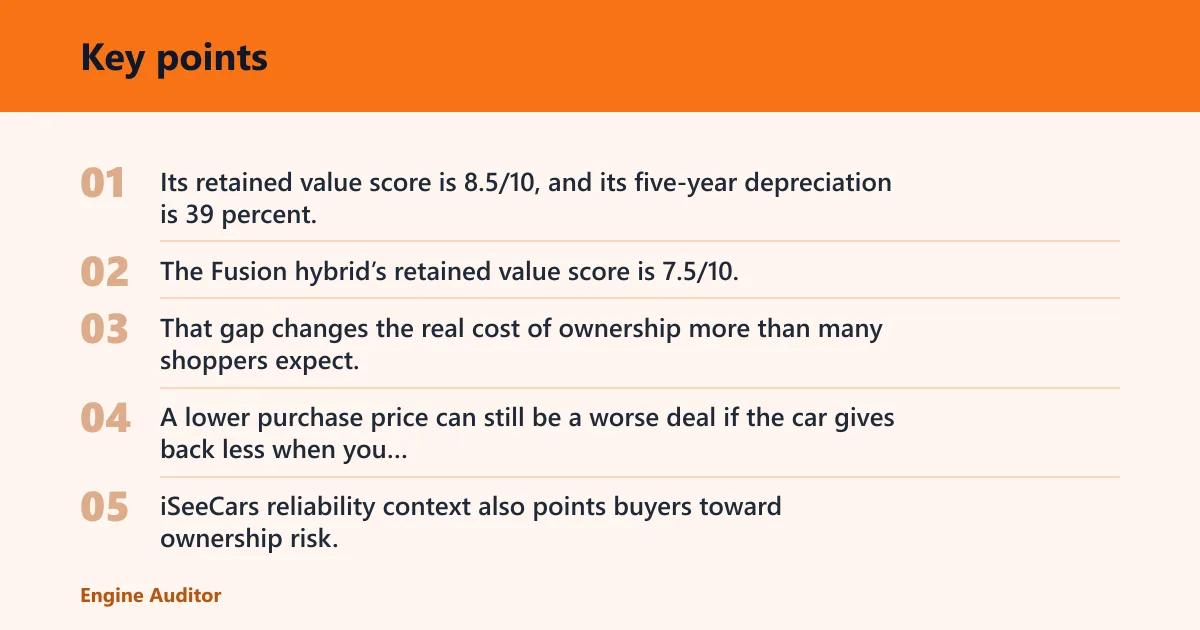
The Camry hybrid also holds value better. Its retained value score is 8.5/10, and its five-year depreciation is 39 percent. The Fusion hybrid’s retained value score is 7.5/10, and its five-year depreciation is 54 percent.
That gap changes the real cost of ownership more than many shoppers expect. A lower purchase price can still be a worse deal if the car gives back less when you sell or trade it.
Remaining life expectancy and 200k-mile odds
iSeeCars reliability context also points buyers toward ownership risk, not just a simple score. The higher-ranked model is the one more likely to have better remaining life expectancy, a stronger chance of reaching 200,000 miles, and a lower expected recall burden across a long ownership window.
That does not mean the Fusion Hybrid is a bad used car. It means the Camry is the model to favor if you want the safer odds for long-term use and less uncertainty as mileage climbs.
What ownership risk means on a used car
On a used hybrid, reliability is not only about whether the car starts today. It also shapes maintenance planning, battery-check priority, tire and brake wear budgeting, and the odds that the car stays economical after the first ownership year.
A common first-timer mistake is to fixate on the lower sticker price and ignore the next two years of expenses. If one car is cheaper to buy but depreciates faster and ranks lower on reliability, the real savings can disappear quickly.
Interior space and cargo room
The Ford Fusion hybrid has the space advantage. The supplied data says it offers more interior volume, which is a meaningful reason to choose it if rear-seat comfort or a roomier cabin matters more than fuel savings. For families, that extra space can be more useful than a few extra MPG.
Front headroom and front legroom
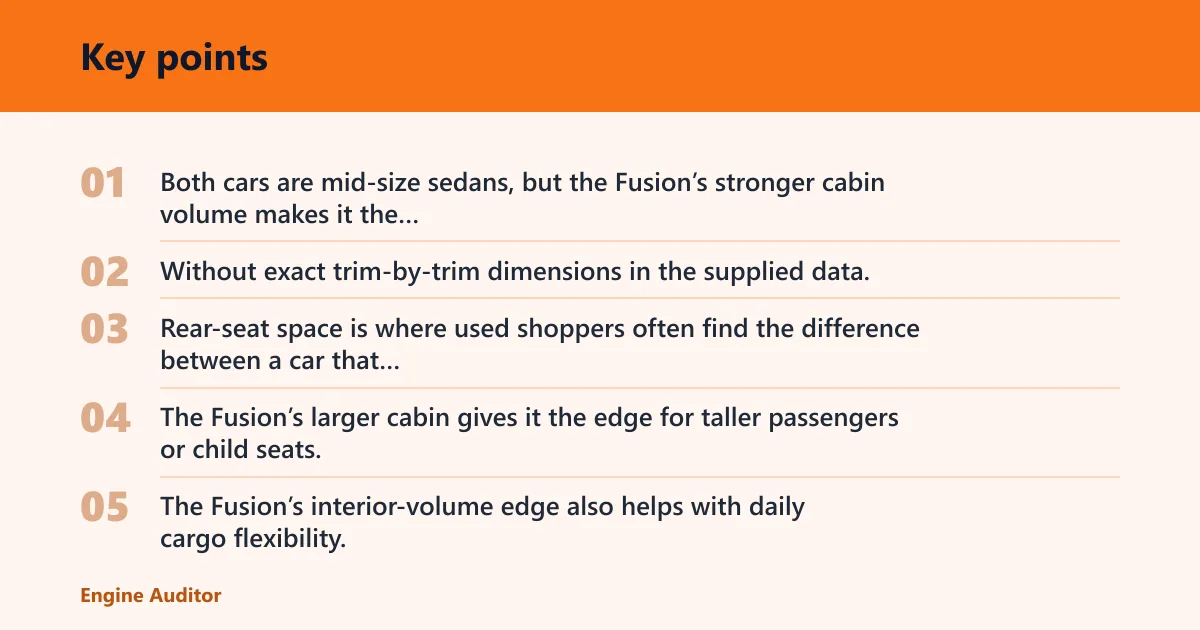
Both cars are mid-size sedans, but the Fusion’s stronger cabin volume makes it the better choice for drivers who want a less cramped front row. Without exact trim-by-trim dimensions in the supplied data, the safest conclusion is that the Fusion is the space-first pick and the Camry is the efficiency-first one.
Rear legroom
Rear-seat space is where used shoppers often find the difference between a car that works and one that only looks right on paper. The Fusion’s larger cabin gives it the edge for taller passengers or child seats, especially if the back row will be used often.
Cargo space advantage
The Fusion’s interior-volume edge also helps with daily cargo flexibility. Grocery runs, diaper bags, and luggage all benefit from a cabin that feels less tight, even if exact cubic-foot measurements are not provided here.
Suppose you regularly carry one adult in back and a folding stroller in the trunk. The Fusion’s extra room can matter more than the Camry’s fuel advantage, because the practicality gain shows up every time you load the car.
Safety ratings and driver aids
Both models carry the same supplied safety rating of 5 out of 5 stars, so the basic crash-rating result is a tie in this comparison. Year-specific safety equipment still matters. Trim-level driver-assistance availability can differ, so the car with the better safety story on paper is not always the one with the more useful used-car feature set.
NHTSA star ratings
For the 2020 figures used here, both the Ford Fusion hybrid and Toyota Camry hybrid are listed at 5 out of 5 stars. That is a strong baseline for either car, but it does not settle the whole safety question by itself.
Trim-dependent driver-assistance features
Used examples can vary a lot by trim and options. Adaptive cruise control, lane support, blind-spot monitoring, and automatic emergency braking may or may not be present on a given car, so you need to verify the exact vehicle rather than assume every hybrid trim is equipped the same way.
Hybrid decision matrix
| Buyer profile | Ford Fusion hybrid | Toyota Camry hybrid | Winner | One-line recommendation |
|---|---|---|---|---|
| Tight budget | Lower used price range | Higher used price range | Ford Fusion hybrid | Choose the Fusion if upfront price matters most and you need to keep more cash available after purchase. |
| High-mileage commuter | 42 MPG combined | 52 MPG combined | Toyota Camry hybrid | Choose the Camry if you drive a lot, because the fuel savings and retained value stack up faster. |
| Reliability-first buyer | 7.2/10 reliability, 54 percent depreciation | 8.1/10 reliability, 39 percent depreciation | Toyota Camry hybrid | Choose the Camry if you want the lower-risk ownership bet and a better chance of holding value. |
| Space-first buyer | More interior volume | Less interior volume | Ford Fusion hybrid | Choose the Fusion if rear-seat room and cabin feel matter more than fuel economy. |
Choose Ford Fusion hybrid if… / Choose Toyota Camry hybrid if…
Choose Ford Fusion hybrid if you want the lower used price, need more cabin space, plan to keep annual mileage moderate, and are willing to accept a weaker resale and reliability profile. It is the better value buy when the purchase budget is tight and the cabin matters more than long-run ownership math.
Choose Toyota Camry hybrid if you want the stronger all-around used-car bet, drive many miles each year, care about fuel economy, and want the model with the better reliability and resale profile. It is the safer choice for buyers who want fewer ownership surprises later.
Bottom line: the Toyota Camry hybrid is the better overall used buy for most shoppers. The Ford Fusion hybrid is the smarter pick only when a lower asking price and larger cabin matter more than fuel savings and long-term ownership risk.
Frequently asked questions
Which is better: Ford Fusion hybrid or Toyota Camry hybrid?
The Toyota Camry hybrid is better for most used buyers because it has stronger fuel economy, better reliability scores, and better retained value. The Ford Fusion hybrid makes more sense only if you prioritize a lower entry price and a roomier cabin over long-term ownership confidence.
Which hybrid sedan is more reliable, Fusion Hybrid or Camry Hybrid?
The Camry hybrid is the more reliable choice in the supplied ratings, with 8.1/10 reliability and 8.2/10 overall quality versus 7.2/10 and 7.6/10 for the Fusion hybrid. That does not make the Fusion unreliable, but it does make the Camry the safer bet.
Is the Ford Fusion Hybrid cheaper to buy used than a Camry Hybrid?
Yes. The Fusion’s lower entry price is one of its main advantages for budget-focused buyers.
Which has better resale value, Fusion Hybrid or Camry Hybrid?
The Camry hybrid has better resale value. Its five-year depreciation is 39 percent, compared with 54 percent for the Fusion hybrid, and its retained value score is higher at 8.5/10 versus 7.5/10. That makes the Camry the better long-term ownership play.
How much interior space do the Fusion Hybrid and Camry Hybrid have?
The Fusion hybrid has more interior volume, so it is the better space-first option. The supplied data does not give exact cubic-foot figures, but the direction is clear enough for shoppers who need a roomier cabin and more relaxed rear-seat packaging.
Which hybrid is safer: Ford fusion hybrid or toyota camry hybrid?
Both models are listed at 5 out of 5 stars in the supplied safety data, so they are tied on that basic rating. The practical difference comes down to the exact year and trim, because driver-assistance equipment can vary between used examples even when the star rating matches.
What are the horsepower and torque differences between the Fusion Hybrid and Camry Hybrid?
The Fusion hybrid has 188 horsepower, while the Camry hybrid has 208 horsepower. Torque figures were not supplied here, so the clean comparison is that the Camry has the power edge, while the Fusion’s appeal comes more from price and cabin room than straight-line performance.
Products related to this article
Sponsored / affiliate links. As an Amazon Associate I earn from qualifying purchases. I may earn additional commission from eligible campaigns.