
Why Does My Car Heater Smell Sweet?
Sweet heater smell diagnosis guide. This article uses a simple triage approach: confirm whether the odor changes with heat, defrost, or A/C use; then separate coolant leaks, evaporator moisture, and cabin contamination before you replace parts. Important safety note: only open the coolant reservoir when the engine is cold, because pressurized coolant can spray and cause burns.
A sweet smell from the heater usually means coolant is leaking into the heater core or engine bay, but that is not the only possibility. It can also be a cabin odor being carried through the HVAC system, or a damp evaporator case that smells musty or chemical rather than syrupy. Ignore it, and you can end up with low coolant, overheating, fogged windows, and expensive interior or engine damage. This guide shows how to tell coolant, refrigerant, and damp-mildew smells apart by where the odor appears and what other symptoms change with it.
Quick answer: A sweet smell with heat or defrost usually points to coolant and a possible heater-core leak; a musty, damp, or chemical smell with A/C use points more toward the evaporator core, drain tube, or cabin contamination. Refrigerant leaks are not reliably identified by smell alone; the better clues are reduced A/C performance and oily or chemical residue. Check coolant only on a cold engine, then look for fogging, damp carpet, residue, or falling coolant level.
What a sweet heater smell usually means
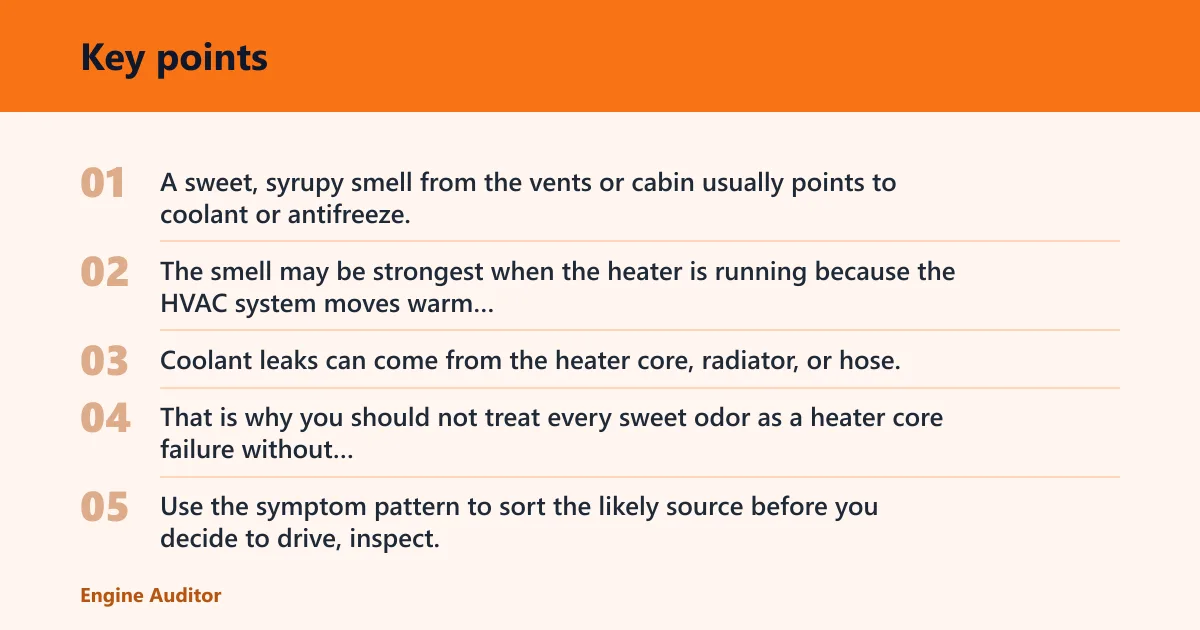

A sweet, syrupy smell from the vents or cabin usually points to coolant or antifreeze, and a leaking heater core is a common cause. The smell may be strongest when the heater is running because the HVAC system moves warm air and odor through the ducts, so the pattern matters as much as the scent itself.
Coolant leaks can come from the heater core, radiator, or hose. That is why you should not treat every sweet odor as a heater core failure without checking where it starts, whether it changes with heat or defrost, and whether you also see coolant loss or engine temperature changes.
Sweet smell triage by symptom
Use the symptom pattern to sort the likely source before you decide to drive, inspect, or book service. The table below separates cabin-side clues from engine-bay clues and shows which patterns call for immediate attention. Identify the system that changes first, then inspect the related component.
| Symptom | Most likely source | Urgency | Next inspection step |
|---|---|---|---|
| Smell only on heat | Heater core or coolant in HVAC ducts | Check soon | Inspect coolant level, then check the passenger carpet for dampness and the vents for residue |
| Smell on defrost | Heater core, duct residue, or evaporator moisture | Check soon | Check for fogging, weak heat, and odor from vents with the blower on |
| Fogging | Heater core leak or excess moisture in the HVAC case | Drive now only if visibility is clear; otherwise stop and inspect | Inspect windshield fogging, passenger carpet, and coolant level |
| Coolant loss | Heater core, radiator, or hose leak | Stop and inspect | Check upper and lower hoses, radiator end tanks, the reservoir, and puddles under the car |
| Wet passenger carpet | Heater core leak | Stop and inspect | Feel the carpet and look under the dash for dampness or residue |
| Weak heat | Low coolant or heater core restriction/leak | Stop and inspect if coolant is dropping | Check coolant level and heater performance together |
| Oily residue at vents | Coolant residue or HVAC contamination | Check soon | Inspect vents and ducts with a flashlight or black light |
| Reduced cooling | Refrigerant leak in the AC system | Check soon | Note whether the sweet or chemical smell comes with weaker A/C output |
The pattern points more toward heater-core coolant in the HVAC case than a random cabin odor, especially if the coolant reservoir drops between checks.
A common first-timer mistake is to assume any sweet odor is harmless because the car still drives. If the smell comes with coolant loss, weak heat, or fogging, the issue can move from annoying to urgent fast.
Could it be a heater core leak?
Yes. A leaking heater core can cause that sweet smell, and it often shows up as a syrupy odor, fogging glass, damp carpet, weak heat, and poor cabin air quality. The heater core can leak coolant into the HVAC ducts, so the smell may be strongest at the vents even when the leak itself sits deeper in the dash.
What the heater core does
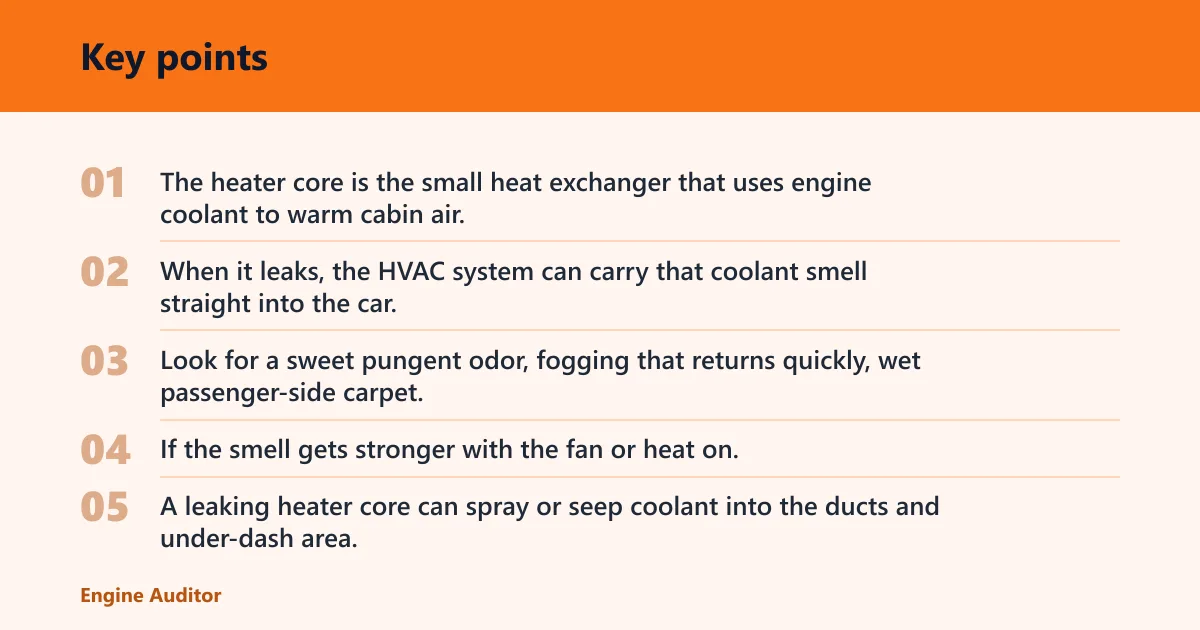
The heater core is the small heat exchanger that uses engine coolant to warm cabin air. When it leaks, the HVAC system can carry that coolant smell straight into the car, and the odor may be obvious before you see any puddle or warning light.
Common heater core leak signs
Look for a sweet pungent odor, fogging that returns quickly, wet passenger-side carpet, and weak heat from the vents. If the smell gets stronger with the fan or heat on, the heater core moves higher on the list, especially when the coolant level is also dropping.
Why a leak can affect cabin air quality
A leaking heater core can spray or seep coolant into the ducts and under-dash area. That can leave residue in the HVAC vents and may affect cabin air quality, so the issue is not only about smell; it can also mean damp contamination inside the HVAC case.
How to check for coolant leaks
Start under the hood. Coolant leaks can come from the heater core, radiator, or hose, and the quickest clues are a falling reservoir level, residue, or puddles under the car. If the smell is stronger outside the cabin than inside, an engine-bay leak becomes more likely. Always inspect the reservoir only when the engine is cold, because opening a hot cooling system can release scalding pressure.
- Check the coolant reservoir level when the engine is cool.
- Inspect upper and lower radiator hoses for wet spots, crusty residue, or splits.
- Look around the radiator end tanks and hose connections for residue.
- Check the ground under the front of the car for puddles after parking.
- Note whether the smell is strongest near the engine bay, the firewall, or inside the cabin.
Look for residue because coolant can leave visible traces on many vehicles. If you find residue plus a dropping coolant level, do not keep treating the smell as a ventilation issue alone. Safety guidance and service literature both treat unexplained coolant loss and overheating as reasons to inspect promptly.
Can vents or the cabin filter cause the smell?
Yes. HVAC vents and ducts can hold odor from leaks or debris, and the cabin air filter can trap dust, leaves, and moisture that carry smells into the cabin. The cabin filter is often the easiest first DIY replacement step, but a dirty filter does not explain coolant loss, fogging, or wet carpet by itself.
How vents and ducts hold odor
Vents and ducts can retain residue from a past leak, a spill, or debris that has gotten damp. A flashlight helps. If the odor is strongest at the vent opening, the HVAC housing deserves a close look.
Why the cabin air filter is a first DIY step
The cabin air filter can trap dust, leaves, and moisture, and that trapped material can transfer odor when air starts moving. If the filter is old or visibly dirty, replacing it is a sensible first step because it is quick, cheap compared with major HVAC work, and easy to verify.
When a dirty filter is not the main cause
If the sweet smell is paired with coolant loss, weak heat, or fogging, the filter is not the root problem. A dirty filter can make the smell linger, but it does not create a leak in the heater core or radiator, and it will not fix the coolant level.
Could the AC system be involved?
Yes. The A/C system can be involved, but the odor description matters. Refrigerant leaks are more often described as chemical, oily, or refrigerant-like than distinctly sweet, while a damp or musty odor usually points to moisture in the evaporator case or drain tube. If the smell comes with weaker cooling instead of weak heat, the A/C side deserves attention.
Evaporator core odor sources
The evaporator core is a cold damp surface where moisture condenses, and that moisture can support mould or bacteria. If the smell is more chemical, damp, or musty than syrupy, and the problem shows up with the A/C rather than the heater, the evaporator area deserves attention.
Clogged evaporator drain tube
The evaporator drain tube should let condensation water escape. If it is clogged, moisture lingers in the case, and that can lead to mould, mildew, and cabin odours that do not behave like a coolant leak. Water on the passenger floor after A/C use is a clue worth checking.
When reduced cooling points to refrigerant loss
If the smell comes with weaker cooling, refrigerant loss becomes more likely than coolant. That said, the odor itself is not enough to call it a refrigerant leak: the stronger clue is loss of A/C performance, possibly with oily residue at hose fittings or on the condenser, while a coolant leak more often ties to heat-side symptoms, fogging, or a dropping coolant reservoir.
Heater core vs. AC system
Use this comparison to separate the two most common HVAC-side causes:
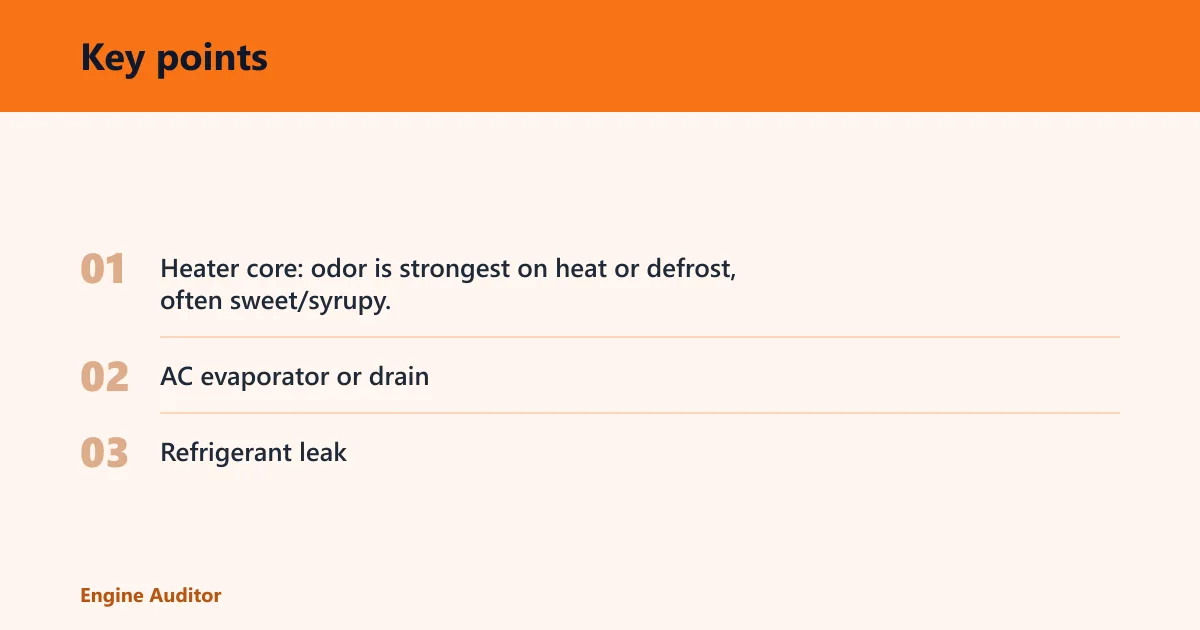
- Heater core: odor is strongest on heat or defrost, often sweet/syrupy, and may come with weak heat, fogging, or damp passenger carpet.
- AC evaporator or drain: odor is more often musty, damp, or chemical, usually shows up with A/C use, and may come with moisture issues or weak cooling.
- Refrigerant leak: usually follows reduced A/C performance and may have an oily or chemical smell rather than a clearly sweet one.
When the smell means you should stop driving
Stop and inspect if the smell comes with noticeable coolant loss, overheating, heavy fogging, or a wet passenger footwell. Those signs point to a leak that can affect both cabin air quality and engine protection, and continued driving can turn a small leak into a much larger repair.
Drive now, check soon, or tow
If the smell is faint, there is no coolant loss, and heat and cooling still work normally, you can usually schedule a check soon. If the smell is strong, the windshield fogs, or the coolant level is dropping, stop and inspect. If the temperature gauge climbs or the engine starts overheating, do not keep driving.
If a compact SUV starts smelling sweet only after ten minutes of heat, and the passenger carpet is damp, that combination points much more toward a heater core leak than a vent filter problem, and it deserves a stop-now inspection instead of a later appointment.
Frequently asked questions
Why does my car heater smell sweet?
A sweet smell from your car heater usually points to coolant leaking into the heater core, radiator, or a hose. If the odor gets stronger with the heat on or defrost selected, treat it as a coolant-loss warning, not just a cabin odor.
Is a sweet smell from the vents coolant?
Often, yes. A sweet smell from the vents can be coolant carried through the HVAC ducts, especially if the heater core is leaking. If the smell comes with fogging, weak heat, or damp carpet, coolant becomes the most likely source.
Can a heater core leak smell sweet?
Yes. A leaking heater core can cause a sweet, syrupy smell inside the car, and it may also leave the windshield fogged or the passenger carpet damp. Because the heater core sits in the HVAC system, the odor can enter the cabin quickly.
Is it safe to drive if my car smells sweet?
Only if the smell is mild, coolant level is stable, and there are no other symptoms. If you also see coolant loss, overheating, wet carpet, or heavy fogging, stop and inspect. A coolant leak can become an engine problem, not just an odor problem.
How can I tell if the smell is from the heater core or AC system?
Use timing and symptoms. A heater-core problem usually smells strongest on heat or defrost and often pairs with weak heat or coolant loss. An A/C or evaporator problem is more likely when the smell comes with weaker cooling, dampness, or a musty chemical odor.
Why do I smell syrup when the heat is on?
That syrup-like odor usually points to coolant being carried through the heater core or HVAC ducts. If the smell appears only with heat, check the coolant level, inspect the vent openings for residue, and look at the passenger carpet for dampness before driving farther.
Products related to this article
Sponsored / affiliate links. As an Amazon Associate I earn from qualifying purchases. I may earn additional commission from eligible campaigns.
 Portable Car Heater Car Heater, Portable Electronic Auto Heater Fan Fast Heating Defrost 12V 120W Car Defrost Defogger, 2 in 1 Heating/Cooling Function 3-Outlet, Plug Adjustable
 Car Heater Assembly, 12V 4 Ports Universal Car Compact Hydronic Heater with Speed Switch Cab Auxiliary Heater Assembly for Trucks Excavators Harvesters