What Does a Heat Shield Rattle Sound Like?
A heat shield rattle commonly sounds like a thin metallic buzz, buzz-rattle, or tinny flutter under the floor or near the exhaust, often at idle, light throttle, around 1,500-3,000 rpm, or over bumps. If you misread it, you can replace the wrong part while the loose shield keeps vibrating and adding heat risk. This guide helps you identify the sound, trace its source, and separate it from converter, hanger, and engine-mount noises.
What a heat shield does

A heat shield is a thin protective barrier mounted near the exhaust system. Its job is to block radiant heat from reaching the floor, body panels, wiring, hoses, and nearby components. OEM service information typically treats shields as simple retainers and fasteners: if a shield is loose, bent, cracked, or missing its hardware, it can vibrate against the exhaust or body and start to rattle. EPA emissions resources also note that damaged exhaust components can affect emissions-related diagnosis, so a “small rattle” should not be ignored if it points to the converter area.
Most heat shields are thin sheet metal, which makes them light and effective but also easy to flex, buzz, and crack after repeated thermal cycling. Rather than rely on a single universal thickness or lifespan, check the vehicle-specific service data: some OEMs use small screws, spring clips, spot-welds, or band-style retainers depending on the shield location and platform.
Why loose fasteners and rust cause noise
Loose fasteners let the shield move a small amount, and that movement is enough to make a sharp tinny sound. Corrosion can enlarge mounting holes, weaken brackets, or break tabs, so the shield no longer sits firmly against its mounts. Missing clips, washers, or screws can do the same thing.
If the shield is badly rusted, re-tightening may not last. The metal can crumble around the mounting point, which turns a simple reattachment into a replacement job. In many OEM repair procedures, once the edge metal tears or the retaining point no longer clamps flat, the recommended fix is replacement rather than repeated tightening.
What does a heat shield rattle sound like?
A heat shield rattle usually sounds light and hollow, more like a can full of pebbles than a deep knock. Drivers often describe a buzzing tin, fluttering sheet metal, or a short burst of chatter that appears and disappears with engine speed or vibration.
Sound patterns that point to a shield
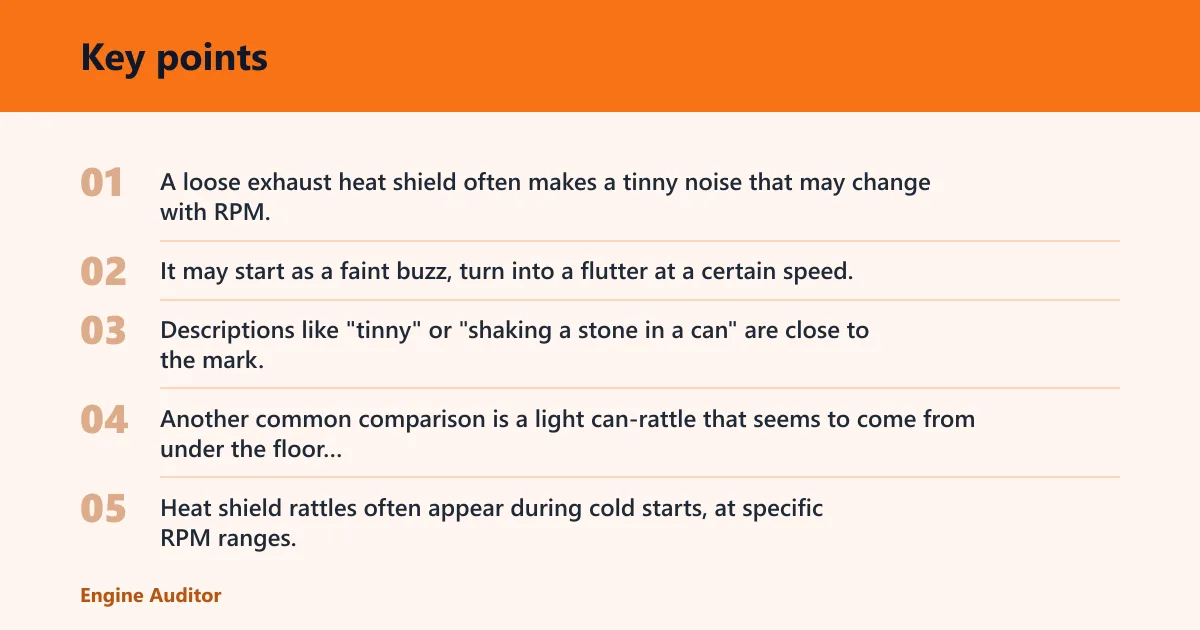
The best clue is the pattern. A loose exhaust heat shield often makes a tinny noise that may change with RPM, road vibration, or the engine’s heat level. It may start as a faint buzz, turn into a flutter at a certain speed, then fade again a few hundred RPM later.
Descriptions like “tinny” or “shaking a stone in a can” are close to the mark. Another common comparison is a light can-rattle that seems to come from under the floor rather than deep inside the engine.
Heat shield rattles often appear during cold starts, at specific RPM ranges, or during acceleration and deceleration. A heat shield rattle may be most noticeable between 1,500–2,500 RPM, especially if the shield only touches the exhaust when the engine moves slightly under load.
When the sound tends to show up
Cold start noise usually suggests a loose shield that vibrates before the exhaust parts expand with heat. After the exhaust warms up, the same shield may quiet down or change pitch. A bump, driveway apron, or rough pavement can also wake up a loose shield because the body and exhaust shift relative to each other. If you want a quick road-surface comparison, see why car rattles over bumps and rough pavement.
Idle and low-speed driving are common trigger points. Light throttle in city traffic often makes the rattle easier to hear because the engine sits in a narrow speed band and the vehicle is not masking the noise with tire or wind sound.
Where the rattle usually comes
Heat shield noise usually seems to come from the exhaust system area, but location matters. The front manifold zone, center tunnel, catalytic converter area, and rear muffler area each create a different sound path. A shield under the engine can fool you, especially if the noise shows up in gear at idle.
Front manifold area
A rattle near the front of the exhaust often comes from the shield around the manifold or front pipe. This area sits close to the engine and sees strong heat, so fasteners and tabs can fail early. The sound may follow engine speed closely and be most obvious at idle or light revs.
Center tunnel and catalytic converter zone
The center tunnel often carries long, thin shields that buzz against the floor pan. The catalytic converter area is another common source. EPA emissions guidance treats the converter as a regulated emissions device, and OEM service information often instructs technicians to inspect the converter shell, the heat shield, and all retaining hardware separately because a shield rattle can mimic converter failure. Depending on load and design, converter exterior temperatures can be high enough to stress nearby shields, while the exhaust stream inside the unit reaches far higher operating temperatures than the outer shell.
That distinction matters because a shield problem is usually external and vibration-based, while converter damage may produce a deeper internal rattle and may also trigger emissions faults or drivability complaints.
Rear exhaust and muffler area
Rear shields can rattle near the muffler, tail pipe, or rear floor. This noise may be easier to hear over rough pavement than at standstill. If the sound seems to come from the back half of the vehicle, check the rear mounts and any shield sections close to the muffler shell.
Heat shield symptom matrix
This matrix helps you match the sound, the conditions, and the location before you guess at the repair. Use it as a first-pass filter, not a final diagnosis.
| Sound character | When it happens | Where it seems to come from | Most likely cause |
|---|---|---|---|
| Light can-rattle, tinny buzz | Idle, cold start, low speed | Front manifold or front pipe | Loose shield fastener or bracket |
| Pebble-in-tin chatter | 1,500–2,500 RPM, light acceleration | Center tunnel or converter zone | Loose exhaust heat shield or worn clamp |
| Fluttering sheet-metal buzz | Over bumps, rough pavement | Floor pan or underbody shield | Loose under-engine shield or missing hardware |
| Sharp metallic rattle that fades hot | Cold start, then quieter as heat builds | Near converter or front exhaust | Shield expansion, rust, or shifting fastener |
| Rattle only in gear at idle | Stopped, transmission in gear | Under-engine area or mounts | Engine movement, mount wear, or lower shield contact |
How to tell it from other noises
Heat shield noise is often mistaken for other undercar sounds because several parts share the same metal structure. The key difference is where the sound seems to live and what makes it start. If it only appears under load, or only in gear at idle, the shield may not be the only suspect.
| Part | Sound | Typical trigger | Typical location | Urgency |
|---|---|---|---|---|
| Heat shield | Thin buzz, flutter, tinny rattle | Idle, bumps, narrow RPM band, heat cycles | Around exhaust, floor pan, tunnel, converter shell | Soon; urgent if loose enough to contact moving parts |
| Catalytic converter | Deeper rattle, rocks-in-can sound | Load changes, acceleration, deceleration | Underbody exhaust midsection | High; emissions-related and can worsen quickly |
| Exhaust hanger | Dull knock, tap, thud | Bumps, engine rock, startup movement | Rear or mid exhaust mounting points | Moderate to high if pipe is unsupported |
| Engine mount | Thump, clunk, shake-induced knock | In gear at idle, shift, throttle tip-in | Engine bay, subframe, drivetrain contact points | High if movement is excessive or contact occurs |
Catalytic converter rattle
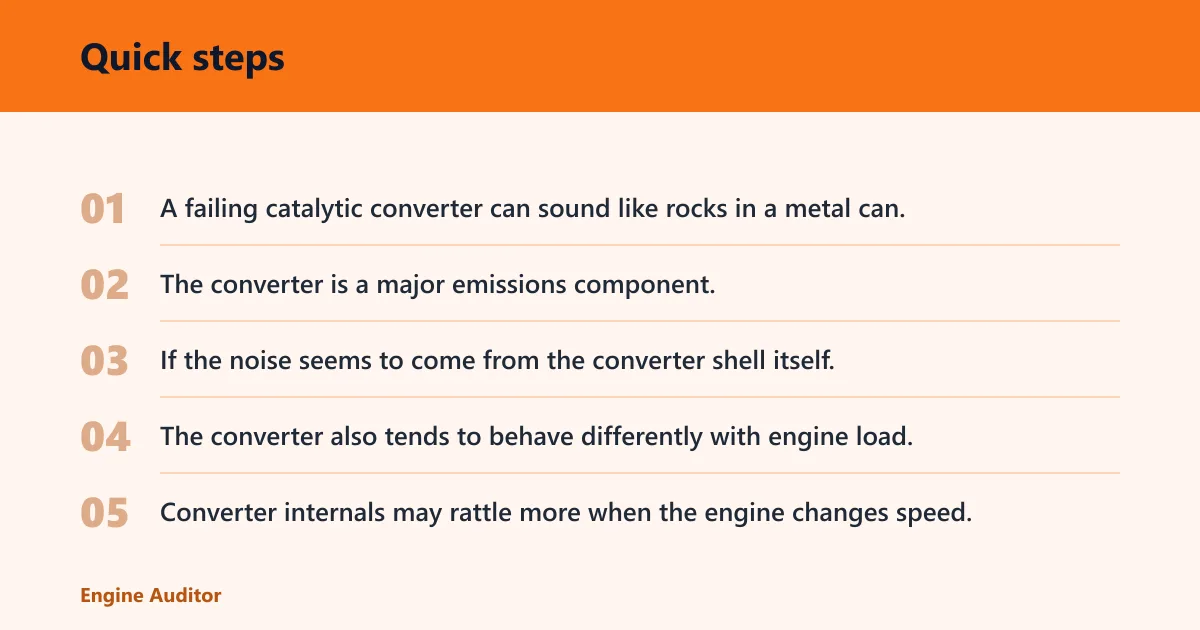
A failing catalytic converter can sound like rocks in a metal can, and that is an important distinction. The converter is a major emissions component, so its internal failure can create a deeper, more solid rattle than a loose shield. If the noise seems to come from the converter shell itself, not the thin shield around it, the diagnosis changes.
The converter also tends to behave differently with engine load. A shield often buzzes from vibration. Converter internals may rattle more when the engine changes speed, especially under acceleration or deceleration. EPA guidance and manufacturer service information both treat converter complaints as emissions-relevant, so a converter-like rattle deserves prompt inspection.
Exhaust hanger and clamp noise
A loose hanger or clamp can create a duller knock or tap than a shield. Hanger noise often shows up when the exhaust moves on its mounts, such as over bumps or during a cold start as parts shift. A shield usually sounds thinner and more like vibrating sheet metal.
Suppose the rattle happens only when you pull away from a stop and then goes quiet at steady speed. That pattern points more toward an exhaust mount, clamp, or pipe contact than a loose heat shield.
Under-engine shield and mount noise
An under-engine shield can rattle in gear at idle, which is why it gets mistaken for an exhaust shield. Engine-mount movement can push a pipe or shield into contact with the body only when the engine is loaded in Drive or Reverse. That makes the noise seem tied to the transmission rather than road speed.
Say your sedan rattles while stopped in Drive, then quiets in Park. That pattern is less typical of a free-hanging heat shield and more consistent with engine movement or an under-engine panel touching something nearby.
Can you keep driving with it?
You can usually monitor a minor heat shield rattle for a short time if the sound is light, the shield is still attached, and there are no signs of heat damage or contact with moving parts. Do not ignore a shield that is hanging low, rubbing the tire, or touching the driveshaft or exhaust.
Monitor soon versus stop driving now
Book a repair soon if the shield only buzzes at a narrow RPM range and remains firmly in place. Stop driving and inspect immediately if the shield is dragging, the noise has turned into scraping, or you can see the shield contacting the tire, axle, or other moving hardware. A loose shield can also break off and strike nearby parts.
- Wait a minimum of 45–60 minutes after the last drive before touching the exhaust area.
- Look for missing bolts, broken tabs, cracked welds, and rusted mounting points.
- Check whether the shield moves by hand or touches the pipe, floor, or brackets.
- Listen again during idle, a light rev, and a short drive over rough pavement.
- If the shield is badly corroded, plan on replacement instead of reattachment.
Heat and rust matter here. A shield that is thin with corrosion may no longer hold a fastener securely, and a repair that seems to work at first may fail again after a few heat cycles. After cooling, a loose shield often feels like a thin, springy flap or a small metal plate that can be nudged and heard tapping back against its mount instead of sitting tight and solid.
Heat shield repair cost bands
Costs vary by vehicle layout, rust level, and whether the shield can still hold hardware. These are realistic U.S. repair bands, not quotes. Parts and labor move with rust severity, access, whether the shield is one-piece or integrated with a converter pipe, and whether the shop can reuse hardware or must fabricate a fix.
| Repair type | Typical situation | DIY tightening | Shop cost band |
|---|---|---|---|
| Tightening or reattachment | Shield is intact, fastener is loose or missing | $0–$20 in basic hardware | $60–$150 |
| Clamp repair | Shield needs a new clamp, rivet, or retaining hardware | $10–$40 in clamps, washers, rivets, or screws | $100–$250 |
| Weld repair | Tabs or brackets need to be re-secured by welding | Usually not a DIY job | $150–$350 |
| Full shield replacement | Rust or heat damage has made the shield non-repairable | $40–$200+ for the part, depending on vehicle | $200–$600+ |
Costs climb when rust has spread into mounting points, when the shield sits above the subframe or exhaust crossover, or when OEM hardware is discontinued. They drop when access is easy, the shield is still straight, and the fix only needs a fastener or clamp. If the shield has already warped or torn, replacement is usually the cleaner long-term repair.
Frequently asked questions
What does a loose heat shield rattle sound like?
A loose heat shield often makes a pebble-in-tin sound, especially at idle, light throttle, or a narrow RPM band. If the shield flexes only when the vehicle vibrates, the noise may be brief and sharp. It can get louder over rough pavement or when the engine shifts on its mounts.
What does exhaust heat shield rattle sound like?
An exhaust heat shield rattle usually sounds tinny and hollow, with a buzz-rattle quality that seems to come from under the floor or along the exhaust tunnel. It often appears during cold starts, low-speed driving, or acceleration and deceleration, then changes as the exhaust warms up.
What causes a heat shield rattle sound like?
Loose fasteners, corrosion, missing hardware, and cracked brackets are the usual causes. The shield may vibrate against the exhaust system or body when the engine idles, revs, or moves under load. Heat cycling and rust are the main reasons the noise gets worse over time.
How do I tell if the rattle is the heat shield or the catalytic converter?
A heat shield usually sounds thinner and comes from the outside of the converter or pipe, while a bad catalytic converter can sound like rocks in a metal can. If the noise seems deeper, stronger under load, or centered in the converter shell itself, inspect the converter as well.
Can I keep driving with a loose heat shield?
Short-term driving may be reasonable if the shield is secure enough not to drag, strike the tire, or contact moving parts. Book a repair soon if the noise stays light. Stop driving now if the shield is hanging, scraping, or showing signs of imminent breakage.
Products related to this article
Sponsored / affiliate links. As an Amazon Associate I earn from qualifying purchases. I may earn additional commission from eligible campaigns.