What Is the Difference Between Engine Knock and Rod Knock?
Engine knock usually comes from combustion or valvetrain issues, and its pitch often changes with throttle or load. Rod knock is a deep bottom-end knock that stays tied to engine speed, often louder at idle and on light revs. Misread the sound, and you can buy parts you do not need or keep running a failing bearing until the crank is damaged. This guide shows a 60-second listen test, the key sound differences, and what to do next before you make the noise worse.
Telling knock and rod knock apart

Engine knock is a broad symptom, not one fault. It can mean detonation, a lifter tick, piston slap, or a bottom-end bearing problem. Rod knock is the urgent one: a deep knock from the crankshaft area that points to bearing clearance or contact in the lower engine.
The fast rule is simple. If the noise follows engine RPM closely, gets deeper with speed, and comes from low in the block, think rod knock. If it shows up mainly under load, such as hard acceleration or climbing a hill, detonation moves higher on the list. Location matters, but RPM and load matter more.
Rod bearings connect the connecting rods to the crankshaft. When they wear or lose oil film, the journal can contact the bearing surface and create a rhythmic knock. If that continues, the connecting rod can be damaged and the repair can move from bearing work to a rebuild or replacement.
What rod knock sounds like
Rod knock is usually a deep, rhythmic thud from the lower engine. It is not a light tick. It often sounds hollow, and it tends to line up with engine speed rather than With road speed or vehicle load alone. Rod knock as a deep hollow thud that worsens with acceleration.
As RPM rises, the rhythm speeds up with it. That direct tracking is a key clue. A brief cold tick that fades can point somewhere else, but a knock that stays present once the engine is warm is far more worrying, especially if it becomes louder at idle after the engine is hot.
Say your sedan idles quietly for 20 seconds after startup, then a deep tap appears once the coolant gauge starts to move and the oil thins with heat. If the sound follows each rise in RPM and stays loud at warm idle, that pattern fits a bottom-end warning far better than a top-end tick.
Knock triage matrix
| Sound type | RPM behavior | Load sensitivity | Cold/warm behavior | Likely cause | Stop driving now? |
|---|---|---|---|---|---|
| Deep rhythmic thud from low in the engine | Tracks engine RPM closely; speeds up as revs rise | May grow louder under throttle, but RPM is the main clue | Often worse when warm if bearing wear is advanced | Rod bearing wear, crankshaft journal contact, rod knock | Yes |
| Sharp metallic ping or rap | May not follow RPM as tightly as a bearing knock | Usually appears more under load | Can be temporary if fuel-related | Detonation from pre-ignition or wrong octane fuel | Maybe, if it persists; diagnose promptly |
| Lighter, higher-pitched tick from the top of the engine | Can change with RPM, but stays lighter than rod knock | Often less tied to heavy load | Common on cold start before oil pressure builds | Hydraulic lifter tick | Usually no, unless it becomes loud or persistent |
| Light knock or slap near startup | May fade as RPM stabilizes | Often less load-sensitive than detonation | Most noticeable cold; may fade warm | Piston slap | Usually no, but confirm if it worsens |
False positives to rule out:
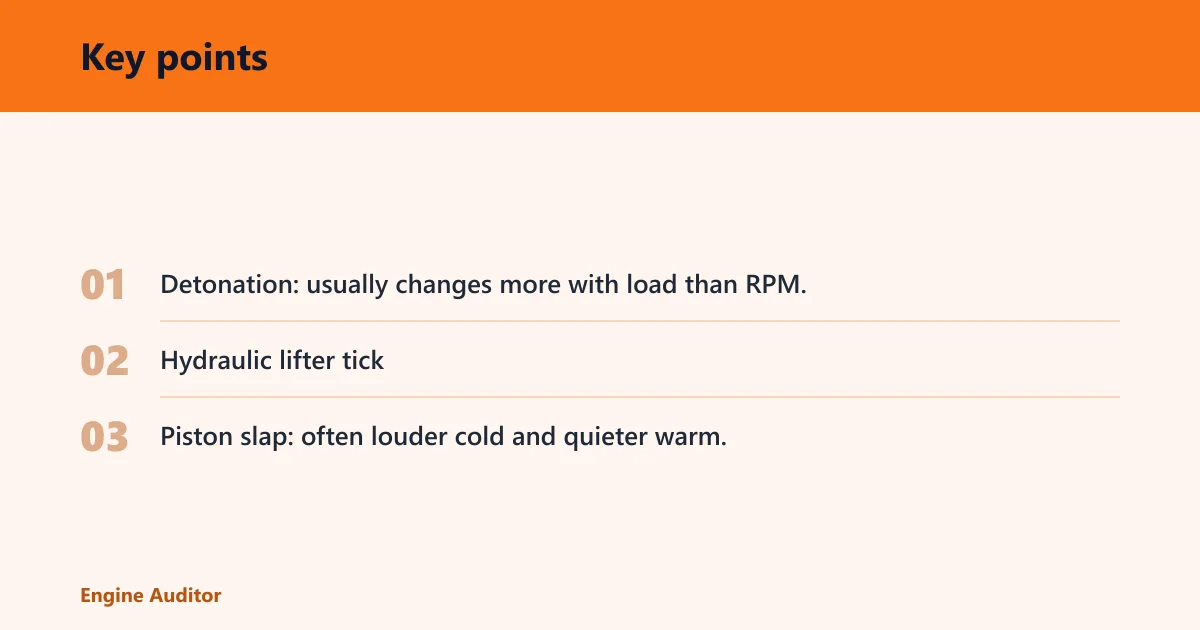
- Detonation: usually changes more with load than RPM. It often shows up during hard acceleration, uphill driving, or high cylinder pressure, and it may ease when throttle is lifted or octane is corrected.
- Hydraulic lifter tick: lighter and higher-pitched than rod knock, often heard on cold start, and it may fade as oil pressure builds. It is a top-end valvetrain noise, not a deep bottom-end thud.
- Piston slap: often louder cold and quieter warm. It can sound hollow, but it usually does not carry the same warm, rhythmic bottom-end urgency as a rod bearing knock.
What causes rod knock?
Rod knock usually starts with bearing wear, lubrication loss, or both. The rod bearings are the plain bearings that separate the connecting rods from the crankshaft journals. If oil level is low, oil pressure is low, or the oil film breaks down, the bearing clearance grows and the journal can begin to strike the bearing surface.
The crankshaft is a bottom-end component, and rod knock happens right at that contact point. As wear continues, the connecting rods can take damage too. Once the bearing material starts breaking down, metal debris can circulate through the engine and make the failure larger than the original knock.
Low oil pressure is especially serious at warm operating temperature. Oil thins as the engine heats up, and a damaged pump, low sump level, clogged pickup, or worn bearings can reduce the film that keeps the crankshaft and rod bearings apart. A persistent knock when warm points to a lubrication problem or bearing damage, not a nuisance noise.
If the oil level is low and the engine starts knocking after some highway driving, that can suggest oil starvation. Topping up oil may reduce the noise if the cause was starvation, but it does not erase bearing damage already done. If the knock remains after oil is corrected, the engine likely has an internal problem that needs a stop-and-inspect response.
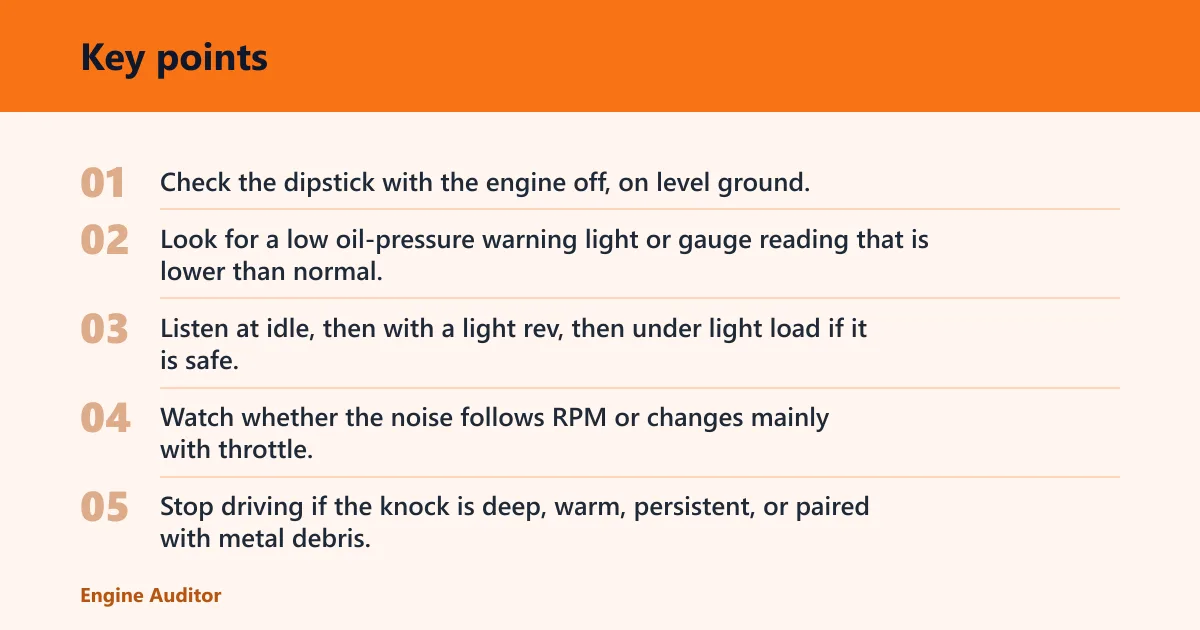
- Check the dipstick with the engine off, on level ground, and after the engine has sat briefly so the oil drains back.
- Look for a low oil-pressure warning light or gauge reading that is lower than normal.
- Listen at idle, then with a light rev, then under light load if it is safe.
- Watch whether the noise follows RPM or changes mainly with throttle.
- Stop driving if the knock is deep, warm, persistent, or paired with metal debris.
Detonation is a combustion problem. Rod knock is a mechanical bottom-end problem. Detonation often changes with engine load more than RPM, especially under hard acceleration or uphill driving. Rod knock usually follows RPM directly, which is why it can sound faster as the engine revs, even at light throttle.
Fuel quality, timing, and engine calibration can all contribute to detonation. Low octane fuel can cause a sharp metallic ping or rap under load. That noise may be temporary if fuel-related, but it should still be treated seriously if it repeats, because repeated detonation can damage pistons and bearings.
By contrast, rod knock usually remains present when load is removed if the bearing damage is already there. A knock that is loudest when blipping the throttle at idle, then stays in step with engine speed, is a much stronger bearing clue than a ping that appears only on a hill in high gear.
Other noises that fool drivers
Hydraulic lifters can tick on cold start before oil pressure builds. That noise is usually lighter, higher-pitched, and more top-end in location than rod knock. If it fades as the engine warms, the odds shift away from a bottom-end failure.
Piston slap can also confuse the picture. It is often most obvious cold and quieter once the engine expands. It may sound hollow, but it does not usually produce the same deep, rhythmic, warm knock tied closely to crankshaft speed that points to rod bearings.
How can you sort them without special tools? Compare cold versus warm, idle versus light revs, and unloaded versus loaded running. A sound that gets worse as the engine warms and speed rises is more alarming than one that fades after startup. Engine load helps separate combustion knock from mechanical knock.
Frequently asked questions
What is rod knock?
Rod knock is a deep knock from the bottom end of the engine, usually caused by worn rod bearings or poor lubrication that lets the connecting rod and crankshaft journal contact each other. It is a serious warning sign because the clearance can grow quickly and damage the crankshaft.
Engine knock vs rod knock: what’s the difference?
Engine knock is a broad term for several noises, including detonation, lifter tick, piston slap, and rod knock. Rod knock is the bottom-end version: it usually follows engine RPM closely and often sounds deeper and more rhythmic than combustion-related knock.
How do I tell detonation from rod knock?
Detonation usually shows up more with engine load than with RPM, such as during hard acceleration or hill climbing. Rod knock tracks engine speed more directly and stays tied to the bottom of the engine. Detonation can be temporary if fuel-related; rod knock usually is not.
When should I stop driving if I hear knocking?
Stop driving now if the knock is deep, persistent, louder when warm, or paired with a low oil-pressure warning or metal in the oil. A short diagnosis move may be reasonable only if the noise is light, brief, and clearly tied to a cold start that fades quickly.
Can engine knock be fixed without rebuilding the engine?
Sometimes, if the noise is detonation, a lifter tick, or a low-oil issue that is caught early. Rod knock is different. If the bearing has already lost enough clearance to knock at warm idle or under light revs, the engine often needs major internal repair rather than a simple top-up or additive.
Products related to this article
Sponsored / affiliate links. As an Amazon Associate I earn from qualifying purchases. I may earn additional commission from eligible campaigns.