How Long Can You Drive with a Clicking CV Joint?
A clicking CV joint can usually handle only short, local driving for a few days to a few weeks, and only if the click is mild and stays unchanged. If it gets louder, adds vibration, or clunks, stop driving. Ignoring it can end with a broken axle, loss of drive, or damage that turns a moderate repair into a roadside tow. This guide shows how far you can risk driving at each stage, and which signs mean monitor, limit use, or park it now.
What a clicking CV joint means
A rhythmic click from one front corner on tight turns is the classic outer CV joint symptom. It usually changes with steering angle, gets louder in one direction than the other, and often goes quiet as the wheel straightens. Tight turns under power bring it out most clearly.
Outer joint versus inner joint
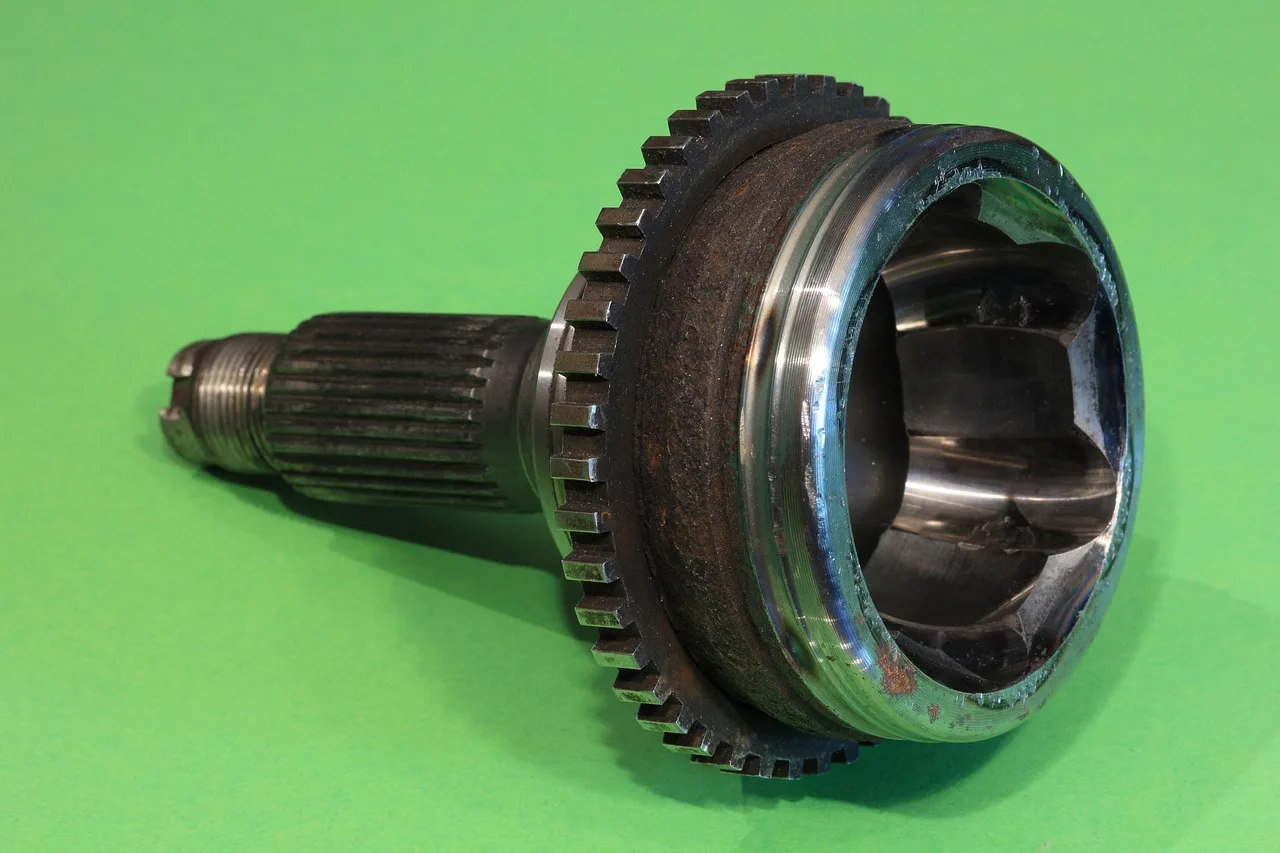
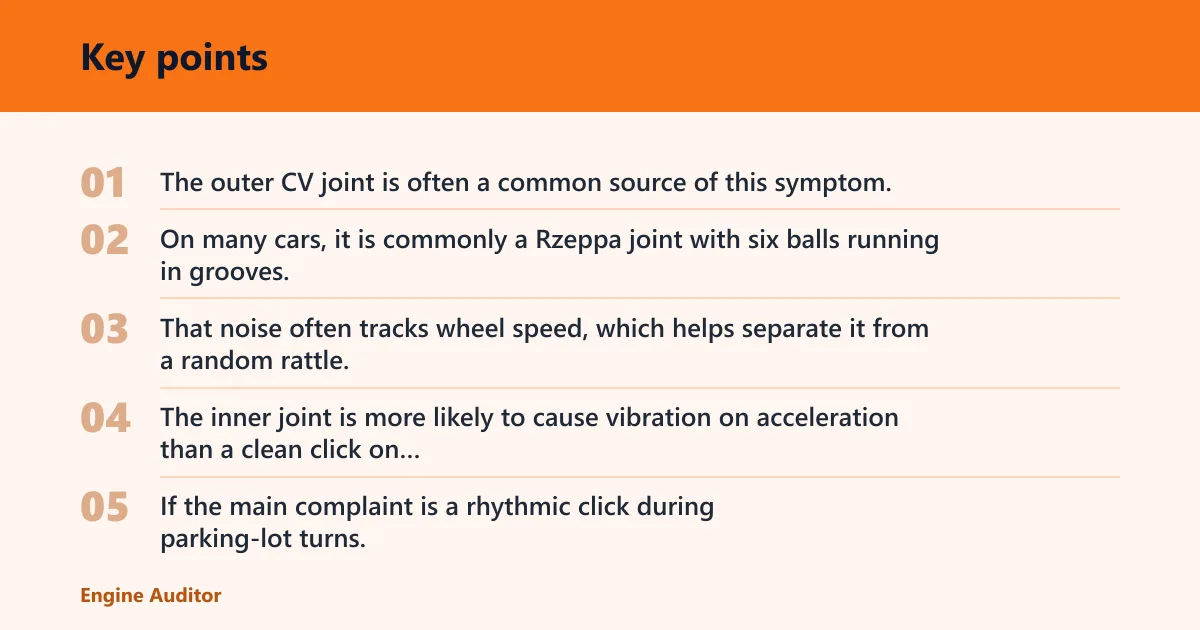
The outer CV joint is often a common source of this symptom. On many cars, it is commonly a Rzeppa joint with six balls running in grooves, and wear can create slack that may let the joint click once per ball per revolution. That noise often tracks wheel speed, which helps separate it from a random rattle.
The inner joint is more likely to cause vibration on acceleration than a clean click on full-lock turns. If the main complaint is a rhythmic click during parking-lot turns, start with the outer joint, not the inner plunge joint.
How to reproduce the click on turns
Use steering full lock in both directions to reproduce an outer-joint click. A tight circle in a parking lot is the usual test. The sound is often louder on one side, and reverse at full lock can make it easier to hear because the joint loads differently.
Full-lock circles in both directions
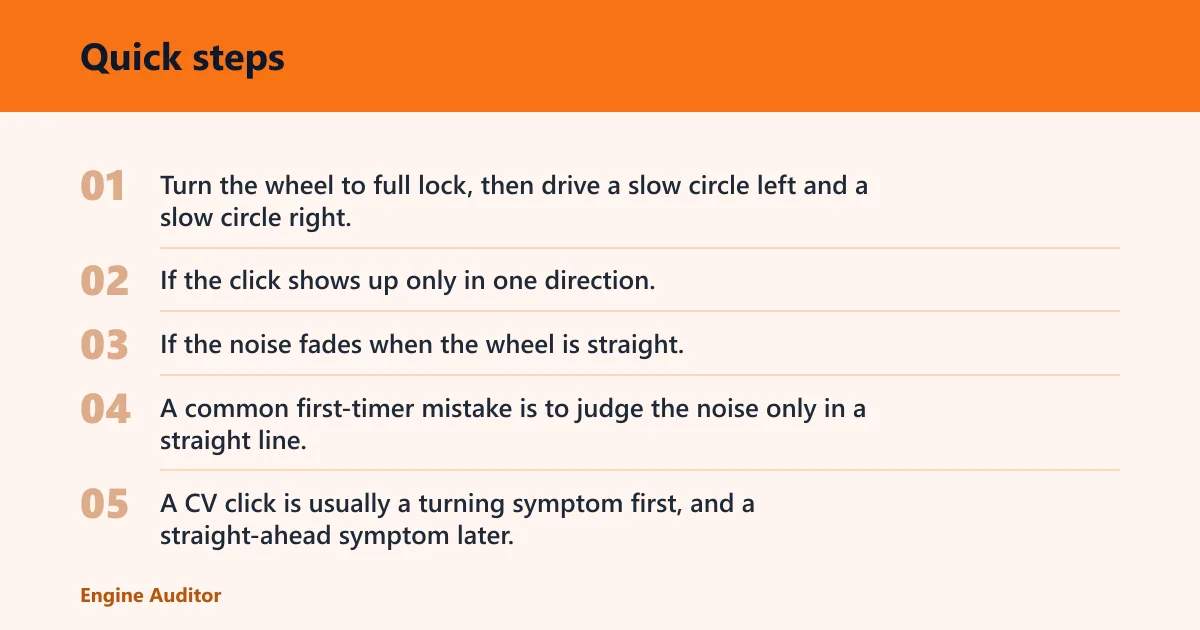
Turn the wheel to full lock, then drive a slow circle left and a slow circle right. If the click shows up only in one direction, that leans toward the outer joint on the loaded side. If the noise fades when the wheel is straight, that also points toward the joint rather than a constant rotating part.
A common first-timer mistake is to judge the noise only in a straight line. That misses the steering-angle clue. A CV click is usually a turning symptom first, and a straight-ahead symptom later, if the wear gets worse.
Why reverse can sound louder
Reverse can load the joint in a way that makes the click easier to hear at full lock. That does not mean reverse caused the problem. It means the worn surfaces inside the outer joint are shifting under load, and the rhythm becomes easier to pick out.
Could something else be clicking?
Yes. Brake hardware, hubcaps, ball joints, strut mounts, and loose lug nuts can all make a front-corner click. The clue that points back to an outer CV joint is a rhythmic click on tight turns that changes with steering angle, follows wheel speed, and quiets as the wheel straightens.
What points to an outer CV joint instead
Look for a click that gets louder on one turn, shows up at full lock, and repeats with wheel rotation. If the sound is tied to turns rather than bumps, and if the outer boot has grease around it, the outer joint climbs to the top of the list.
Do not skip the quick visual check. A torn CV boot is an important clue because grease can be flung around surrounding parts. That spiral fling pattern around the wheel well is one of the cleanest signs that the boot has failed and dirt may already be inside.
CV joint driveability matrix
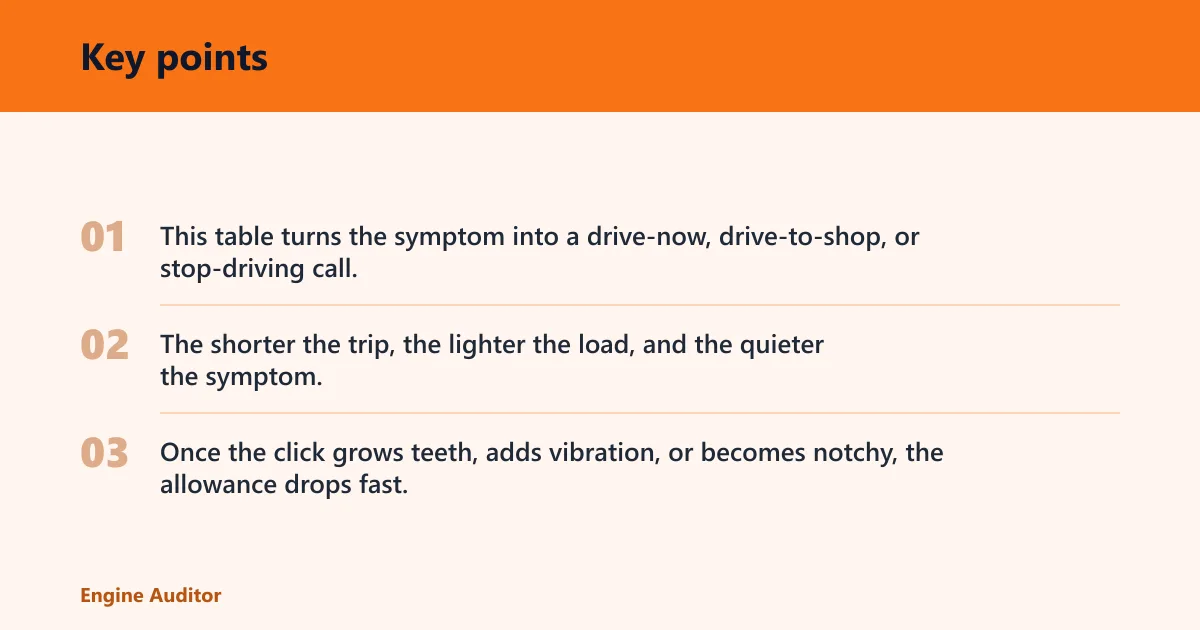
This table turns the symptom into a drive-now, drive-to-shop, or stop-driving call. The shorter the trip, the lighter the load, and the quieter the symptom, the more room you have to move the car. Once the click grows teeth, adds vibration, or becomes notchy, the allowance drops fast.
| Symptom stage | Likely condition | Driving allowance | Max trip guidance | What to avoid | Stop-driving trigger |
|---|---|---|---|---|---|
| Light click only | Outer CV joint wear with slack, often a Rzeppa joint | Drive-to-shop is usually acceptable | Short, local trips for a few days to a few weeks if the sound stays mild | Hard acceleration in turns, sharp full-lock maneuvers, long highway runs | Click becomes louder, more frequent, or starts to sound rough |
| Click plus grease sling | Torn CV boot with grease loss and possible contamination | Drive only as needed, then schedule repair soon | One short trip to a shop if the click is still light | Rain, pothole abuse, hard launches, and repeated parking-lot circles | Grease spread is heavy or the click changes during the same drive |
| Click plus vibration/clunk | Joint wear has advanced and may be loading the shaft or inner joint | A click plus vibration or clunk means normal driving should be avoided. | Only the nearest safe route to repair, if the car still tracks cleanly | Acceleration in a turn, highway speed, towing, or heavy cargo | Any rise in vibration, clunking, or loss of drive |
| Binding/notchy steering | Severe joint damage or a binding axle assembly | A binding or notchy steering condition means driving should be stopped. | Move only to the nearest safe place to park | Any farther travel | Steering feels notchy at full lock or the wheel will not turn smoothly |
What changes the risk level?
The biggest risk jump comes from load. Hard acceleration while turning increases joint stress, and full-lock steering adds more angle. Trip length matters too, because a short drive to a shop is very different from a long commute with repeated turns, merges, and lane changes. Heavy cargo raises the load again.
Load, speed, and route
Keep speed low, skip abrupt throttle inputs, and avoid sharp parking maneuvers until the joint is inspected. If you can get there by a direct local route, that is safer than stretching the trip. Stop using the car for errands if the click starts to grow during a single drive.
Suppose the click only shows up on a slow left turn out of a driveway. A short trip to a nearby shop may be reasonable if the sound stays mild and there is no vibration. If the same turn starts adding a clunk on the next outing, that is a different stage and the car should not keep being used normally.
Torn boot and grease signs
Check the CV boot for tears, missing clamps, and grease around the wheel well, suspension arm, and inner face of the wheel. A torn boot can let grit and water into the joint, and that contamination accelerates wear. A quiet torn boot may be repairable, but a clicking joint usually needs replacement.
How to spot grease sling and contamination
Grease sling often shows up as a spiral pattern on nearby parts. That pattern matters because it shows the axle has been throwing grease outward as it rotates. If the grease looks dirty or gritty, the joint may already be wearing faster than the symptom alone suggests.
Do not assume a fresh boot fixes a joint that already clicks. Once a joint has started to click, it is usually not worth re-booting. The wear has already changed the ball grooves, so the more reliable repair is often axle replacement, not boot-only work.
When repair stops being optional
A light outer-joint click is a repair to schedule, not an emergency. The line changes when the click becomes loud, is joined by vibration, or turns into clunking. At that point the page guidance is to stop driving, because a damaged CV joint can cause vibration, noise, or loss of drive.
Why a bad joint can leave you stranded
As wear gets worse, the joint can lose smooth motion, bind, or break enough to stop transmitting power. That may begin as a click and end as a no-move condition. The risk is not only noise. It is the possibility of losing drive without much warning once the joint is far enough gone.
Picture a sedan that clicks only on tight right turns for two weeks. If the noise stays light, the car may be driven carefully to a shop. If it begins clunking on acceleration out of the same turn, the safer choice is to stop using it and arrange repair before the axle fails farther.
CV axle fitment check
If replacement is needed, match the correct side and axle length for the vehicle application. Left and right halfshafts are often different lengths, so the wrong axle can fit badly even if it looks close. A new aftermarket axle of the wrong length can bind the inner plunge joint and vibrate on acceleration.
ABS ring and axle nut details
Some axles carry an ABS tone ring on the outer joint, and the tooth count must match the vehicle. The axle nut also matters. Many manufacturers specify that nut as one-time-use, so replace it where required instead of guessing.
- Confirm which side is noisy by steering direction and visual inspection.
- Check the boot for tears, grease sling, and contamination.
- Match the axle length to the vehicle application.
- Verify ABS tone ring details if the axle uses one.
- Replace the axle nut if the manufacturer calls it one-time-use.
- Inspect the other side too, because both axles have seen the same miles.
The other side should be inspected even if only one corner is noisy. Both axles have seen the same miles, so the quiet side may be close behind. That check can prevent a second repair visit soon after the first.
Frequently asked questions
How long can you drive with a clicking CV joint?
A light click may sometimes be tolerated for only short, local driving for a few days to a few weeks if it stays unchanged. That is not a promise of safety. If the sound grows louder, adds vibration, or becomes a clunk, the safe answer changes to stop driving and schedule repair.
How long can you drive with a popping CV joint?
A popping CV joint is closer to the danger side of the scale than a light click. If the pop is regular, louder, or paired with vibration, do not keep normal driving up. Use the shortest route to repair only if the car still feels stable; otherwise, park it and arrange a tow.
Can you drive with a clicking CV joint?
Yes, but only in the mild stage and only as a short-term plan to get to a shop. Avoid hard acceleration in turns, sharp full-lock maneuvers, and long trips. If the click is getting louder or more frequent, the safer move is to stop driving and have it checked.
Is it safe to drive with a clicking CV joint?
It can be acceptable for short local use when the click is light and unchanged, but it is not something to ignore. The risk rises fast if vibration, clunking, or notchy steering appears. That is why the symptom stage matters more than the word “click” by itself.
How far can you drive with a bad CV joint?
There is no single safe distance that is safe for every bad CV joint. A light click may allow a short trip to a shop, while a loud click with vibration should not be driven farther. If steering feels notchy at full lock or the joint clunks, the distance should be to the nearest safe place only.
Is a clicking CV joint dangerous?
It can become dangerous as it worsens. The early stage is usually a repair-to-schedule problem, but a loud click, vibration, or clunk can point to advancing failure and possible loss of drive. That is the point where the risk shifts from inconvenience to roadside trouble.
Products related to this article
Sponsored / affiliate links. As an Amazon Associate I earn from qualifying purchases. I may earn additional commission from eligible campaigns.
 Auto Car Dent Repair Puller Head Paintless-Dent Repair Removal Kit for Slide Hammer Pulling Tab Adapter Pulling Tabs Car Aluminum-alloy Puller Head Adapter Screw Glue-tabs for Slide Hammer and
 4G GPS Tracker Car Anti-Theft Long Battery Life 20000mAh Real Time GPS Tracking Device Magnet No Geographic Restriction Car Tracker with Alerts, Geo Fence, History Playback TK905C