What Happens If You Ignore Small Car Problems?
A small car problem can turn into a breakdown within days or weeks. If a warning light flashes, a leak grows, or a noise changes, get it checked right away. Delay can add a second failed part, a safety hazard, and a repair bill far above the original fix. This guide explains which symptoms you can monitor, which need quick diagnosis, and which mean stop driving now.
How small car problems turn expensive
A small symptom usually starts with one worn part. Then the load moves to the next weak part, and the repair grows from one component to a chain of damage, labor time, and possible towing.
That chain matters more than the first failure. A worn brake pad can damage a rotor. A low coolant level can push the engine into overheating. A weak battery can point to a failing alternator, and that can leave the car running on stored charge until the electrical system drops out.
Why delay raises labor, towing, and downtime costs
Once the car stops moving under its own power, the bill usually changes fast. Towing adds a fixed cost. Diagnostic time adds labor. If the second failure reaches a sensor, rotor, hose, wheel bearing, or alternator, the shop may need to remove more parts before the original issue can even be seen.
That is why the cheapest repair is often the one done early. Waiting can turn a short appointment into a longer job with more labor hours and more parts.
When a minor fix becomes a safety problem
Some problems shift from inconvenience to risk before the car quits. Brakes can lose stopping distance, tires can lose grip, cooling faults can overheat the engine in traffic, and a charging fault can shut off lights or power steering assist on some vehicles.
Use one rule: if the symptom affects braking, steering, temperature, or charging, treat it as more urgent than a cabin rattle or a stale odor.
Warning lights you should not ignore
Warning lights do not all mean the same thing. The check engine light often points to an emissions or engine-management fault. The oil pressure light can mean low pressure, which can damage bearings quickly. The battery light usually points to a charging problem. The temperature warning means the engine is running hot and may need an immediate stop.
Check engine light: common causes and next step
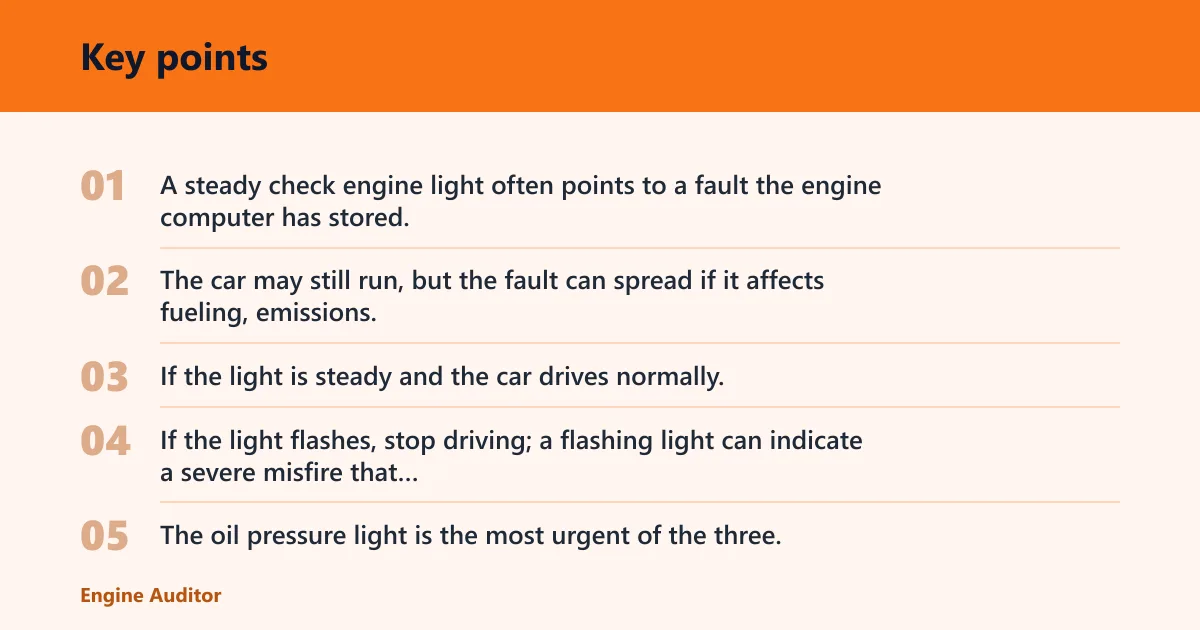
A steady check engine light often points to a fault the engine computer has stored, such as an ignition misfire, sensor fault, evaporative leak, or fuel-system issue. The car may still run, but the fault can spread if it affects fueling, emissions, or misfire load.
If the light is steady and the car drives normally, a quick OBD-II scan is the cheapest first step. If the light flashes, stop driving; a flashing light can indicate a severe misfire that may damage the catalytic converter.
Oil pressure light, battery light, and temperature warning
The oil pressure light is the most urgent of the three. It usually means oil pressure is too low to adequately protect the engine. Shut the engine off as soon as it is safe. The battery light often means the alternator is not keeping up, so the car may run only until the battery drains. The temperature warning can mean the engine is overheating or getting close to overheating.
For the battery light, driving a short distance to a safe place may be possible if the car is not stalling and the dash is not losing power, but the risk rises quickly. For the temperature warning, stop now if the gauge is in the red, steam appears, or the cabin heater blows cold air while the engine runs hot.
Which lights mean stop driving now?
Stop driving now for an oil pressure light, a flashing check engine light, or a temperature warning. Treat a battery light as urgent, because the car may die after the battery is depleted. A steady check engine light can sometimes wait for a short, careful trip to a shop if the car runs smoothly and nothing else feels wrong.
Brake noise and pedal changes
Brake problems rarely stay small. Pad wear can turn into rotor damage, longer stopping distance, and fluid-related pedal changes. If braking feels different, the system needs attention before traffic or a panic stop turns a wear item into a safety problem.
Squealing pads versus grinding pads
Squealing usually points to pad wear indicators, glazing, or light rust on the rotor surface. It is a warning, not a failure. Grinding means the pad material may be gone and metal may be contacting the rotor. That usually raises repair cost fast.
A squeal can often wait for prompt service. Grinding should be treated as a stop-and-check issue, because each mile can remove more rotor material and increase the chance of caliper damage.
How worn pads can damage rotors and raise stopping distance
As pad thickness drops, heat rises and braking feel changes. The car may need more pedal effort and more distance to stop. If the pad backing plate touches the rotor, the rotor can score or warp, and the job can expand from pads only to pads, rotors, and possibly hardware.
Brake fluid level and why a soft pedal matters
Low brake fluid can mean pad wear, a leak, or another hydraulic issue. A soft or sinking pedal matters because it can point to air in the system or a leak that reduces brake force. If the pedal feels spongy, goes lower than usual, or the warning light is on, do not assume it will correct itself.
Engine oil leaks and low oil
Engine oil does more than lubricate. It reduces wear and helps control heat. A small leak can become a bigger leak, and low oil can create both wear and overheating risk. The problem may start as a spot on the driveway and end as engine damage.
What a small leak can become if it is ignored
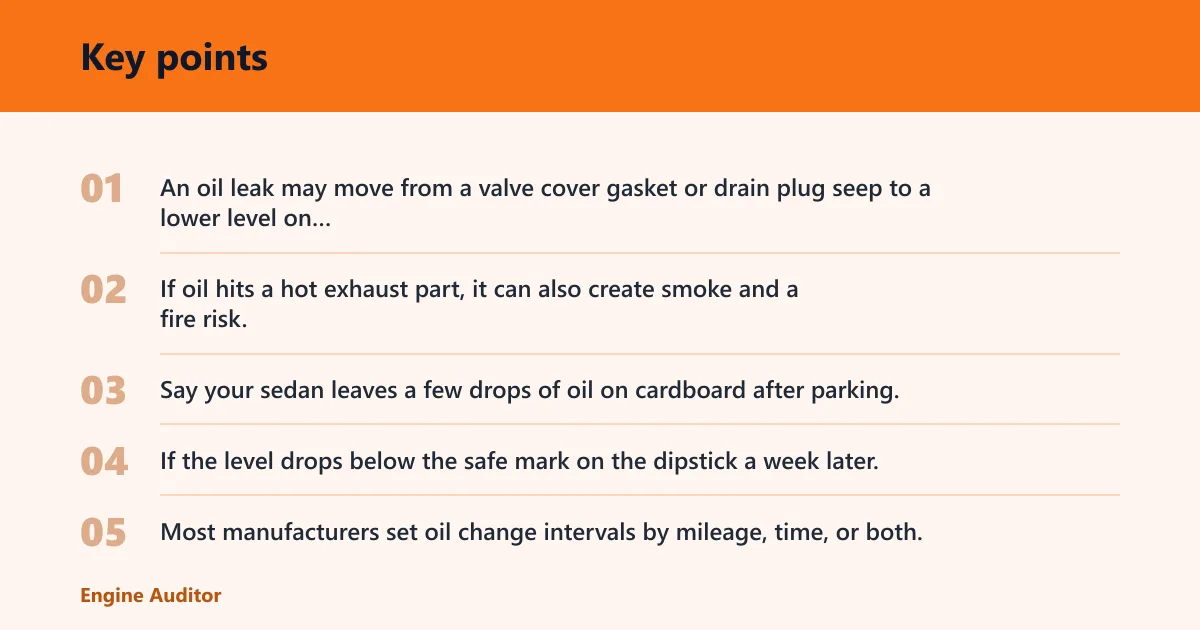
An oil leak may move from a valve cover gasket or drain plug seep to a lower level on the dipstick, then to delayed oil pressure at startup, then to worn internal parts. If oil hits a hot exhaust part, it can also create smoke and a fire risk.
Say your sedan leaves a few drops of oil on cardboard after parking. That may look minor. If the level drops below the safe mark on the dipstick a week later, the issue has moved from nuisance to real oil loss, and the source should be found before the engine runs low again.
Oil change interval, low level, and engine wear
Most manufacturers set oil change intervals by mileage, time, or both. Skipping service does not only age the oil; it can increase sludge, reduce lubrication quality, and raise engine wear. A low oil level adds another problem because the pump has less supply to work with.
If the oil level is low, top off with the correct grade and check for leaks. If the engine has been run low repeatedly, do not assume topping off is enough.
When oil loss means do not keep driving
Do not keep driving if the oil pressure light comes on, if the engine knocks, or if the leak is heavy enough to leave a fresh puddle each time you park. A small seep is a monitor-and-book issue. A fast leak is a stop-driving issue.
Cooling problems and overheating
The cooling system protects the engine from heat damage. Coolant loss, hose leaks, thermostat failure, and radiator trouble can all end in overheating. Once temperature rises too far, the bill can jump from a hose or thermostat to a warped head or damaged gasket.
Coolant smell, puddles, and hose leaks
A sweet coolant smell often means a leak. A puddle under the front of the car, green or orange residue around a hose, or a damp radiator tank all point to a loss in the system. Small leaks often grow when pressure and temperature rise.
Thermostat and radiator faults that raise temperature
A thermostat that sticks closed can block flow. A radiator with blocked passages or damaged fins can reduce heat transfer. Either fault can make the temperature gauge climb in traffic, at idle, or under load. If the gauge rises and falls erratically, the system needs diagnosis, not guesswork.
Suppose a compact SUV starts smelling hot after a highway exit, and the temperature light comes on at the next light. That is not a “drive it home” situation. Pull over, shut it off, and let it cool before any check is made.
Overheating signs that call for an immediate stop
Stop immediately for steam, a red temperature warning, a rapidly rising gauge, or a heater that suddenly blows cold while the engine is hot. Overheating can crack plastic parts, blow hoses, and damage the head gasket if the engine keeps running hot.
Tire wear and steering vibration
Tires and alignment shape how the car tracks, grips, and stops. Low pressure, uneven wear, and alignment drift can create vibration and pull. If ignored, tire damage can spread to suspension parts and raise blowout risk.
Uneven wear, low pressure, and alignment drift
One shoulder wearing faster than the other often points to alignment or suspension wear. Low pressure wears the tire differently and can make the sidewall flex too much. If the steering wheel sits off-center or the car drifts on a straight road, alignment should be checked soon.
Why vibration can point to tire, wheel, or suspension trouble
Vibration at speed may come from tire balance, a bent wheel, a separated tire belt, or worn suspension parts. If the shake changes with speed, braking, or road surface, the cause may be different. That is why a vibration deserves inspection rather than random parts replacement.
How neglected tires raise blowout risk
A tire with low pressure, damaged sidewalls, or severe wear carries more heat and less reserve strength. That raises blowout risk, especially on long highway drives. If cords show, a bubble appears, or the tire is losing air quickly, do not keep driving far.
Battery, codes, and cheap diagnosis
Electrical and engine-management faults often leave clues before a failure. Slow cranking, jump-start dependence, and stored fault codes can point to the next bad part. A cheap scan and a few basic checks can prevent a larger diagnosis bill later.
Slow cranking, jump-start dependence, and alternator issues
A weak battery often shows up as slow cranking, dim lights, or the need for repeated jump-starts. If the car starts with a jump but dies later, the alternator may not be charging the battery properly. Electrical faults can also affect control modules and sensors.
OBD-II scanner basics: stored codes and pending codes
An OBD-II scanner reads stored codes, and many tools also show pending codes. Stored codes are faults the computer has confirmed. Pending codes are problems seen once or twice that have not fully set yet. Intermittent faults often show up here before a warning light stays on.
Free code reading at parts stores can help with the first step, but the code is only a clue. The cause may be a sensor, wiring issue, vacuum leak, or another part nearby.
First low-cost checks to ask
Ask for a battery and charging test, visual inspection of loose hoses or leaks, brake pad thickness, tire pressure, and a scan for stored and pending codes. Those checks often find the fault category before more expensive parts are replaced.
Small car problems checklist
Use this checklist to judge urgency without guessing. The cheapest first step is the least expensive thing that can confirm the issue, not the final repair.
| Symptom | Likely system | Immediate risk | Keep driving? | Cheapest first diagnostic step |
|---|---|---|---|---|
| Squealing brakes | Brake pads | Pad wear; longer stop distance | Monitor and book soon | Brake pad thickness inspection |
| Grinding brakes | Brake pads and rotors | Rotor damage; reduced braking | No | Lift wheel and inspect pad material |
| Soft brake pedal | Brake hydraulic system | Loss of braking force | No | Check brake fluid level and leaks |
| Oil leak | Engine oil system | Low oil level; engine wear | Monitor if slight; no if heavy | Check dipstick level after parking |
| Battery warning light | Charging system | Battery drain; stall risk | Short trip only if needed | Battery and alternator test |
| Temperature warning | Cooling system | Overheating; engine damage | No | Check coolant level after cool-down |
| Coolant smell | Cooling system | Leak and overheating risk | Monitor and book soon | Look for wet hoses, tanks, and puddles |
| Tire vibration at speed | Tires, wheels, suspension | Loss of control; tire failure | Short trip only if mild | Check tire pressure and visible damage |
| Steering pull or drift | Alignment or suspension | Uneven tire wear; control issues | Monitor and book soon | Check tire pressure and tread wear pattern |
| Slow cranking | Battery or starter | Stranded start failure | Monitor and book soon | Battery voltage and load test |
Frequently asked questions
What happens if you ignore small car problems?
Ignoring a small car problem often turns one worn part into a second failure, then a bigger repair. A brake squeal can become rotor damage, a coolant seep can become overheating, and a weak battery can become a charging-system problem that strands the car.
Can a small car problem turn into a big repair?
Yes. A cheap part can trigger secondary damage when the car keeps running with the fault in place. That is how a leak becomes low fluid, low fluid becomes overheating or wear, and wear becomes a much larger parts and labor bill.
How long can you drive with a small car issue?
That depends on the system. A mild squeal, a steady check engine light, or a slow seep may allow short-term driving while you book service. A flashing warning light, overheating, grinding brakes, or a soft pedal should shorten that answer to minutes, not days.
What car problems should never be ignored?
Do not ignore the oil pressure light, temperature warning, flashing check engine light, grinding brakes, a soft brake pedal, heavy coolant loss, or a tire with visible damage. Those problems can affect engine life, braking force, or control of the car very quickly.
How much does it cost if you wait too long to fix a car problem?
The cost often rises in layers: the original repair, then secondary damage, then towing, then more labor to reach the failed part. A small early job may stay simple. Waiting can add rotor replacement, hoses, sensors, or engine repair, plus downtime.
Can a check engine light turn off by itself if I ignore it?
Yes, the light can go out if the fault is intermittent or the monitor does not see the problem again. That does not mean the issue is fixed. Stored and pending codes can remain, and the underlying cause may still return under load or temperature changes.
Is it safe to keep driving with a small oil leak or noise?
Only if the leak is minor, the oil level stays full, and the noise does not change. If the level drops, the oil pressure light appears, or the sound gets louder, stop driving and inspect it. Oil loss and knocking are not symptoms to gamble with.
What is the worst that can happen if I delay car maintenance?
The worst case is a chain failure: one worn part damages another, the car becomes unsafe, and a breakdown leads to towing and a larger repair than the original issue. Overheating, brake loss, tire failure, and electrical shutdown can all start from small warning signs.
Products related to this article
Sponsored / affiliate links. As an Amazon Associate I earn from qualifying purchases. I may earn additional commission from eligible campaigns.