What Is a Truck-Based SUV? Pros and Cons
A truck-based SUV is usually a body-on-frame utility vehicle built on a pickup-style chassis, often with rear-wheel-drive hardware and generally stronger tow ratings than most crossovers. Pick the wrong platform, and you pay for capability you do not need, or give up the ride comfort, fuel economy, and parking ease you wanted. This guide compares truck-based SUVs with crossovers and pickups for towing, off-road use, and daily driving, so you can match the platform to the job.
Quick answer

A truck-based SUV is an SUV built on a separate frame with the body mounted on top of it. That body-on-frame layout is common in trucks and truck-based SUVs, and it usually brings stronger towing, more durability under load, and a heavier curb weight than a unibody crossover.
The key difference from a crossover is structure. Crossovers usually use a unibody shell, where the body and frame are one piece. Truck-based SUVs usually keep the frame and body separate, which helps with trailer loads, rough roads, and off-pavement use, but it also tends to add weight and reduce ride polish.
Common traits are easy to spot. They often offer enclosed cargo areas and multiple seating rows, and many are sold with 4×4 systems, terrain modes, and locking differentials. That mix makes them attractive to buyers who want family space without giving up truck-grade hardware.
Truck-based SUV decision matrix
The simple scoring below uses a 1-to-5 scale, where 5 means best in class for that use. It is not a full ownership rating. It is a quick way to separate what each platform does well from what it does poorly.
| Platform | Towing | Payload | Ride comfort | Cargo security | Parking ease | Off-road use | Best fit |
|---|---|---|---|---|---|---|---|
| Truck-based SUV | 4 | 3 | 3 | 5 | 3 | 4 | Family towing, trail use, enclosed cargo |
| Crossover | 2 | 2 | 5 | 5 | 5 | 2 | Daily commuting, school runs, urban parking |
| Pickup truck | 5 | 5 | 2 | 1 | 2 | 4 | Heavy towing, dirty cargo, open-bed hauling |
Simple scoring rubric
- 5 means the platform is a clear strength in that category.
- 3 means usable, with clear trade-offs.
- 1 means it is usually the weakest choice for that need.
For towing, truck-based SUVs generally land in the middle of the comparison frame, with quoted capacity often in the 5,000-9,000 lbs range. Pickups usually lead at 7,000-14,000 lbs. Crossovers sit below both, which matters if you haul boats, campers, or loaded trailers with any regularity.
Buy by use, not image. Choose a truck-based SUV if you need enclosed cargo, regular towing, and light-to-moderate trail use. Choose a crossover if your driving is mostly commuting, parking, and fuel-conscious errands. Choose a pickup if you need the highest tow rating, the highest payload, or an open bed for dirty gear.
What are the advantages of a truck-based SUV?
The main advantage is that you get truck hardware with an enclosed cabin. That gives you towing strength, available 4×4 systems, and a cargo area that protects luggage, tools, and luggage from weather and theft better than an open bed. It is a useful middle ground for mixed-duty buyers.
Most truck-based SUVs can tow more than crossovers. In this comparison frame, SUVs commonly land at 5,000-9,000 lbs of tow capacity, with payload around 1,200-2,000 lbs. That is enough for many boats, small campers, and utility trailers, provided the hitch, cooling, brakes, and wheelbase are up to the job.
Off-road hardware is another strength. Ground clearance in the 8-11 inches range helps with ruts and rocks, and many serious models pair that with terrain management, skid plates, and locking differentials. Trucks can have the edge in breakover angles, but a short- or mid-wheelbase SUV can still work well on tight trails.
Enclosed seating matters too. The cabin often has multiple rows, so passengers do not ride in the weather the way cargo does in a pickup bed. For families, that can mean better child-seat placement, easier bag storage, and less exposure to rain or road spray.
Resale value is usually strong for SUVs in this comparison. Buyers keep coming back to the same formula: truck-based durability, enclosed cargo, and family seating. That combination tends to keep demand steady when the vehicle is clean, well maintained, and configured with useful options.
What are the trade-offs of a truck-based SUV?
The trade-off is simple: the same structure that improves towing and durability often makes daily use less pleasant than a crossover. Body-on-frame designs are usually heavier, ride more firmly, and can feel noisier over broken pavement. You get capability, but you also pay for it in comfort and efficiency.
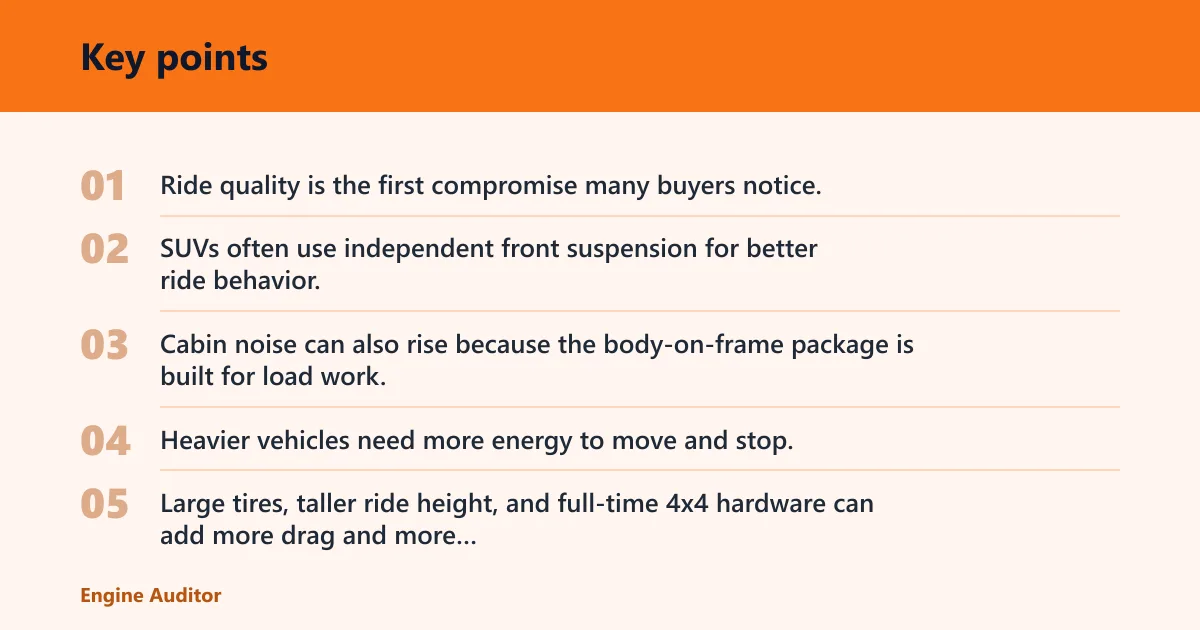
Ride quality is the first compromise many buyers notice. SUVs often use independent front suspension for better ride behavior, but the platform still tends to feel firmer than a unibody crossover. Cabin noise can also rise because the body-on-frame package is built for load work, not pure commuting polish.
Fuel economy is another cost. Heavier vehicles need more energy to move and stop, and that usually means more fuel burned in city use and on long grades. Large tires, taller ride height, and full-time 4×4 hardware can add more drag and more expense over time.
Parking and garage fit matter more than many shoppers expect. Taller ride height, longer wheelbase, and a wider stance can make tight parking decks frustrating. If your garage opening is narrow or your commute includes dense city streets, a truck-based SUV can feel cumbersome fast.
Maintenance also tends to cost more. Body-on-frame vehicles often wear larger tires and brakes, and those parts are rarely the cheapest versions in the catalog. Insurance can also run higher on some trims because the vehicle is heavier, more expensive to repair, and more likely to be used for towing or recreation.
Say your garage has a 19-foot depth and a narrow turn into the bay. A truck-based SUV with a long wheelbase may fit on paper but feel awkward every day, especially if the rear hatch needs extra room to open. In that case, a crossover often makes more sense.
How is a truck-based SUV different from a crossover?

The difference starts with structure and shows up everywhere else. A truck-based SUV uses a separate frame and body, while a crossover uses a unibody layout. That means the crossover usually rides better, parks more easily, and uses less fuel, while the SUV usually wins on towing, durability, and rough-road ability.
Daily livability usually favors the crossover. It is typically easier to place in tight spaces, easier to load through a lower floor, and friendlier in traffic. Truck-based SUVs can still be pleasant, but the added weight and truck-style geometry often make them feel less nimble around town.
Ground clearance and wheelbase shape the experience on and off pavement. A shorter wheelbase can help maneuverability and breakover on trails, but a longer wheelbase often feels steadier at speed and while towing. That is why some buyers prefer a mid-size truck-based SUV over a full-size one, even when both can handle the same general terrain.
Child-seat access can tilt the decision too. A crossover often has a lower floor, which makes buckling in a child seat or lifting a sleeping child easier. A truck-based SUV may give you more space overall, but the taller step-in height can be tiring if you do it several times a day.
Picture a family of five that tows a 21-foot camper four times a year and commutes the rest of the time. A truck-based SUV may fit that pattern well. A family that rarely tows and mostly drives in stop-and-go traffic will usually be happier in a crossover.
Truck vs SUV pros cons
Pickup trucks keep the edge when payload, towing, and dirty cargo are the priority. In this comparison frame, pickups often reach 7,000-14,000 lbs of towing and 1,500-3,500 lbs of payload, with 9-12 inches of ground clearance. Truck-based SUVs give up some of that raw utility in exchange for enclosed cargo and better passenger protection.
Trucks also bring a separate cab and bed design. That open bed is ideal for mulch, firewood, greasy parts, or tall items that would dirty an interior. But the cargo is weather-exposed, and rear-seat space can feel less useful than the enclosed second and third rows in a truck-based SUV.
For rear passengers, the SUV usually wins. For cargo security, the SUV usually wins. For maximum work duty, the truck usually wins. That is why the right answer depends on how often you need the bed versus how often you want the back half of the vehicle protected and climate controlled.
Are truck-based SUVs more comfortable than pickup trucks? Usually, yes. The enclosed body, full cabin, and passenger-focused trim content often make them easier to live with than an open-bed pickup. But they are still body-on-frame vehicles, so they rarely match the calm ride of a good crossover.
Choose truck-based SUV vs crossover
Choose a truck-based SUV if you need a covered cargo area, plan to tow on a regular basis, or spend real time on dirt roads and trails. Choose a crossover if your driving is mostly commuting, school runs, parking decks, and airport trips. That split gives you the cleanest match between platform and use.
Choose a truck-based SUV if you need more than a soft-roader can offer, but do not want an exposed bed. Choose a crossover if you care more about ride comfort, fuel use, and easy parking than frame strength. Choose a pickup truck if your trailer or payload demands the highest numbers.
Use-case guide
- Frequent towing: truck-based SUV or pickup truck.
- Urban commuting: crossover.
- Dirty, bulky cargo: pickup truck.
- Family travel with weather protection: truck-based SUV.
- Trail use with passengers: truck-based SUV.
Frequently asked questions
What is a truck-based SUV?
It is an SUV built on a truck-style body-on-frame chassis rather than a unibody shell. That structure supports towing, durability, and off-road hardware, while still giving you an enclosed cabin and multiple seating rows. It is the middle ground between a crossover and a pickup truck.
Is a truck-based SUV better for towing than a crossover?
Yes, in most cases. Truck-based SUVs usually tow more than crossovers, with many in the 5,000-9,000 lbs range in this comparison. But tow rating is only part of the story. Cooling, braking, wheelbase, and trailer stability matter just as much in real use.
Are truck-based SUVs more comfortable than pickup trucks?
Usually, yes. The enclosed body, full cabin, and passenger-oriented seating make them easier to live with than a pickup truck. Even so, they still ride more like trucks than crossovers do. If comfort is the top priority, a crossover is often the better buy.
Products related to this article
Sponsored / affiliate links. As an Amazon Associate I earn from qualifying purchases. I may earn additional commission from eligible campaigns.