What Is the Difference Between AC and DC Charging?
AC charging uses the car’s onboard charger and is commonly best suited to home or workplace charging. DC charging sends power directly to the battery and is generally much faster. Pick the wrong one and you can pay too much for public fast charging, wait longer than needed, or use DC where AC would do the job. This guide explains speed, cost, battery behavior, and where each type makes the most sense.
How AC and DC power flow into the EV battery
What alternating current means
Alternating current comes from the grid and changes direction repeatedly. In EV charging, that matters because the electricity still needs to be converted into battery-ready direct current before it can be stored. That conversion step is what separates most AC charging from DC charging in practical use.
What direct current means
Direct current flows in one direction. EV batteries store direct current power, so DC charging gives the battery the form of electricity it can accept without an in-car conversion step. That is why public rapid charging can move much faster than a typical home AC setup.
Why EV batteries need DC
An EV battery cannot store alternating current as alternating current. The battery needs direct current, so any AC supply must be turned into DC somewhere before energy goes into the pack. With AC charging, that conversion happens inside the vehicle. With DC charging, it happens outside the vehicle.
How AC charging works
AC charging is the home charging method and the common choice for workplace charging. The grid sends AC to the car, the onboard charger converts it to DC, and the battery receives that converted power. Because the car does the conversion, the onboard charger sets the ceiling for AC speed.
The role of the on-board charger
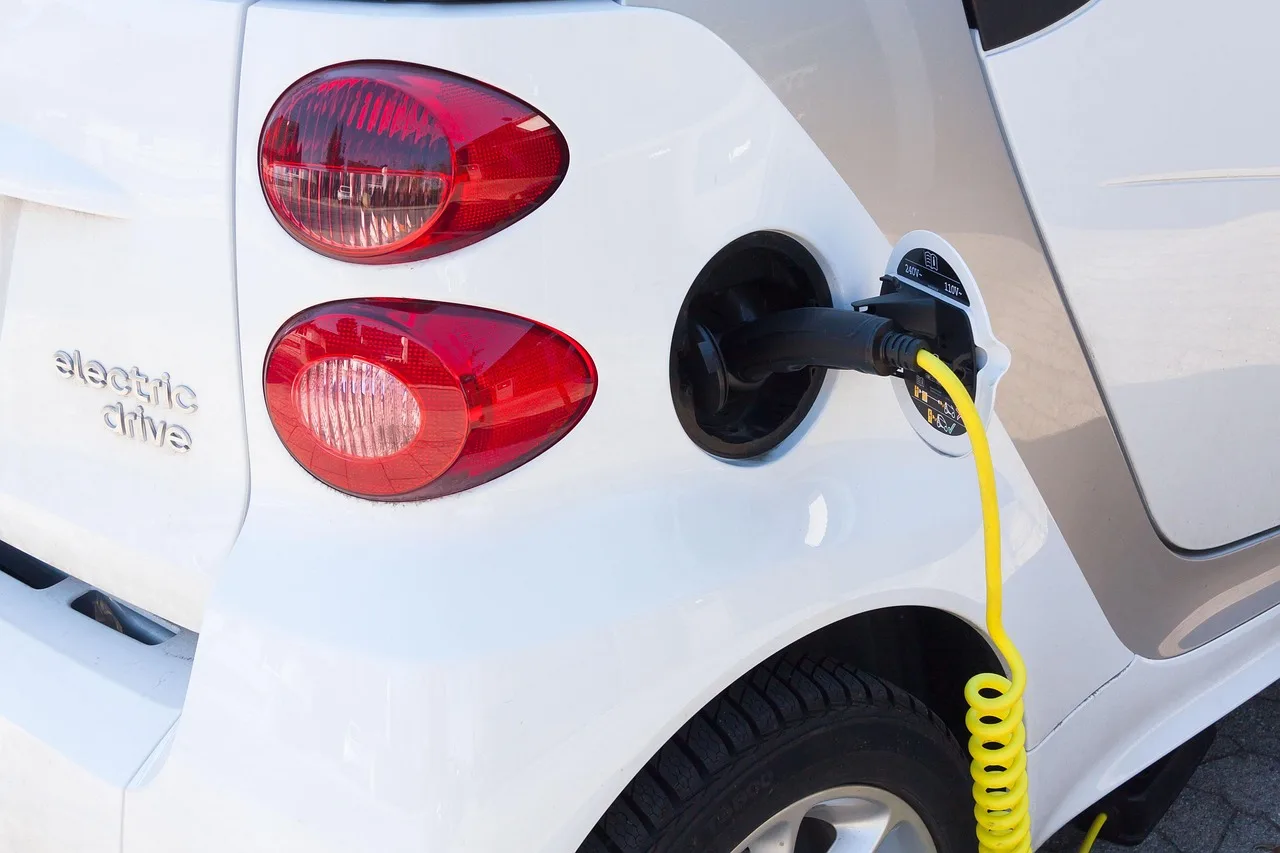
The onboard charger resides inside the car. It converts AC to DC, and it is the reason a powerful wall unit does not always mean faster charging. If the car’s onboard charger tops out around 11 kW, a bigger AC supply will not make the battery accept power faster than that limit.
Why AC charging speed varies
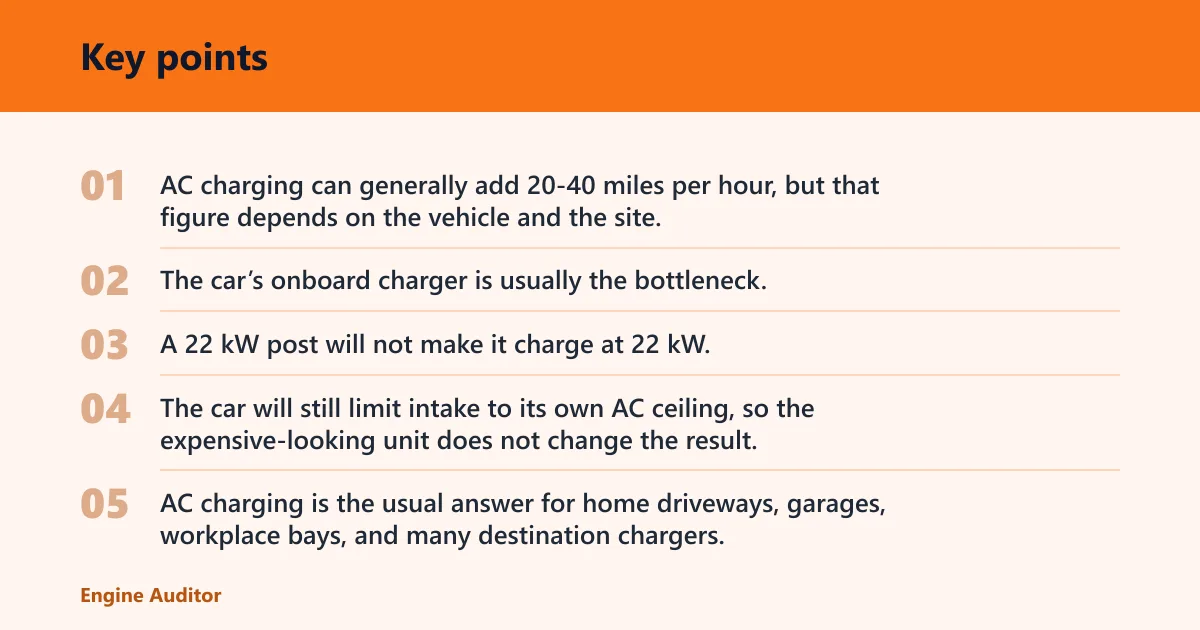
AC charging can generally add 20-40 miles per hour, but that figure depends on the vehicle and the site. The maximum AC charging speed is usually around 11 kW, though some sources note AC charging up to 22 kW on certain vehicles and hardware. The car’s onboard charger is usually the bottleneck.
Say your car can accept only 7 kW on AC. A 22 kW post will not make it charge at 22 kW. The car will still limit intake to its own AC ceiling, so the expensive-looking unit does not change the result.
Where AC charging is most common
AC charging is the usual answer for home driveways, garages, workplace bays, and many destination chargers. It is generally cheaper to install and operate than DC fast chargers, and it suits long dwell times. That makes it the better fit for overnight charging or top-ups while parked for hours.
How DC fast charging works
DC charging converts electricity externally before it enters the vehicle. The conversion happens outside the car, so the onboard charger is bypassed. That removes one speed limit from the chain, which is why DC fast charging is used at public rapid stations and motorway services.
Why the conversion happens outside the car
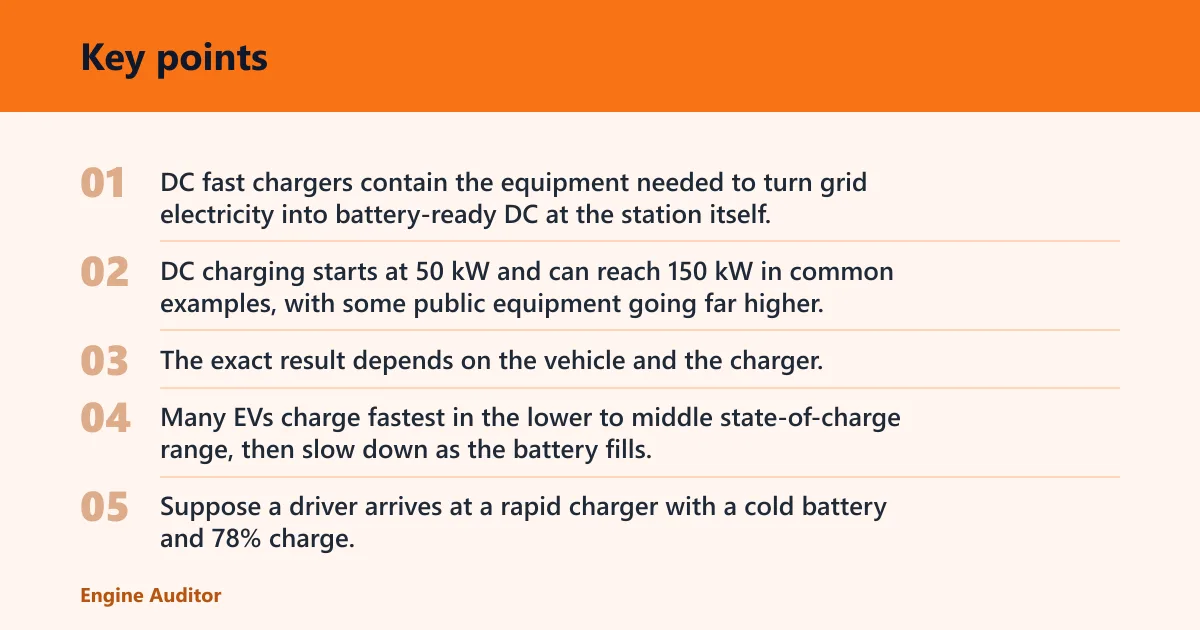
DC fast chargers contain the equipment needed to turn grid electricity into battery-ready DC at the station itself. Because the power arrives in the form the battery can store, the car does not have to process it through its onboard charger. This is the main reason DC can charge much faster than AC.
Why DC can charge much faster
DC charging starts at 50 kW and can reach 150 kW in common examples, with some public equipment going far higher. It can reach about 80% in around 30 minutes, and some vehicles can go from 10% to 80% in as little as 18 minutes. The exact result depends on the vehicle and the charger.
Why battery temperature and state of charge matter
DC speed is not flat from start to finish. Battery temperature, state of charge, and the vehicle’s charging curve all affect how quickly energy moves into the pack. Many EVs charge fastest in the lower to middle state-of-charge range, then slow down as the battery fills.
Suppose a driver arrives at a rapid charger with a cold battery and 78% charge. The session may feel slow because the car is protecting the battery and because high state of charge often reduces charging speed. Arriving at 15% with a warmed battery usually gives a very different result.
What is the real difference for you?
The real difference is not only electrical. AC usually wins on cost, convenience, and overnight use. DC wins on time and trip planning. If you charge where the car sits for hours, AC is usually enough. If you need a quick top-up on a route, DC is the better tool.
Cost and installation
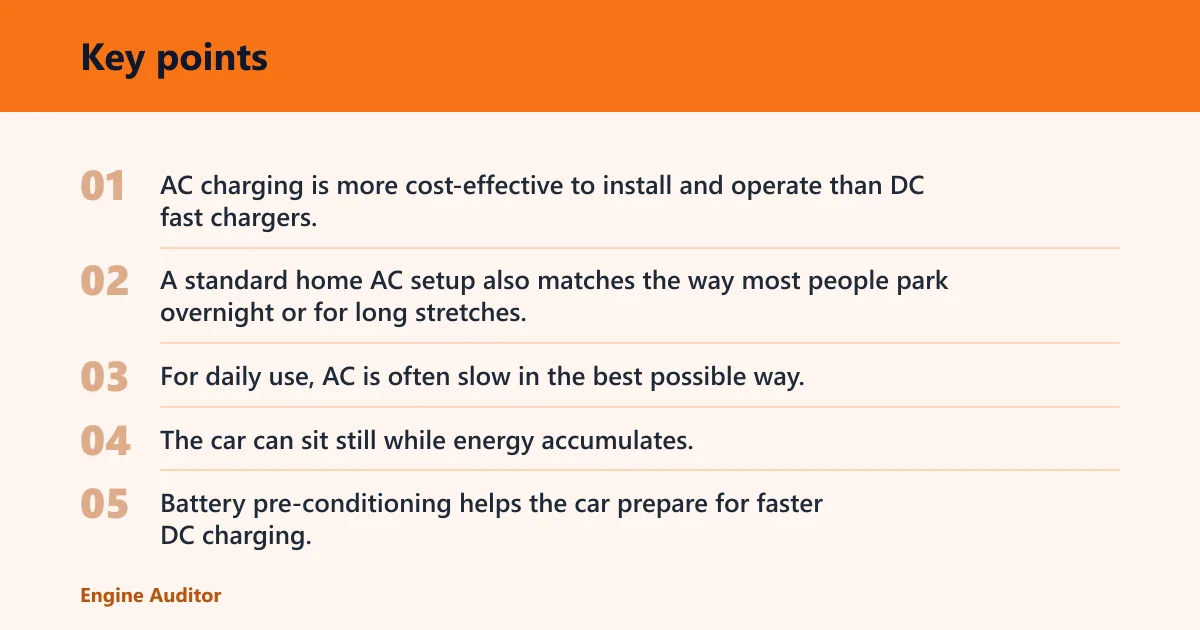
AC charging is more cost-effective to install and operate than DC fast chargers. A standard home AC setup also matches the way most people park overnight or for long stretches. DC equipment needs more electrical infrastructure, which is why it is usually found at public sites rather than at most homes.
Speed and trip planning
For daily use, AC is often slow in the best possible way. The car can sit still while energy accumulates. For long trips, that same pace is a problem. DC charging cuts waiting time enough to matter on road trips, especially when the route includes multiple stops and a tight schedule.
Battery pre-conditioning and charging curve
Battery pre-conditioning helps the car prepare for faster DC charging. In some EVs, navigation to a rapid charger can trigger battery pre-conditioning automatically. The goal is to bring the battery into a temperature range that supports quicker charging, which can improve the early part of a DC session.
Charging curves also matter. A charger rated at 250 kW will not usually hold that full rate through the entire session on most cars. The vehicle decides how much power it will accept at each stage, so the strongest number on the post is only part of the story.
Charging compatibility and connectors
Plug shape, power level, and vehicle support are separate checks. AC and DC are not just plug shapes, and a connector that fits does not guarantee every charging mode will work. Some public sites offer both AC and DC, but the station, the cable, and the vehicle still have to match on support and power.
-
Check the charging type. Confirm whether the site is AC or DC. That tells you whether the car’s onboard charger will be used or bypassed, which changes the speed expectation immediately.
-
Check the connector standard. Make sure the vehicle supports the plug type at that site. A compatible connector shape is necessary, but it is not the same thing as charging-mode support.
-
Check the power limit. Compare the charger’s kW rating with the car’s AC or DC limit. A high-powered post will not force higher intake than the vehicle allows.
-
Check battery readiness. For DC sessions, warm the battery when the vehicle allows pre-conditioning. That helps the car accept higher power sooner and can reduce the slow early portion of the session.
Sites that offer both AC and DC
Some charging stations include both types on the same site. That is useful when one driver wants an overnight AC bay and another needs a quick DC stop. It also gives you a backup if one part of the site is busy, though the actual charging rate still depends on the car and the dispenser used.
Charging decision table
This table turns the choice into a practical call. It focuses on where you park, how quickly you need energy, and which type gives the better result for that use case.
| Use case | Recommended charging type | Typical power range | Expected time implications | Why this choice wins |
|---|---|---|---|---|
| Home overnight | AC | Up to about 11 kW | Usually enough time to replenish by morning | Cheaper to install, suits long dwell times, and the car can charge while parked |
| Daily commuter | AC | 7 kW to 11 kW, sometimes higher on supported hardware | Fits workday or overnight top-ups without needing a rapid stop | Lower cost and easier access matter more than extreme speed |
| Apartment resident | AC where available; DC for occasional fill-ups | AC at lower to moderate power; DC at 50 kW and above | AC works well if the car can stay parked for hours; DC helps when access is limited | Shared parking often makes slow, steady charging the most realistic option |
| Road-trip driver | DC | 50 kW to 150 kW and higher on some sites | Can reach about 80% in around 30 minutes, with some cars faster from 10% to 80% | Short stops matter more than low installation cost |
Which charging type fits each use case?
AC is the better choice when the car will sit for hours and the goal is convenient, lower-cost charging. DC is the better choice when time matters more than price per session. Most EV owners need both at different moments, but they do not need both for every charge.
When AC is the better choice
Choose AC for home overnight charging, workplace charging, and most daily refill patterns. It is the smarter fit when you can leave the car plugged in for a long stretch and when lower installation cost matters. AC also makes sense when you do not need to chase the fastest possible stop.
When DC is the better choice
Choose DC for road trips, motorway stops, and quick top-ups when the battery is low and time is short. It is also the better option when AC access is limited and you need a meaningful amount of range in one stop. Remember that the car, the charger, and the battery state still control the final speed.
Frequently asked questions
What is the difference between AC and DC charging for EV?
AC charging sends alternating current to the car, where the onboard charger converts it to DC for the battery. DC charging converts the power outside the car and sends battery-ready DC straight in. That makes AC slower but usually cheaper, while DC is faster and better for public rapid charging.
What is the difference between AC charging and DC fast charging?
AC charging is usually the home charging method and typically tops out around 11 kW in common examples. DC fast charging is usually found at public charging stations and starts around 50 kW, with much faster refill times. The main difference is where the AC-to-DC conversion happens.
What is the main difference between AC and DC charging?
The main difference is the conversion step. AC needs the car’s onboard charger to turn grid power into battery-ready DC, while DC charging does that work outside the vehicle. That one change affects speed, installation cost, where you charge, and how much time you spend plugged in.
Are EV chargers AC or DC?
EV chargers can be either. Home and workplace units are often AC chargers, while public rapid units are usually DC fast chargers. Some charging stations offer both, so the answer depends on the site and the type of charging the vehicle supports.
Is a car battery AC or DC?
A car battery is DC. EV batteries store direct current power, which is why AC electricity has to be converted before the battery can accept it. That conversion happens inside the car during AC charging and outside the car during DC charging.
Why do rapid chargers use DC current?
Rapid chargers use DC because the battery already stores DC, so the station can bypass the car’s onboard charger and send usable power directly to the pack. That removes a major bottleneck and allows much higher charging rates, especially when the battery is warm and at a lower state of charge.
Products related to this article
Sponsored / affiliate links. As an Amazon Associate I earn from qualifying purchases. I may earn additional commission from eligible campaigns.