Steering Wheel Shakes at High Speed: Tire or Suspension?
If the steering wheel shakes only above about 50 mph, start with tires and wheels; if it pulses mainly while braking, look at rotors; if it changes with road bumps or steering load, check suspension and steering parts. Ignoring that pattern can send you to the wrong parts and hide a safety issue. This guide shows how to separate tire, wheel, alignment, brake, and suspension causes by symptom.
How speed range and vibration location pinpoint the source


What speed bands point to a wheel or tire issue
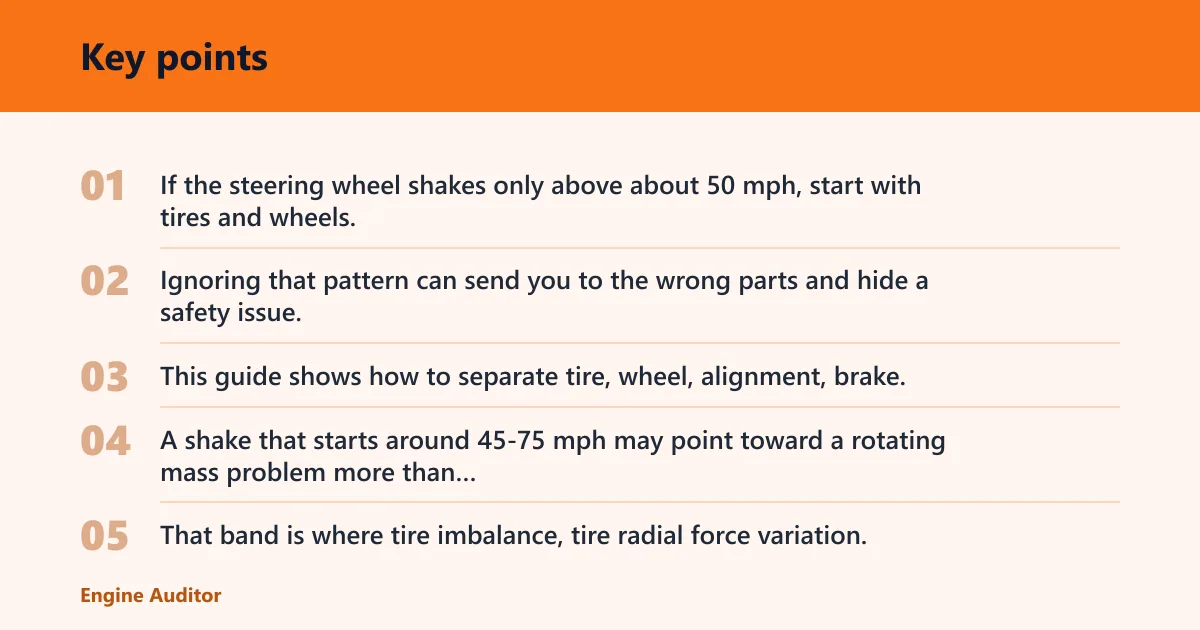
A shake that starts around 45-75 mph may point toward a rotating mass problem more than a steering-link problem. That band is where tire imbalance, tire radial force variation, and a bent wheel often become noticeable. A low-speed shimmy that fades as road speed climbs usually points elsewhere.
Speed matters because rotating forces scale with wheel speed. A tire that feels fine at 30 mph may shake the wheel at 65 mph, while the same car can feel normal at neighborhood speeds.
How steering wheel shake differs from seat vibration
Steering wheel vibration usually points to the front axle, since the front wheels transmit motion into the steering gear. Seat or floor vibration often points to the rear wheels, rear tires, or rear suspension. That difference is one of the fastest ways to narrow the source before any parts come off.
Do not treat all vibration the same. A front-heavy shake can be felt in the steering wheel with little seat movement, while a rear tire problem can buzz the seat and floor with a calm steering wheel.
Why braking changes the diagnosis
If the shake appears mainly during braking, brake rotors move higher on the list of likely causes. Uneven rotor thickness or rotor runout can send pulses through the pedal and steering wheel, but that pattern is different from a constant-speed vibration. If the shake is present even with light throttle and disappears off the brake pedal, rotors are less likely.
That separation matters. A driver who replaces tires for a brake-only vibration can miss the real fault.
High-speed shake diagnostic matrix
Use the pattern first. Then inspect the part that matches it. This table groups the symptom, the likely source, and the first check so you can avoid random parts replacement.
| Speed band | Braking? | Where it is felt | Likely front or rear source | First inspection step |
|---|---|---|---|---|
| 35-45 mph, light shimmy | No | Steering wheel | Front tire imbalance or bent wheel | Check tire pressure, missing wheel weights, and visible wheel damage |
| 50-70 mph, steady shake | No | Steering wheel | Front tire imbalance or tire radial force variation | Spin balance the front tires and inspect for tire stiffness variation or runout |
| 50-70 mph, cyclic vibration | No | Steering wheel or seat | Bent wheel or tire wear pattern such as cupping | Look for flat spots, scalloping, and wheel wobble on a balancer or dial indicator |
| Any speed, stronger under braking | Yes | Steering wheel and pedal | Brake rotors | Measure rotor runout and thickness variation |
| Highway speed, plus wander or pull | No | Steering wheel | Alignment or worn steering parts | Check toe, tire wear, and play in tie rods and ball joints |
| Highway speed, seat or floor buzz | No | Seat or floor | Rear tire imbalance, rear wheel damage, or rear suspension wear | Inspect rear tires, wheels, and shocks or struts |
Is it tire balance or a bent wheel?
Wheel imbalance is commonly reported as a leading tire-and-wheel cause of a highway shake, especially when a wheel is missing a weight or was mounted unevenly. A bent wheel can feel similar, but it often creates a more regular, cyclic vibration and may show visible runout. Both can affect one wheel more than the others.
Lost wheel weights and basic imbalance
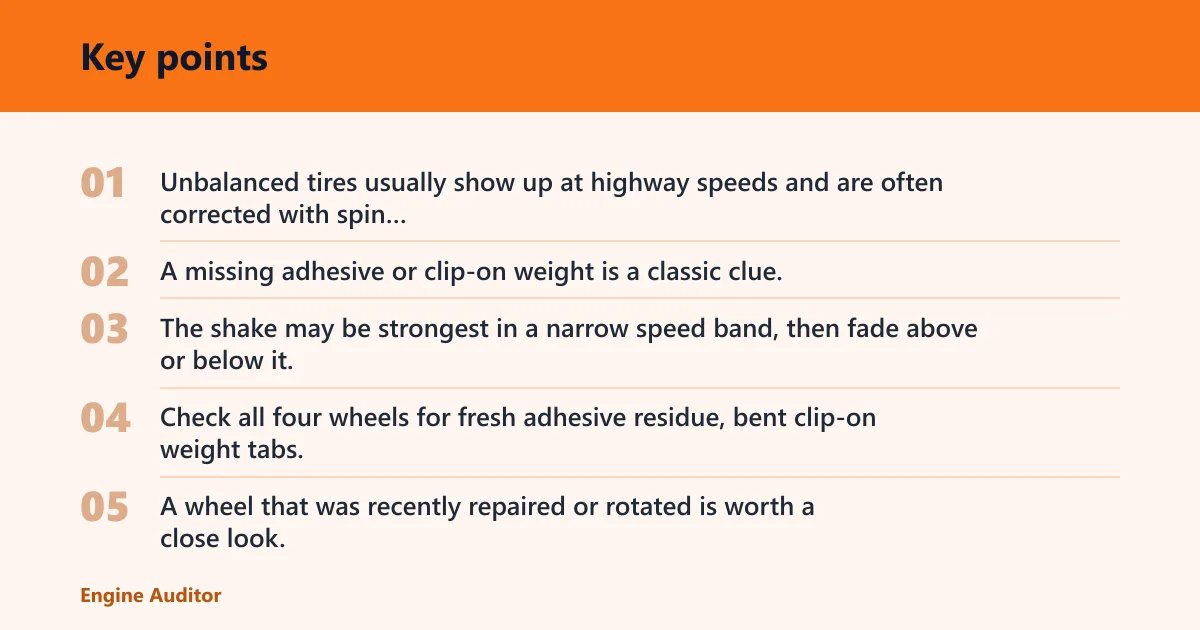
Unbalanced tires usually show up at highway speeds and are often corrected with spin balancing. A missing adhesive or clip-on weight is a classic clue. The shake may be strongest in a narrow speed band, then fade above or below it.
Check all four wheels for fresh adhesive residue, bent clip-on weight tabs, and mud or packed debris on the inner barrel. A wheel that was recently repaired or rotated is worth a close look.
Tire radial force variation that feels like imbalance
Tire radial force variation can mimic balance problems, but the root issue is tire stiffness variation rather than mass imbalance alone. It often becomes noticeable around about 50-70 mph and may not be fixed by standard balancing alone. That is why a shop may balance a tire, then still see the same shake on the road.
If the vibration stays after a proper balance, the tire itself may be the problem. Road-force testing, if available, can reveal a tire that pushes harder at one point in rotation.
How to tell if a bent wheel is causing the vibration
A bent wheel often follows a pothole or curb impact. It can create a cyclic shake and may show visible lateral or radial runout when spun. A balancer can reveal the problem, and a dial indicator can confirm it by measuring runout directly.
Picture a car that started shaking after a deep pothole hit on the right front. If the wheel is bent, the vibration may appear only at a certain speed and may not improve with balance alone.
Can tire wear or alignment cause the shake?
Yes, but the pattern usually points more toward instability and wear than a pure wheel shake. Alignment problems more often cause pull, crooked steering wheel position, and uneven tire wear. Cupping or scalloping on the tread can create a speed-related vibration that feels like a balance issue.
Cupping and scalloping as vibration clues
Cupped or scalloped tread blocks can thump the road once per wheel revolution. That noise and vibration often point to worn shocks or struts, weak damping, or an alignment issue that lets the tire hop. You can often see it by eye and feel it by running a hand across the tread.
A common first-timer mistake is to balance a tire with obvious scalloping and expect the shake to disappear. The tire may still vibrate because the wear pattern itself is the source.
Toe and camber problems that add instability
Toe and camber issues usually do not create a pure steering-wheel shake on their own. They more often cause tire wear, pull, drift, and a loose feel at speed. But when the tires wear unevenly, the worn tread can add vibration.
Alignment should be checked after suspension repairs, curb strikes, or pothole impacts. It is a follow-up check more often than a first diagnosis for a highway shake.
Why alignment is often a follow-up check
If the car shakes at 60 mph and the wheels are out of balance, alignment will not be the main fix. If the tires are cupped, the alignment and damping history matter more. In practice, alignment sits behind tire and wheel checks in the diagnostic order.
What suspension parts can make it shimmy?
Worn suspension and steering parts can add looseness, shimmy, or wandering, especially if the shake changes with bumps or steering input. Tie rods, ball joints, control arm bushings, and struts or shocks all deserve inspection when the wheels and tires do not explain the pattern.
Tie rods, ball joints, and control arm bushings
Loose tie rods or ball joints can let the wheel steer itself slightly over bumps or at speed. Worn control arm bushings can let the wheel move fore and aft under load. These faults often show up as play on a lift, not as a simple balance issue.
Check for torn boots, grease loss, and side-to-side play. A steering-wheel shake that changes when the road surface changes deserves this inspection.
Struts and shocks when tire cupping appears
Weak struts or shocks can let the tire bounce enough to create cupping and scalloping. That wear pattern then feeds vibration back into the cabin. If the tires show uneven scallops, damping should be part of the inspection, not an afterthought.
What a lift inspection should check for play
A lift inspection should check wheel play at 12-and-6 and 3-and-9 positions. The 12-and-6 check helps reveal ball joint or bearing play, while 3-and-9 points toward tie rods or steering linkage. Any looseness should be traced before parts are replaced.
What else should you inspect before replacing parts?

Start with the easiest checks and move toward deeper mechanical faults. Tire pressure, visible damage, missing weights, and tread wear come first. Then check wheel bearings, hub runout, brake rotors if the shake happens under braking, and only then start replacing steering or suspension parts.
- Check tire pressure on all four tires.
- Look for cuts, bulges, flat spots, and missing wheel weights.
- Inspect tread for cupping, scalloping, and uneven wear.
- Confirm whether the shake appears only at highway speed or also at lower speed.
- Note whether the shake changes during braking, acceleration, or coasting.
- Check wheel runout and balance the suspect wheels.
- Inspect wheel bearings, tie rods, ball joints, bushings, and shocks or struts for play.
- Measure rotor condition if the symptom appears mainly while braking.
- Check alignment after impact damage or suspension repairs.
Suppose the steering wheel shakes at 62 mph, stays steady on smooth pavement, and gets worse only when braking from highway speed. That pattern points first to a wheel and tire issue plus a brake check, not to a random suspension swap. The road-test notes matter as much as the lift inspection.
A shop should record the exact speed band, whether the shake is in the wheel or seat, whether braking changes it, and whether the road surface changes the symptom. Those notes often separate a front tire imbalance from a rear tire issue or a brake problem before any parts are removed.
Should you rotate or balance your tires first?
If the shake started at highway speed and there is no brake-only symptom, balance comes before rotation in most cases. Rotation can move the vibration around and help localize the source, but it does not correct imbalance, bent wheels, or force variation. If one wheel is suspect, inspect and balance that wheel first.
Is it safe to keep driving if the steering wheel shakes on the highway?
Light vibration that stays within one speed band is often a repair-now issue rather than an immediate stop-driving emergency, but it should still be checked soon. Stop driving sooner if the shake grows fast, the wheel feels loose, the car pulls hard, or the vibration appears with braking and steering instability. Those signs can point to a tire, wheel, or steering fault that may worsen quickly.
Frequently asked questions
Why does my steering wheel shake only at high speed?
High-speed shake usually points to a rotating problem that grows with wheel speed, such as imbalance, tire radial force variation, or a bent wheel. Those faults often become noticeable around 45-75 mph. If the shake disappears at lower speed, that clue matters more than a generic “something is loose” guess.
Is steering wheel vibration more likely to be tire balance or suspension?
At highway speed, tire and wheel issues are more likely than suspension wear when the steering wheel is the main place you feel the vibration. Suspension problems usually add looseness, wander, or shimmy over bumps. A lift check is still important, but balance and wheel condition usually come first.
Can bad alignment make the steering wheel shake at 60 mph?
Alignment problems can contribute to shake indirectly, but they more often cause pull, drifting, and uneven tire wear than a pure 60 mph vibration. Toe and camber issues matter more when the tires are already worn or the car has hit a curb or pothole. Check alignment after repairs or impact.
What tire problems cause shaking in the steering wheel?
Unbalanced tires, lost wheel weights, tire radial force variation, cupping, scalloping, and damaged tires can all send vibration into the steering wheel. A bent wheel can do the same. If standard balancing does not cure it, the tire or wheel may have a structural problem that needs closer inspection.
How do I tell if a bent wheel is causing the vibration?
A bent wheel often follows an impact and can cause a regular, cyclic shake that may not respond to balancing alone. Look for visible wobble, runout on a balancer, or measurement with a dial indicator. If the vibration started after a pothole hit, the wheel deserves priority inspection.
Can worn tie rods or ball joints cause shaking at speed?
Yes. Worn tie rods, ball joints, and control arm bushings can add looseness and shimmy, especially if the shake changes over bumps or during steering input. They are best checked for play on a lift, with attention to the 12-and-6 and 3-and-9 wheel positions and torn protective boots.
Products related to this article
Sponsored / affiliate links. As an Amazon Associate I earn from qualifying purchases. I may earn additional commission from eligible campaigns.