Can a Remote Start Help Warm the Cabin Faster in Winter?
Remote start can warm the cabin faster if the engine idles long enough for coolant to reach operating temperature, often about 5 to 15 minutes. In cold weather or on engines that warm slowly at idle, a cold vent after that window does not automatically mean there is a fault. Skipping the real issue wastes fuel and leaves you with poor defrosting, slow window clearing, and a cold drive. This guide explains the warm-up sequence and how to tell when remote start helps.
How remote start warms the cabin via coolant and heater core
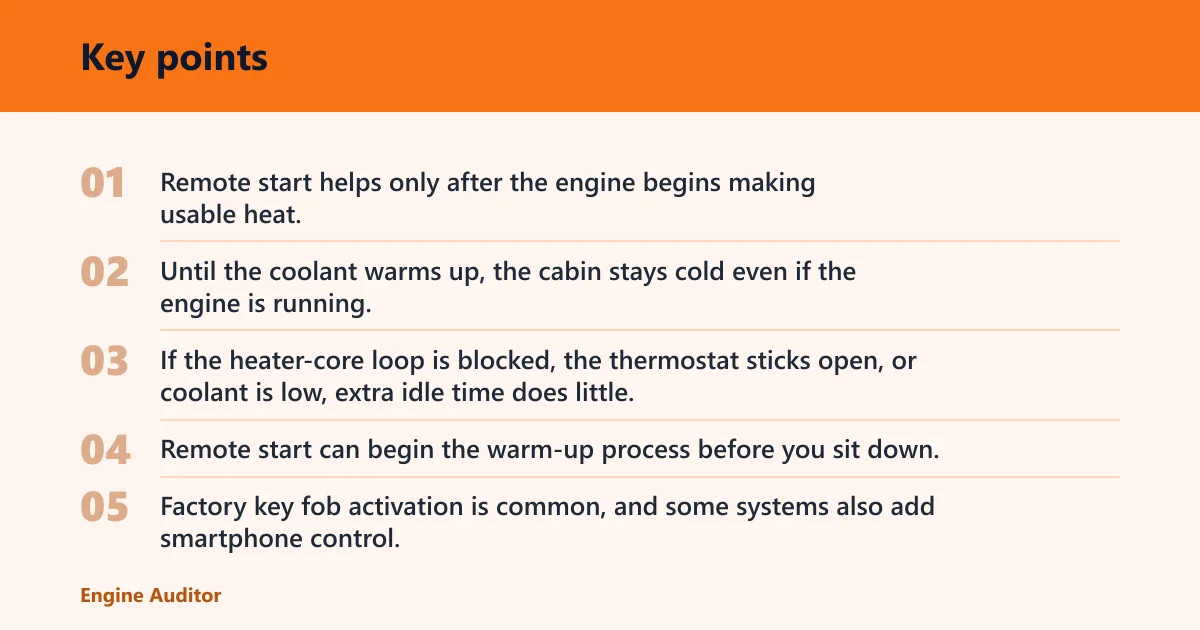


Remote start helps only after the engine begins making usable heat. The sequence is simple: cold engine, rising coolant temperature, heater-core heat transfer, then warmer air from the vents. On many vehicles the heater core can begin receiving hot coolant before the thermostat is fully open, so the cabin may start warming before the engine reaches full operating temperature. Until the coolant warms up, the cabin stays cold even if the engine is running.
That is why a remote starter is a comfort tool, not a repair. If the heater-core loop is blocked, the thermostat sticks open, or coolant is low, extra idle time does little.
What remote start can and cannot change
Remote start can begin the warm-up process before you sit down. It cannot create heat faster than the engine can produce and transfer it.
Factory key fob activation is common, and some systems also add smartphone control. Remote-start packages vary widely by vehicle and installer.
Why coolant temperature matters first
Engine coolant temperature is the gatekeeper. Once the coolant climbs high enough, hot coolant flows through the heater core, which is the small heat exchanger that feeds the cabin.
If the thermostat is stuck open, the engine may never build heat quickly enough in very cold weather. The blower then pushes air that feels lukewarm or cold, even after several idle minutes.
Does remote start actually warm the cabin faster in winter?
Yes, but only when the engine can idle long enough to raise coolant temperature before you drive. The cabin usually warms faster because the heater core receives hotter coolant and the vents start delivering warmer air before you enter. Cold weather can still slow the process because the engine loses heat to the surroundings faster.
Remote start is most useful when the outside temperature is low enough that the cabin, glass, and steering wheel begin very cold. It helps less on mild days, and it helps almost not at all when the heater system has a fault.
The heat-up sequence from engine to vents
- Start the engine remotely. Let the engine idle long enough for the coolant to begin rising from cold-start temperature. The goal is not idle time by itself; the goal is heat transfer into the coolant.
- Use the warm-up period wisely. As coolant warms, the heater core gets hotter coolant and cabin heat usually starts to improve. On many vehicles, that can happen before the engine is fully warm.
- Set the climate controls wisely. Use a moderate blower speed and a windshield-safe air distribution mode if visibility matters. A high fan setting can make cold air feel stronger before the heater core is ready.
- Drive once heat is available. Gentle driving often warms the engine faster than more idling because the engine is under light load and the cooling system moves heat more effectively than at a standstill.
Picture a sedan at 10°F with the fan on low and the defrost mode selected. After several minutes, the windshield may begin clearing because warmed air reaches the glass, but the rear seat area may still feel cold. That split result is normal.
Why colder weather can help and hurt the result
Cold weather can make remote start feel more valuable because the cabin starts from a deeper chill. It can also make the warm-up slower because the engine loses more heat to the air and the glass stays cold longer. Wind, snow, and short trips add to the delay.
Heated seats and a heated steering wheel often feel faster than cabin air because they warm your body directly. That is perceived warmth, not cabin temperature, and it is why a driver can feel comfortable before the air inside the vehicle is fully warm.
How long should you let it run?
A practical rule is to remote-start for about 5 to 15 minutes, then drive gently if the cabin air has begun warming. In very cold weather, a longer wait can help, but only up to the point where coolant temperature actually rises. If the air is still cold after that window, more idle time usually is not the fix.
Use the shortest run time that gets you usable heat and clear glass. That saves fuel and reduces unnecessary idling.
Practical run-time guidance by temperature band
| Outside temperature | Expected cabin benefit | Ideal remote-start run time | When remote start is not the answer |
|---|---|---|---|
| 32°F to 20°F | Noticeable comfort gain; glass begins to clear sooner | 5 to 10 minutes | If vents stay cold, check coolant level, thermostat behavior, and blower output |
| 19°F to 0°F | Strong benefit if the engine reaches normal warm-up | 10 to 15 minutes | If the cabin warms very slowly every day, suspect a heater-system fault |
| Below 0°F | Helps most with comfort and windshield clearing, but warm-up is slower | 10 to 15 minutes, then reassess | If the blower is weak or the thermostat is stuck open, more idle time will not solve it |
Suppose the outside temperature is 8°F and the engine has been idling for 12 minutes, but the vent air is still nearly cold. That points away from remote-start usefulness and toward a heater fault, a thermostat problem, or low coolant.
What affects the result most?
Three things dominate the outcome: engine coolant behavior, climate control setup, and the comfort features bundled with the vehicle. Remote start can speed the warm-up sequence, but it cannot overcome a bad heater circuit or poor airflow.
Engine coolant and thermostat behavior
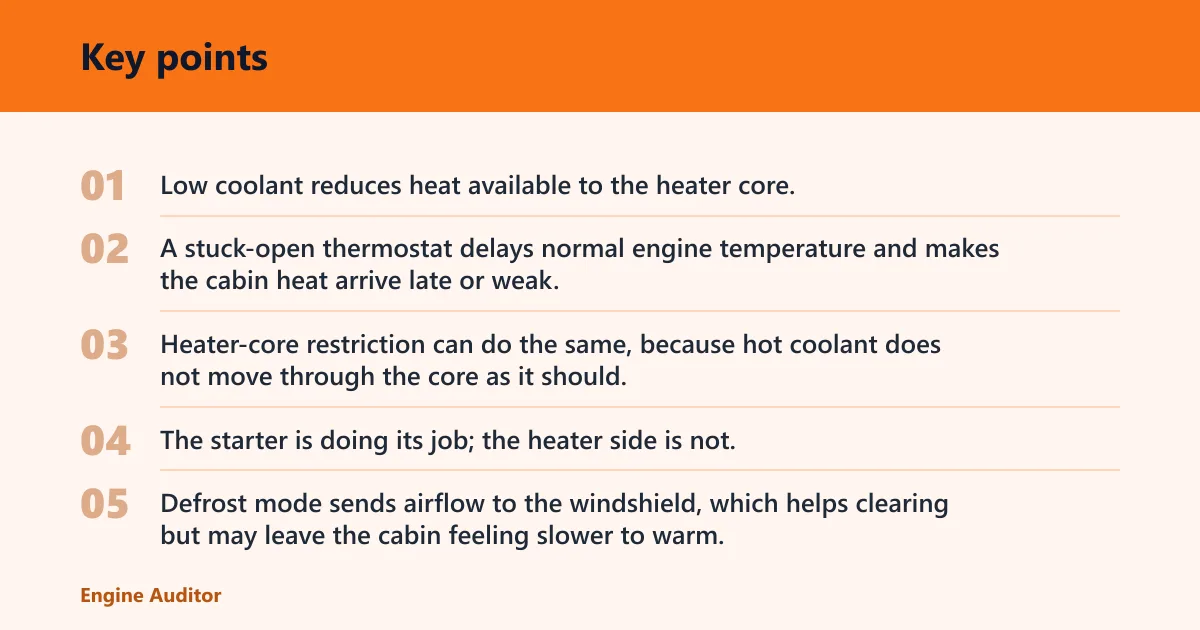
Low coolant reduces heat available to the heater core. A stuck-open thermostat delays normal engine temperature and makes the cabin heat arrive late or weak. Heater-core restriction can do the same, because hot coolant does not move through the core as it should.
That is why remote start sometimes appears useless when the real problem is inside the heating system. The starter is doing its job; the heater side is not.
Climate control settings and blower speed
Blower speed changes how quickly warm air reaches you, but a high setting can feel colder at first if the engine has not warmed yet. Air distribution mode matters too. Defrost mode sends airflow to the windshield, which helps clearing but may leave the cabin feeling slower to warm.
Use a setting that matches the goal. If you need clear glass, choose defrost. If you want faster cabin comfort after the windshield is clear, reduce fan speed and shift airflow toward the cabin.
Heated seats and heated steering wheels
Heated seats warm the body faster than cabin air alone. Consumer Reports notes that heated seats can warm you faster than the car’s heater. A heated steering wheel does the same for your hands. Both are comfort supplements, not replacements for a working heater. (Consumerreports)
These features matter most on short drives, where the engine may never fully warm before you arrive.
Winter warm-up decision table
This table separates real cabin benefit from heater-system problems. Use it to decide whether remote start is enough or whether the vehicle needs diagnosis.
| Condition | What you should expect | What to do | Likely issue if heat stays poor |
|---|---|---|---|
| Mild winter day, 32°F to 20°F | Cabin should begin to feel less cold within 5 to 10 minutes | Remote-start, then drive gently once the windshield begins clearing | Fan or thermostat issue if air stays cold |
| Cold day, 19°F to 0°F | Heat should improve clearly after about 10 to 15 minutes | Use defrost first, then lower fan speed after glass clears | Low coolant, stuck-open thermostat, or heater-core restriction |
| Very cold day, below 0°F | Heat may be delayed, but it should still improve with a healthy system | Allow a short remote-start window, then reassess after driving begins | Weak blower, poor airflow, or a thermostat that never closes properly |
| Any temperature, vents stay cold after 15 minutes | Remote start is not giving normal cabin heat | Stop treating idle time as the fix and inspect the heater system | Cooling-system or HVAC fault |
When remote start will not help much
Remote start will not meaningfully warm the cabin if the heater system cannot move heat into the vents. Low coolant, a stuck-open thermostat, weak blower performance, and heater-core restriction are the common failure cases. More idle time does not correct those problems.
If the defroster is slow and the vents stay cool after a normal warm-up window, treat that as a diagnostic clue. Do not assume the starter is too weak or too short-range.
Low coolant or heater-core problems
Low coolant can starve the heater core and reduce cabin heat. A restricted heater core can block the flow of hot coolant, which leaves the vents cool even when the engine seems warm. Both faults often show up as weak heat at idle and poor defrost performance.
Weak blower performance or poor airflow
A weak blower can make the cabin feel slow to warm because not enough air passes over the heater core. Poor airflow from clogged cabin filters or blocked vents can create the same symptom. If the engine is warm but the cabin is not, the airflow path deserves attention.
Stuck-open thermostat symptoms
A stuck-open thermostat can keep the engine from reaching normal temperature quickly. That often shows up as slow heat, especially on short trips and in very cold weather. The longer you let it idle, the more fuel you burn without solving the cause.
Is remote start worth using every cold morning?
It is worth using when it saves time, improves comfort, and the vehicle has a healthy heater system. It is less worthwhile if your owner’s manual or local rules discourage prolonged idling, or if the vehicle already has enough heat-producing features to make the cabin comfortable quickly.
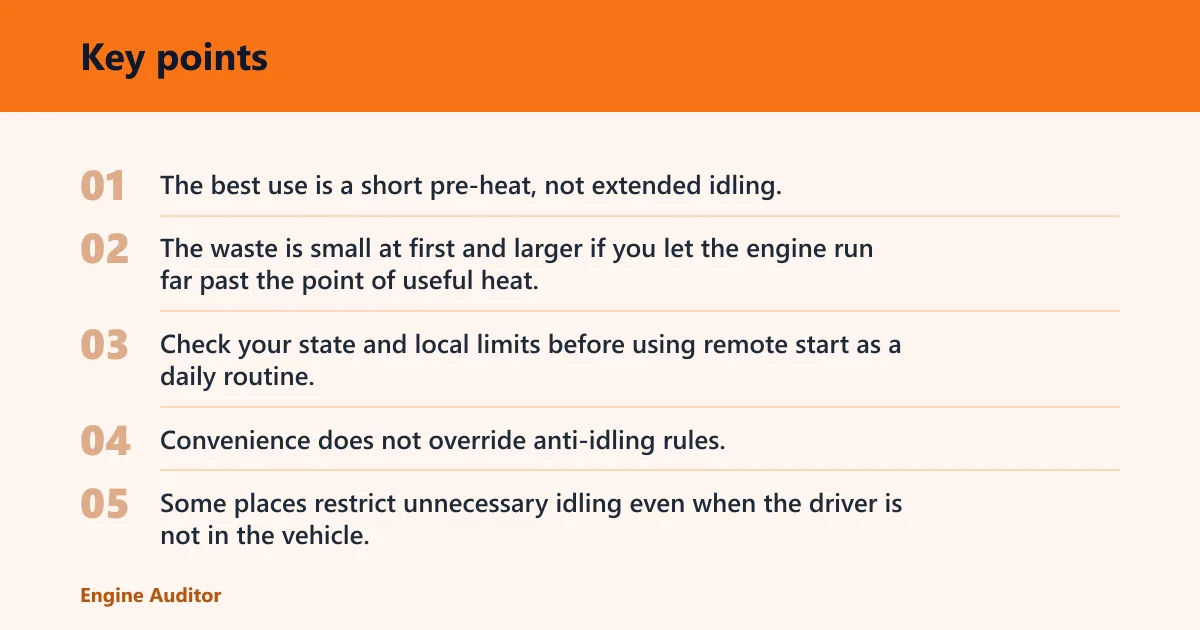
Remote start can use more fuel in winter because the engine is running while parked, and long idle periods may not add much heat once coolant is already warm. The best use is a short pre-heat, not extended idling.
Fuel use, idle time, and local compliance
Any idling burns fuel. The waste is small at first and larger if you let the engine run far past the point of useful heat. Local rules and owner’s manual guidance matter too, because allowed idle duration can be shorter than the time you want to wait. Check your state and local limits before using remote start as a daily routine.
Convenience does not override anti-idling rules. Some places restrict unnecessary idling even when the driver is not in the vehicle.
Best add-on features for faster comfort
Heated seats are often the fastest comfort upgrade for short winter drives. A heated steering wheel helps as soon as you touch it. Cold-weather packages may also include heated mirrors, wiper de-icers, and heated washer jets, which improve visibility and daily convenience.
The same source describes heated mirrors as using elements like the rear-window defroster. It also says heated windshield systems are rare and can be distracting. If visibility is the main winter problem, those features may be more valuable than a longer remote-start run.
Frequently asked questions
How long should I let my car run with remote start before driving?
A common rule is 5 to 15 minutes, depending on outside temperature and engine behavior. In mild cold, shorter is usually enough. In deep cold, give the coolant more time, then drive gently if the vents have started delivering warmer air.
Is remote start better than idling the car yourself in cold weather?
Remote start is usually better for convenience, but not for heat output by itself. The engine warms the same way either way. The real advantage is that you can begin the process before entering the vehicle, which shortens the time you spend in a cold cabin.
Will remote start help my defroster work faster too?
Yes, but only if the engine is producing warm coolant and the blower and defrost settings are working properly. Defrost performance depends on heated air, blower output, and how you direct that air to the glass. A broken heater system will still clear slowly.
Does remote start use more fuel in winter?
Usually yes, because the engine runs while the vehicle is parked and not moving. The longer the idle, the more fuel is burned. That tradeoff can be reasonable for comfort and visibility, but long idle periods add cost without adding much heat once the engine is warm.
Do all cars warm up at the same rate with remote start?
No. Engine size, thermostat behavior, diesel versus gasoline design, blower strength, and climate control programming all change the result. Some vehicles make usable heat quickly. Others need more time, and some show heater faults much sooner when remote start seems ineffective.
Products related to this article
Sponsored / affiliate links. As an Amazon Associate I earn from qualifying purchases. I may earn additional commission from eligible campaigns.