Why Does My Ford Escape Make a Clunking Noise?
A Ford Escape clunk usually comes from worn struts, control-arm bushings, sway-bar links, motor mounts, brake hardware, or a CV axle; stop driving if the clunk is sudden, steering-related, or paired with vibration. Left alone, that noise can turn into poor handling, longer stopping distance, or a failed joint or mount. This article maps the sound to the moment it happens so you can sort the likely fault and judge whether it is safe to drive.
When the clunk happens matters most
The moment the noise happens matters more than the word “clunk.” A single thud over one bump can point somewhere different from repeated clunks during steering lock, and a startup knock can point somewhere different again. On the Ford Escape, that split usually separates suspension wear from driveline movement or a loose mount.
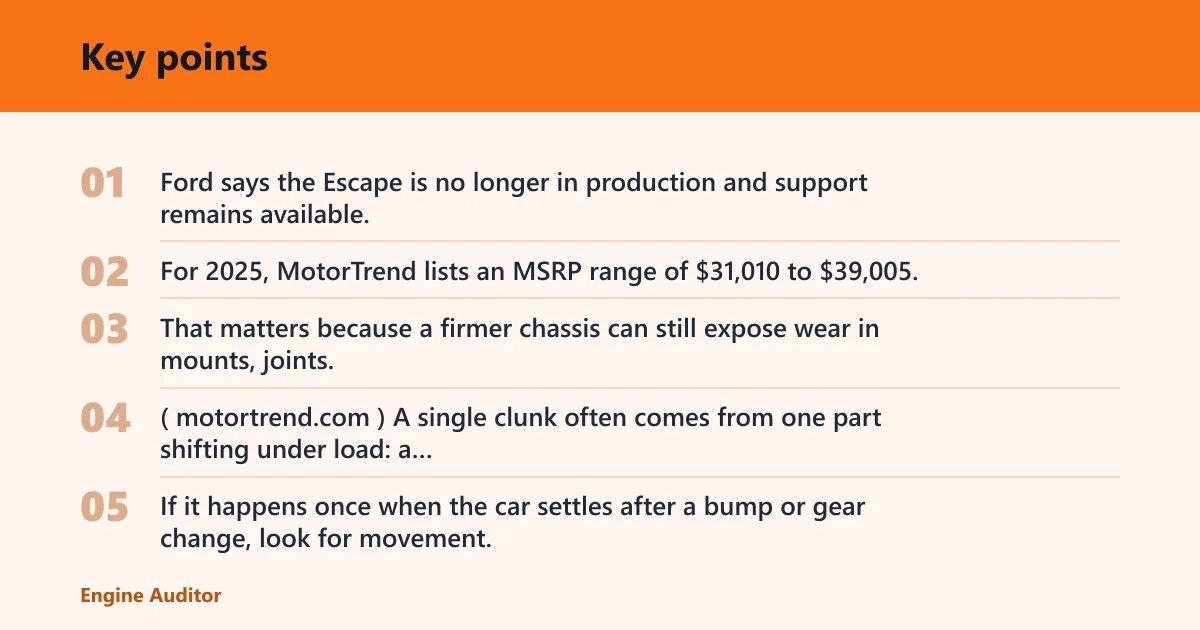
Ford says the Escape is no longer in production and support remains available. For 2025, MotorTrend lists an MSRP range of $31,010 to $39,005, says the Escape has two hybrid options, describes its driving feel as surprisingly sporty, and notes features such as a 1.5-liter turbo inline three-cylinder engine, a 2.0-liter turbo inline four-cylinder engine, and wireless Apple CarPlay and Android Auto on all 2025 models. That matters because a firmer chassis can still expose wear in mounts, joints, and bushings as a sharp noise. (Motortrend)
What a single clunk usually points
A single clunk often comes from one part shifting under load: a sway-bar link, control-arm bushing, loose brake hardware, a mount, or a subframe fastener. If it happens once when the car settles after a bump or gear change, look for movement, looseness, or contact marks rather than assuming the whole front end is worn out.
How repeated clunks differ from a one-time thud
Repeated clunks usually mean a rotating or cycling part is moving every time the wheel turns or the suspension compresses. Think tie-rod play, a bad outer CV joint, a wheel bearing with looseness, or a loose component that keeps tapping. A one-time thud is often a shift. Repeated noise is often wear.
Why the driving condition matters more than the sound alone
A clunk over bumps can point toward suspension or loose hardware. A clunk on acceleration can point toward mounts or an inner CV joint. A clunk on turns can point toward the outer CV joint, ball joints, tie rods, or wheel hub play. A clunk while braking can point toward pad hardware, caliper slide pins, or a shifting caliper bracket.
📊 MotorTrend lists the Escape’s 2025 MSRP range at $31,010 to $39,005. Source: Motortrend.
Escape clunking decision table
Use the condition that triggers the noise, not just the location you think you hear. This table narrows the source before you start replacing parts.
| Driving condition | Most likely source | Quick driveway check | Stop-driving threshold |
|---|---|---|---|
| Bumps | Sway-bar links, struts, control arm bushings, ball joints, loose underbody shields, exhaust hangers | Push down on each front corner, then inspect for hanging shields, torn bushings, and visible play at links or joints | Stop if steering feels loose, the noise becomes a metallic knock, or a wheel looks unstable |
| Turning | Outer CV joint, tie rods, ball joints, wheel bearing or hub play | Turn lock to lock in a parking lot and listen for clunks, clicking, or grinding that repeats with wheel angle | Stop if the steering wheel has free play, the car wanders, or the sound becomes harsh and constant |
| Acceleration | Inner CV joint, engine mounts, transmission mounts, subframe shift under load | Watch for engine movement while shifting from park to drive and during a light launch | Stop if the clunk is sharp on every takeoff or if vibration rises with speed |
| Braking | Pad hardware, caliper slide pins, loose bracket hardware, wheel movement under load transfer | Check for pad movement, loose caliper hardware, and lug nut torque | Stop if braking feel changes, the car pulls, or the noise becomes a repeated knock |
| Start-up | Engine mount, transmission mount, loose exhaust hanger, subframe or bracket shift | Listen during start and during the shift from park to drive while the hood is open and the vehicle is secured | Stop if the entire powertrain lurches, the clunk is violent, or the engine shifts more than a small amount |
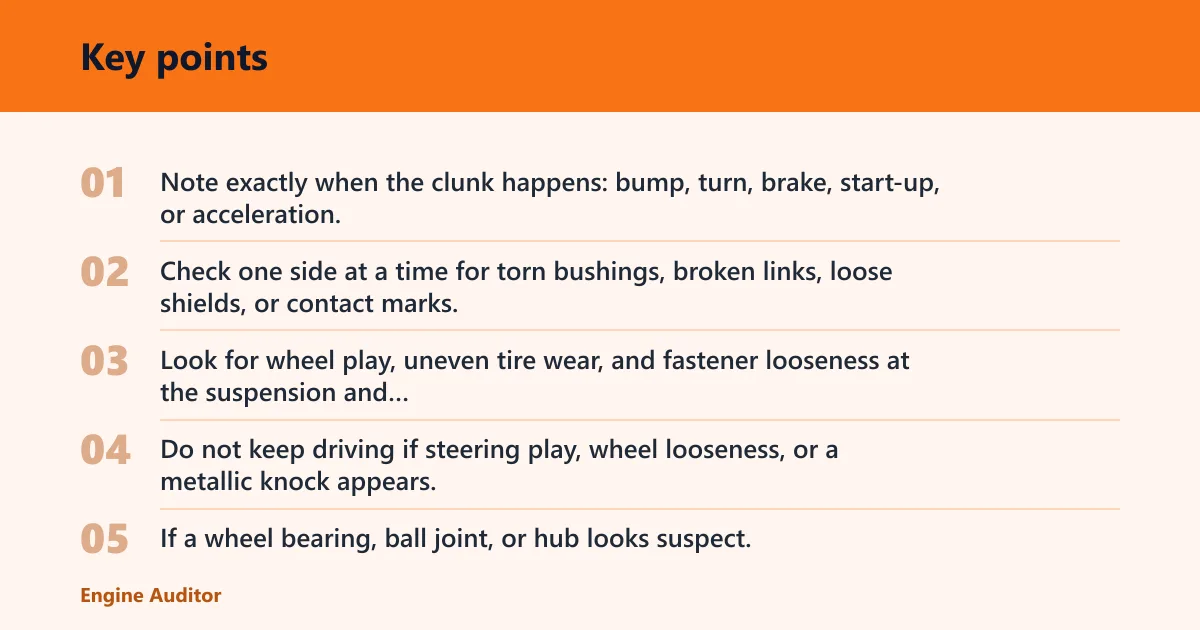
- Note exactly when the clunk happens: bump, turn, brake, start-up, or acceleration.
- Check one side at a time for torn bushings, broken links, loose shields, or contact marks.
- Look for wheel play, uneven tire wear, and fastener looseness at the suspension and subframe.
- Do not keep driving if steering play, wheel looseness, or a metallic knock appears.
- If a wheel bearing, ball joint, or hub looks suspect, arrange a tow rather than a longer road test.
Why does my Escape clunk over bumps?
A clunk over bumps usually means a suspension part is shifting as the body rises and drops. On a Ford Escape, the usual suspects are struts, sway-bar links, control arm bushings, ball joints, and loose underbody pieces. If the noise is most obvious at low speed on broken pavement, that pattern matters.
Struts and sway bar links
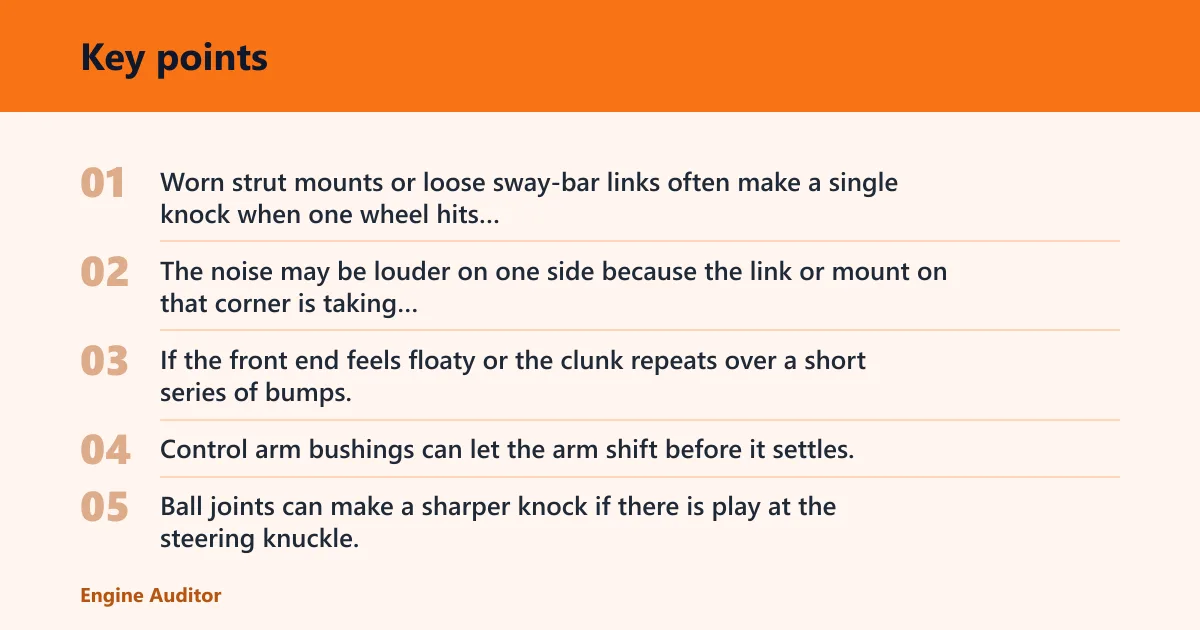
Worn strut mounts or loose sway-bar links often make a single knock when one wheel hits a sharp edge. The noise may be louder on one side because the link or mount on that corner is taking the load. If the front end feels floaty or the clunk repeats over a short series of bumps, those parts deserve priority.
Control arm bushings and ball joints
Control arm bushings can let the arm shift before it settles, which sounds like a dull clunk. Ball joints can make a sharper knock if there is play at the steering knuckle. These faults matter because they affect wheel location, not just comfort.
Loose underbody shields or exhaust hangers
Not every bump noise comes from the suspension. Loose shields, splash panels, heat shields, or exhaust hangers can tap the floor or subframe when the body twists. Suppose a clunk happens only on speed bumps and disappears on smooth pavement; a hanging shield can sound serious even though the fix is a fastener or hanger, not a major joint.
Why does my Ford Escape clunk when turning?
Turning-related clunks usually point to parts that move as steering angle changes. On the Escape, that includes the outer CV joint, tie rods, ball joints, and wheel hub bearings. A clunk that appears only at steering lock is more useful than a noise that happens everywhere, because it narrows the load path.
Outer CV joint clues
An outer CV joint more often clicks than it clunks, especially on tight turns at low speed. If the sound becomes a rhythmic click or clack on full lock, or if a grease boot is torn and grease is slung nearby, the joint is a strong suspect. A damaged boot can lead to joint wear quickly.
Tie rods and ball joints
Loose tie rods can produce a knock when the wheel changes direction, and a worn ball joint can pop or clunk as the suspension loads in a corner. These are steering safety parts, so any play at the wheel should be treated seriously. Do not keep driving if the steering feels vague or delayed.
Wheel bearing and hub play
A loose hub or worn wheel bearing can change tone with steering angle and vehicle speed. It may sound like a clunk at first, then become a growl or rumble as speed rises. If the wheel has side-to-side movement or the noise changes while weaving lightly in a lane, inspect the hub before driving farther.
Clunking on acceleration or start-up
Clunks under throttle or during the shift from park to drive usually point to load shift in the drivetrain. That can come from an inner CV joint, a soft or broken engine mount, a transmission mount, or a subframe that moves because a fastener has loosened. The sound often appears as one hard knock, then disappears until the next load change.
Inner CV joint behavior
An inner CV joint can clunk when torque loads the axle shaft, especially during takeoff or a low-speed roll-on. Unlike an outer joint, it may be quieter on turns and louder when you accelerate in a straight line. If the noise appears with a shudder, especially from low speed, the inner joint is a strong candidate.
Engine and transmission mounts
Mounts hold the powertrain in position while it moves slightly under load. When an engine mount or transmission mount is weak, the unit shifts and then stops against its limit, making a single clunk. A startup clunk or a knock during the shift from park to drive often comes from this movement, not from the suspension.
Subframe shift under load
Loose subframe bolts or worn suspension mounting points can let the front structure move under acceleration and braking. That can sound like a deeper knock that seems to come from the floor or firewall. If the sound changes after a pothole or after recent work, the mounting points deserve a close look.
A common first-timer mistake is blaming the brakes when the noise happens the instant the Escape moves off the line. If the clunk appears on the first foot of throttle and not on pedal application, the brake system is lower on the list than mounts or an inner CV joint.
Brake or wheel hardware sources
Brake parts can clunk, but they usually do it in a specific way. Pad hardware can shift over bumps, caliper slide pins can let the caliper move, and loose bracket hardware can knock when the vehicle weight transfers forward or back. Wheel and hub issues add another layer because they can also create speed-related noise.
Pad hardware and caliper slide pins
Missing or loose pad clips can let pads move in the bracket. Loose slide pins can let the caliper shift when you brake, then settle with a clunk when you release. If the sound appears on braking or right after shifting into drive and applying the pedal, check the brake hardware before assuming the suspension is bad.
Lug torque and hub looseness
Improper lug torque can let the wheel seat incorrectly and create clunking or tapping that changes with speed. Hub looseness can do the same, but with more risk. Inspect wheel torque and look for movement at the tire while the vehicle is safely supported. Any visible play calls for immediate attention.
Noise that changes with speed
If the sound rises and falls with wheel speed, the hub, bearing, or axle moves higher on the list. Brake clunks often track pedal use, not road speed. That difference helps separate a wheel-end issue from a mount or underbody rattle.
When the noise means stop driving
Some clunks are inspection items. Others are safety problems. Stop driving if steering play is present, if the wheel feels loose, if the noise turns into a metallic knock, or if the sound is getting worse quickly. Tow the Escape if a wheel-bearing failure, ball-joint failure, or major hub looseness is suspected.
Steering play and wheel looseness
Any looseness in the steering wheel, tie rods, ball joints, or hub can change the vehicle’s path before the driver expects it. That is not a comfort issue. It is a control issue. If the wheel wobbles by hand or the car does not respond cleanly, do not continue driving.
Metallic knock and fast worsening noise
A metallic knock means parts may be contacting metal directly. That can mean a broken link, a separated joint, or a mount that has failed completely. If the sound gets louder in a few miles, the vehicle should not be used for a longer trip.
Tow instead of driving
Choose a tow when the noise is paired with steering looseness, tire shake, hub play, or a ball joint that looks suspect. A short drive to “see if it gets worse” is the wrong move when the part can affect wheel control. One broken joint can turn a repair into a roadside recovery.
Say your Escape makes one hard clunk when shifting from park to drive, then nothing else at idle. That pattern points more toward a mount or subframe movement than a brake pad. Now suppose the same clunk appears every time the front left wheel crosses a driveway lip; the balance shifts toward strut, link, or bushing wear.
Frequently asked questions
Why is my Ford Escape making a clicking noise?
A clicking noise on a Ford Escape often points to an outer CV joint, especially if it happens on tight turns at low speed. Clicking can also come from a loose brake shield, worn tie rod, or hub issue. If the click becomes a clunk or starts showing up on acceleration, inspect it sooner.
What causes a clunking noise when driving?
Most clunking noises while driving come from suspension wear, loose brake hardware, worn mounts, or a CV axle problem. The key is when it happens. Bumps suggest suspension or loose hardware. Turns suggest steering or axle parts. Acceleration suggests mounts or an inner CV joint. That timing is the best clue.
What causes a knocking noise when driving?
A knocking noise can come from a worn strut, sway-bar link, ball joint, tie rod, loose subframe bolt, or mount that shifts under load. If the knock gets louder over rough pavement or appears with steering input, do not ignore it. A worsening knock can signal a part that is close to failure.
Why does my car make a clunking noise when I start it?
A start-up clunk usually points to engine or transmission mounts, exhaust hangers, or a loose subframe or bracket that shifts when the powertrain loads. If the noise happens right as the selector moves from park to drive, that also fits a mount-related problem. It is less typical of brake wear.
Why does my car clunk when turning?
Clunking on turns often comes from the outer CV joint, tie rods, ball joints, or wheel bearing and hub play. A repeatable clunk at steering lock is especially useful because it narrows the load path. If the steering feels loose or the sound changes with vehicle speed, get it checked promptly.
Is a clunking noise from the front end dangerous?
It can be. A front-end clunk may be harmless loose hardware, or it may be a steering, hub, or ball-joint problem that affects control. If you feel steering play, hear a metallic knock, or suspect wheel looseness, stop driving and arrange inspection or towing. That is the safe threshold.
Why is my Ford Escape making a clicking noise?
If the clicking happens only while turning, the outer CV joint moves to the top of the list. If it appears with speed, inspect the hub and axle. If it is tied to brake use, look at pad hardware and caliper pins. The fix depends on the trigger, not the noise label.
Products related to this article
Sponsored / affiliate links. As an Amazon Associate I earn from qualifying purchases. I may earn additional commission from eligible campaigns.