How to Spot a Bad Alignment Before It Gets Worse
A bad alignment can show up as a steering wheel that sits off-center, a pull on flat roads, or uneven tire wear; if it starts right after a pothole or curb hit, book service soon. Ignore it, and you can shorten tire life fast, make the car wander, and hide suspension damage. This guide shows how to spot a bad alignment before it gets worse, rule out tire pressure, balance, and brake causes, and decide when the problem is urgent.
Signs of a bad alignment
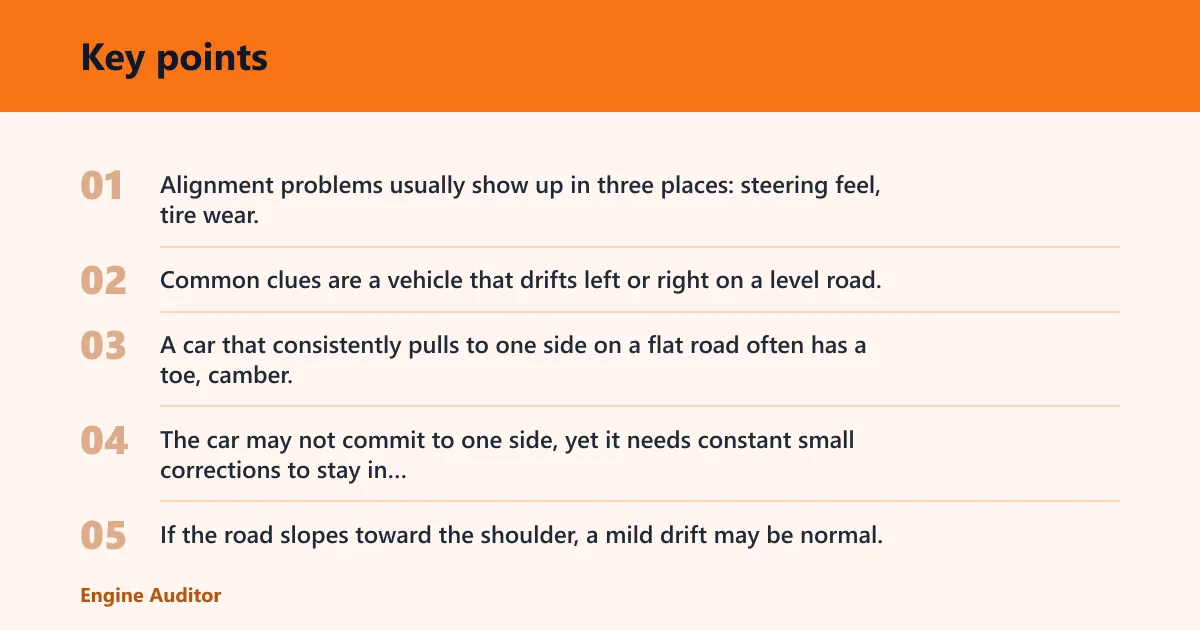


Alignment problems usually show up in three places: steering feel, tire wear, and straight-line tracking. Common clues are a vehicle that drifts left or right on a level road, a steering wheel that is no longer centered when driving straight, and tire wear that looks uneven across the tread.
Vehicle pull and wandering
A car that consistently pulls to one side on a flat road often has a toe, camber, or caster issue, but it can also be caused by tire pressure differences or brake drag. Wandering is different. The car may not commit to one side, yet it needs constant small corrections to stay in lane.
Road crown can fool you here. If the road slopes toward the shoulder, a mild drift may be normal. The test is simple: on a level road at steady speed, a bad alignment usually shows the same pull every time, while road crown changes with lane position and road shape.
Steering wheel centering
An off-center steering wheel while the car travels straight is a common early warning sign. That usually points to toe being off, because toe affects straight-line tracking first. The wheel should sit centered on a level road after the car has been aligned to measured specifications, not eyeballed.
What vibration does and does not mean
Alignment alone is not usually the cause of vibration. If the steering wheel or seat shakes, start with tire condition, wheel balance, bent wheels, or damaged suspension parts. A vibration that appears at a specific speed is much more likely to be a tire or wheel problem than a pure alignment issue.
Say your sedan starts drifting right after a front tire rotation, and the steering wheel is 10 degrees off-center on a level road. That pattern points first to alignment or tire pressure, not a suspension collapse. If the pull remains after pressures are corrected, the car needs a measured alignment check.
What causes alignment issues?
Most alignment problems start with impact or worn parts. A pothole, curb strike, or accident can bend a wheel, shift a steering component, or knock an angle out of specification. Over time, worn tie rods, control arms, ball joints, struts, or bushings can make the settings drift again.
Pothole or curb impact
A hard impact is the most common sudden trigger. Even if the tire still holds air, the hit can change toe, bend a control arm, or damage a wheel. If the problem started right after the impact, the car needs more than an alignment check if parts are bent.
Worn suspension components
Alignment will not stay in spec if the suspension has play. Tie rod ends, control arm bushings, ball joints, and strut mounts all affect how the wheels sit under load. If a car needs repeated alignments in a short period, the issue is often wear in one of those parts.
Ride-height changes and sagging parts
Camber changes when ride height changes. Sagging springs, worn struts, or altered suspension parts can tilt the wheel enough to create shoulder wear and handling changes. In that case, correcting alignment without fixing the height or worn part usually leads to the same problem returning.
Wheel alignment angles explained
Wheel alignment is the measured setting of toe, camber, and caster. These angles must be checked against manufacturer specifications. A visual guess is not enough, because small differences can change tire wear and steering feel before the car looks obviously wrong.
Toe angle and straight-line tracking
Toe is the direction the front wheels point relative to each other. If they point slightly inward, that is toe-in; slightly outward is toe-out. Toe is a common cause of rapid edge wear and usually affects straight-line tracking first, so it often shows up as pull or a steering wheel that sits off-center.
Camber angle and tire shoulder wear
Camber is the inward or outward tilt of the wheel at the top. Excess negative camber can wear the inner shoulder, while excess positive camber can wear the outer shoulder. Camber problems often point to suspension damage, sagging parts, or ride-height changes more than to a simple toe drift.
Caster angle and return-to-center feel
Caster affects how the steering returns to center after a turn and how stable the car feels in a straight line. A caster problem is often less obvious in tire wear than toe or camber, but it can make the car feel darty, heavy to center, or biased to one side.
Front-end vs four-wheel alignment
Some vehicles need a front-end alignment only. Others need a four-wheel alignment because the rear angles influence thrust line and steering wheel centering. If the rear is out of spec, the front can be adjusted correctly and the wheel can still sit crooked on the road.
Tire wear clues that point to alignment
Tire wear patterns help separate toe, camber, and other faults. Check all four tires, not just the one that looks worst. One worn tire can point to a local issue, while matching wear on both sides often suggests a broader alignment or suspension problem.
Feathering across the tread
Feathering feels smooth in one direction and sharp in the other when you run a hand across the tread blocks. That pattern often points to toe error. It usually appears across the tread rather than only on one shoulder, and it may be easiest to feel before it is obvious by eye.
Inner-edge and outer-edge wear
Inner-edge wear often points to too much negative camber or toe that is too far in. Outer-edge wear can point to positive camber or toe that is too far out. Check both shoulders on all four tires before deciding it is alignment, because low pressure can wear the edges too.
Cupping versus balance-related wear
Cupping looks like scalloped dips around the tread. That pattern is more often tied to shock or strut problems, loose suspension parts, or imbalance than to alignment alone. If the tire is cupped, do not stop at an alignment check; inspect the suspension and wheel balance too.
Suppose a front tire has heavy inner-edge wear and the other three tires look normal. That can happen with a toe or camber issue on one corner, but it can also follow a bent part after a curb hit. The next step is not a guess; it is a measured alignment inspection plus a suspension check.
Alignment symptoms versus lookalikes
Before assuming alignment, rule out the lookalikes. Tire pressure, brake drag, and wheel balance can mimic parts of the same problem. The fastest way to avoid a wrong repair is to sort the symptom by what it does on the road and what the tires look like.
Check tire pressure first
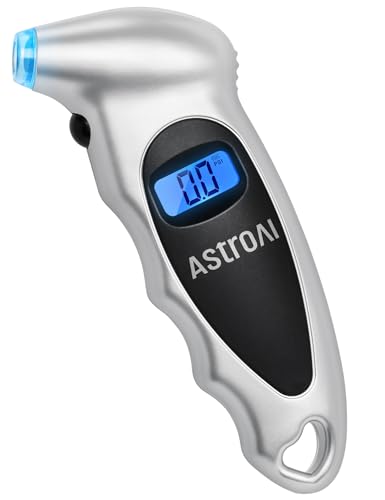
Set all tires to the door-jamb specification when the tires are cold. Underinflation can make the car pull, wander, and wear the shoulders of the tire. If pressure is uneven side to side, fix that before diagnosing alignment. A bad pressure reading can create a false alignment complaint.
Rule out brake drag
Brake drag can cause a pull to one side, heat at one wheel, and poor fuel economy. After a short drive, a dragging brake often leaves one wheel much hotter than the others. If a pull is accompanied by a hot wheel or burning smell, alignment should not be the first assumption.
Separate alignment from wheel balance
Wheel balance problems usually create vibration, often at a particular speed range. Alignment problems usually create drift, off-center steering, or wear. If vibration is the main complaint and the car does not pull, balance and tire condition should come before alignment as the likely cause.
When road crown can fool you
Many roads slope to the right for drainage, so a slight rightward drift can be normal. The comparison test is simple: if the pull changes when you switch lanes or roads, the surface may be at fault. If the same side pull stays present on several flat roads, diagnosis should continue.
Alignment symptom check table
This table helps you map the symptom to the likely cause, how urgent it is, and the first next step. Use it as a triage tool, not a final diagnosis. A bad alignment can share signs with tire pressure, brake drag, or wheel balance, so each clue needs a rule-out step.
| Symptom | Likely cause | Rule out first | Urgency | Next step |
|---|---|---|---|---|
| Pulls left or right on a flat road | Toe, camber, or caster off; also possible road crown | Tire pressure and brake drag | Moderate, sooner if the pull is strong | Check cold tire pressures, then book a measured alignment check |
| Steering wheel is off-center when driving straight | Toe setting out of spec, sometimes thrust line issue | Tire pressure | Moderate | Have the alignment measured and set to spec |
| Feathered tread across the tire | Toe wear | Wheel balance and uneven inflation | Moderate, because wear can accelerate fast | Inspect all four tires, then get alignment checked |
| Inner-edge or outer-edge wear | Camber or toe, sometimes ride-height changes | Tire pressure | Moderate to urgent if cords are near | Inspect suspension height and wear, then align to spec |
| Vibration at one speed | Wheel balance, bent wheel, tire defect, or suspension damage | Alignment alone is unlikely | Urgent if the vibration is strong or growing | Check tires and wheels first, then inspect suspension |
| Starts after pothole or curb impact | Bent wheel, tie rod, control arm, or alignment shift | Tire pressure and visible tire damage | Urgent if the pull is severe or the car feels unstable | Have the wheel and suspension inspected before a final alignment |
When should you get it checked?
Get it checked soon after any pothole or curb hit, after a new wear pattern appears, or if the steering wheel keeps going off-center after being corrected. If the alignment will not stay in spec, that is a sign of worn or bent suspension parts, not just a settings problem.
After a pothole or curb hit
If the pull starts immediately after the impact, do not wait for the tires to wear further. A bent tie rod, wheel, or control arm can make the car unsafe or keep the alignment from holding. The more severe the impact, the more urgent the inspection.
After new tire wear appears
New feathering, inner-edge wear, or outer-edge wear means the problem is active. A worn tire will not fix itself, and the remaining tread can disappear quickly if the angle is far enough out. If cords are showing, the tire is already a safety issue.
If the wheel keeps going off-center
An alignment that is set correctly but drifts out again points to loose or worn parts. Tie rods, control arms, ball joints, struts, and bushings should be inspected for movement, damage, or play. Repeated realignment without that inspection usually wastes time and money.
If alignment will not stay in spec
When the numbers keep moving, the problem is often mechanical rather than just geometric. That is why the final fix may involve a suspension repair, not only a four-wheel alignment. The measured spec matters because the car has to be aligned to a target, not to a visual estimate.
How do I know if my alignment is off?
Check for a pull on a level road, an off-center steering wheel, wandering that needs constant correction, and tire wear that is uneven across the tread. Then rule out tire pressure, brake drag, and wheel balance. If those checks do not explain the symptoms, a measured alignment is the next step.
Good and bad alignment examples
A good alignment keeps the car tracking straight, lets the steering wheel sit centered, and leaves the tread wearing evenly across all four tires. A bad alignment may make the wheel sit crooked, make the car drift, or create one-sided wear long before the car feels obviously loose.
How long can I drive with a bad alignment?
There is no single safe mileage estimate that fits every case. A mild drift from road crown is different from a strong pull after a curb hit or a tire with visible edge wear. If the tire is wearing quickly, the steering feels unstable, or the symptom began after impact, do not keep driving as if nothing changed.
Frequently asked questions
What causes bad alignment?
Bad alignment is usually caused by impact or wear. Potholes, curbs, and accidents can bend parts or shift angles. Over time, worn tie rods, control arms, ball joints, struts, and bushings can let toe, camber, or caster drift out of specification again.
Can a bad alignment cause vibration?
Usually, no. Vibration points first to tire balance, a bent wheel, a tire defect, or damaged suspension parts. Alignment can coexist with those issues, but if vibration is the main symptom, it is smarter to inspect the tires and wheels before assuming alignment is the cause.
What are the signs of a bad alignment?
The main signs are pull, wandering, an off-center steering wheel, and uneven tread wear. Toe often shows up first as straight-line drift or feathering. Camber shows up more as inner-edge or outer-edge wear. Caster usually changes return-to-center feel and straight-line stability.
What causes alignment issues after hitting a pothole?
A pothole can bend a wheel, shift toe, or damage steering and suspension parts. Even if the tire still holds air, the impact can change how the wheel sits under load. If the pull started right after the hit, the car needs an inspection, not only an alignment.
How do I fix my alignment?
Start by checking cold tire pressures and looking for obvious tire damage. If symptoms remain, a shop should measure toe, camber, and caster against the vehicle’s specifications and inspect the suspension for wear or impact damage. If parts are bent or loose, repair them before the final alignment is set.
What causes poor alignment?
Poor alignment is usually the result of impact, worn suspension parts, or changes in ride height. It can also return if the underlying problem was never fixed. If the car keeps going out of spec, the issue is often mechanical, not just a one-time adjustment error.
Products related to this article
Sponsored / affiliate links. As an Amazon Associate I earn from qualifying purchases. I may earn additional commission from eligible campaigns.