How to Build a Car Care Budget That Actually Works
A common rule of thumb is to set aside about 1% to 2% of the car’s value per month for car care, then split it into scheduled maintenance, wear items, and emergency repairs; older cars often need the higher end of that range. Underbudgeting turns routine ownership into surprise bills and deferred repairs. This guide shows how to set each bucket, include registration, and adjust the monthly number for your car’s age and mileage.
What a car care budget includes


- Tracks car maintenance and repairs
- Records oil changes and other services
- Organizes auto expenses and logs
A car care budget is often easier to manage when fixed costs are kept separate from variable costs, then the variable side is split into routine maintenance, wear-item replacement, and true emergency repairs. Add annual registration and inspection fees as monthly equivalents so the total reflects the full cost of keeping the car road-legal and reliable.
Routine maintenance follows time or mileage triggers. Wear items follow service life. Emergency repairs are the uncertain part, and that is why they need a reserve instead of a guess.
Costs to group by bucket
- Routine maintenance: oil changes, tire rotations, fluid checks, filters, and scheduled service.
- Wear items: brake pads, wiper blades, battery, belts, hoses, and tires.
- Emergency repairs: diagnostics, tow charges, out-of-pocket deductible amounts, and surprise mechanical failures.
- Yearly fees: registration, inspection, and renewal charges.
What you’ll need
Gather records first. A useful budget depends on the car’s actual service pattern, not a generic monthly guess.
- Mileage log or odometer history
- Past service invoices and receipts
- Current insurance deductible amount
- Registration and inspection fee totals
- A simple monthly tracker, paper ledger, or budgeting app
How do you set the monthly number?
Start with annual routine maintenance, add an annual wear-item reserve, and add an annual emergency reserve. Then divide the yearly total by 12. That gives you a car-care sinking fund contribution: a separate account or envelope that gets replenished after you spend from it.
If your annual total is about $2,400, your monthly sinking-fund contribution is about $200. If you spend $600 on tires, the reserve drops and the next deposits refill it.
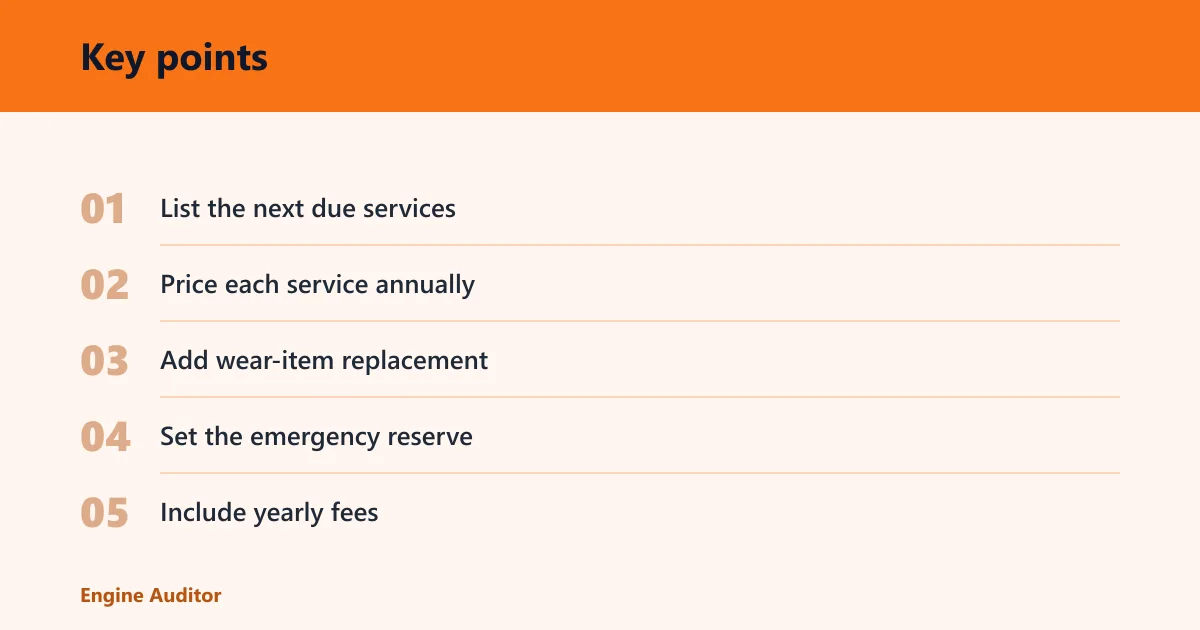
- List the next due services. Use the mileage log to find oil changes, rotations, fluid checks, and filters due within the next 12 months.
- Price each service annually. If oil changes are due every 5,000 miles and you drive about 15,000 miles a year, budget for about three oil changes.
- Add wear-item replacement. Include brake pads, wiper blades, battery, belts, hoses, and a tire fund for pair or four-tire purchases.
- Set the emergency reserve. Use a minimum starting balance for diagnostics and towing, then raise it for older or less reliable cars.
- Include yearly fees. Divide registration and inspection totals by 12 and add that monthly equivalent to the fund.
- Divide by 12. Add the annual totals, then divide by 12 for your monthly contribution.
- Top up after any spend. Add the exact amount spent, then recheck the monthly target the next cycle.
Step 1: total routine maintenance
Use mileage or time triggers for oil changes, tire rotations, fluid checks, and filters. Pull the next due services from your records, then convert each one to an annual cost. If the vehicle has a 7,500-mile oil interval and you drive about 18,000 miles a year, plan on about three oil changes rather than one.
Scheduled service records matter here. A mileage log and past invoices show what already happened and what comes due next, which prevents paying twice for the same service.
Routine maintenance worksheet
| Service | Trigger | Times per year | Annual cost |
|---|---|---|---|
| Oil change | Every 5,000 to 7,500 miles or 6 months | 2 to 4 | Fill in |
| Tire rotation | Every 5,000 to 7,500 miles | 2 to 4 | Fill in |
| Fluid and filter checks | Time or mileage based | 1 to 2 | Fill in |
Step 2: build wear-item reserves
Estimate brake pads, wiper blades, battery, belts, and hoses by service-life range, then create a separate tire fund for replacement and alignment-related costs. Tires often come as a pair or a full set of four, so the reserve should match that purchase pattern rather than a single-tire price.
A common first-timer mistake is treating brakes and tires as routine maintenance. They are wear items. They arrive on their own schedule, and the budget needs room for that timing.
Typical wear-item ranges
- Brake pads: often about 30,000 to 70,000 miles, depending on driving and vehicle weight.
- Wiper blades: about 6 to 12 months.
- Battery: about 3 to 5 years in many cars.
- Belts and hoses: often inspected at major service intervals and replaced by condition or age.
- Tires: commonly 30,000 to 60,000 miles, plus alignment if wear is uneven.
How much should you save for repairs?
Set an emergency repair reserve with a minimum starting balance that can cover a diagnostic scan and a tow, then raise the target for older vehicles or cars with unreliable history. If you would need cash before an insurance claim payout, match the reserve to your deductible so the repair budget reflects the actual out-of-pocket hit.
Older cars do not all need the same number. Mileage, deferred maintenance, and past failures change the target. A car with incomplete records deserves a larger reserve than one with consistent service invoices.
Emergency reserve targets
- Minimum starting balance: enough for diagnosis plus towing.
- Older vehicle target: higher than the minimum, especially if the car is beyond 100,000 miles.
- Deductible match: keep cash equal to the deductible if a repair could go through insurance.
Car care budget worksheet
Use this fill-in formula: annual routine maintenance total + annual wear-item reserve + annual emergency reserve, divided by 12. Add annual registration and inspection to the yearly total before dividing, because those costs arrive once a year but still belong in the monthly number.
| Budget line | Your annual amount | Monthly contribution |
|---|---|---|
| Routine maintenance | $_____ | Annual amount ÷ 12 |
| Wear-item reserve | $_____ | Annual amount ÷ 12 |
| Emergency reserve | $_____ | Annual amount ÷ 12 |
| Registration and inspection | $_____ | Annual amount ÷ 12 |
| Total | $_____ | Total ÷ 12 |
Sample completed budgets
| Vehicle profile | Routine maintenance | Wear-item reserve | Emergency reserve | Registration/inspection | Annual total | Monthly contribution |
|---|---|---|---|---|---|---|
| Low-mileage car | $300 | $400 | $300 | $120 | $1,120 | $93.33 |
| Average-mileage car | $600 | $700 | $500 | $150 | $1,950 | $162.50 |
| High-mileage car | $900 | $1,000 | $900 | $180 | $2,980 | $248.33 |
Common mistakes
Most budget problems come from merging different costs into one pile. Keep maintenance, wear items, and emergency repairs separate so one large bill does not wipe out money meant for oil changes or tires.
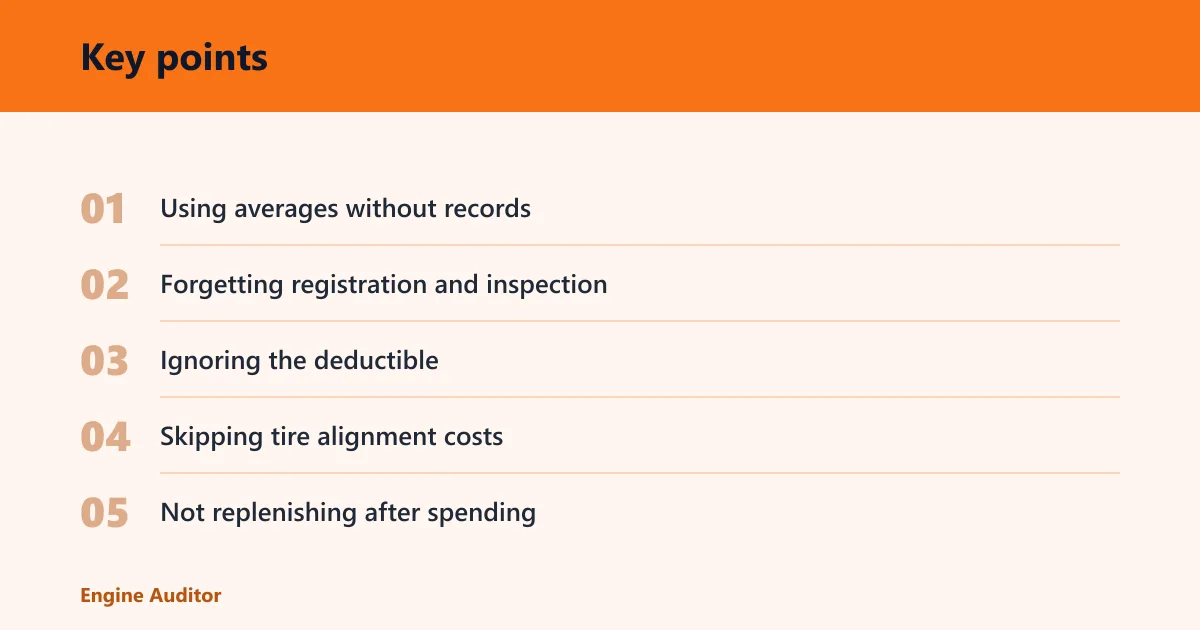
- Using averages without records: check invoices and mileage instead.
- Forgetting registration and inspection: divide yearly fees by 12.
- Ignoring the deductible: cash needed before payout still counts.
- Skipping tire alignment costs: uneven wear usually brings extra expense.
- Not replenishing after spending: refill the sinking fund after each repair.
Suppose the car has deferred maintenance. Suppose a sedan is due for plugs, two tires, and a battery this year because records show they were skipped last cycle. Budget those items now, not later. The monthly number should rise until the catch-up work is paid for, then settle back to the normal target.
Prevention
Review the mileage log after each service and compare it with the next due interval. That one habit keeps the reserve tied to actual need instead of guesswork.
Frequently asked questions
What is a car in budgeting?
In a budget, a car is a recurring cost center with fixed items like insurance and registration plus variable items like tires and repairs. Treat it as a separate category so you can plan for ownership costs instead of absorbing them into general spending.
How much should I set aside each month for car maintenance?
Use the annual total from routine maintenance, wear-item reserves, emergency repairs, and yearly fees, then divide by 12. For a low-mileage car, that may land near $90 a month; higher-mileage cars often need closer to $150 or more, depending on records and condition.
What expenses belong in a car care budget?
Include oil changes, tire rotations, filters, fluids, brake work, tires, wiper blades, batteries, belts, hoses, diagnostics, towing, registration, inspection, and the insurance deductible amount if you might pay it before reimbursement. Gas and insurance belong in the broader car budget too.
How do I budget for tires, oil changes, and repairs?
Put oil changes and rotations into routine maintenance, tires into a separate wear-item fund, and repairs into an emergency reserve. A tire fund should assume pair or four-tire purchases plus alignment-related costs. That structure keeps one big expense from draining every other category.
How do I budget for car care on an older car?
Raise the wear-item and emergency reserves, not just the maintenance line. Older cars often need a higher monthly contribution because belts, hoses, brakes, batteries, and suspension parts are closer to replacement. Use service records and mileage, not age alone, to set the number.
Products related to this article
Sponsored / affiliate links. As an Amazon Associate I earn from qualifying purchases. I may earn additional commission from eligible campaigns.