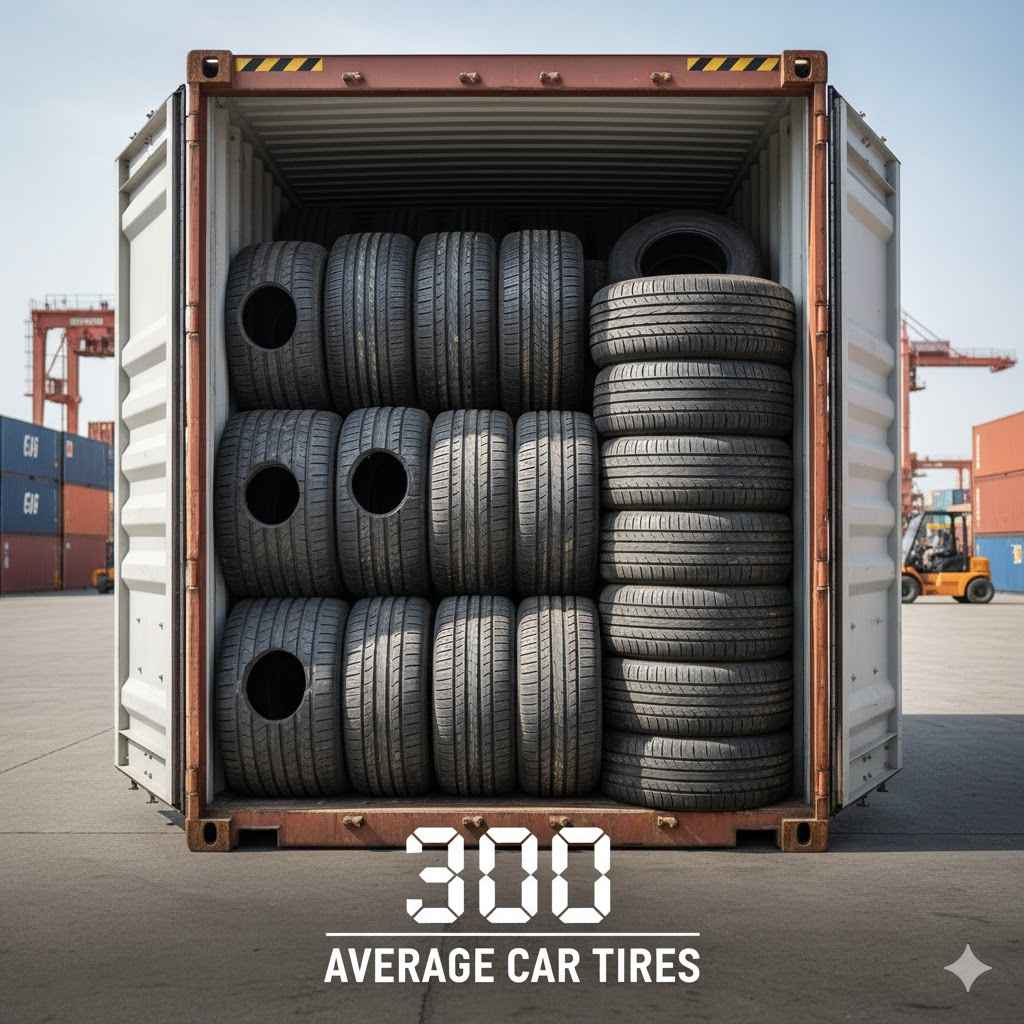
How Many Car Tires Fit In A 20ft Container
Figuring out how many car tires fit in a 20ft container can seem like a puzzle, especially if you’re new to shipping or logistics. It’s a question many people ask when they need to move a lot of tires, and it’s not always obvious. The answer depends on a few simple things we’ll break down easily.
Don’t worry, we’ll walk through it step by step so you can get a clear idea without any confusion. We’ll cover everything you need to know to get a good estimate.
Estimating Tire Volume For Shipping
When you start thinking about shipping tires, the first big question is how much space they actually take up. Tires aren’t flat boxes; they’re round and can be squished a bit, but they still need significant room. Understanding their volume helps you guess how many will fit into a standard shipping container.

Antego Tire & Wheel
Antego 18x8.50-12 Flat Free Golf Cart Tire…
- Set of 4 Tire & Wheel Assemblies: Includes four Antego branded 18x8.50-12 flat free golf cart tire and wheel assemblies. These com…
- Flat Free Golf Cart Tire Design: Built to help eliminate flat tires, air pressure checks, tubes, and puncture-related downtime. Th…
- 18x8.50-12 Golf Cart Size: Designed for carts that use 18x8.50-12, 18x8.5-12, or 18x8.50x12 tires. This low-profile 18-inch tire o…
As an Amazon Associate I earn from qualifying purchases.
This is a key step for anyone planning to move tires, whether for a business or a personal project.
Tire Dimensions And Their Impact
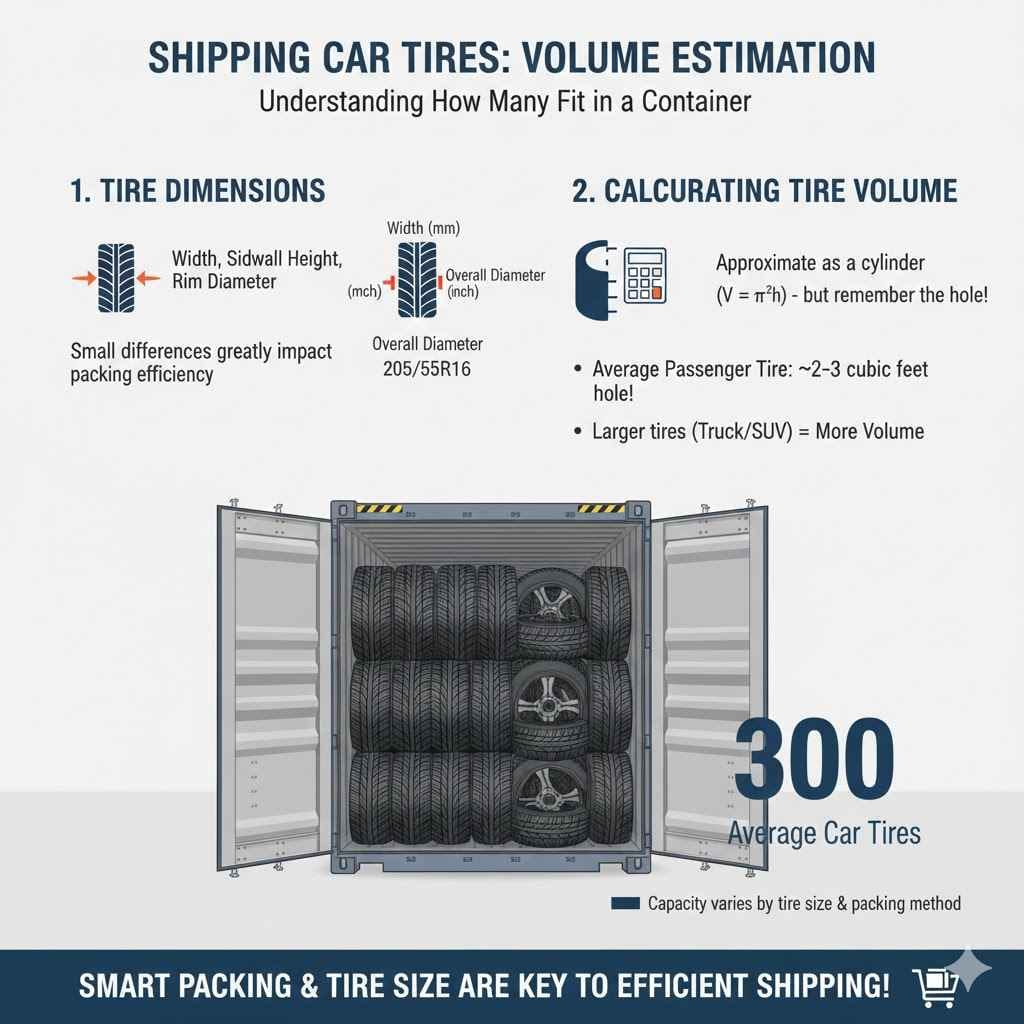
Every car tire has specific measurements. These include the width, the height of the sidewall, and the diameter of the wheel it fits on. For example, a common tire size might be 205/55R16.
The 205 is the width in millimeters, 55 is the aspect ratio (sidewall height as a percentage of width), and R16 means it’s a radial tire for a 16-inch rim. These numbers aren’t just for mechanics; they directly affect how many tires can be packed together efficiently.
Even small differences in tire size can make a big difference in how many fit into a limited space like a 20ft container. Tires with thicker sidewalls or wider treads will naturally take up more room. When you’re trying to maximize the number of tires you ship, knowing these specific dimensions is like having a secret weapon.
It lets you plan your packing strategy much more effectively.
Imagine trying to stack round balls versus stacking perfect cubes. Tires are more like the balls, with space between them when they aren’t arranged just right. However, with careful stacking and perhaps some slight compression, you can reduce the empty space.
This is where smart packing techniques come into play, and it’s crucial for anyone aiming to ship a large quantity of tires.
Calculating Tire Volume
To get a good idea of how many car tires fit in a 20ft container, we first need to think about the volume of a single tire. A tire isn’t a perfect cylinder, but we can approximate its volume. A rough way to do this is to think of it as a cylinder.
The height of this cylinder would be the tire’s width, and the radius would be half of the tire’s diameter.
The formula for the volume of a cylinder is Pi times the radius squared, then multiplied by the height (V = πr²h). However, tires are not solid cylinders; they have a hole in the middle. A more accurate approach for a tire might involve more complex calculations or simply using the tire’s overall dimensions to estimate its cubic footprint when stacked.
For practical purposes, we often use average figures or real-world packing data.
When you’re dealing with many tires, it’s helpful to know the approximate volume of an average tire. For a standard passenger car tire, the volume can range significantly, but a common estimate might be around 2 to 3 cubic feet. This is a simplified number that helps in initial planning, but we’ll refine this with real-world packing information.
The important takeaway here is that tire size matters. Larger tires, like those for trucks or SUVs, will have a bigger volume. Smaller tires, like those for compact cars, will have less.
So, if you’re shipping a mix of tire sizes, the calculation gets more complex. For a basic estimate, however, using average dimensions is a good starting point.
Understanding A 20ft Shipping Container
A 20ft shipping container is a standard piece of equipment used all over the world for moving goods. It’s built to be tough and hold a lot. Knowing its exact size is essential if you want to figure out how many car tires fit in a 20ft container.
These containers have specific interior dimensions that we need to consider.
Internal Dimensions And Cubic Capacity
A standard 20ft shipping container has an interior length of about 19 feet 4 inches (5.89 meters). The interior width is typically around 7 feet 8 inches (2.35 meters). The interior height is usually about 7 feet 10 inches (2.39 meters).
These measurements are important because they tell us the total usable space inside the container.
The total internal volume of a 20ft container is roughly 1,172 cubic feet or about 33 cubic meters. This is the maximum theoretical space available. However, you can’t always fill every single cubic foot because of how goods are packed.
Tires, being round, create empty spaces between them if not stacked perfectly.
When we talk about shipping tires, we’re interested in the usable cubic feet. The actual amount of space that can be filled efficiently depends on the packing method. For example, if tires are just thrown in, a lot of space will be wasted.
If they are stacked in an organized way, more can fit.
It’s also worth noting that the weight limit of a container is also a factor, but for tires, volume is usually the limiting factor first. A 20ft container typically has a maximum payload capacity of around 28,000 to 30,000 kilograms (about 60,000 to 66,000 pounds). Most car tires weigh between 20 to 50 pounds each, so you’re unlikely to hit the weight limit before filling the container with tires.
Factors Affecting Loadability
The shape of tires is the biggest challenge. They are not uniform blocks, so they don’t tessellate (fit together perfectly) without gaps. This means that even if you calculate the total volume of the container, you can’t expect to fill it completely with the summed volume of all the tires.
There will always be some wasted space, often called ‘air space’.
The way tires are loaded also makes a big difference. Are they laid flat? Are they stacked on their sides?
Are they nested? Each method impacts how tightly they can be packed and how much space is left over. For instance, stacking tires flat on top of each other might seem straightforward, but it can lead to unstable loads if not done carefully.
Loading techniques like ‘tire racking’ or using specialized equipment can significantly increase the number of tires that fit. Racking systems might allow for vertical stacking and better utilization of the container’s height. Without such aids, the load might be lower but more stable.
Another factor is whether the tires are new or used. New tires often come with labels and packaging that might prevent them from nesting as tightly as used tires. Used tires, especially those that have been driven on, might be more flexible or already slightly compressed, allowing for tighter packing.
Calculating How Many Car Tires Fit
Now we get to the main event: figuring out how many car tires fit in a 20ft container. This isn’t a single, exact number because of all the variables we’ve discussed. However, we can use common estimates and packing methods to arrive at a very useful range.
Estimates Based On Packing Methods
There are a few common ways people pack tires into containers, and each has a different outcome for how many fit.
- Loose Loading: This is where tires are simply placed into the container as space allows, without any special arrangement. This is the least efficient method, and you might fit fewer tires.
- Stacked Loading: Tires are often stacked in rows, either flat or on their sides.Stacking on their sides can sometimes allow for better nesting.
- Palletized Loading: Tires are stacked on pallets. This makes loading and unloading easier but might take up more space due to the pallet itself.
- Bulk Loading With Straps: Tires are loaded in bulk and then secured with heavy-duty straps to prevent shifting during transit. This can be very efficient if done well.
The most common and efficient way to pack car tires into a 20ft container is to stack them on their sides, often in a staggered or interlocking pattern. This takes advantage of the tire’s shape, allowing them to nestle into each other. This method minimizes the wasted space between tires.
When tires are packed this way, professionals often estimate that a 20ft container can hold anywhere from 400 to 600 passenger car tires. This range accounts for variations in tire size and the specific packing density achieved. For example, smaller, low-profile tires might fit more units than larger, bulkier tires.
It’s important to note that these numbers are for standard passenger car tires. If you are shipping truck tires or other larger types, the number will be significantly lower. Truck tires are much bigger and heavier, meaning fewer will fit in the same space.
Real-World Packing Examples
Let’s look at some real-world scenarios. Shipping companies and tire distributors have developed best practices for maximizing tire loads. One common method involves loading tires in rows, alternating the direction they face to allow for better nesting.
Imagine placing the first tire on its side, then the next one so its sidewall fits into the recess of the first.
A common scenario is shipping a full container of used tires. These are often quite flexible and can be packed very tightly. In such cases, packing densities can reach the higher end of the spectrum, potentially exceeding 600 tires in a 20ft container.
This is especially true if the tires are relatively uniform in size.
For new tires, the process might be slightly different. New tires often have more uniform shapes and less flexibility. However, they are usually loaded with great care to prevent damage.
Manufacturers and logistics experts work to achieve optimal packing, and figures around 500 to 550 tires per 20ft container are frequently cited for new passenger car tires.
A shipping company that specializes in automotive parts reported successfully loading 580 passenger car tires into a 20ft container using a specific interlocking stacking method. This involved careful arrangement and bracing to ensure stability. This highlights that with expertise, the higher end of the estimate can be achieved.
Factors That Influence The Number
The exact number of tires that fit into a 20ft container can vary greatly based on several factors. The most obvious one is the size of the tires themselves. Are they small economy car tires, standard sedan tires, or larger SUV/truck tires?
A tire labeled P205/55R16 will take up less space than a P275/55R20 tire.
The condition of the tires also plays a role. New tires might be firmer and have more uniform shapes, while used tires can be more flexible and might compress slightly, allowing for tighter packing. However, extremely worn tires might also lose some structural integrity, making them harder to stack securely.
The packing method is crucial. Are they loaded loosely, stacked neatly, or expertly interlocked? The level of care and expertise used in loading can directly translate into how many tires fit.
Professional loaders often have techniques to minimize void space.
The presence of tire pallets or racks can also affect the count. While pallets add structure, they also add volume that isn’t filled with tires. Specialized racking systems might allow for more tires to be stacked vertically, increasing the overall count.
Finally, the type of tire matters. While we’ve focused on car tires, if you’re considering van tires, light truck tires, or even performance tires with unusual profiles, the volume and packing efficiency will change. For instance, heavy-duty truck tires are significantly larger and heavier, drastically reducing the number that can fit.
Advanced Packing Strategies
To get the absolute most out of a 20ft container when shipping tires, there are advanced strategies beyond simple stacking. These methods require careful planning and execution but can significantly increase the tire count, saving costs and resources.
Nesting And Interlocking Techniques
Nesting tires involves placing one tire partially into another. When tires are stacked on their sides, the natural curves allow the rim of one to fit into the cavity of the next. This reduces the overall height of the stacked tires, allowing more rows to be placed vertically within the container’s height.
This is a primary technique for maximizing density.
Interlocking is similar but refers to how different stacks or rows of tires are arranged relative to each other to create a more stable and compact load. It’s like fitting puzzle pieces together. For example, a row of tires might be staggered so that the gaps between tires in one row align with the tires themselves in an adjacent row.
Consider a row of tires standing on their sidewalls. If you place the next tire in the same row, there will be a gap. If you then place another row next to it, you can place these second-row tires slightly into the gaps of the first row, and then place the third row tires into the gaps of the second row.
This creates a very dense packing configuration.
These techniques are most effective when tires are of similar sizes. If you have a mix of very different sizes, achieving such tight nesting and interlocking becomes much harder. Professionals often use computer simulations or past experience to determine the optimal arrangement for mixed loads.
The goal is to reduce the amount of empty air space within the container. Every inch of wasted space means fewer tires can be shipped, increasing the cost per tire. Advanced nesting and interlocking aim to fill as much of the container’s volume as possible with actual tire material.
Utilizing Vertical Space
Shipping containers have significant vertical height. Simply stacking tires as high as they can go without any special arrangement might not utilize this space effectively. Advanced strategies often involve creating multiple levels of tires, either by direct stacking or by using simple bracing.
For example, if you can stack tires 4-5 high in a stable configuration, and the container height allows for this, you are already using the vertical space well. However, if there’s still significant headroom, loaders might consider creating a second tier of tires above the first. This usually requires some form of support structure or very stable stacking.
One method is to create a stable base layer, and then build a second, slightly raised layer of tires. This might involve using some of the tires themselves as support or, more commonly, using durable dunnage (packing material) to create a level platform for the second tier. This is particularly effective for taller tires.
A common approach is to load tires in stacks, often around 5-6 feet high, depending on the tire size. If the container is nearly 8 feet high, this leaves plenty of space above. By carefully arranging the tires to nest, you can often achieve a denser pack in the lower section.
Then, depending on stability, you might be able to add another partial layer or ensure the first layer is as dense as possible.
When planning, always consider the center of gravity for safety during transport. Loading heavier items lower is always preferable. Tires, while not exceptionally heavy individually, can add up.
Keeping the bulk of the load low and stable is key for safe shipping.
Bracing And Securing The Load
Even when tires are packed tightly, they can shift during transit due to vibrations, braking, and acceleration. This shifting can damage the tires and the container, and it’s a major safety concern. Therefore, proper bracing and securing are essential.
Bracing involves using materials like wooden beams, dunnage bags, or even some of the tires themselves to fill any remaining large gaps and to support the stacks of tires. This prevents them from moving side-to-side or front-to-back. Dunnage bags, also known as air bags, are placed in gaps and inflated to create a firm barrier.
Securing the load typically involves using heavy-duty straps or webbing. These straps are tensioned around the tire stacks and anchored to the container’s lashing points. This ensures that the entire load is held firmly in place and cannot shift during the journey.
Multiple straps are often used to distribute the force.
A common practice is to create a solid block of tires in the center of the container and then brace the sides and front/back. This central block is the most stable. Then, smaller gaps near the doors are filled with bracing materials.
This approach maximizes the use of internal space while ensuring safety.
It is critical that the bracing is strong enough to withstand the forces of shipping. A load that shifts can cause significant damage and pose a safety hazard. Professionals often use a combination of interlocking packing, dunnage, and robust strapping to create a secure and efficient load.
Calculating A Realistic Estimate
Putting all the pieces together, we can arrive at a practical estimate for how many car tires fit in a 20ft container. This estimate will be based on averages and efficient packing methods.
Average Tire Size Considerations
Most passenger car tires fall within a certain size range. For example, many common tires are between 24 to 28 inches in diameter. Their width might range from about 7 to 10 inches.
These dimensions are crucial for estimating the volume each tire occupies when packed.
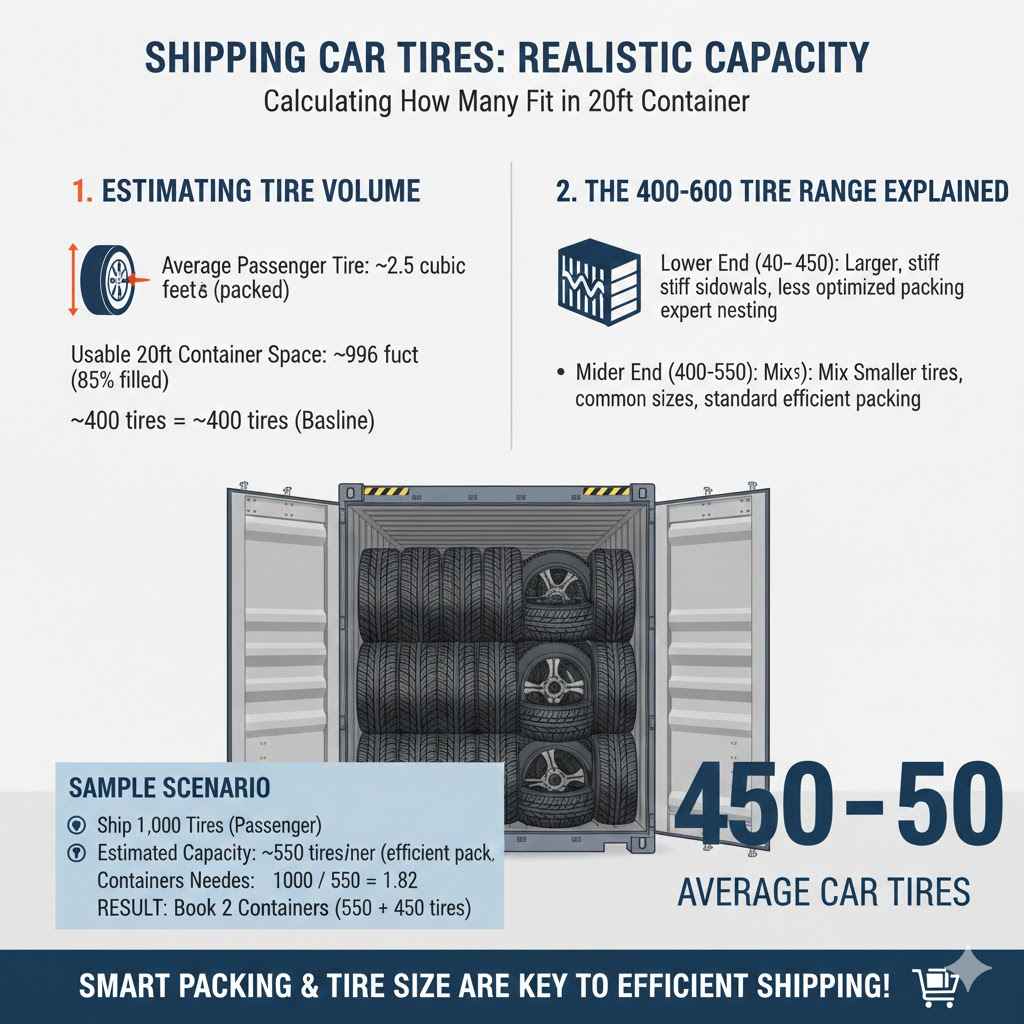
If we consider an average passenger car tire to occupy roughly 2.5 cubic feet of space when packed efficiently (this includes some allowance for the unavoidable air gaps), then we can do a simple calculation. A 20ft container has about 1,172 cubic feet of internal volume.
However, you can never fill 100% of the space. A realistic fill rate for irregularly shaped items like tires is often around 80-90% when packed expertly. So, the usable space might be closer to 1,172 cubic feet * 0.85 = 996 cubic feet.
Dividing the usable space by the estimated space per tire: 996 cubic feet / 2.5 cubic feet/tire = 398.4 tires. This calculation suggests that around 400 tires is a baseline.
This simple calculation shows that the commonly cited range of 400-600 tires is reasonable. The higher end of this range comes from tires that are smaller, more flexible, and packed with exceptional skill, minimizing the air gaps even further. The lower end reflects larger tires or less optimized packing.
The 400-600 Tire Range Explained
The range of 400 to 600 passenger car tires in a 20ft container is widely accepted in the shipping and logistics industry. Here’s why this range exists:
- Lower End (Around 400-450 Tires): This typically applies to larger passenger tires, tires with stiff sidewalls, or when a less aggressive packing method is used. It also accounts for more substantial bracing materials if needed.
- Mid-Range (Around 450-550 Tires): This is a good general estimate for a mix of common passenger tire sizes packed using standard efficient methods. Most shipments will likely fall within this band.
- Higher End (Around 550-600+ Tires): This is achievable with smaller passenger tires, very flexible used tires, and expert loading techniques that maximize nesting and minimize all void spaces. This level often requires specialized loading expertise.
For example, a shipper might find they can fit 480 tires of a specific model. If they switch to a slightly smaller model or use a more skilled loading team, they might reach 530 tires. Pushing beyond 600 tires requires ideal conditions and expertise.
The difference of 200 tires within this range represents a significant volume of goods and can impact shipping costs. Therefore, accurate estimation and efficient packing are very important for businesses that ship tires regularly.
When you’re planning a shipment, it’s always best to consult with your logistics provider or experienced tire loaders. They can give you a more precise estimate based on the specific tires you are shipping and the methods they will use.
Sample Scenario
Imagine you need to ship 1,000 passenger car tires from a warehouse to a distribution center across the country. You have a standard 20ft shipping container available.
- Determine the Tire Type: You confirm these are standard passenger car tires, not truck or specialty tires.
- Assess Packing Potential: You decide to use efficient packing techniques, aiming for the higher end of the estimate. You will stack tires on their sides, nesting them to reduce space.
- Estimate Container Capacity: Based on your estimates and common practice, you believe you can fit about 550 tires per 20ft container with good packing.
- Calculate Number of Containers Needed: To ship 1,000 tires, you divide the total by the capacity per container: 1000 tires / 550 tires/container = 1.82 containers.
- Adjust for Full Containers: Since you can’t order a fraction of a container, you’ll need to book 2 full 20ft containers. The first container will hold about 550 tires, and the second will hold the remaining 450 tires, with some extra space in the second container.
This scenario shows how to use the estimated range to plan your shipping needs. It highlights that you might need more containers than initially thought if your packing isn’t perfectly efficient or if you are shipping slightly larger tires.
Frequently Asked Questions
Question: What is the most common number of car tires that fit in a 20ft container?
Answer: The most common estimate for passenger car tires in a 20ft container is between 400 and 600 units, depending on tire size and packing method.
Question: Does tire size affect how many fit in a container?
Answer: Yes, absolutely. Larger tires take up more space, so fewer will fit. Smaller tires allow for more units to be packed into the same container.
Question: Is it possible to fit more than 600 car tires in a 20ft container?
Answer: It is possible in rare cases with very small tires and expert nesting, but 600 is generally considered the upper limit for typical passenger car tires.
Question: How do I get the most accurate estimate for my specific tires?
Answer: Consult with your shipping provider or experienced tire loaders who can assess your specific tire dimensions and recommend the best packing strategy.
Question: What factors are most important for maximizing tire capacity in a container?
Answer: The key factors are tire size, the efficiency of nesting and interlocking techniques, and careful securing of the load to prevent shifting.
Summary
Figuring out how many car tires fit in a 20ft container boils down to understanding tire dimensions, container volume, and efficient packing methods. A realistic range for passenger car tires is 400 to 600 units. By using techniques like nesting and interlocking, and securing the load properly, you can maximize the number of tires shipped.
Related pick: Check today's price on Amazon
Products related to this article
Sponsored / affiliate links. As an Amazon Associate I earn from qualifying purchases. I may earn additional commission from eligible campaigns.