Best Cars with Manual Transmission: Still Worth Buying?
A manual transmission is still worth buying if you want lower purchase prices, more driver control, or a simpler car, but it is a poor choice if traffic, shared driving, or resale convenience matter more. Pick wrong, and commuting gets tiring fast, while the car can be harder to sell later. This guide compares the best surviving manual cars by use case, from budget picks to snow-friendly daily drivers.
Are manual cars still worth buying in 2026?
Yes, but only for the right buyer. Manuals still make sense when you value driver involvement, want a narrower set of enthusiast models, or need a specific vehicle that still offers a stick shift. They are weaker choices for heavy traffic, mixed-driver households, and buyers who plan to resell quickly.
When a manual still makes sense
Manuals can still fit a buyer who wants a more involved drive and is willing to trade convenience for control. They also remain relevant in a few segments where the manual is part of the model’s character, such as sports cars, hot hatches, and a small number of trucks and SUVs.
That matters because iSeeCars says the manual transmission has become a rarity in new-car showrooms, and current automatics outperform manuals in acceleration and fuel efficiency. The manual question is no longer “is it cool?” It is “does it fit your use case better than the automatic alternative?”
When an automatic is the better pick
If you sit in stop-and-go traffic, share the car with multiple drivers, or care most about easy resale, an automatic is usually the cleaner choice. It also makes more sense if you want the widest trim selection, the smoothest commute, and the least learning curve for new drivers in the household.
A common first-timer mistake is buying a manual because the road test felt fun, then discovering that a 35-minute commute with repeated hill stops changes the equation fast. Fun on an open route does not erase friction in daily use.
📊 Car and Driver notes Honda’s CPO program includes a seven-year, 100,000-mile powertrain warranty for the CR-V example, which is one reason some shoppers compare certified-pre-owned coverage when deciding whether to buy new or used. Source: Caranddriver.
Manual cars decision matrix
This matrix compares the surviving manual choices by buyer scenario, not by badge loyalty. Read the “not worth it if” column first. That is where many buyers save themselves from the wrong trim, the wrong drivetrain, or the wrong expectation.
| Model | Daily commute | Beginner friendliness | Snow and all-weather use | Long-term ownership cost | Enthusiast fun | Not worth it if… |
|---|---|---|---|---|---|---|
| Mazda MX-5 Miata | Good for short to moderate trips; light controls help | Friendly on clear roads; 6-speed manual is easy to learn | Poor in deep snow; RWD limits traction | Can be reasonable, but sporty tires and two-seat practicality limit usefulness | Excellent; iSeeCars lists it among the best manual sports cars and ranks it at 8.7 | You need winter practicality or rear seats |
| Honda Civic Si | Strong daily choice; compact-car practicality with sporty character | Very good for new stick-shift drivers | Usable with proper tires, but FWD performance is not a snow specialty | Usually sensible for a sporty compact | High without becoming punishing | You want all-wheel drive or a soft-riding commuter |
| Ford Mustang GT | Acceptable if you can live with size and RWD behavior | Less forgiving than compact manual cars | Weak on slick roads without careful tire choice | Performance-car costs and tire wear can add up | Very high; iSeeCars ranks the Ford Mustang coupe at 8.6 among manual sports cars | You want an easy city car or low running costs |
| Subaru WRX | Good if you accept firmer ride and turbo character | Moderate; clutch and boost make it less forgiving than a Civic Si | Strong; AWD and winter traction are the main draw | Can be more costly than a mild compact, especially with abuse history | High on rough roads and in bad weather | You want relaxed commuting or a soft suspension |
| Toyota GR86 | Fine for two-person use and shorter commutes | Manageable for learners who want a real sports-car feel | Limited by RWD and low stance | Can be manageable, but tires and insurance matter | Very high; playful chassis and 6-speed manual are the point | You need space, cargo room, or winter traction |
| Volkswagen Golf GTI | One of the best all-round manual daily drivers | Good, though traffic still adds work | Usable with winter tires; FWD is predictable | Used-market value can be strong; parts and upkeep vary by condition | High for a practical hatch | You want RWD balance or maximum simplicity |
| Jeep Wrangler | Poor for long commutes unless you want the truck-like experience | Not the easiest first manual | Strong when equipped properly; one of the few manual SUVs left | Can be costly if neglected or modified | High off-road, moderate on pavement | You care more about on-road smoothness than utility |
| Toyota Tacoma | Workable, but truck gearing and size limit ease | Moderate to difficult for beginners | Useful in poor weather and rough terrain | Can be durable, but manual trucks are niche and condition matters | Low to moderate on-road; high for utility buyers | You want a small, easy commuter |
Best manual cars by use case
The best manual is the one that fits your commute, parking, and backup drivers. Badge status matters less than the car’s fit for your daily routine. That is where many comparison lists go wrong.
Best for daily driving
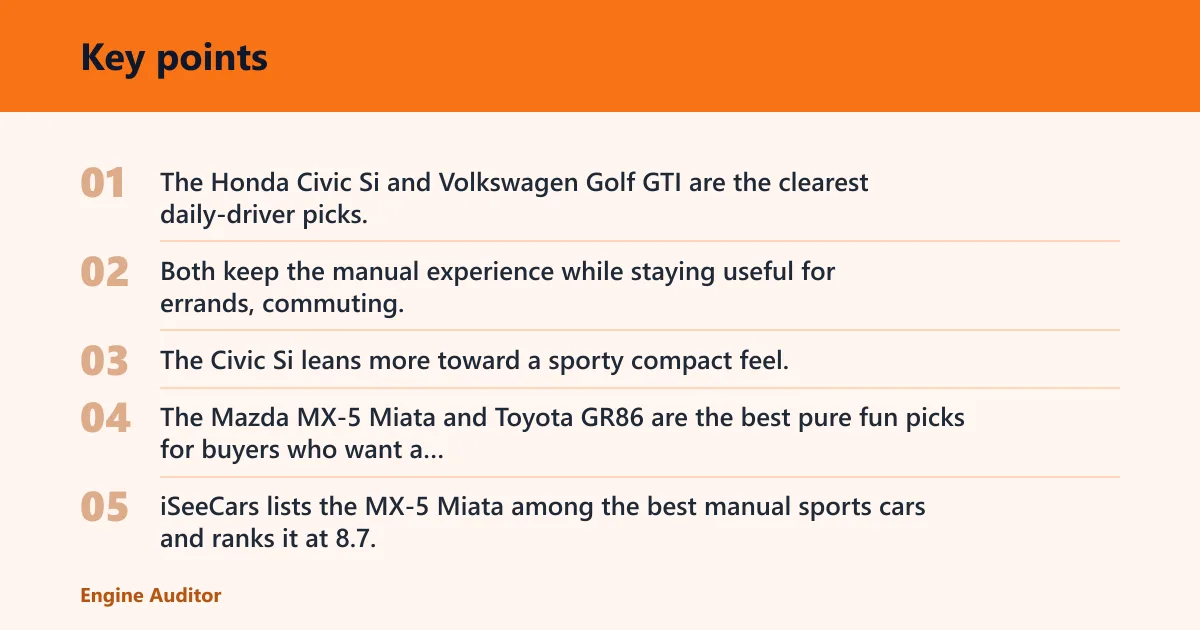
The Honda Civic Si and Volkswagen Golf GTI are the clearest daily-driver picks. Both keep the manual experience while staying useful for errands, commuting, and weather that is not ideal. The Civic Si leans more toward a sporty compact feel, while the GTI adds hatchback cargo flexibility.
Best for weekend fun
The Mazda MX-5 Miata and Toyota GR86 are the best pure fun picks for buyers who want a manual because the car itself feels alive. iSeeCars lists the MX-5 Miata among the best manual sports cars and ranks it at 8.7. The GR86 fits the same buyer, but with more coupe body style and a little more usable space.
Best for all-weather traction
The Subaru WRX is a strong all-weather pick on this list because its AWD layout can give it an advantage on wet, slushy, or snowy roads. It is one of the few manuals that still makes sense for buyers who live with winter for part of the year rather than merely visiting it.
Best for cargo or utility
The Volkswagen Golf GTI is the easiest manual to recommend for cargo utility, while the Jeep Wrangler and Toyota Tacoma matter for buyers who want a manual in a utility vehicle. iSeeCars says the Wrangler is one of the few manual SUVs left, and the Tacoma is the lone manual midsize truck in its list.
Best value on the used market
Used manual value depends on model-specific demand more than on the transmission alone. A manual in a sought-after trim can hold value better than a base automatic, especially when enthusiasts keep looking for it. That is why resale value is tied to scarcity and to the model’s following, not to the gear lever by itself.
Suppose you are comparing two used hatchbacks with similar mileage. The manual GTI may bring stronger interest than a less desirable trim, but a worn clutch or sloppy shift action can erase that advantage quickly. Demand helps only when the car is still in good shape.
Which new cars still come with a manual transmission?
Manuals survive in a limited set of new vehicles, mostly where the gearbox is part of the product story. Sports cars, hot hatches, and a few trucks and SUVs still offer one. That is why iSeeCars can call the manual a rarity and still list real current options.
Sports cars and coupes
The Mazda MX-5 Miata remains a 6-speed manual sports car, with two seats and rear-wheel drive. The Ford Mustang GT also offers a manual option in a performance coupe format, and the Toyota GR86 keeps the 6-speed manual alive in a playful rear-wheel-drive coupe.
iSeeCars ranks the Ford Mustang coupe at 8.6 among manual sports cars and the Mazda MX-5 Miata at 8.7. Those rankings fit the market reality: these are the cars where the manual still belongs.
Hot hatches and sedans
The Honda Civic Si stays relevant because it commonly pairs a 6-speed manual with everyday practicality. The Volkswagen Golf GTI was another strong choice before the U.S. manual ended after the 2024 model year, and it remains a relevant used buy for shoppers who still want hatchback flexibility. These cars matter because they keep manual control without giving up back-seat or cargo usefulness. (Caranddriver)
SUVs and trucks that still offer one
The Jeep Wrangler and Toyota Tacoma are the main manual holdouts in more practical vehicle classes. The Wrangler and Tacoma matter because they remain among the few modern manual SUV and midsize truck options.
Manual ownership costs you should expect
A manual can cost less than an automatic in some cases, but that is not a promise. The real answer depends on clutch condition, how the car was driven, and whether the model has extra demand that pushes used prices up. Manuals also shift some cost from the transmission hardware to the driver’s left leg.
Clutch wear and replacement
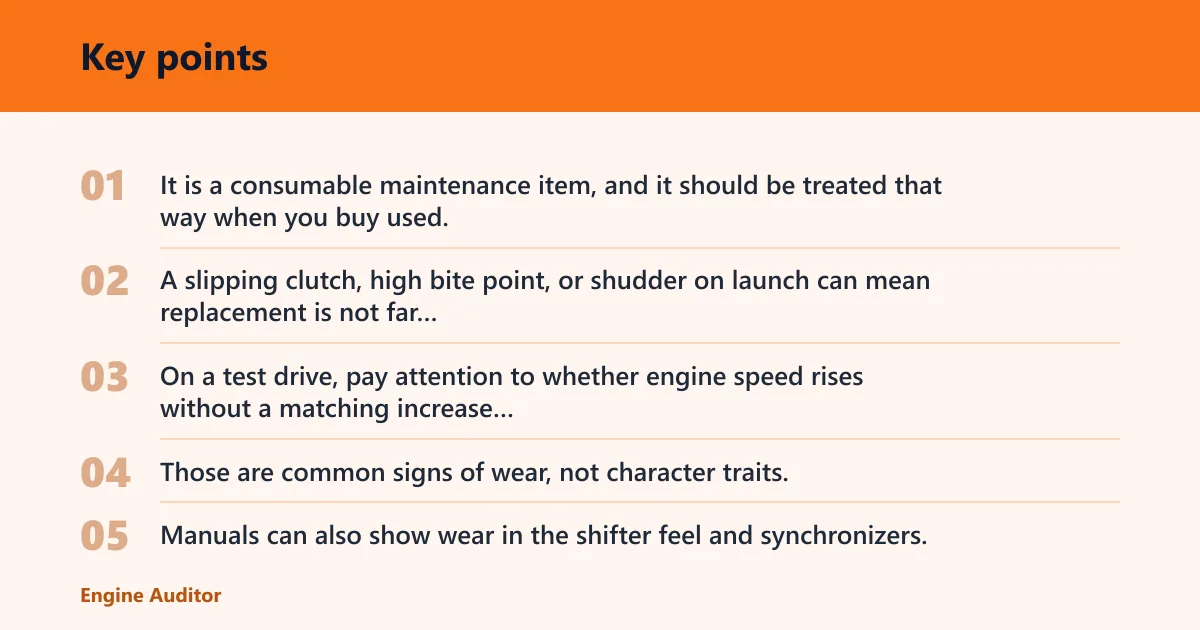
Clutch wear is the first cost to watch. It is a consumable maintenance item, and it should be treated that way when you buy used. A slipping clutch, high bite point, or shudder on launch can mean replacement is not far away.
On a test drive, pay attention to whether engine speed rises without a matching increase in road speed, whether the engagement point is very high, and whether takeoffs feel jerky even when the driver is gentle. Those are common signs of wear, not character traits.
Shifter and synchro wear
Manuals can also show wear in the shifter feel and synchronizers. A healthy gearbox should engage cleanly without excessive notchiness, grinding, or resistance during normal shifts. Missed-shift clues matter because repeated abuse can leave a transmission feeling vague or sticky even if it still moves through the gears.
Fuel economy and maintenance
Do manual cars get better fuel economy than automatics? Often, not anymore. iSeeCars says current automatics outperform manuals in acceleration and fuel efficiency. That does not mean every manual loses, but it does mean the old rule no longer holds as a blanket buying argument.
Is a manual car cheaper to maintain than an automatic? Sometimes, but only in a narrow sense. A manual may have fewer complex parts than some automatics, yet clutch replacement is a real expense, and hard use can bring that bill forward. The maintenance picture depends on the specific model and the previous driver.
Resale value and scarcity
Resale value for manuals is a mix of scarcity and demand. A manual transmission can help a desirable model hold interest because fewer examples are available. But if the model is hard to live with, the pool of buyers shrinks too. Scarcity helps only when demand remains healthy.
What to check before buying a used manual
Used manuals reward careful inspection. You are not just buying a transmission. You are buying the previous owner’s shifting habits, hill-start habits, and patience with clutch wear.
- Check clutch slip and bite point. A high engagement point, flare under load, or shudder on takeoff can point to wear.
- Feel the shifter in every gear. Look for grinding, refusal to enter a gear, or a vague lever that feels loose between shifts.
- Test a hill start if possible. Rollback, chatter, or a burned-clutch smell after a short start can be a warning sign.
- Listen for noise. Whine, rattle, or rumble that changes with pedal position can hint at bearing or clutch-related problems.
- Review service history and previous use. A manual that lived through towing, modifications, or repeated hard launches needs more caution.
Picture a compact manual hatchback that starts cleanly on level ground but chatters badly on a short incline. That can point to clutch wear or a driver mismatch, and either one matters when you plan to commute in traffic.
Best manual cars for specific buyers
The right manual depends on what kind of buyer you are. A beginner, a commuter, and an enthusiast do not need the same gearbox behavior, clutch weight, or chassis balance. Choose the car around your worst day, not your best road.
For beginners
The Honda Civic Si is the easiest strong recommendation for first-time manual buyers who still want a practical car. The Volkswagen Golf GTI is another sensible pick if you want hatchback flexibility. Both are easier to live with than a Mustang GT, WRX, Wrangler, or Tacoma.
For commuters
The Civic Si and Golf GTI are the best commuting manual picks because they keep the workload reasonable. If your route includes traffic, these are the models that balance daily use with a stick shift without making every trip feel like a chore.
For snow country
The Subaru WRX is the clearest choice for snow and bad weather. Its AWD layout gives it more margin on slippery roads than the RWD Miata, GR86, or Mustang GT. The Wrangler also belongs here if off-road use matters, but it is a less civilized pavement car.
For driving enthusiasts
The Mazda MX-5 Miata and Toyota GR86 remain the sharpest fun-first picks, with the Mustang GT bringing more power and straight-line force. iSeeCars places the BRZ at 8.2 among manual coupes, which shows the platform’s appeal even when buyers want something compact and playful rather than large and loud.
Frequently asked questions
Are manual transmission cars still worth buying in 2026?
Yes, if your priorities match what a manual still does well: engagement, lower complexity in some trims, and a driving feel that automatics do not copy. They are less sensible for heavy traffic, shared drivers, or buyers who want the easiest resale path. The value is use-case specific.
Is a manual car cheaper to maintain than an automatic?
Not automatically. A manual can avoid some automatic-transmission complexity, but clutch replacement is a real ownership cost and abuse can shorten its life. If you buy used, condition matters more than the gearbox label. A well-kept automatic can be cheaper than a worn manual.
What are the best manual cars for daily driving?
The Honda Civic Si and Volkswagen Golf GTI are the best all-around daily drivers on this list. They mix everyday practicality with a manual that still feels worthwhile. If you need all-weather traction, the Subaru WRX is stronger, but it is less calm than the Civic Si or GTI.
Do manual cars get better fuel economy than automatics?
Not usually anymore. iSeeCars says current automatics outperform manuals in acceleration and fuel efficiency. Some specific pairings may differ, but you should not buy a manual expecting a fuel-economy advantage by default. That old rule is no longer reliable across the modern market.
What should I check before buying a used manual car?
Check clutch slip, bite point, shift feel, and gear engagement first. Then test hill starts, listen for noise, and review the service history for signs of hard use. A manual with clean shifts and a healthy clutch can be a smart buy; one with grinding or slip can erase the savings fast.
Products related to this article
Sponsored / affiliate links. As an Amazon Associate I earn from qualifying purchases. I may earn additional commission from eligible campaigns.