Best Cars for Reliability and Repair Cost: Overall Winners
The best cars for reliability and repair cost are usually the Toyota Corolla, Honda Civic, Toyota Camry, Lexus ES, and Mazda3; for lower risk, favor simple, high-volume trims over luxury or turbo variants. Reliability and repair cost both matter. A car can start every day and still drain your budget if parts are pricey or labor is long. This guide ranks the strongest new and used picks by reliability and expected repair exposure, then separates the safest buys for each group.
Best reliability repair table
This table separates two things that are often mixed together: long-term reliability and repair-cost exposure. A car can be dependable yet still cost more to fix because its parts are pricier, its labor time is longer, or its trim uses a more complex powertrain. Scores below use a 1-to-5 scale, where 5 is best.
| Model | Segment | Reliability | Repair risk | Parts and labor exposure | Maintenance simplicity | Model-year caution | New-buyer note | Used-buyer note |
|---|---|---|---|---|---|---|---|---|
| Toyota Corolla | Compact car | 5 | 5 | 5 | 5 | 4 | Best on lower trims with the naturally aspirated engine. | Strong choice if service records are complete and no recall work is open. |
| Honda Civic | Compact car / sedan | 5 | 4 | 4 | 4 | 3 | Good balance of durability and resale value. | Avoid neglected turbo trims; a clean service history matters. |
| Toyota Camry | Midsize sedan | 5 | 5 | 4 | 5 | 4 | Best if you want a larger sedan without a complexity penalty. | Often the safest used buy in this group if the transmission and cooling system are clean. |
| Lexus ES | Midsize sedan | 5 | 4 | 3 | 4 | 4 | Excellent reliability, but repair exposure is higher than Toyota’s mainstream sedans. | Best as a certified pre-owned purchase because parts and labor can cost more. |
| Mazda3 | Compact car | 4 | 4 | 4 | 4 | 4 | Good pick if you want lower risk without moving up to a premium badge. | Favor non-turbo versions for simpler ownership. |
| Toyota RAV4 | Compact SUV | 5 | 4 | 4 | 4 | 4 | Strong all-around SUV choice, especially in simple trims. | Inspect for complete maintenance and any powertrain updates before purchase. |
| Toyota Highlander Hybrid | Midsize SUV / hybrid | 5 | 4 | 3 | 3 | 3 | Best when you want family space and strong fuel economy. | Buy only with full records, since hybrid parts are more expensive than a basic gas sedan. |
What the scores measure
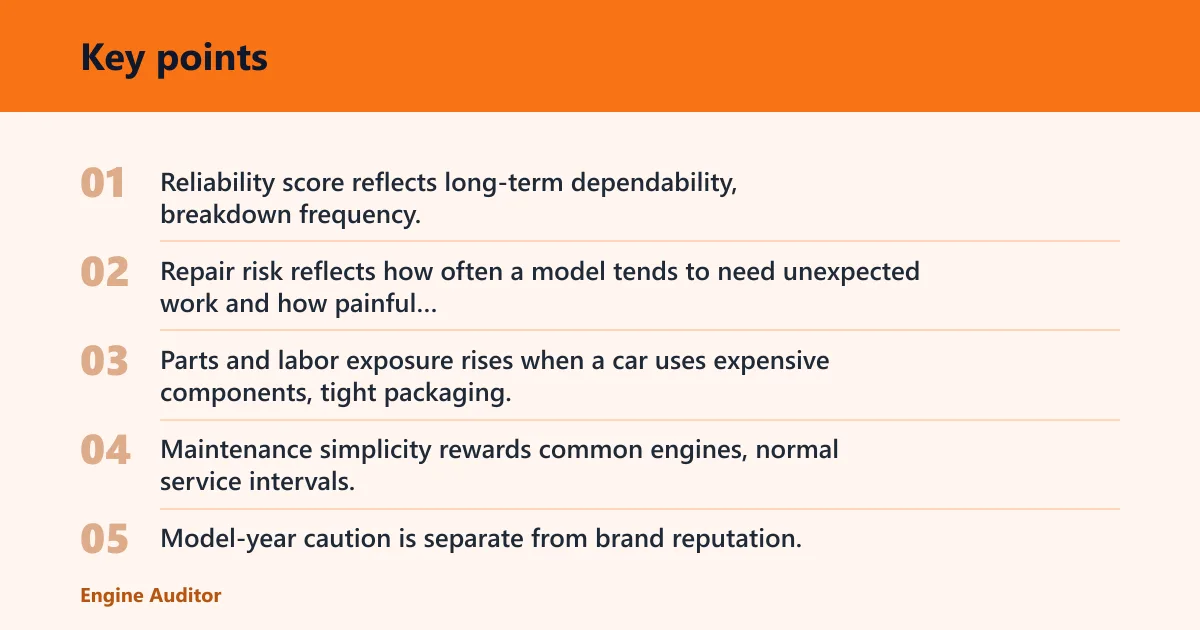
Reliability score reflects long-term dependability, breakdown frequency, and recall history seen across owner surveys, repair databases, warranty-claim data, and recall databases. Repair risk reflects how often a model tends to need unexpected work and how painful that work can be when it happens. Parts and labor exposure rises when a car uses expensive components, tight packaging, or dealer-only parts. Maintenance simplicity rewards common engines, normal service intervals, and easy access to wear items.
Model-year caution is separate from brand reputation. A good nameplate can still have a bad generation, a problem transmission, or a recall-heavy first year after a redesign. That is why the table flags caution even on otherwise strong models.
How to read the new-versus-used note
The new-buyer note focuses on trim choice. The used-buyer note focuses on records, recall work, and whether the model has a known weak year or powertrain. A car that is easy to recommend new can still be a bad used buy if it comes from the wrong engine, transmission, or redesign year.
What makes a car cheap to own?
Cheap ownership is not the same as cheap repairs. A car can have low repair bills yet still cost more over five years if it burns more fuel, carries higher insurance, or loses value quickly. The best low-risk cars usually keep maintenance simple, stay easy to service, and hold value well, which helps long ownership value stay controlled.
Reliability versus repair cost
Reliability answers a basic question: how likely is the car to stay out of the shop? Repair cost answers a different one: if something does fail, how expensive will it be to fix? A dependable car with a turbocharged engine, expensive headlights, or a complex hybrid system can still have higher repair-cost exposure than a simpler sedan.
Say your daily drive is a 12-mile city commute with lots of stop-and-go traffic. A hybrid may save fuel, but if you buy a trim with costly tires or premium brakes, the repair bill can still outrun the fuel savings over time.
Where maintenance, fuel, insurance, and depreciation fit
Routine maintenance includes oil changes, brake service, tires, and fluid service. These are predictable. Repair cost is the surprise part: sensors, pumps, transmissions, and cooling components that fail early or age poorly. Fuel economy, insurance, and depreciation sit beside repairs in total ownership cost, which is why a Corolla or Camry often beats a more expensive badge even when both score well for reliability.
Which cars are the best overall winners?
The strongest overall winners are the Toyota Corolla, Honda Civic, Toyota Camry, Lexus ES, Mazda3, Toyota RAV4, and Toyota Highlander Hybrid. For the broadest mix of durability and low repair exposure, the Corolla leads. The Camry and RAV4 follow closely. The Lexus ES is excellent for reliability, but its repair exposure is higher than Toyota’s mainstream sedans.
Top-ranked sedan choices
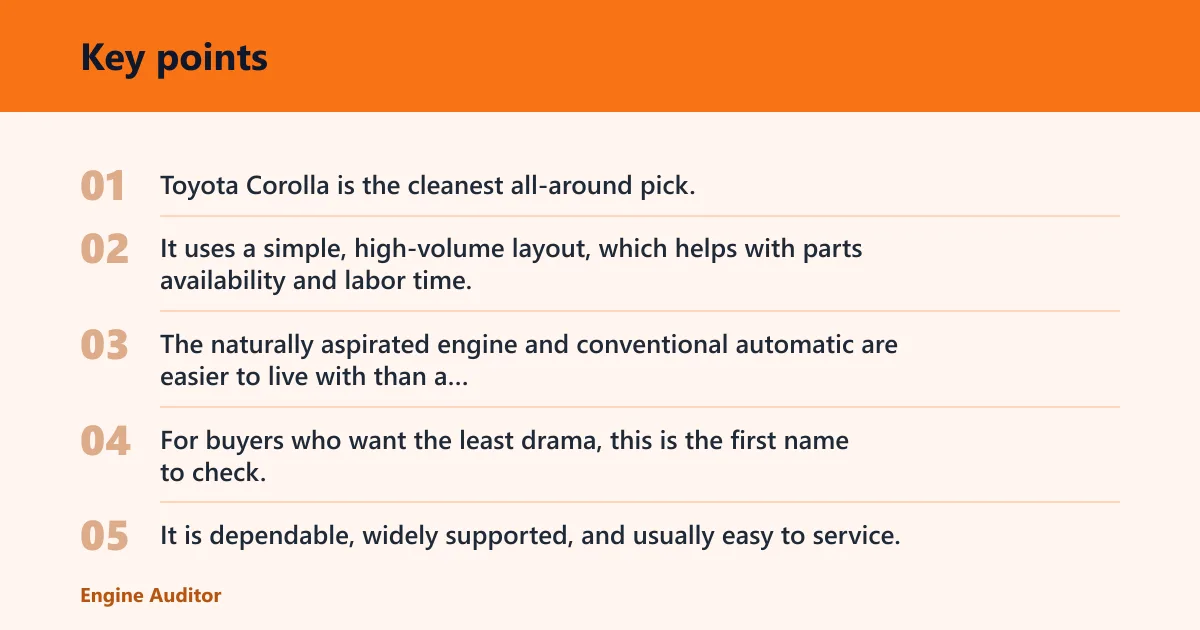
Toyota Corolla is the cleanest all-around pick. It uses a simple, high-volume layout, which helps with parts availability and labor time. The naturally aspirated engine and conventional automatic are easier to live with than a turbocharged setup. For buyers who want the least drama, this is the first name to check.
Honda Civic is the closest competitor. It is dependable, widely supported, and usually easy to service. The catch is trim control: lower-complexity versions are safer than more powerful turbo trims. That matters because the wrong Civic can carry higher repair exposure without gaining much in return.
Toyota Camry is the best midsize sedan choice for buyers who need more space. It tends to combine strong long-term reliability with sensible maintenance needs, and the standard gas versions keep things simpler than performance-oriented alternatives. For family use, highway commuting, and long ownership, it is one of the safest bets.
Lexus ES deserves a place because reliability is excellent. Repair costs are the tradeoff. Even when the car breaks less often, parts and labor can cost more because of the premium badge and more expensive component pricing. That makes it a reliability winner, but not the cheapest repair proposition.
Top-ranked compact SUV choices
Toyota RAV4 is the compact SUV to beat. It fits shoppers who want higher seating, cargo flexibility, and winter usefulness without moving into a larger, more expensive vehicle class. The simple gas version is the safer long-term choice if low repair exposure is the priority.
Compact SUVs usually cost a bit more to insure and fit larger tires than compact sedans, so they are often a little more expensive over five years. That does not make them bad buys. It just means the repair bill is only one piece of the total-cost puzzle.
Top-ranked hybrid choice
Toyota Highlander Hybrid is the best hybrid-style family pick on this list. It can reduce fuel spending, but hybrid ownership adds complexity, so the repair-cost advantage is not as absolute as many buyers expect. The battery system, inverter-related parts, and specialized labor can raise exposure if something unusual fails.
For a buyer who needs space and low fuel use, the hybrid still makes sense. For a buyer focused only on the lowest repair bills, a conventional Corolla or Camry is the simpler route.
Which cars are best for used buyers?
Used buyers should favor models with boring histories, full service records, and clean recall status. Check the service history before buying used. The best used picks here are the Toyota Corolla, Toyota Camry, Honda Civic, Mazda3, and Toyota RAV4 in uncomplicated trims. Certified pre-owned coverage can reduce risk when the car is only a few years old and the price premium is reasonable.
Best buys by model year and generation
Choose the current or late-cycle generation when possible, because the first model year after a redesign is more likely to carry software bugs, supplier changes, or recall exposure. For this list, that means looking for late-run examples with documented maintenance rather than chasing the oldest bargain on the lot.
A common first-timer mistake is buying a turbocharged sedan because the price looks right, then discovering that the service history is thin and the previous owner stretched oil-change intervals. That is exactly how a “reliable” badge turns into a repair bill.
What to verify before you buy used
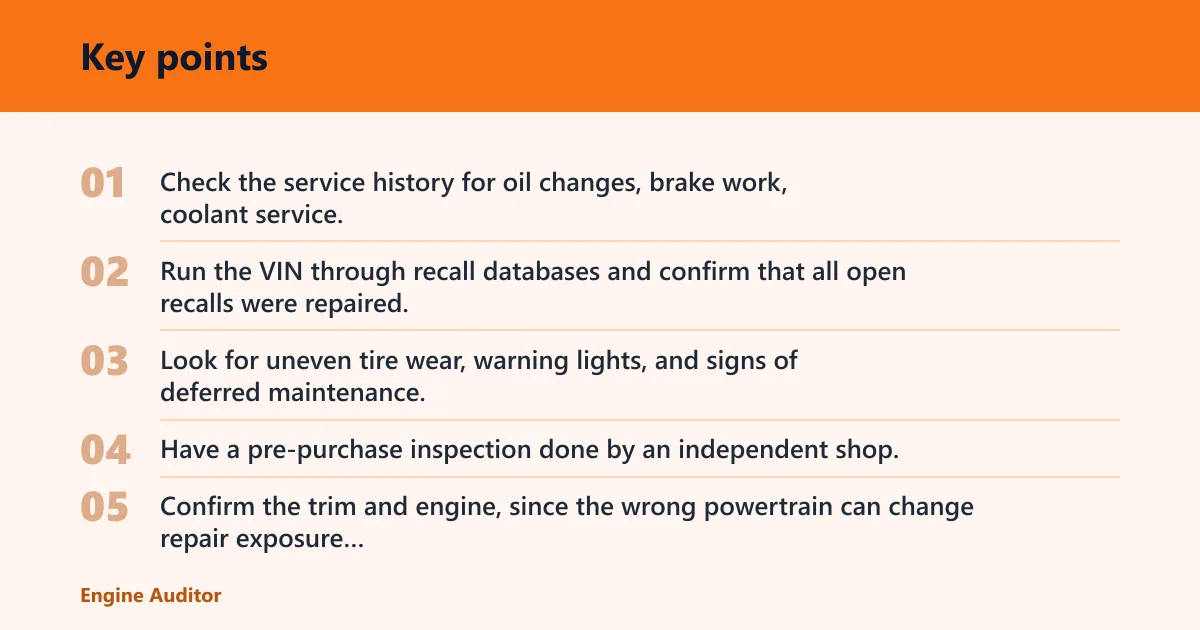
- Check the service history for oil changes, brake work, coolant service, and transmission service.
- Run the VIN through recall databases and confirm that all open recalls were repaired.
- Look for uneven tire wear, warning lights, and signs of deferred maintenance.
- Have a pre-purchase inspection done by an independent shop.
- Confirm the trim and engine, since the wrong powertrain can change repair exposure sharply.
Certified pre-owned can make sense when the car is close to new, the inspection checklist is strict, and the warranty coverage is meaningful enough to reduce risk. It is less useful if the vehicle is heavily optioned, has a complex turbo engine, or sits in a problematic year of its generation.
When certified pre-owned makes sense
Choose CPO when the dealer inspection is documented, the warranty extension is clear, and the car has no open recalls. That extra layer can reduce the odds of absorbing a large repair in the first ownership stretch. It is still smart to compare the CPO premium against the lower price of a clean private-party example.
How do powertrains change repair risk?
Powertrain choice matters a lot. Naturally aspirated engines usually have fewer heat and boost-related stress points than turbocharged engines. Conventional automatics and simple hybrid systems can be good, but complexity changes the repair profile. A car can be reliable and still carry more expensive parts if its hardware is more complicated.
Naturally aspirated engines versus turbocharged engines
Naturally aspirated four-cylinders are often the safest choice for long ownership because they avoid turbochargers, extra plumbing, and the heat load that comes with forced induction. Turbo engines can be efficient and strong, but they often depend on more sensitive maintenance habits. If oil changes are late, repair exposure climbs quickly.
That is why lower-trim Corolla, Camry, Civic, and Mazda3 models are the cleaner recommendations. The basic engine is usually the better bet than the highest-output version.
Automatic transmission choices
Transmission design affects both reliability and repair cost. A conventional automatic is usually easier to evaluate and service than more complex setups, while some continuously variable transmissions can be very reliable in the right application but still create anxiety for used buyers if service history is missing. The safest move is to confirm the exact transmission in the year and trim you are considering.
Hybrid system complexity
Hybrids can cut fuel use, and that helps total cost of ownership. They also add specialized components, which can increase repair exposure if failure occurs outside warranty. The right hybrid can still be a smart buy, but the tradeoff is different from a basic gas sedan.
What maintenance costs matter most?
Oil changes, brake service, tires, and fluid service are the big recurring costs. Manufacturers often specify oil-change intervals by mileage and time, brake wear varies by driving style, tires depend on size and compound, and fluids follow the owner’s manual. Keeping up with those basics is the easiest way to protect both reliability and resale value.
Oil change and fluid intervals
Follow the owner’s manual for the exact schedule. Many modern cars use longer oil intervals than older models, but short trips, extreme heat, towing, and dusty driving can shorten service life. Missing fluid service on a transmission, coolant system, or brake system can turn a cheap sedan into an expensive one.
Brakes, tires, and wear items
Wear items shape ownership cost more than most shoppers expect. Larger wheels, stickier tires, and heavier SUVs often cost more than compact sedans to keep in rubber and brakes. That is one reason the Corolla and Civic remain favorites: they tend to keep wear-item costs in a reasonable range.
Parts and labor exposure by segment
Sedans usually win on repair exposure because they often use smaller tires, simpler suspension packages, and less expensive body parts. Compact SUVs sit in the middle. Midsize SUVs can cost more because they are heavier and more complex. Hybrids can save fuel, but the specialized components can raise repair bills if something fails outside warranty.
Follow the vehicle manual, never work under a vehicle held only by a jack, never exceed the vehicle’s rated roof, hitch, or tow limit, keep items out of airbag zones and the driver’s view, and check local laws.
Model years to check carefully
Model year matters as much as model name. A redesign year can bring improved safety or efficiency, but it can also bring early-production issues. The best used-buy strategy is to target late-generation examples, avoid known problem years, and check recall history before you sign anything.
Generation changes and mid-cycle updates
First-year redesigns deserve extra caution because suppliers, software, and hardware changes can all land at once. Mid-cycle updates are usually safer, but they still deserve a VIN-specific check. A good nameplate does not guarantee every year is equally strong.
Recall exposure and known problem years
Open recalls are a red flag only if they are unresolved. They are also a reminder to verify the exact year and trim, since some complaints apply to one powertrain or one production run. Do not treat a badge as proof that every year is safe. Check the specific car.
Frequently asked questions
What are the best cars for reliability and low repair costs?
The strongest all-around answers are the Toyota Corolla, Honda Civic, Toyota Camry, Mazda3, and Toyota RAV4. The Corolla and Camry lead when low repair exposure matters most. The Lexus ES is highly reliable too, but its parts and labor costs are usually higher than those of Toyota’s mainstream models.
Which car brands are cheapest to repair long term?
Brands with high-volume parts support and simple mainstream drivetrains usually cost less over time. Toyota, Honda, and Mazda are common low-exposure choices. The exact cost still depends on model, engine, transmission, and trim, so a brand reputation should not replace a year-by-year check.
Are sedans or SUVs more reliable and cheaper to maintain?
Sedans are usually cheaper to maintain because they tend to use smaller tires, lighter drivetrains, and less expensive parts. SUVs can be very reliable, especially compact ones like the RAV4, but they often cost more to keep on the road. For lowest exposure, a sedan still has the edge.
What cars have the lowest maintenance costs over 5 years?
The lowest five-year maintenance costs usually come from simple compact and midsize sedans such as the Toyota Corolla, Honda Civic, and Toyota Camry. Those cars combine common parts, manageable wear-item costs, and broad shop familiarity. A hybrid can lower fuel spending, but it does not always lower maintenance cost.
Which used cars are most reliable and affordable to fix?
The best used answers are the Toyota Corolla, Toyota Camry, Honda Civic, Mazda3, and Toyota RAV4 in clean, late-generation form. The key is service history. A reliable model with neglected oil changes, old fluids, or open recalls can still become expensive fast.
How do reliability ratings compare with repair cost data?
Reliability ratings tell you how often trouble tends to show up. Repair-cost data tells you how expensive the trouble is when it does show up. A vehicle can score well on reliability yet still have high repair bills if its parts are costly or its labor times are long. Both views matter.
What should I check before buying a reliable car used?
Check service records, recall completion, tire wear, brake wear, warning lights, and the exact engine and transmission. Then get a pre-purchase inspection from an independent shop. Certified pre-owned can help, but only if the warranty terms, inspection checklist, and price premium all make sense together.
Which cars are good choices if I want low cost of ownership?
The Corolla, Civic, Camry, and RAV4 are the clearest low-cost ownership answers because they balance reliability, repair exposure, fuel use, and resale value well. The Mazda3 is also a strong pick. If you want the cheapest path, start with a simple trim and confirm the model year before buying.
Products related to this article
Sponsored / affiliate links. As an Amazon Associate I earn from qualifying purchases. I may earn additional commission from eligible campaigns.