
How to compare certified pre-owned cars vs regular used
Choose a certified pre-owned car only when its price premium is smaller than the value of added warranty coverage, lower repair risk, and stronger resale; on many mainstream models, that premium may be in the low-thousands. Skip that math, and you can pay thousands extra for a badge while the car itself is nearly the same. This guide shows how to compare price, warranty, inspection, repair exposure, and resale so you can decide which option costs less over time.
This guide is part of our Car comparison guide series.
| Decision factor | How to compare certified pre-owned cars | regular used | Winner |
|---|---|---|---|
| Upfront price | Usually costs more because it includes certification, inspection, and reconditioning. | Usually lower sticker price and more room to negotiate. | regular used |
| Repair exposure | Often includes warranty coverage that cuts owner repair exposure. | Warranty is often absent, so repair costs land on the buyer faster. | How to compare certified pre-owned cars |
| Resale value | Often holds value better if the certification is real and transferable. | Usually depreciates faster once it leaves the lot. | How to compare certified pre-owned cars |
| Inspection confidence | Backed by a multi-point inspection and history checks, though standards vary by brand. | Inspection quality depends on the seller. | How to compare certified pre-owned cars |
| Best use case | Better for buyers who plan to keep the car for years and value predictability. | Better for buyers focused on the lowest purchase price or short ownership. | tie |
What certified pre-owned means versus regular used
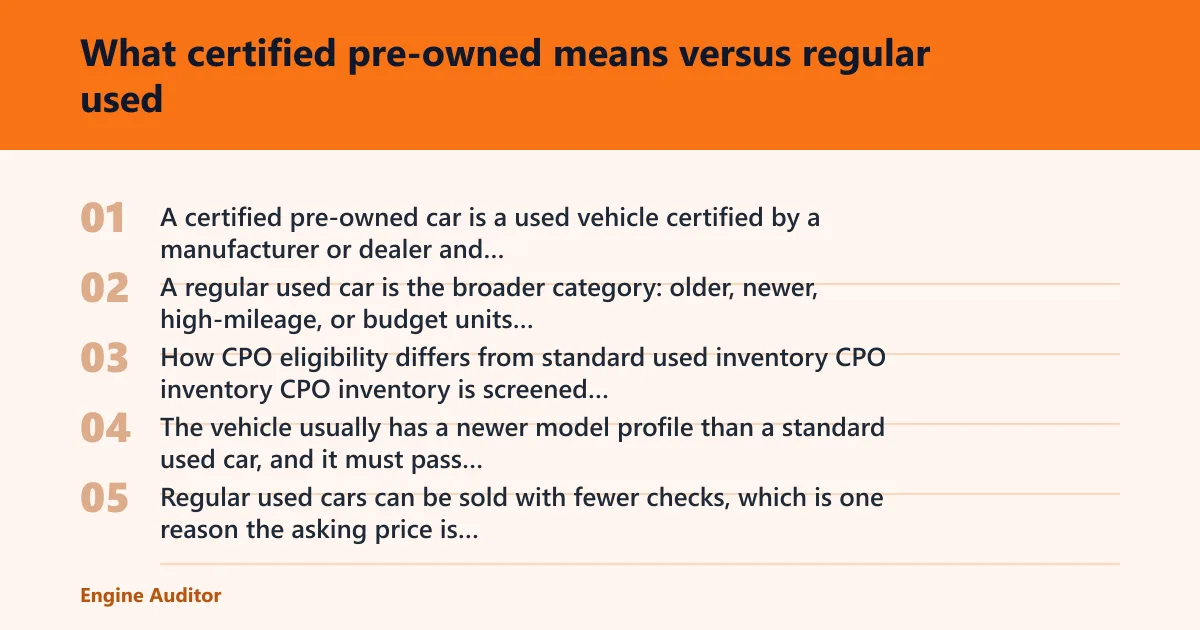
A certified pre-owned car is a used vehicle certified by a manufacturer or dealer and usually subject to mileage and condition standards. A regular used car is the broader category: older, newer, high-mileage, or budget units sold with much less consistency in inspection and warranty support.
How CPO eligibility differs from standard used inventory
CPO inventory is screened before it reaches the buyer. The vehicle usually has a newer model profile than a standard used car, and it must pass the seller’s certification process before it can wear the CPO label. Regular used cars can be sold with fewer checks, which is one reason the asking price is often lower.
Why age, mileage, and condition matter
A CPO car tends to be younger and less worn, but age and mileage still matter. A well-kept regular used car can be the better deal if it has a clean history and the price gap is wide enough. The label does not erase wear; it only changes how that wear is screened and covered.
What regular used cars can offer at a lower price
Regular used cars win when the buyer’s main goal is to cut the purchase price. They can also make sense for short ownership, low annual mileage, or buyers who already budget for repairs and do not need warranty-backed predictability. The tradeoff is simple: less protection, more inspection work for the buyer.
How to compare certified pre-owned cars and regular used
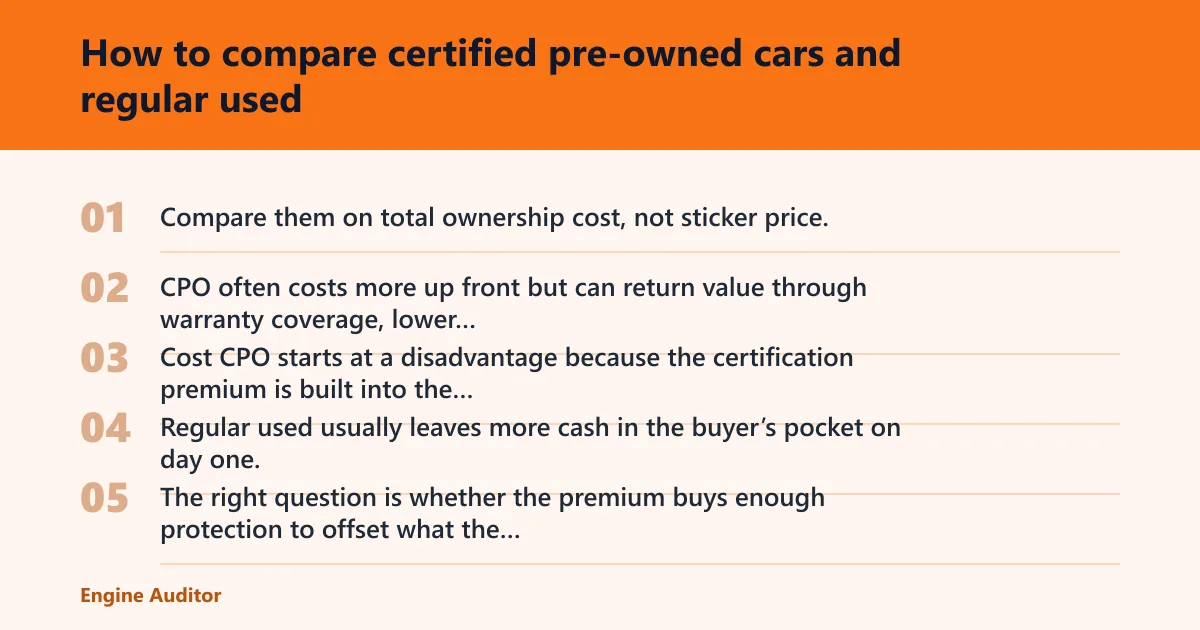
Compare them on total ownership cost, not sticker price. CPO often costs more up front but can return value through warranty coverage, lower repair exposure, and better resale, while regular used usually wins on purchase price and may still be cheaper over the full ownership period if repair risk stays low.
Cost
CPO starts at a disadvantage because the certification premium is built into the price. Regular used usually leaves more cash in the buyer’s pocket on day one. The right question is whether the premium buys enough protection to offset what the cheaper car may need later.
Protection
CPO usually includes warranty coverage, and that can change the ownership math quickly. Regular used often has no warranty at all, so a single sensor, brake job, or electronics repair can erase the savings from the lower sticker price. Coverage details matter more than the badge.
Resale
Certified cars often bring a better resale story if the paperwork is clean and the program is recognized. A regular used car can still resell well, but the buyer pool may discount it harder because there is no certification layer to support confidence. That difference matters if you plan to sell within a few years.
Best fit
CPO fits buyers who want fewer surprises. Regular used fits buyers who can tolerate more repair uncertainty or who expect to move on quickly. The “best” choice depends less on the car itself and more on how long it will stay in your driveway.
What a CPO package usually includes
A CPO package often includes an extended manufacturer warranty, roadside assistance, and sometimes service perks. Warranty coverage is included in CPO but not usually in used cars, and service perks are also more common in CPO programs than in standard used inventory.
Extended manufacturer warranty and coverage limits
The warranty is the main reason CPO exists. It reduces owner repair exposure after purchase, but it is not unlimited and it is not the same across brands. Buyers should check what starts on day one, what begins after reconditioning, and what is excluded.
Roadside assistance and service perks
Roadside assistance can matter more than it sounds, especially for commuters and families. CPO programs may include roadside support and service perks that standard used cars do not. Those extras do not replace a warranty, but they can reduce hassle during early ownership.
What is not always included
CPO does not mean full bumper-to-bumper protection. Deductibles, transferability limits, mileage caps, and exclusions are common. Some programs also start coverage after reconditioning or after the original factory warranty ends, so the paperwork has to be read line by line.
What gets checked in a CPO inspection
Many CPO inspections require over 100 points. The checklist commonly covers brakes, suspension, steering, tires, wheels, alignment, engine performance, transmission, electronics, and history checks, plus a reconditioning pass before the vehicle is sold.
Multi-point inspection basics
A multi-point inspection is the backbone of certification. It is meant to catch wear, safety issues, and mechanical faults before the car gets certified. The count alone is not enough; the quality of the inspection and the quality of the reconditioning decide whether the car is actually worth the premium.
Why reconditioning quality changes the result
Two cars can both wear a CPO label and still be very different. If one gets careful reconditioning and the other gets bare-minimum cleanup, the buyer is not getting the same product. The program name matters less than the actual work done and documented.
How do you know a car is really certified pre-owned?
Verify the VIN, ask for certification paperwork, and confirm that the warranty is properly registered. A real CPO car should match the program name in the paperwork, the vehicle history report, and the manufacturer or dealer database. If those three do not line up, stop and check again.
VIN decoder and certification paperwork
Start with the VIN and the certification documents. A VIN decoder can help you confirm the exact vehicle identity, while the paperwork should show the CPO program name and the seller’s certification claim. If the seller cannot produce both, treat the CPO label as unproven.
Warranty registration and program name checks
Ask when the warranty started, what registration number exists, and whether the coverage is transferable. This is where fake or sloppy claims often fail. A vehicle can be cleaned up and marketed as certified without being properly registered under the program.
Vehicle history report red flags
A vehicle history report can help screen for accidents, flood damage, title issues, and past damage claims. CPO inspections can include a vehicle history report for accidents or flood damage, but that does not mean every problem is solved. A clean report plus odd paperwork is still a warning sign.
When is the CPO premium worth paying?
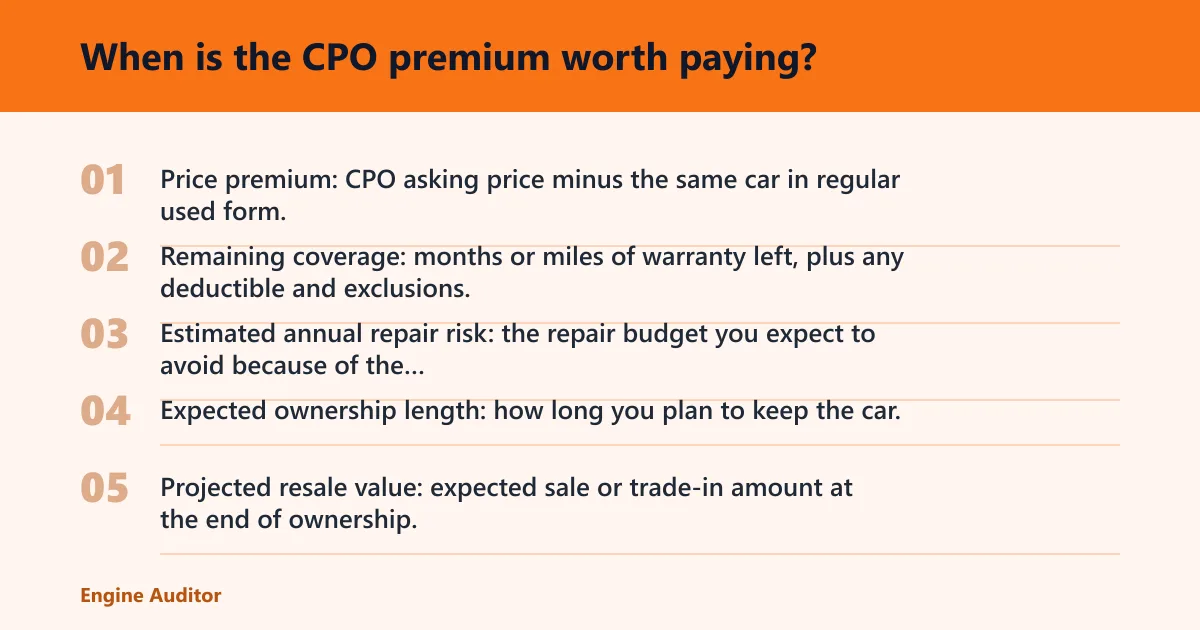
The CPO premium is worth paying when the added cost is smaller than the value of remaining coverage, expected repair savings, and resale gain over your planned ownership period. If those three benefits do not beat the premium, the cheaper used car is the better buy.
Five-input decision worksheet
Use this worksheet before you shop, and plug in real numbers from the actual cars you are comparing.
- Price premium: CPO asking price minus the same car in regular used form.
- Remaining coverage: months or miles of warranty left, plus any deductible and exclusions.
- Estimated annual repair risk: the repair budget you expect to avoid because of the warranty.
- Expected ownership length: how long you plan to keep the car.
- Projected resale value: expected sale or trade-in amount at the end of ownership.
Break-even formula for coverage, repair risk, and resale value
Use this simple rule: CPO breaks even when warranty value + avoided repair costs + resale premium is greater than the CPO price premium. If the premium is around $2,800 and you estimate roughly $1,200 in avoided repairs, about $900 in resale gain, and about $500 in coverage value, CPO may come out slightly ahead. If those benefits total less than the premium, buy the regular used car.
Buyer profiles that usually benefit most
Commuters who rack up miles, first-time buyers who want fewer repair surprises, families who need dependable transportation, and high-mileage drivers who value predictable downtime often get more from CPO. Buyers with strong repair budgets or very short ownership plans often do better with regular used inventory.
How much more should you pay for CPO?
Pay only enough extra that the CPO package still wins after you account for repairs and resale. On many mainstream cars, a small premium can make sense when the warranty is solid and the history is clean, but a wide gap usually means the used car is the better value.
Setting a ceiling based on expected repairs
Set your ceiling by estimating the repair bill you would rather not absorb during ownership. Then add the resale advantage only if the model holds value well and the certification is transferable. If the premium is larger than those two numbers combined, walk away.
When a small premium makes sense
A modest premium is easier to justify on newer cars with remaining factory coverage, clean history, and a clear certification process. It also makes sense when financing is cheap and the monthly difference is minor compared with the repair protection. The car has to earn the premium.
When the gap is too large
If the CPO price is far above similar used inventory, the buyer should ask what is actually being paid for. Sometimes the premium is mostly branding, not added value. In that case, the regular used car wins unless the warranty is unusually strong.
What mistakes do buyers make with CPO cars?
Buyers often pay for a CPO label without checking age, warranty timing, prior damage, or paperwork. That is where the bad deals hide: near-end-of-warranty cars, accident history that was not studied closely, and certification claims that are missing real documentation.
Near-end-of-warranty examples
A car can be certified and still have very little coverage left. That matters because the premium may buy only a short window of protection. If the warranty is almost over, the buyer is often paying for inspection and branding more than real risk reduction.
Accident history and prior damage issues
A vehicle history report is not optional. Cars with prior accidents or flood damage can still be dressed up well enough to look safe at the lot, but the resale and reliability picture changes fast once the history is known. Certification should not be treated as a clean-history guarantee.
Fake certification or missing paperwork
Some sellers use the CPO phrase loosely. If the certification paperwork is missing, the VIN does not match the warranty record, or the dealer cannot explain the program name, the claim is weak. Treat that as a serious red flag, not a paperwork nuisance.
Choose How to compare certified pre-owned cars if…
Choose CPO if you plan to keep the car long enough for warranty coverage and resale value to offset the premium, and if the paperwork proves the certification is real. Choose regular used if your top priority is the lowest purchase price, you can budget for repairs, or you want to avoid paying extra for coverage you may never use.
Best choice for commuters, families, and first-time buyers
CPO is usually the cleaner fit for commuters and families because predictable repair risk matters more when the car is needed every day. First-time buyers also tend to benefit from the guardrails of a verified inspection, warranty coverage, and roadside support. That is where the premium can earn its keep.
Best choice for budget buyers and short ownership
Regular used is the better choice when the math says the premium will not come back to you before you sell. It also fits buyers who have a trusted mechanic, can judge condition well, or only need the car for a short stretch. Lower upfront cost is its main advantage.
Frequently asked questions
What is the difference between certified pre-owned and regular used cars?
A certified pre-owned car is a used vehicle that has passed a manufacturer or dealer certification process and usually comes with warranty coverage. A regular used car is any pre-owned vehicle sold without that certification layer, so inspection quality, coverage, and reconditioning can vary much more from seller to seller.
Is a certified pre-owned car better than a used car?
It is better only when the added price is smaller than the value of warranty coverage, lower repair exposure, and resale strength. If the premium is high and the coverage is thin, regular used can be the smarter buy. The better car is the one with the lower total cost to own.
What does a certified pre-owned car usually include?
CPO usually includes an extended manufacturer warranty, roadside assistance, and sometimes service perks. It also includes a certification inspection and reconditioning before sale. Buyers still need to check exclusions, deductibles, mileage limits, and whether the warranty starts at purchase or only after the original coverage ends.
How much more should I pay for a certified pre-owned car?
Pay only the amount that your expected warranty value, avoided repairs, and resale premium can justify. If the premium is a little over your estimate, regular used probably wins. If the gap is modest and the coverage is real, CPO can be worth it.
What gets checked in a CPO inspection?
Many CPO inspections require over 100 points and commonly cover brakes, suspension, steering, tires, wheels, alignment, engine performance, transmission, electronics, and a vehicle history report. The goal is to catch wear, damage, and hidden faults before sale. Reconditioning quality matters just as much as the checklist.
How do I know if a car is really certified pre-owned?
Check the VIN, certification paperwork, and warranty registration, and make sure all three match the seller’s claim. Then review the vehicle history report for accidents, flood damage, and title issues. If the dealer cannot prove program status in writing, do not treat it as certified.
Products related to this article
Sponsored / affiliate links. As an Amazon Associate I earn from qualifying purchases. I may earn additional commission from eligible campaigns.