How Many Car Tyres Fit In A 20ft Container
Figuring out how many car tyres fit in a 20ft container can seem tricky, especially when you’re new to shipping or logistics. It’s a common question for businesses or even individuals who need to move a lot of tyres. Don’t worry, though!
We’ll break down exactly how many car tyres fit in a 20ft container with simple steps. Let’s get straight to the easy-to-follow plan.
Calculating Car Tyre Capacity In A 20ft Container
This section will help you understand the basic math and common methods for estimating how many car tyres can be packed into a standard 20-foot shipping container. We will explore the factors that influence this number and provide a general idea of the capacity. This is the first step in planning your shipment.

Fix-A-Flat
Fix-A-Flat S60420 Aerosol Emergency Flat Tire Repair…
- Emergency flat tire repair solution, connect, inflate and go! The easiest and quickest way to temporarily repair a flat tire in an…
- Fix-a-Flat is designed to seal small tread tire punctures up to 1/4 of an inch in diameter in seconds and provide enough inflation…
- Flats happen, so be prepared with Fix-a-Flat, an easy-to-use, better alternative to the spare tire and perfect for roadside emerge…
As an Amazon Associate I earn from qualifying purchases.
Understanding Container Dimensions
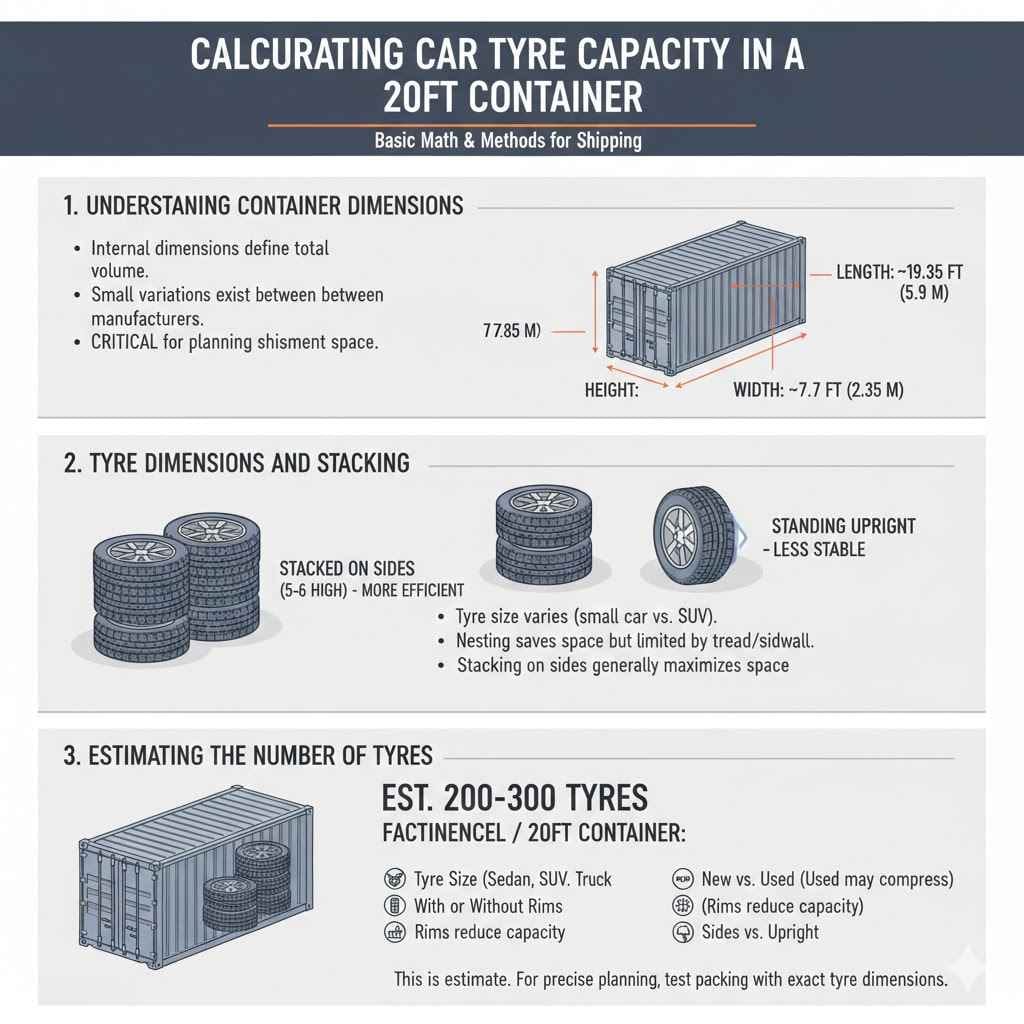
A 20-foot container has standard internal dimensions that are important for calculating space. Knowing these exact measurements is key. This helps you visualize the available area for packing.
The internal length of a 20ft container is typically around 19.35 feet (or about 5.9 meters). The internal width is usually about 7.7 feet (or about 2.35 meters). The internal height is often around 7.87 feet (or about 2.39 meters).
These dimensions can vary slightly between manufacturers, but they are very close for most standard containers.
These measurements are critical because they define the total volume you have to work with. Think of it like packing a moving box; you need to know how big the box is before you can figure out how much stuff fits inside.
Tyre Dimensions And Stacking
The size of car tyres is not uniform; it varies by make, model, and size. For example, a small economy car tyre will be smaller than a large SUV tyre. You also need to consider how they stack.
Tyres are round and can be a bit awkward to pack efficiently.
When stacking, tyres can nest inside each other to some extent, which saves space. However, the tread pattern and sidewall can prevent perfect nesting. The most efficient way to pack is usually to stack them in rows.
Sometimes, tyres are placed upright or on their side. This choice impacts how many can fit.
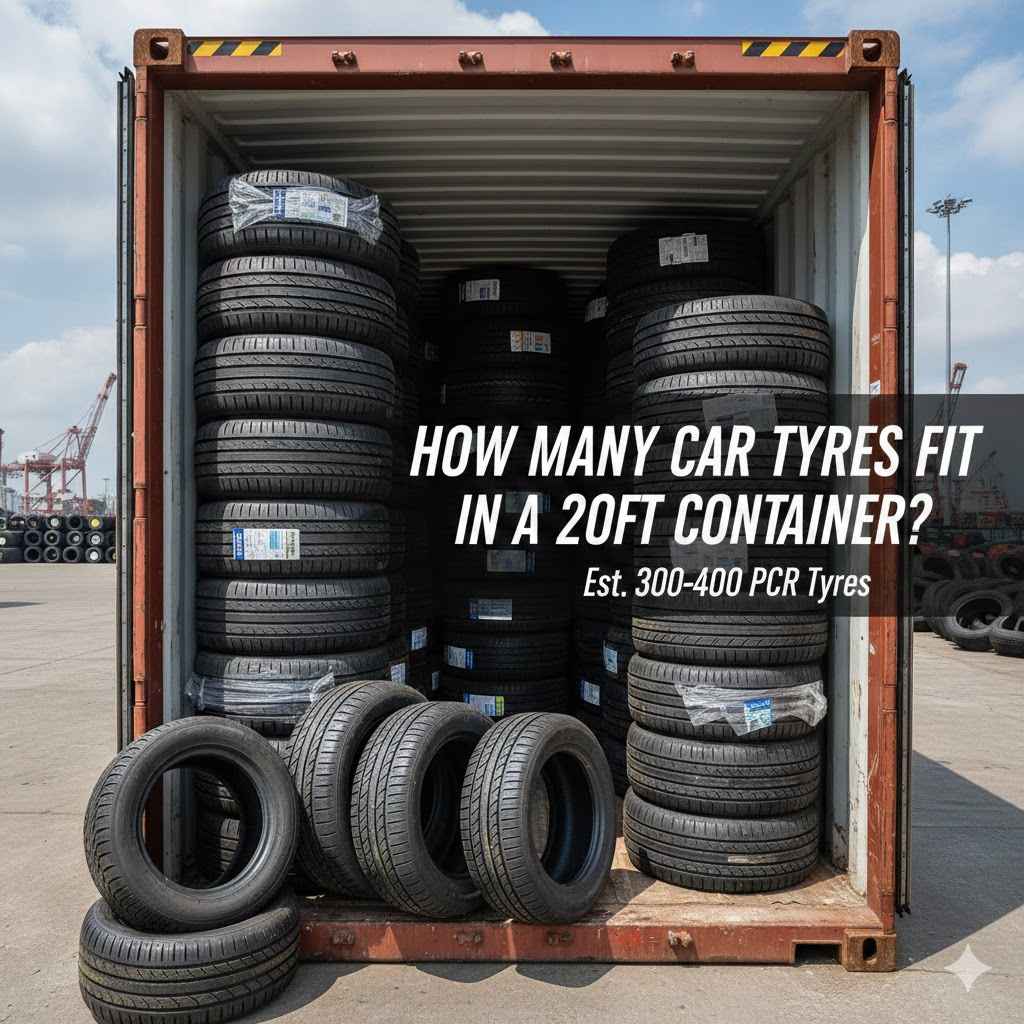
For most standard car tyres, you can expect to stack them about 5 to 6 high when placed on their sides. If you stand them up, you might only be able to stack them 2 or 3 high before they become unstable. Stacking on their sides is generally more space-efficient.
Estimating The Number Of Tyres
Calculating precisely how many car tyres fit in a 20ft container involves considering both the container’s volume and the tyre’s dimensions. A common estimation for standard car tyres is between 200 and 300 tyres per 20ft container. This is a rough average and depends heavily on how they are packed.
Factors like whether the tyres are new or used, if they have rims attached, and the specific tyre sizes all play a big role. Used tyres might be compressed more easily. Tyres with rims take up more space because the rim adds bulk and prevents nesting.
It’s important to remember this is an estimate. For precise planning, you would need to know the exact dimensions of the tyres you intend to ship and test a small batch packing method.
Factors Affecting Tyre Capacity
Several key factors influence the maximum number of car tyres you can fit into a 20-foot container. Ignoring these can lead to underestimating or overestimating the space needed, potentially causing issues with loading or shipping costs. Let’s explore these influences.
Tyre Size And Type
The dimensions of a car tyre are not universal. Tyres come in various sizes, indicated by numbers like 205/55R16. The ‘205’ is the width in millimeters, ’55’ is the aspect ratio (sidewall height as a percentage of width), and ’16’ is the rim diameter in inches.
Larger numbers mean larger tyres.
For example, a tyre for a compact car will be smaller and have a lower profile than a tyre for a large truck or SUV. This size difference directly impacts how many can fit. A smaller tyre means you can pack more into the same space.
Tyre types also matter. Passenger car tyres, light truck tyres, and performance tyres can have different shapes and thicknesses. A tyre with a very aggressive tread pattern might not nest as well as a smoother one.
With Or Without Rims
Whether the tyres are mounted on rims or are just the rubber tyres themselves makes a significant difference. Tyres without rims are much more flexible and can be stacked more tightly. They can nest into each other more effectively, maximizing the use of space.
Tyres with rims are rigid and bulky. The metal rim prevents tyres from fitting snugly together. They take up more volume individually, meaning fewer can be loaded into the container.
You cannot stack them as high or as compactly as bare tyres.
For bare tyres, you can typically fit more. For tyres with rims, the number will be considerably less. This is a crucial detail for any shipping plan.
New Vs. Used Tyres
New tyres often have more rigid sidewalls and consistent shapes. Used tyres, especially those that have been driven on, can sometimes be more flexible and might compress slightly better when packed tightly. However, this is not always the case.
The condition of used tyres is also a factor. Severely worn tyres might not be stackable to the same height as newer ones. Also, regulations might affect the shipping of used tyres, depending on their condition and destination.
Generally, packing used tyres without rims can lead to a slightly higher number fitting, but the difference might not be massive compared to new, bare tyres.
Packing Method And Load Density
The way tyres are arranged inside the container is paramount. Efficient packing means minimizing empty space. This involves strategic stacking and placement.
A professional packer will use techniques to maximize density.
Tyres can be loaded in various ways. They can be stacked upright, on their sides, or even in a staggered pattern. Stacking them on their sides, with some nesting, is often the most effective for achieving high load density.
Using straps or load bars can help secure the stacked tyres and prevent shifting during transit. Proper securing also allows for higher stacking without compromising safety. The goal is to fill as much of the container’s volume as possible with tyres.
Calculating The Volume Of A 20ft Container
To get a more accurate idea of how many tyres fit, we need to look at the actual volume available. This involves understanding the internal dimensions and how much space a single tyre occupies.
Container Internal Volume
A standard 20-foot (TEU – Twenty-foot Equivalent Unit) container has an approximate internal volume of 1,172 cubic feet or 33.1 cubic meters. This is the total space available inside the container.
To calculate this, we multiply the internal length, width, and height:
Internal Length: ~ 5.9 meters (19.35 feet)
Internal Width: ~ 2.35 meters (7.7 feet)
Internal Height: ~ 2.39 meters (7.87 feet)
Volume (cubic meters) = 5.9 m 2.35 m 2.39 m = ~33.1 m³
Volume (cubic feet) = 19.35 ft 7.7 ft 7.87 ft = ~1171.7 cubic feet
This volume is the theoretical maximum space. However, you can never fill 100% of this volume with irregularly shaped objects like tyres.
Volume Occupied By A Single Tyre
The volume of a single car tyre varies greatly. We can approximate it by considering its outer dimensions. Let’s take a common tyre size like 205/55R16.
The outer diameter of such a tyre is approximately 25 inches (about 0.635 meters). The width of the tread, which determines how much horizontal space it takes up, might be around 8 inches (about 0.203 meters).
If we approximate the tyre as a cylinder, its volume is calculated using the formula: Volume = π (radius)² height (or width of the tyre in this case).
Radius = Diameter / 2 = 25 inches / 2 = 12.5 inches (0.3175 meters)
Approximate Volume = π (0.3175 m)² 0.203 m ≈ 0.064 cubic meters (or about 2.26 cubic feet)
This is a simplified calculation. Tyres are not perfect cylinders, and their shape can deform when stacked.
Calculating Estimated Capacity
Now we can use the container volume and the estimated tyre volume to get another approximation.
Estimated number of tyres = Total Container Volume / Volume Per Tyre
Using cubic meters: 33.1 m³ / 0.064 m³ per tyre ≈ 517 tyres.
Using cubic feet: 1171.7 cubic feet / 2.26 cubic feet per tyre ≈ 518 tyres.
This calculation gives a theoretical maximum if tyres could perfectly fill the space like liquid, which they cannot. This is why real-world numbers are much lower.
Practical Packing Methods For Tyres
Achieving a good number of tyres in a container requires smart packing. Simply throwing them in will not maximize space. Professional packers use specific techniques.
Stacking On Sides (Most Common)
This is the most typical and often most efficient way to pack car tyres. Tyres are laid on their sides, and they can be nested. One tyre’s rim fits partially into the cavity of another.
You can create rows and columns of these stacked tyres. The height of the stack will depend on the tyre size and how stable the stack is. For standard car tyres, stacks of 5 or 6 are common.
For example, you might arrange them in layers. The first layer would be tyres laid flat. The next layer would have tyres placed to nest into the first layer, and so on.
This method minimizes the overall height needed for each tyre and fills the width and length of the container well.
Upright Stacking
In this method, tyres are placed vertically, standing on their edge. This can be useful for certain types of tyres or if you need to access them easily. However, it is generally less space-efficient than stacking on their sides.
When tyres are stacked upright, the tread of one tyre sits on the sidewall of the one below it. This creates gaps between the tyres, and they cannot nest effectively. You can usually only stack 2 or 3 upright before they become unstable and take up too much space.
This method might be used if you are shipping tyres with rims and want to protect the rims. Even then, it’s less common for maximizing tyre count.
Staggered Packing
This technique involves mixing orientations or placing tyres in a way that fills irregular spaces. For instance, some tyres might be placed upright, while others are on their sides, to fill gaps left by the main stacking pattern.
This often happens in the final stages of packing to use up any remaining space. It’s about optimizing the fit by using the less-than-perfect shapes to your advantage. It requires skill and experience to do it effectively.
This method is more about fine-tuning the load after the primary stacking is done. It helps achieve higher densities and prevents items from shifting.
Securing The Load
Once packed, the tyres must be secured to prevent movement during transit. Loose tyres can cause damage to the container and the goods themselves.
Common methods include using ratchet straps to tie down stacks of tyres to the container walls or floor. Load bars can also be used to create barriers and secure the load. Dunnage, like cardboard or wood, can be used to fill small gaps and provide cushioning.
Properly securing the load is not just about safety; it also allows for more stable and potentially higher stacking, increasing the overall number of tyres that can be safely transported.
Real-World Examples And Statistics
Seeing how this works in practice gives a clearer picture. Let’s look at some examples and figures.
Industry Estimates
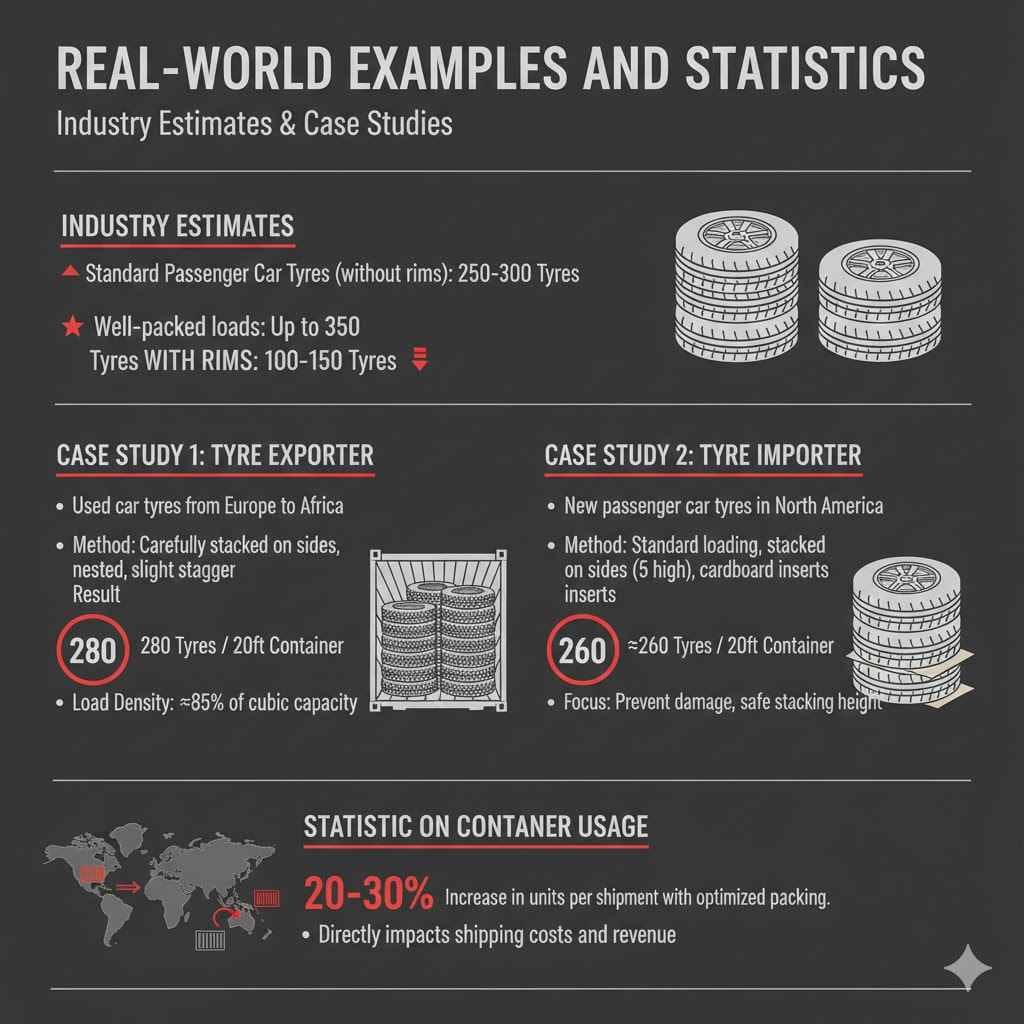
Logistics companies and tyre distributors often have specific figures based on their experience. For a 20ft container filled with standard passenger car tyres (without rims), a commonly cited range is 250 to 300 tyres. Some exceptionally well-packed loads might reach up to 350.
For tyres with rims, the number drops significantly, often to around 100-150 tyres per 20ft container. This is because of the added bulk and inability to nest properly.
These numbers assume reasonable effort in packing. If extreme care is taken, or if the tyres are of a very specific, smaller size, slight variations are possible.
Case Study 1 Tyre Exporter
A company exporting used car tyres from Europe to Africa found that by carefully stacking tyres on their sides and nesting them, they could consistently fit 280 tyres into a 20ft container. They used a team trained in tyre loading.
They discovered that using a slight stagger in the rows allowed the sidewalls to lock together more securely. This enabled them to stack 6 tyres high in most sections of the container. They reported a load density of about 85% of the container’s cubic capacity for tyres.
Case Study 2 Tyre Importer
An importer receiving new passenger car tyres in North America also averaged around 260 tyres per 20ft container. They used standard loading procedures, stacking tyres on their sides in stacks of 5.
Their challenge was ensuring the tyres were not damaged during transit, so they did not stack to the absolute maximum height possible but rather a safe stacking height. They also used cardboard inserts between layers to prevent tread wear.
Statistic On Container Usage
Globally, shipping containers are used for a vast array of goods. For tyres, efficient loading is critical as they are relatively bulky. Studies in logistics have shown that optimizing the packing of irregularly shaped items like tyres can increase the number of units per shipment by as much as 20-30% compared to haphazard loading.
This highlights the economic benefit of understanding how many car tyres fit in a 20ft container and employing good packing practices. It directly impacts shipping costs and revenue.
Frequently Asked Questions
Question: What is the average number of car tyres that fit in a 20ft container?
Answer: The average number of standard car tyres (without rims) that fit in a 20ft container is typically between 250 and 300. This can vary based on tyre size and how they are packed.
Question: Do tyres with rims fit in a 20ft container?
Answer: Yes, tyres with rims can fit, but far fewer do. Expect around 100 to 150 tyres with rims per 20ft container due to their bulk and inability to nest effectively.
Question: What is the most efficient way to pack car tyres?
Answer: The most efficient method is usually stacking tyres on their sides and nesting them. This minimizes the overall space they occupy and allows for higher stacks.
Question: Does the size of the tyre affect how many fit?
Answer: Absolutely. Smaller tyres will allow you to fit more into a container, while larger tyres will result in a lower count.
Question: Should I count the tyres before packing or estimate?
Answer: For accurate planning and costing, it’s best to know the exact dimensions of your tyres and potentially do a test pack. However, using the average ranges (250-300 for bare tyres) is a good starting point for estimation.
Summary
Knowing how many car tyres fit in a 20ft container depends on tyre size, rims, and packing methods. Stacking tyres on their sides allows for the highest quantity, typically 250 to 300 bare tyres. Professional packing and understanding dimensions lead to better results. See also how do car tires lose air over time the real explanation.
Related pick: Check today's price on Amazon
Products related to this article
Sponsored / affiliate links. As an Amazon Associate I earn from qualifying purchases. I may earn additional commission from eligible campaigns.