Why Your Car Won’t Crank but Lights Still Work: Causes
If your car won’t crank but the lights still work, I usually start with the battery cables, starter circuit, relay, interlock, or security system, not the battery itself; a key check is whether voltage stays above about 10 volts while you try to start it. Guess wrong and you waste parts, then end up stranded with a dead click or an intermittent no-start. This guide gives a symptom-based decision tree to separate power, control, and starter failures before you replace anything.
This guide is part of our Vehicle troubleshooting guide series.
What you’ll need


- Multimeter or battery tester
- Basic hand tools for terminal checks
- Flashlight
- Gloves
- Helper, if available
Why won’t my car crank but the lights still work?
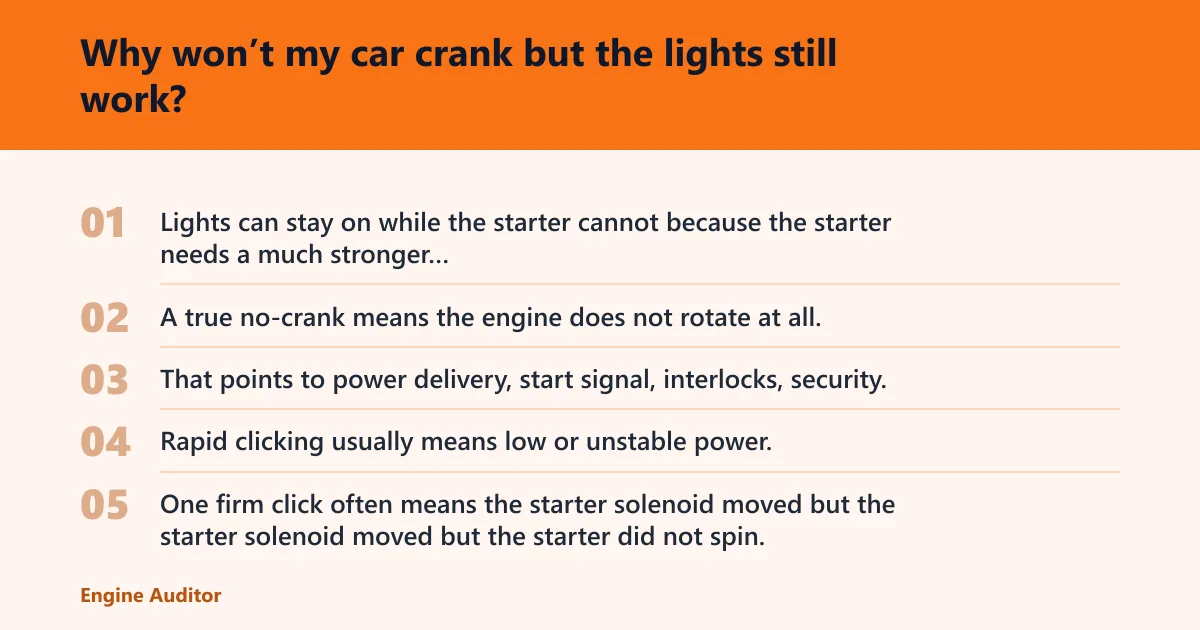
Lights can stay on while the starter cannot because the starter needs a much stronger burst than the dash, interior lamps, or even headlights. A true no-crank means the engine does not rotate at all. That points to power delivery, start signal, interlocks, security, or the starter motor itself.
Use the sound first. Rapid clicking usually means low or unstable power. One firm click often means the starter solenoid moved but the starter did not spin. Complete silence can mean the starter never got a start signal. Those three sounds split the problem fast.
What the dashboard lights do and do not prove
Dash lights prove some low-current circuits still have power. They do not prove the battery can carry starter load. I have seen batteries show fair voltage and still fail under load, so a quick visual check of lamps is weak evidence. Treat lights as a clue, not a verdict.

What you’ll need to check first
Start with a multimeter, then move to the battery posts, clamps, and ground points. A helper makes sound diagnosis easier, because one person can turn the key while the other listens for clicking, grinding, or no sound. Keep the hood area clear and do not keep cranking a weak system.
- Measure battery resting voltage with the car off.
- Try one jump-start and note whether the engine cranks immediately.
- Inspect terminals, cable ends, and grounds for looseness or corrosion.
- Listen for the starter sound: rapid clicking, a single clunk, grinding, or whirring while turning the key.
- Check interlocks, starter relay, and related fuse if power parts look good.
Step 1: Check the battery first
A healthy, fully charged battery often reads near 12.6 volts at rest. A reading near or below 12.2 volts means the charge is low. If the number is borderline, try a jump-start before replacing the battery, because a weak battery can still fool a quick no-load reading.
If the car starts with a jump but not by itself, think beyond the battery. That pattern can mean cable loss, charging trouble, or parasitic draw after shutdown. It can also mean the battery is weak under starter load even if the rest voltage looked acceptable.
Use load-test clues when the battery seems fine at rest
If the battery reads well parked but the starter only clicks, the problem may appear only under load. Turn the key while watching voltage if possible. If it drops hard and the starter stays dead, the battery, cables, or grounds are failing when current demand rises.
Is it the battery terminals or ground cables?
Loose clamps and poor grounds can add resistance on the high-current side and may keep the starter from working even if the lights still work. Twist each battery clamp by hand. It should not move. Look for corrosion on the posts, clamps, and cable ends; it may appear white, blue, or green. Those colors usually mean contact loss.
Check the engine ground path too. A poor engine ground can mimic a bad starter because the starter current never completes its loop. I see this one often: the battery looks usable, but the current path falls apart at the cable ends or block ground.
Twist-test the clamps and check the ground path
Use a wrench only after the hand check. Clean obvious corrosion, then retighten and retest. If the car cranks after moving a clamp or ground, the starter was probably innocent. That saves money and keeps you from replacing a part that only looked guilty.
Can the starter or relay be the problem?
Yes. A starter motor can fail with a one-click pattern, a no-crank with good battery power, or grinding and whirring if the gear is not engaging properly. Smoke, hot cables, or a burning smell are stop signs. Repeated start attempts can overheat the starter, battery cables, cable ends, relays, and wiring.
Check the starter relay and related fuse if there is silence. The relay carries the start signal, and a failed relay can block power from reaching the starter control side. If you hear one click and everything else looks healthy, the starter solenoid may be moving while the motor itself stays still.
When starter symptoms point away from the battery
Grinding usually means the starter gear is not meshing correctly. Whirring can mean the motor spins without fully engaging the flywheel. Those are mechanical starter clues, not just weak-battery clues. Stop cranking if the noise changes from click to grind; that is how teeth get damaged.
What about the ignition switch, park switch, or security system?
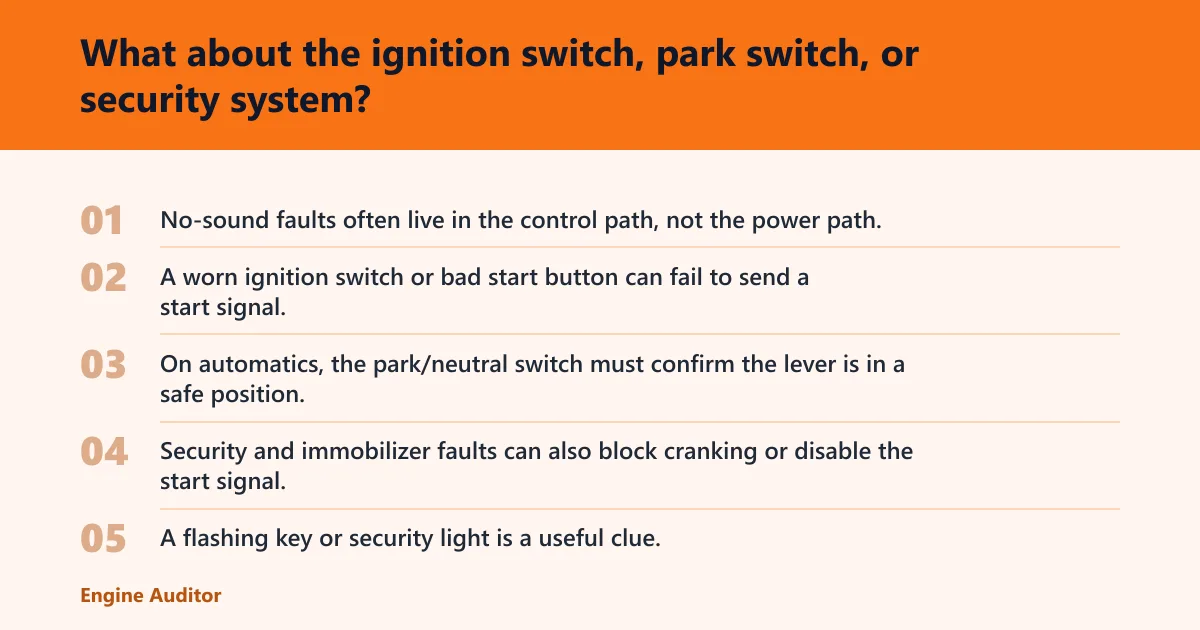
No-sound faults often live in the control path, not the power path. A worn ignition switch or bad start button can fail to send a start signal. On automatics, the park/neutral switch must confirm the lever is in a safe position. On manuals, the clutch switch must close.
Security and immobilizer faults can also block cranking or disable the start signal. A flashing key or security light is a useful clue. Smart-key and push-button systems add another layer: the car may need to recognize the fob before it allows starter control. If the key is not recognized, the circuit may stay open.
Key start vs push-button start differences
Traditional key systems may have problems at the ignition switch or somewhere in the relay path. Push-button systems may fail at the button, fob recognition, brake switch, or body-control logic. If the brake pedal must be pressed, confirm the brake lamps work; a bad brake switch can stop a start request on some cars.
Use this no-crank decision table
| Symptom | Likely subsystem | First test | Stop-testing red flags |
|---|---|---|---|
| Slow, weak crank | Battery or cable loss | Measure rest voltage; then try a jump-start | Burning smell, hot cables, repeated failed jumps |
| Rapid clicking | Low or unstable power | Check battery voltage and terminal tightness | Smoke, melted insulation, sparking |
| One firm click | Starter or starter cable path | Check voltage at battery and main starter feed | Grinding, whirring, heat damage |
| Complete silence | Relay, ignition switch, interlock, or security | Check start signal path and security light | Flashingly obvious security fault, repeated key cycles |
| Starts with jump only | Battery, cables, charging, or parasitic draw | Retest after jump and inspect charging output later | Repeated no-crank after fresh charge |
| Grinding or whirring | Starter engagement failure | Stop cranking and inspect starter drive | Any smoke, noise worsening, or smell of heat |
What should I check first when my car won’t crank?
Check battery voltage, then the clamps, then the sound. That order finds most causes quickly without random parts swapping. If the battery is near 12.6 volts at rest but the car still will not crank, move immediately to cable resistance, starter relay, and interlock checks.
Do not assume the battery is good because the lights work. Headlights use far less current than the starter motor. A battery can power lamps and still collapse when asked for starter current, especially in cold weather or after short trips.
Common mistakes
Replacing the starter before checking voltage drop wastes time. A corroded cable end or weak ground can mimic starter failure. Ignoring a bad ground because the lights still work is another mistake. The starter pulls current through paths that lamps never stress.
Keeping the key turned after repeated no-crank attempts can overheat parts. Stop if you hear grinding, smell burning, or see smoke. If the car starts with a jump but fails again later, do not stop at “bad battery”; look at charging output, cable loss, and parasitic draw.
If that didn’t work, try this next
- Scan for security or body-control clues: flashing key light, immobilizer message, or missing fob recognition.
- Try a known-good spare key or fob if the car supports it.
- Check the starter relay and related fuse with the relay swap or fuse inspection method in the owner’s box.
- Test the park/neutral switch or clutch switch by cycling the shifter or pressing the clutch fully.
- Book a shop diagnosis if the car still gives one click, silence, or repeated jump-only starts.
Cost and complexity, in plain terms
Battery voltage and terminal checks are cheap DIY. Relay, fuse, and interlock checks are still manageable with basic tools. Starter replacement, ground-path tracing, and security faults often need more time, scan tools, or lift access, so they move into shop territory faster.
Frequently asked questions
Why does my car just click when I try to start it?
Rapid clicking usually points to low or unstable power, while one firm click often means the starter solenoid moved but the starter did not spin. Check battery voltage, then terminal tightness, then the main ground. If it still clicks after a jump, move toward the starter path.
What if my car makes no sound at all when I turn the key?
Complete silence often means the starter never got a start signal. Check the relay, fuse, ignition switch or start button, park/neutral switch, clutch switch, and security light. If the key light flashes or the fob is not recognized, address that first before touching the starter.
Can a bad starter make the lights work but the engine not crank?
Yes. The starter can fail while the rest of the vehicle still has power. A failed starter often shows one-click behavior, no spin, or grinding and whirring. If battery voltage is healthy and the cables are tight, a starter fault becomes much more likely.
Why does my car start with a jump but not by itself?
That pattern usually points to a weak battery, charging problem, bad cable, or parasitic draw. A jump can hide a battery that fails under load. If the car starts by jump but dies again later, test the charging system and inspect the cable ends and grounds.
Is it the battery if the lights work but the car won’t start?
Maybe, but lights alone do not prove the battery can crank the engine. A healthy battery often reads near 12.6 volts at rest, and near or below 12.2 volts suggests low charge. Even then, a battery can look fair and still fail under starter load.
What should I check first when my car won’t crank?
Check battery voltage first, then inspect the clamps and ground. After that, listen for rapid clicking, one click, or silence, because each sound points to a different part of the circuit. If there is grinding or smoke, stop testing and get help.
Products related to this article
Sponsored / affiliate links. As an Amazon Associate I earn from qualifying purchases. I may earn additional commission from eligible campaigns.