Ford Maverick hybrid vs EcoBoost: which is better?
For most commuters, the Maverick Hybrid is the better buy; choose EcoBoost only if you need the 4K tow package, regular winter traction, or stronger passing pull. Pick the wrong one and you will burn more fuel, end up with the wrong drivetrain, or spend winter fighting towing and snow. This guide uses a commute, tow, snow, and budget matrix to match each engine to the right buyer.
Ford Maverick hybrid vs EcoBoost: which is better?


The short answer is plain: the hybrid costs less to run day after day and uses less fuel in city traffic, while the EcoBoost brings more power, better towing, and more traction options. If you use the truck like a commuter car with a bed, the hybrid fits well. If you need more truck, the EcoBoost is the safer purchase.
| Decision factor | Ford Maverick hybrid | EcoBoost: which is better | Winner |
|---|---|---|---|
| Fuel economy | 37 mpg combined; 42 mpg city | 25 mpg combined; 22 mpg city, 29 mpg highway | Ford Maverick hybrid |
| Power and passing | 191 hp total system output | 250 hp; 277 lb-ft torque | EcoBoost: which is better |
| Towing | 2,000 lbs | 4,000 lbs with the 4K Tow Package | EcoBoost: which is better |
| Drivetrain choice | 2WD only | AWD available | EcoBoost: which is better |
| Ownership cost | Lower fuel use, usually lower running cost | Higher fuel use, but better fit if capability prevents buying a second vehicle | Ford Maverick hybrid |
Fuel economy
The hybrid wins on mpg. With 37 mpg combined and 42 mpg city, it is built for stop-and-go use, school runs, delivery routes, and short hops where a truck sits idling, creeping, and braking.
The EcoBoost AWD model is rated at 25 mpg combined, with 22 mpg city and 29 mpg highway. That is still solid for a turbo truck, but the gap is big enough that fuel cost belongs in the purchase decision, not after it.
Power and passing
EcoBoost is the better choice when traffic gets fast. Its 250 hp and 277 lb-ft of torque give it stronger midrange pull for passing, merging, and climbing grades with the bed loaded.
The hybrid’s 191 hp total system output is fine for calm driving, but it does not feel as eager when the driver needs a quick lane change or a hard merge onto a busy freeway.
Towing and hauling
The hybrid is capped at 2,000 lbs, and that is the line that matters. Light utility trailers are fine. Regular towing, heavier loads, or steep grades are not where it belongs.
The EcoBoost, with the 4K Tow Package, can tow up to 4,000 lbs. That doubles the hybrid’s limit and turns the truck from a light-duty commuter with a bed into a much more flexible small hauler.
Drivetrain and winter use
The hybrid’s 2WD-only setup limits it in snow, slush, and loose surfaces. Good tires help, but they do not replace AWD when the road changes fast.
The EcoBoost’s available AWD makes it the more complete choice for drivers who regularly see unplowed roads, steep driveways, muddy job sites, or winter commutes where traction matters more than fuel savings.
According to Ford Maverick Hybrid vs Ecoboost 2026: Which Is Better? — The Maverick EcoBoost engine is a 2.0L turbocharged powertrain.
Which Maverick engine is better for city driving?
The hybrid is better for city driving because it uses less fuel in the exact conditions where trucks waste the most. Stop-and-go traffic, short trips, and repeated cold starts favor the hybrid’s 42 mpg city rating and lower operating cost.
Stop-and-go mpg advantage for the hybrid
City driving punishes larger engines. The hybrid stretches each gallon farther, and its 13.8-gallon fuel tank can support a 500+ mile range expectation in the right mix of driving. One real-world example claimed 595.2 miles on a tank and 44.1 mpg average fuel efficiency, which shows why commuters keep coming back to it.
Noise, throttle response, and low-speed feel
The hybrid is usually the quieter and cheaper daily choice, but it is not the more urgent one. The EcoBoost feels more immediate when pulling away from a light or slipping into a fast gap, and some drivers will prefer that response even if they pay more at the pump.
How much does the EcoBoost matter for passing and merging?
It matters a lot for drivers who spend time on highways, two-lane roads, or hilly routes. The EcoBoost’s extra horsepower and torque make it more confident when the truck is loaded, the lane is short, or the road demands a quick burst of speed.
Acceleration and midrange pull
The practical difference shows up in passing, not just at a stoplight. A 2.0L turbocharged powertrain with 250 hp and 277 lb-ft of torque will generally feel stronger in the middle of the rev range than the hybrid’s 191 hp total system output.
When the stronger engine pays off
If the truck regularly carries passengers, cargo, or a trailer, the EcoBoost’s extra reserve matters more than a fuel economy edge on paper. That reserve is also useful on mountain grades and in windy conditions where a small truck can feel busy.
Is the Ford Maverick hybrid or EcoBoost better for towing?
The EcoBoost is better for towing, and by a wide margin. The hybrid’s 2,000 lbs limit suits light utility work only, while the EcoBoost with the 4K Tow Package raises the ceiling to 4,000 lbs and is the clear pick for repeated trailer use.
2,000 lbs vs 4,000 lbs with the 4K Tow Package
The number matters because towing is not only about whether the truck can move the load once. It is about braking feel, grade climbing, heat, and stability on long pulls. The hybrid’s limit leaves very little buffer once passengers and cargo are added.
Why the hybrid is the wrong pick for frequent trailer use
If towing is part of the weekly routine, the hybrid is the wrong tool. A truck that runs near its limit often will feel strained, and buyers usually end up wishing they had bought the stronger drivetrain from the start.
Can you get AWD on a Ford Maverick hybrid?
No. The Maverick hybrid is 2WD only, so buyers who want all-weather traction need to look to the EcoBoost. That single drivetrain choice often decides the purchase for drivers in snowbelt states or for anyone on gravel, mud, or steep grades.
2WD-only hybrid limitation
The hybrid’s efficiency advantage comes with a hard tradeoff. If the driveway freezes, the road stays sloppy, or the truck is used on job sites with loose surfaces, 2WD can become a real limitation rather than a minor spec-sheet detail.
Why AWD EcoBoost matters for snow and poor roads
AWD does not make a truck invincible, but it improves launch traction and confidence in conditions where the hybrid must rely entirely on tires and careful throttle use. For winter-first buyers, that is worth paying for.
What does ownership cost look like over time?
The hybrid usually wins on fuel cost, while the EcoBoost wins on capability. That sounds obvious, but the real decision is whether the extra fuel spend is cheaper than buying the wrong truck and living with the wrong drivetrain, tow rating, or traction package.
Fuel savings versus purchase price
Ford lists the 2026 Maverick starting at MSRP $28,145, so the entry price is already close enough that fuel use can shift the value equation quickly. A driver who racks up city miles will usually recover the hybrid’s fuel advantage faster than a driver who mostly cruises on the highway.
Range, tank size, and refill frequency
The hybrid’s 13.8-gallon fuel tank and 37 mpg combined rating point to a strong range story, and that 500+ mile tank range expectation is realistic in mixed use. The 595.2-mile real-world example shows what happens when the driving pattern suits the truck.
The EcoBoost’s 25 mpg combined figure means more frequent fill-ups, especially for commuters. If the truck is also used for towing or winter traction, though, those extra stops can be easier to justify than buying a second vehicle later.
When the hybrid pays back and when it does not
The hybrid pays back best for solo commuting, errands, and light bed use. It pays back poorly if the owner needs AWD, hauls a trailer every week, or spends winters on rough roads, because the savings at the pump can be erased by buying the wrong drivetrain.
Buyer decision matrix: hybrid vs EcoBoost by use case
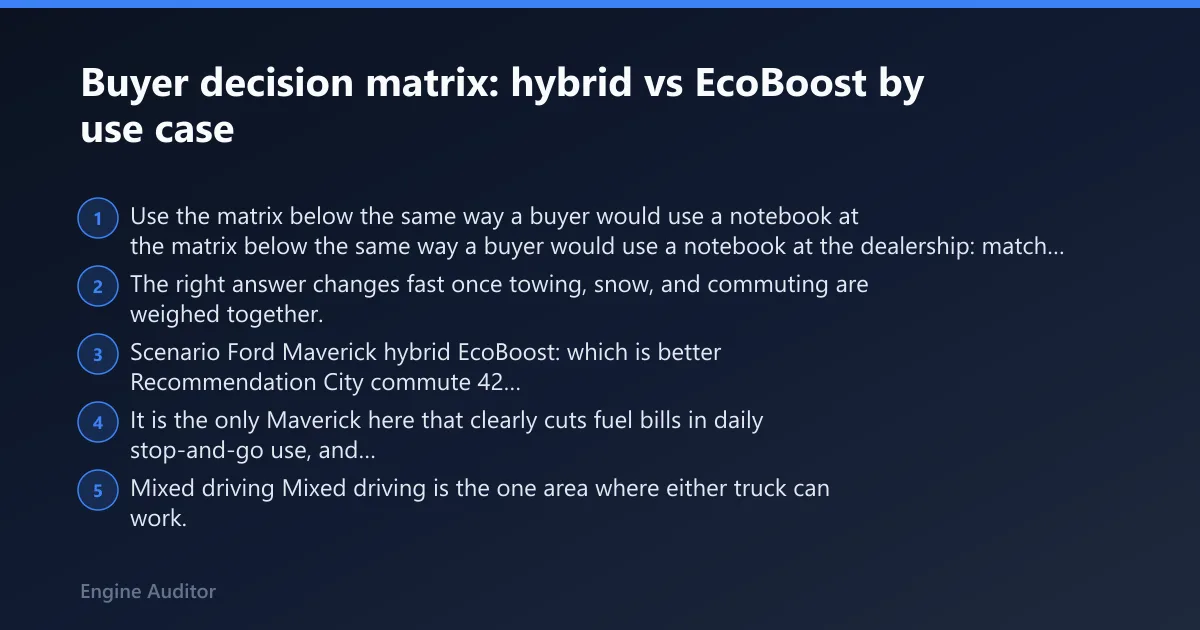
Use the matrix below the same way a buyer would use a notebook at the dealership: match the truck to the job first, then let fuel cost and comfort settle the tie. The right answer changes fast once towing, snow, and commuting are weighed together.
| Scenario | Ford Maverick hybrid | EcoBoost: which is better | Recommendation |
|---|---|---|---|
| City commute | 42 mpg city, 37 mpg combined, lower fuel spend | 25 mpg combined, stronger response but higher fuel use | Ford Maverick hybrid |
| Mixed driving | Best if the mix is mostly commuting and errands | Best if highway merges, hills, or load hauling matter more | Tie, with use case deciding |
| Towing | 2,000 lbs limit, light-duty only | 4,000 lbs with the 4K Tow Package | EcoBoost: which is better |
| Winter use | 2WD only, traction depends heavily on tires | AWD available, better for snow and poor roads | EcoBoost: which is better |
City commute
Pick the hybrid. It is the only Maverick here that clearly cuts fuel bills in daily stop-and-go use, and that is where the biggest savings show up.
Mixed driving
Mixed driving is the one area where either truck can work. If the mix includes long freeway runs, steep grades, or weekend hauling, the EcoBoost earns its keep. If it is mostly short trips with light cargo, the hybrid still makes more sense.
Towing
Pick EcoBoost. The 4K Tow Package is the difference between occasional light duty and real trailer work, and that is exactly where the hybrid starts to feel small.
Winter use
Pick EcoBoost if winter traction matters. AWD availability is the practical advantage here, and the hybrid’s 2WD-only setup is the wrong answer for many snowbelt buyers.
Choose Ford Maverick hybrid if… / Choose EcoBoost: which is better if…
Choose the Ford Maverick hybrid if you drive mostly in the city, want the lowest fuel bill, do not need AWD, and will stay well under the 2,000 lbs towing limit. It is the cleaner fit for commuters, errand runners, and drivers who want truck utility without truck fuel costs.
Choose the EcoBoost: which is better if you tow regularly, want AWD, live with winter roads, or care about stronger passing and merging. It is also the better choice if you expect the truck to carry heavier loads often, because the 4K Tow Package changes what the Maverick can realistically do.
Walk away from the hybrid if you need traction in snow or more than light towing. Walk away from the EcoBoost if your life is mostly commuting and you want the lowest operating cost over time.
Frequently asked questions
Ford Maverick hybrid vs EcoBoost: which is better?
The hybrid is better for most commuters, while the EcoBoost is better for towing, AWD, and stronger passing. If daily fuel cost is the main concern, the hybrid wins. If the truck has to do more than commute, the EcoBoost is usually the safer pick.
Is the Ford Maverick hybrid or EcoBoost better for towing?
The EcoBoost is better for towing because it can reach 4,000 lbs with the 4K Tow Package, while the hybrid is limited to 2,000 lbs. That gap is large enough that frequent trailer users should start with the EcoBoost instead of trying to make the hybrid fit.
Does the Maverick hybrid get better gas mileage than the EcoBoost?
Yes. The hybrid is rated at 37 mpg combined and 42 mpg city, while the EcoBoost AWD is rated at 25 mpg combined, 22 mpg city, and 29 mpg highway. That difference is the main reason many city shoppers choose the hybrid first.
Can you get AWD on a Ford Maverick hybrid?
No. The Maverick hybrid is 2WD only, so buyers who want AWD need the EcoBoost. That matters most for snow, poor roads, steep driveways, and any use case where traction is part of the daily commute rather than an occasional concern.
How much can a Ford Maverick EcoBoost tow?
The Maverick EcoBoost can tow up to 4,000 lbs with the 4K Tow Package. Without that setup, it should not be treated as the same towing truck. Buyers who need a trailer in regular rotation should verify the package before they buy.
Which Ford Maverick engine should I buy?
Buy the hybrid if your truck is mainly a commuter with a bed and you want the best fuel economy. Buy the EcoBoost if you need AWD, expect winter use, or plan to tow. The right answer is the one that matches the hardest job the truck has to do.
Products related to this article
Sponsored / affiliate links. As an Amazon Associate I earn from qualifying purchases. I may earn additional commission from eligible campaigns.