Ford Maverick vs Hyundai Santa Cruz: Which Pickup Wins?
The Ford Maverick gives you the better value and stronger tow-capable setup; the Hyundai Santa Cruz is the better road-biased pick, so your best choice comes down to budget, trailer weight, cabin feel, and how often you carry cargo. Pick poorly, and you may give up fuel savings, rear-seat space, towing confidence, or ride comfort you use every day. This guide compares towing, commuting, cargo, cabin comfort, and ownership costs so you can match each truck to real needs.
This guide is part of our Ford cars guide series.
| Decision factor | Ford Maverick | Hyundai Santa Cruz | Winner |
|---|---|---|---|
| Starting price | Starts at MSRP $28,145 | Typically starts higher than Maverick | Ford Maverick |
| Bed length | 54.1 inches | 52.1 inches | Ford Maverick |
| Towing ceiling | Up to 4,000 pounds | Up to 5,000 pounds on top trims | Hyundai Santa Cruz |
| Payload | Up to 1,500 pounds | 1,411 pounds in this comparison | Ford Maverick |
| Fuel economy | Hybrid is far thriftier | Turbo gas models are the main path | Ford Maverick |
| Rear-seat priority | Usable, but tight | Usually the more comfortable choice | Hyundai Santa Cruz |
Ford Maverick vs Hyundai Santa Cruz: the core trade-off
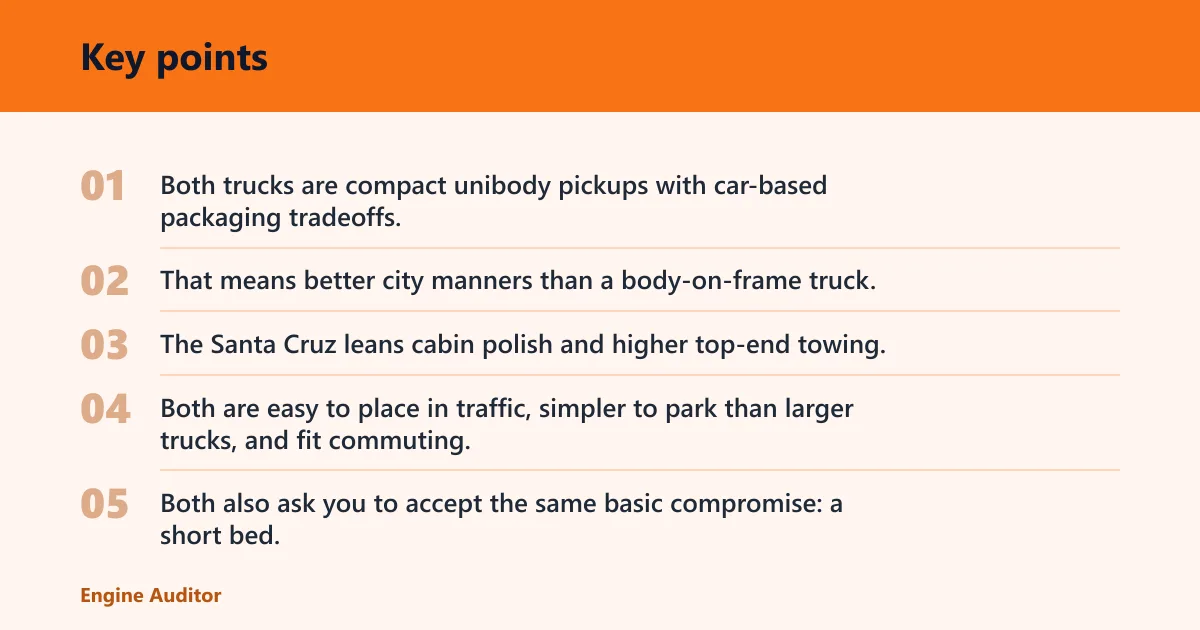


Both trucks are compact unibody pickups with car-based packaging tradeoffs. That means better city manners than a body-on-frame truck, but less cab-and-bed flexibility than many pickup buyers expect. The Maverick leans utility and price. The Santa Cruz leans cabin polish and higher top-end towing.
What both compact pickups get right
Both are easy to place in traffic, simpler to park than larger trucks, and fit commuting, errands, and light weekend hauling. Both also ask you to accept the same basic compromise: a short bed, a rear seat that is usable but limited, and less cargo volume than an SUV with the seats folded.
Where the Maverick and Santa Cruz split by use case
The Maverick is the more budget-sensitive choice, and its bed is longer at 54.1 inches. The Santa Cruz answers with a more upscale cabin and a stronger top towing rating, reaching 5,000 pounds on higher-output trims. That split matters more than styling debates.
📊 Ford Maverick starts at MSRP $28,145. Source: FORD.
Side-by-side specs that matter most
These are the numbers that change buying decisions. If you ignore trim level, the comparison blurs fast, because base and top trims do very different work in each lineup.
| Spec | Ford Maverick | Hyundai Santa Cruz | What it means |
|---|---|---|---|
| Starting MSRP | $28,145 | Higher starting point in typical shopping | Maverick is easier to reach on budget |
| Bed length | 54.1 inches | 52.1 inches | Maverick has a small but real cargo advantage |
| Payload | Up to 1,500 pounds | 1,411 pounds | Maverick handles heavier loose cargo better |
| Top towing | 4,000 pounds | 5,000 pounds | Santa Cruz has the edge for heavier trailers |
| Hybrid efficiency | 42 mpg city, 33 mpg highway | No direct hybrid match in this comparison | Maverick is the commuter-friendly pick |
| Rear-seat implications | Functional, but space is limited | Also limited, with a more upscale feel | Santa Cruz usually feels better trimmed inside |
Price and packaging
The Maverick starts at MSRP $28,145, which places it below the Ranger in Ford’s lineup and below many shoppers’ expectations for a pickup. The Santa Cruz usually asks more money before equipment matching even starts. That matters because these trucks are often cross-shopped on monthly payment, not just sticker price.
Bed length and payload
The Maverick’s 54.1-inch bed is a meaningful advantage over the Santa Cruz’s 52.1-inch bed when you load coolers, bags of mulch, or a folded stroller. Maverick also lists up to 1,500 pounds of payload, versus 1,411 pounds for the Santa Cruz in this comparison. If you carry heavy cargo more often than you tow, that difference is useful.
Powertrain spread
The Maverick is the truck with the clearer efficiency split. Its hybrid uses a 2.5-liter four-cylinder system with about 191 horsepower and roughly 42 mpg city and 33 mpg highway, while the 2.0-liter turbo is around 250 horsepower, uses an 8-speed automatic, and gets about 23 mpg city and 29 mpg highway. Those are very different ownership equations.
Is the Ford Maverick or Hyundai Santa Cruz better for daily driving?
The Maverick is usually the better daily driver if you care most about fuel use, shorter trips, and lower entry price. The Santa Cruz is the better fit if you want a calmer-feeling cabin and expect more highway time, especially with passengers, though you will usually pay more for that setup.
City parking and commute-friendly size
Both trucks are city-friendly compared with larger pickups because they are compact and unibody-based. The Maverick’s lower starting price and hybrid option make it the easier commuter choice, especially for stop-and-go routes where 42 mpg city matters.
Ride, visibility, and low-speed use
Low-speed driving is less about raw horsepower here and more about how the truck fits your routine. A common first-timer mistake is buying towing capacity that gets used twice a year and then paying for extra fuel every weekday. If your driving is mostly short city trips, the Maverick Hybrid makes more sense.
How do towing and hauling compare?
The Santa Cruz wins on top towing, while the Maverick wins on payload and bed usefulness for loose cargo. If you tow a larger camper or trailer, the Santa Cruz’s 5,000-pound rating on top trims gives it the higher ceiling. If you carry building materials, tools, or heavy gear in the bed, the Maverick is often the better fit.
Maverick Hybrid vs Maverick 2.0-liter turbo
The Maverick Hybrid is the economy choice. Its towing rating is enough for light utility trailers, small campers, and many motorcycle or utility loads, but may not be the best choice for buyers who tow regularly near the limit. The 2.0-liter turbo raises towing to 4,000 pounds and makes the Maverick a more flexible tow vehicle.
Santa Cruz towing limits and XRT positioning
The Santa Cruz line is more split by trim than the Maverick line. Common shopping advice centers on a 3,500-pound towing limit for many versions, while higher-output trims can reach 5,000 pounds. The XRT and similar upper trims make sense only if you need the stronger trailer rating or prefer their off-road-oriented packaging.
Bed length, payload, and what fits in each truck
The Maverick’s extra bed length helps when you load long but not tall items, such as bikes with wheels turned, landscape edging, or flat-pack materials. The Santa Cruz still works for everyday hauling, but its shorter bed means you will reach the tailgate sooner. For contractor gear, payload and bed length matter more than brochure power.
Picture a buyer who hauls two mountain bikes, a couple of 27-gallon storage bins, and a folded dog crate on weekends. The Maverick’s longer bed gives those items a little more breathing room, while the Santa Cruz asks for a tighter load plan.
How do the Maverick hybrid and Santa Cruz compare on fuel economy?
The Maverick Hybrid is the clear fuel-economy leader, and that can matter more than towing on a long commute. With 42 mpg city and 33 mpg highway, it is built for buyers who spend most of their miles in traffic or on short urban runs. The Santa Cruz can be efficient for a pickup, but it does not match that hybrid advantage.
Who benefits most from the hybrid
If you commute 40 miles a day or more, the Maverick Hybrid is the cleaner financial fit for many shoppers because fuel use stays lower in the exact driving pattern that costs the most at the pump. It also keeps operating costs easier to predict for buyers who rarely tow.
When the turbo makes more sense
The 2.0-liter turbo Maverick is the better choice if you need stronger acceleration, want the 4,000-pound tow rating, or expect the truck to carry more load than a hybrid buyer usually does. It sacrifices efficiency, but it gives the Maverick a much broader work envelope.
Which pickup has the bigger bed, Ford Maverick or Hyundai Santa Cruz?
The Ford Maverick has the bigger bed in this comparison, with 54.1 inches versus 52.1 inches for the Santa Cruz. That difference is small on paper, but it can decide whether a cooler, toolbox, or folded outdoor gear sits flat without creative packing.
Why two inches can matter
Two inches is not dramatic, but it can change how the tailgate closes and how much gear you can stack behind the cab. If you carry pets in a crate, bicycles, or contractor tools, the Maverick’s extra space makes loading a little simpler.
What neither truck solves
Neither truck turns into a large cargo hauler. Both still ask you to think like a compact pickup owner, not a half-ton buyer. If you regularly move sheet goods or large appliances, you need a bigger truck.
Which truck is more comfortable for rear passengers?
The Santa Cruz is usually the better pick for rear passengers because its cabin often feels more premium, even though both trucks have rear-seat tradeoffs. The Maverick is serviceable, but rear-seat room is not the reason most shoppers buy it. If adults ride back there often, test the space before you commit.
Rear-seat room and child-seat fit
Rear seats in both trucks are usable, but they are compact compared with SUVs. Child seats fit best when you do not need the front seat pushed far back. If you haul kids, the Santa Cruz’s better-trimmed cabin can make daily use feel less bare-bones.
Premium features in the Santa Cruz
The Santa Cruz leans into premium interior features more often, especially in upper trims. That does not automatically make it the better value, but it does make sense for buyers who spend long hours in traffic and care about cabin feel as much as bed utility.
Use-case decision matrix and one-screen verdict chart
This is the part many comparison pages skip. Real buyers do not shop by spec sheet alone. They shop by what they haul, how far they commute, and whether the truck has to carry people as often as cargo.
| Use case | What matters most | Ford Maverick recommendation | Hyundai Santa Cruz recommendation | Best fit |
|---|---|---|---|---|
| Light towing | Occasional trailer use under 4,000 pounds | 2.0-liter turbo for 4,000-pound towing | Higher-output trim if you need up to 5,000 pounds | Tie, depending on trailer weight |
| Bed size | Longer flat cargo floor for gear | 54.1-inch bed | 52.1-inch bed | Ford Maverick |
| Rear seats | Adults, child seats, or frequent passengers | Acceptable, but tight | Usually the better cabin feel | Hyundai Santa Cruz |
| Commute mileage | High miles, stop-and-go traffic | Hybrid with 42 mpg city and 33 mpg highway | Gas-focused trims only | Ford Maverick |
| Budget | Lowest entry price and payment control | Starts at MSRP $28,145 | Usually costs more to start | Ford Maverick |
| Scenario | Ford Maverick | Hyundai Santa Cruz | Verdict |
|---|---|---|---|
| Pets | Longer bed helps with crates and muddy gear | Cabin feel is nicer for short trips | Maverick for cargo, Santa Cruz for cabin comfort |
| Bikes | Better fit for long frames and loose gear | Works, but tighter | Ford Maverick |
| Contractor gear | Better bed length and payload | Better if the job is mostly road time | Ford Maverick |
| Child seats | Usable, but space is limited | Usually easier to live with | Hyundai Santa Cruz |
| Light towing | Hybrid for occasional light trailers, turbo for heavier loads | Higher trims for the best tow rating | Tie by trailer weight |
Fuel, tires, insurance, and depreciation in the real world
Ownership cost is broader than fuel alone. The Maverick Hybrid lowers fuel spend most clearly, while the turbo and the Santa Cruz add more cost pressure through thirstier powertrains and, often, higher trim content. Tires, insurance, and depreciation vary by trim and market, so the safest shopping move is to compare the exact builds you can afford, not the whole nameplate.
Choose Ford Maverick if… / Choose Hyundai Santa Cruz if…
Choose the Ford Maverick if your priority list starts with price, fuel savings, payload, or a slightly longer bed. Choose the Hyundai Santa Cruz if you want the stronger top towing rating, a more premium cabin, and a road-biased feel that better suits mixed commuting and occasional trailer duty.
Choose Ford Maverick if…
You want the lower starting price at MSRP $28,145. You drive a lot of city miles and can use the hybrid’s 42 mpg city rating. You care about the 54.1-inch bed, the up-to-1,500-pound payload rating, or the 4,000-pound turbo tow rating more than upscale interior trim.
Best Maverick trims usually split into two paths. The Maverick Hybrid fits high-mileage commuting and light-duty hauling. The 2.0-liter turbo makes more sense if towing or mixed-use weekend work matters more than fuel economy.
Choose Hyundai Santa Cruz if…
You want the 5,000-pound top towing rating, a nicer cabin, or an off-road-leaning XRT-style trim. You care less about bed length and more about how the truck feels on long pavement drives. The Santa Cruz also fits shoppers who treat the rear seat as a real passenger space more often.
Buy the Santa Cruz trim that matches your trailer, not the one with the most badges. The higher-output versions are the ones that change the towing story. Lower trims are better viewed as commuter trucks with cargo utility, not tow-first models.
Frequently asked questions
Is the Ford Maverick or Hyundai Santa Cruz better for daily driving?
The Maverick is usually better for daily driving if your commute is long, stop-and-go, or budget-sensitive, because the hybrid brings strong fuel economy. The Santa Cruz is better if you value a more premium cabin and spend more time on highway miles than at the fuel pump.
Which small truck has more towing capacity, Maverick or Santa Cruz?
The Santa Cruz has the higher top towing rating at 5,000 pounds on top trims, while the Maverick tops out at 4,000 pounds with the 2.0-liter turbo. If you tow near the upper limit often, that extra 1,000 pounds can change the buying decision.
How do the Maverick hybrid and Santa Cruz compare on fuel economy?
The Maverick Hybrid is the clear efficiency winner with 42 mpg city and 33 mpg highway. The Santa Cruz does not have a direct hybrid answer in this comparison, so buyers who spend more time commuting than towing usually save more with the Maverick Hybrid.
Which pickup has the bigger bed, Ford Maverick or Hyundai Santa Cruz?
The Ford Maverick has the bigger bed, measuring 54.1 inches long versus 52.1 inches for the Santa Cruz. The difference is modest, but it helps with longer items, tighter packing, and hauling gear that needs just a little more floor length.
Which truck is more comfortable for rear passengers?
The Hyundai Santa Cruz is usually the more comfortable choice for rear passengers because its cabin presentation tends to be more upscale. That said, both trucks have rear seats that are acceptable rather than roomy, so families should test child-seat access and legroom before buying.
Should I buy the Maverick Hybrid or the turbocharged Maverick instead?
Buy the Maverick Hybrid if your driving is mostly commuting, errands, and light cargo, because the 42 mpg city figure and lower starting cost make it easy to live with. Buy the turbocharged Maverick if you need the 4,000-pound tow rating or want stronger passing power and a wider work range.
Products related to this article
Sponsored / affiliate links. As an Amazon Associate I earn from qualifying purchases. I may earn additional commission from eligible campaigns.