Ford EV vs gas Ford: which is cheaper to own long term?
A Ford EV can be cheaper to own if you can charge at home and drive a fairly high number of miles each year; a gas Ford can be cheaper for lower-mile drivers, people who cannot charge at home, or those who tow often, while a hybrid may fall somewhere in between. Pick the wrong setup and fuel, charging, or depreciation can cost more than expected. This guide compares Ford EV, gas truck/SUV, and hybrid ownership costs by annual miles, charging access, and towing needs.
This guide is part of our Ford cars guide series.
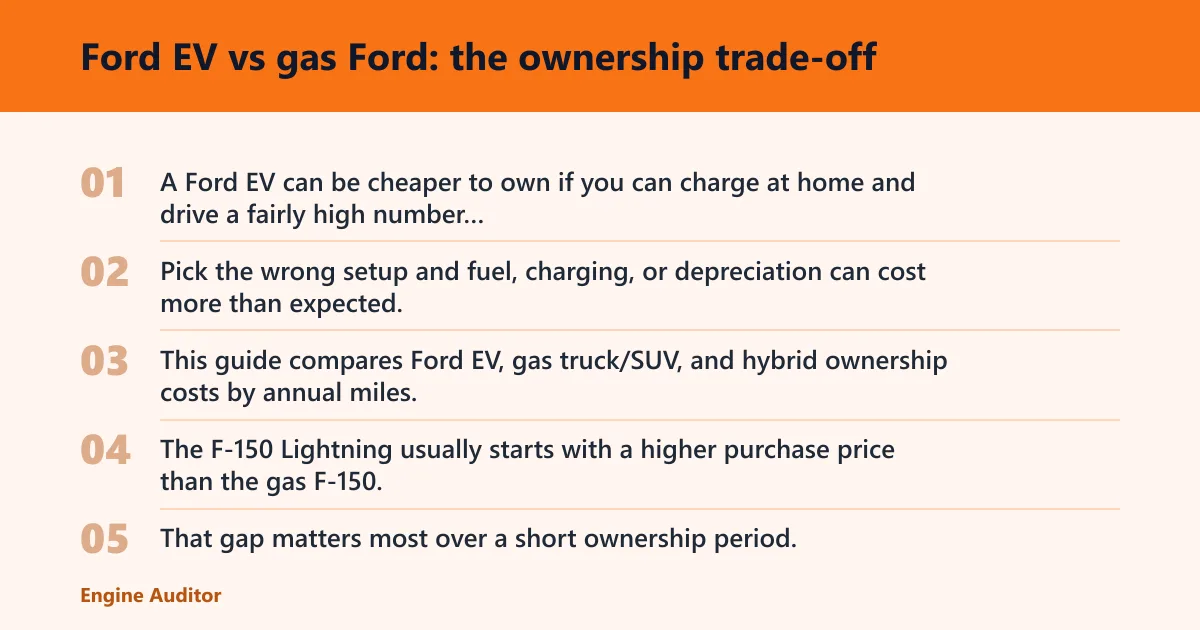
Ford EV vs gas Ford: the ownership trade-off


| Decision factor | Ford EV | gas Ford | Winner |
|---|---|---|---|
| Up-front purchase price | Usually higher, especially for an F-150 Lightning versus a gas F-150 | Usually lower sticker price | gas Ford |
| Fuel or energy cost per mile | Lower with home Level 2 charging; much less attractive on public DC fast charging | Higher and tied to gasoline prices | Ford EV with home charging |
| Routine maintenance | Usually lower: no oil changes and fewer routine wear items | Higher: oil changes, more fluid service, and more engine-related wear items | Ford EV |
| Towing and long-distance flexibility | Can work, but range drops under load and charging stops matter | Better for long tow days and refueling speed | gas Ford |
| Break-even speed | Faster with higher miles, home charging, and tax-credit eligibility | Less likely to recover a higher purchase price through fuel savings | Ford EV for higher-mileage buyers |
Up-front price versus ownership math
The F-150 Lightning usually starts with a higher purchase price than the gas F-150, and the Mustang Mach-E often sits above many gas SUVs on sticker alone. That gap matters most over a short ownership period, because fuel savings need time to catch up.
Ford’s shopping flow can calculate monthly payment including taxes and fees, and Ford says buyers can receive a financing decision within 90 seconds. Ford also says dealer selling price may include dealer documentation fees, and the purchase is between the customer and the dealer, not directly with Ford.
Fuel savings only count if charging is cheap enough
Home charging gives a Ford EV its best cost case. Public DC fast charging can erase savings quickly, especially if you rely on it several times a week or use it as your main refill method.
Say your commute is a moderate daily distance and you can plug in overnight at home. That driver can usually make the EV math work much faster than a similar driver who depends on a fast charger near the highway.
📊 Ford says buyers can receive a financing decision within 90 seconds. Source: FORD.
Which Ford model fits your use case?
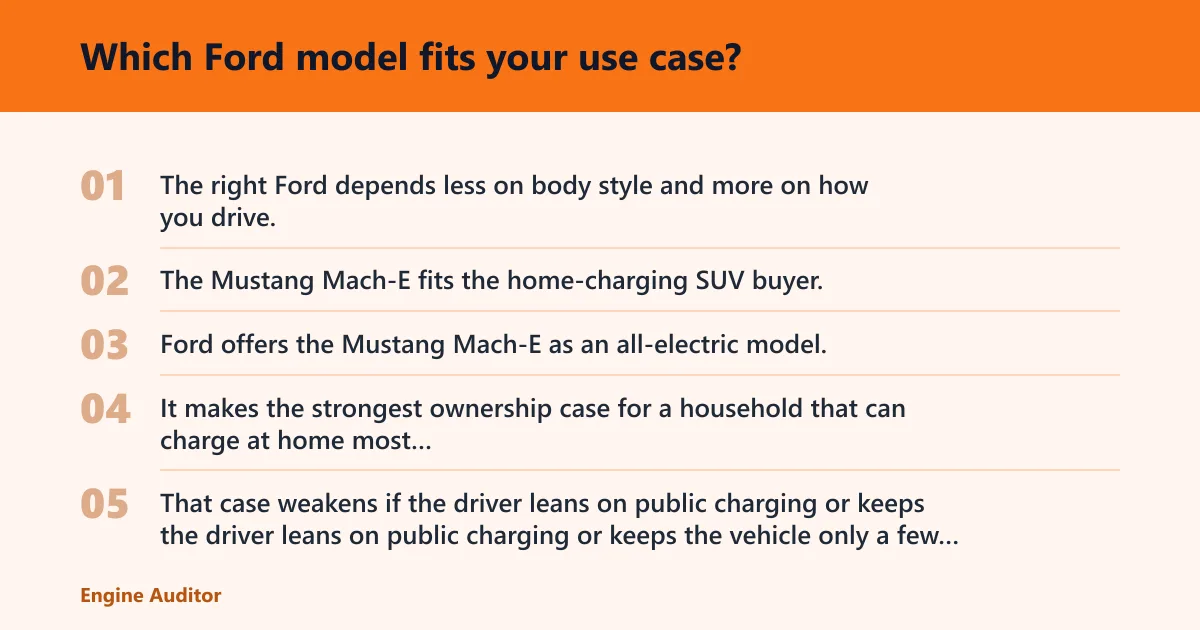
The right Ford depends less on body style and more on how you drive. The Mustang Mach-E fits the home-charging SUV buyer, the F-150 Lightning fits the truck buyer who can plan around charging, and the Maverick Hybrid is the cost-control fallback when EV pricing or charging access does not fit.
Mustang Mach-E for drivers with reliable home charging
Ford offers the Mustang Mach-E as an all-electric model. It makes the strongest ownership case for a household that can charge at home most nights and wants to keep daily energy costs down.
That case weakens if the driver leans on public charging or keeps the vehicle only a few years. Incentive eligibility also matters, because federal and local credits can close part of the purchase-price gap.
F-150 Lightning for truck buyers who can live with charging time
Ford lists the F-150 Lightning as an all-electric truck option. It can lower energy and maintenance costs compared with a gas F-150, but the higher purchase price and towing range penalty still shape the decision.
If you tow often, drive long rural routes, or need maximum refuel speed, the gas truck usually stays ahead. If you mostly commute, run errands, and charge at home, the Lightning has a clearer path to lower total cost.
F-150 or Maverick Hybrid when price and flexibility matter more
Ford lists the Maverick as hybrid available, and Ford lists the Ranger as hybrid available. The Maverick Hybrid is the middle ground when you want lower fuel use without paying for a full EV or changing your charging routine.
For buyers who do not want charging planning, a gas F-150 remains the straightforward benchmark. For buyers who want the lowest running cost without moving to a full EV, the Maverick Hybrid often beats both a larger gas truck and a more expensive electric truck on practical ownership math.

How much does it cost to drive a Ford EV versus gas Ford models?
At the mile level, a Ford EV is usually cheaper to run than a gas Ford if you charge at home. The cost gap narrows when you use public DC fast charging often, and it narrows again if gasoline prices fall while electricity prices rise.
Home Level 2 charging versus gasoline
Home Level 2 charging is the cleanest cost case for a Ford EV because you buy electricity at your residential rate instead of a public charging markup. Energy use is commonly discussed in miles per kWh or kWh per 100 miles, and that efficiency determines how far each dollar goes.
For a shopper, the key question is simple: does your electricity rate and charging pattern beat the local cost of gasoline on a per-mile basis? If the answer is yes, the EV has room to pay back its higher sticker price.
Public DC fast charging cuts into savings
Public DC fast charging usually costs more per kWh than home charging, and the price can vary by network, time of day, and location. That matters because a Ford EV that looks cheap on a driveway can look much closer to a gas truck if it spends most of its life on fast chargers.
A common first-timer mistake is treating all EV charging as if it costs the same. It does not, and that difference can decide whether the Ford EV is cheaper over 5 years or only cheaper on paper.
Gas baseline: the F-150 and fuel cost exposure
The F-150 is the gas benchmark for pickup ownership cost. In a comparison article, Ford used a $40,960 F-150 example price, while the Lightning example price was $54,769, which shows how the EV often starts with a bigger gap to recover. (caranddriver.com)
Gas costs are easier to understand, but they also move with fuel prices and engine choice. More miles mean more gasoline, and more gasoline means a faster penalty for a heavy-use truck owner.
What changes when you factor in maintenance and insurance?
EVs usually need less routine maintenance than gas vehicles, but the savings are not zero, and insurance can eat into them. For a Ford buyer, the maintenance advantage is real; the question is whether it is large enough to offset a higher payment or a higher premium.
EV maintenance savings come from fewer scheduled engine items
Ford says mobile service can handle oil and filter changes and brakes, which are part of the gas vehicle service stack but not part of routine EV engine maintenance. A Ford EV does not need oil changes, and it avoids many of the engine-related items that add up over time.
Gas Ford maintenance still includes oil changes, brake wear, transmission fluid service, and other scheduled items. That is one reason the maintenance line usually favors the EV in long ownership periods.
Insurance can narrow the gap
EV insurance premiums can run higher because the vehicles often cost more to repair, and coverage varies by trim, location, and driver profile. That does not erase EV savings by itself, but it can shrink them enough that a low-mileage buyer should pay attention.
For a shopper comparing a Mustang Mach-E to a gas SUV, or an F-150 Lightning to a gas F-150, insurance belongs in the total-cost math from day one.
5-year Ford ownership comparison table
The table below uses the ownership pattern, not a single sticker price, to show how the break-even direction usually changes. It is most useful as a decision aid: home charging helps the EV, public fast charging hurts it, and low mileage often favors the gas Ford or the Maverick Hybrid.
| Scenario | Ford EV fuel or energy over 5 years | Ford gas fuel or energy over 5 years | Maintenance direction | Likely break-even direction |
|---|---|---|---|---|
| Home-charging commuter, about 12,000 miles a year | Lowest cost case for Mustang Mach-E or Lightning | Higher fuel cost than EV if gas prices stay ordinary | EV wins on routine service | Ford EV usually wins if the credit applies and the owner keeps it long enough |
| Mixed public and home charging driver, about 12,000 miles a year | Moderate to high, depending on how much fast charging is used | Stable relative cost, though still tied to gas prices | EV still tends to spend less on service | Depends on fast-charging share; gas Ford or Maverick Hybrid can be cheaper overall |
| Low-mileage owner, about 8,000 miles a year | Low total energy use, but savings are too small to recover a big price gap quickly | Lower fuel spend because mileage is low | EV still saves on maintenance, but not enough for every buyer | gas Ford or Maverick Hybrid often wins unless the EV discount is unusually strong |
Home-charging commuter
This is the best Ford EV case. The owner charges at home, drives enough miles for energy savings to matter, and can hold the vehicle long enough for the lower maintenance to show up in the budget.
Mixed public and home charging driver
This is the hardest case to call. If the driver relies on fast charging for weekly travel, the EV’s per-mile advantage shrinks enough that the F-150 or Maverick Hybrid may come out ahead on total cost.
Low-mileage owner
At 8,000 miles a year, the fuel bill is simply too small to pay back a large premium quickly. A low-use owner often gets better value from a gas Ford or a Maverick Hybrid unless the EV is discounted hard and kept for many years.
Does the Federal Clean Vehicle Credit change the math?
Yes. The Federal Clean Vehicle Credit can be worth up to $7,500, and that amount can materially shrink the gap between a Ford EV and a gas Ford. The catch is that eligibility depends on income caps, MSRP limits, and whether the model qualifies. (irs.gov)
Why the credit matters for Ford shoppers
On a Mustang Mach-E or F-150 Lightning, a full credit can change the payback period enough to move an EV from “maybe” to “likely.” That is especially true for higher-mileage drivers who will keep the vehicle long enough to capture the running-cost savings.
Ford lists the buyer-dealer transaction as separate from Ford itself, so dealer selling price, regional incentives, taxes, and fees all sit in the real out-the-door number. A credit helps most when the dealer price is already competitive.
Eligibility risk is real
The credit is not automatic. Income limits, MSRP limits, and model eligibility can block or reduce the benefit, and those rules can change the purchase math more than a small fuel-price difference would.
That is why a Ford EV should be compared against the gas alternative after incentives, not before them.
How much does maintenance differ between Ford EV and gas vehicles?
Ford EVs usually cost less to maintain because they avoid oil changes and have fewer routine drivetrain service items. Gas Ford vehicles still need oil, filters, and other scheduled service, and those costs keep stacking up as miles rise.
Gas Ford maintenance items that keep adding up
Oil changes are the obvious one, but they are not the only one. Brake wear, transmission fluid, and other scheduled service items all belong in the long-term ownership total for a gas Ford, especially on higher-mileage trucks.
EVs still have maintenance, just less of it
EVs still need tires, brakes, cabin filters, and general inspection items. The savings come from removing engine maintenance, not from eliminating service entirely.
When is a gas Ford cheaper than a Ford EV?
A gas Ford is often cheaper when you drive relatively few miles each year, cannot charge at home, rely heavily on public fast charging, tow often, or plan to sell within a few years. In those cases, the EV’s lower energy and maintenance costs often fail to beat the higher purchase price and financing burden.
Picture a buyer who tows a boat on weekends and lives in an apartment with one shared charger. That buyer may spend more time and money planning charging than saving on energy, which is why the F-150 or Maverick Hybrid can be the better ownership fit.
How do insurance and financing affect EV vs gas ownership costs?
Insurance and financing can move the answer as much as fuel does. A higher monthly payment, a longer loan term, or a higher EV premium can erase several years of fuel savings, especially for low-mileage drivers.
Financing makes the sticker gap more important
Ford says buyers can get a financing decision within 90 seconds, which matters because the monthly payment often drives the final choice more than the sticker. A higher EV price spreads across the loan, so interest charges can follow the buyer for years.
Depreciation matters if you do not keep the vehicle long
Short ownership windows are where EV math gets fragile. If a buyer sells before fuel savings and maintenance savings have time to accumulate, the price gap and resale value can dominate the decision.
Choose Mustang Mach-E if… / Choose F-150 Lightning if… / choose F-150 or Maverick Hybrid if…
Choose the Mustang Mach-E if you can charge at home, drive around 12,000 miles a year or more, and can qualify for the Federal Clean Vehicle Credit or a strong local incentive. Choose the F-150 Lightning if you want a truck, can tolerate charging stops, and use it more for commuting and general driving than heavy towing.
Choose the F-150 if you tow often, need fast refueling, or drive far from home chargers. Choose the Maverick Hybrid if you want the lower operating cost of a hybrid without betting on charging access or a bigger EV purchase price.
Frequently asked questions
Is charging an EV cheaper than gas for a Ford?
Usually yes, if you charge at home and compare it to gasoline on a per-mile basis. The advantage shrinks with public DC fast charging, and it can shrink further if your utility rate is high or your driving is low enough that the savings never add up much.
Are EVs cheaper than gas cars to own over time?
Often, but not always. EVs usually save on energy and routine maintenance, while gas vehicles usually cost less up front, so mileage, charging access, incentives, insurance, and ownership length decide the winner.
What is the cost to drive EV vs gas Ford models?
The Ford EV is cheaper to drive when home charging is available and electricity is reasonably priced. The gas Ford becomes more competitive when the driver depends on fast charging, drives fewer miles, or keeps the vehicle only a short time.
Does the Ford EV tax credit change the ownership math?
Yes. The Federal Clean Vehicle Credit can cut up to $7,500 from the effective price, but only if the buyer and vehicle meet the income and MSRP rules. That can materially improve the Mustang Mach-E or F-150 Lightning case.
How much does maintenance differ between Ford EV and gas vehicles?
Ford EVs generally avoid oil changes and several engine-related service items, so scheduled maintenance is usually lower. Gas Ford vehicles still need oil, brake, and transmission-related service, which becomes more expensive as mileage rises.
When is a gas Ford cheaper than a Ford EV?
A gas Ford is usually cheaper for low-mileage owners, frequent tow drivers, apartment dwellers without reliable charging, and shoppers who plan to sell quickly. In those cases, the EV’s savings often do not have enough time to offset the higher purchase price.
Products related to this article
Sponsored / affiliate links. As an Amazon Associate I earn from qualifying purchases. I may earn additional commission from eligible campaigns.
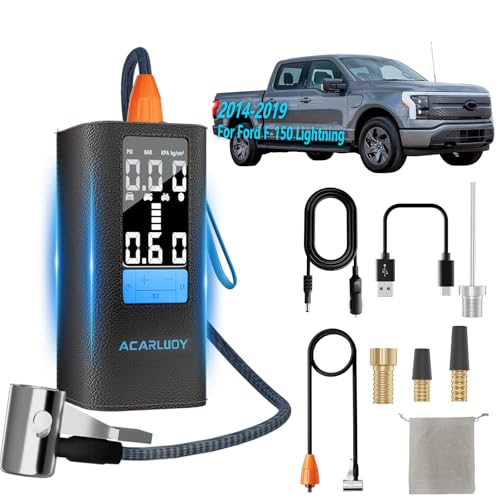 ACARLUOY Portable Air Compressor for Car Tires - 3X Faster Inflation, Fit for Ford F-150 Lightning 2014-2019,6000mAh Battery, LCD Screen, LED Light,Auto Shutoff
 ACARLUOY Portable Air Compressor for Car Tires - 3X Faster Inflation, Fit for Ford F-150 Lightning Ford 2014-2019,6000mAh Battery, LCD Screen, LED Light,Auto Shutoff