Do Electric Cars Need Oil Changes?
No, electric cars do not need engine oil changes because they do not have a combustion engine. Paying for one on an EV usually means paying for the wrong service line item. This guide explains which EV fluids may still need attention, what to check on the invoice, and how to stop a bad recommendation before you pay.
Why hybrids still need oil changes


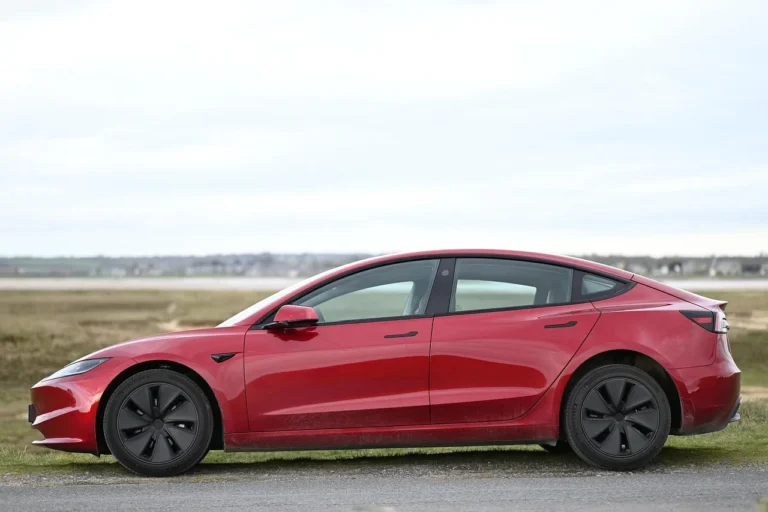
Pure battery-electric vehicles do not need engine oil changes. A BEV uses an electric motor instead of an internal-combustion engine, so there are no pistons, valves, or camshafts to lubricate with engine oil. The confusion starts when a shop uses the word “oil” for a different fluid service.
That difference matters. A drive-unit fluid change, brake-fluid service, or coolant service is not the same thing as an engine oil change, and each one has its own interval and purpose.
Why hybrids and plug-in hybrids are different
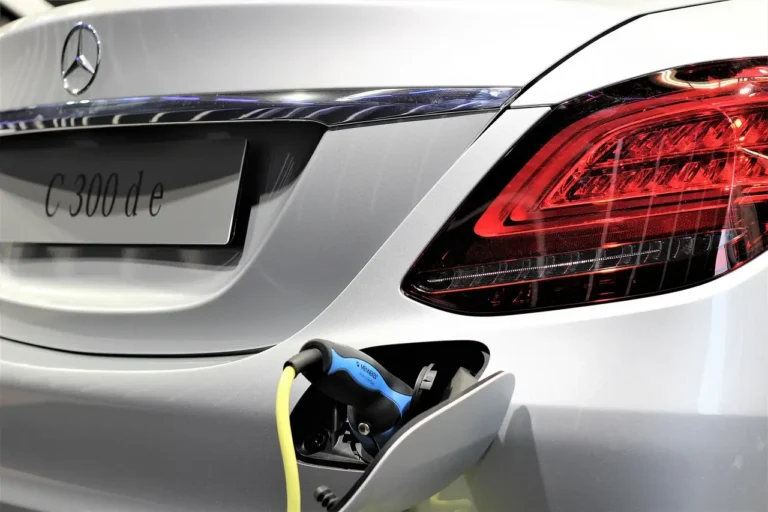
Hybrids and plug-in hybrids still have an internal-combustion engine, so they still need oil and oil filter changes. A plug-in hybrid may drive on electricity for part of the trip, but its engine still contains the same friction-producing parts that wear oil down over time. Do not group them with a pure BEV at the service counter. (Wikipedia)
Why EVs skip engine oil
Electric cars skip engine oil because the main drivetrain is different. An electric traction motor has far fewer moving parts than a gas engine, and it does not use engine oil for routine service. In a combustion engine, oil protects pistons, valves, camshafts, and related parts from heat, fuel dilution, moisture, and combustion by-products.
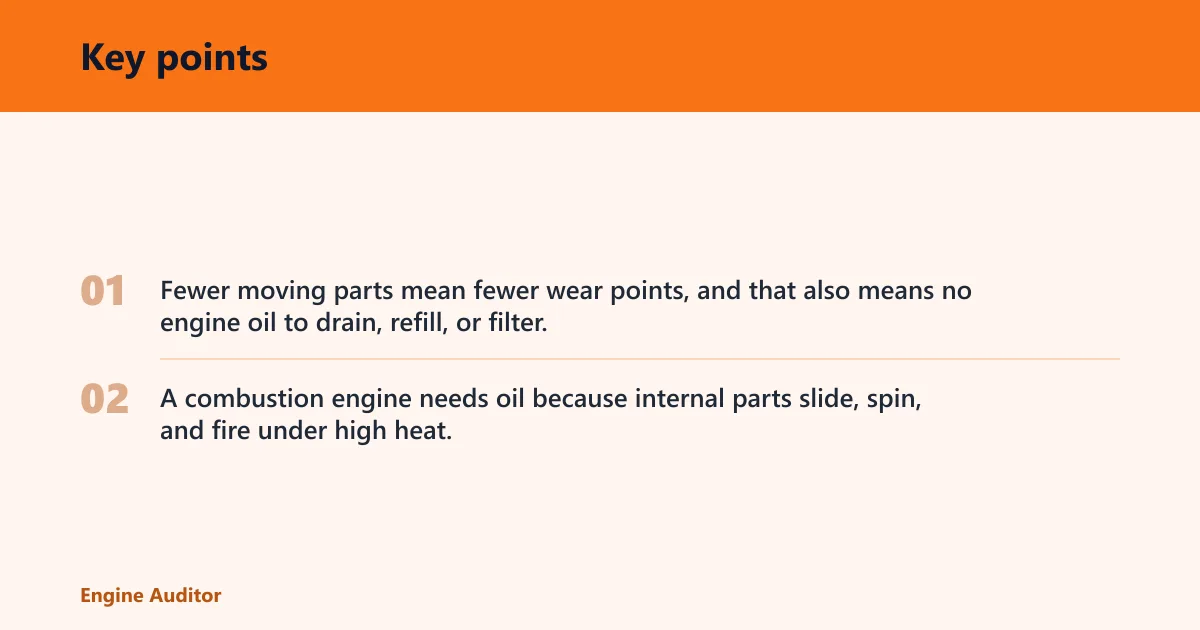
That is the core reason the maintenance list changes. Fewer moving parts mean fewer wear points, and that also means no engine oil to drain, refill, or filter.
Electric motor vs. combustion engine
A combustion engine needs oil because internal parts slide, spin, and fire under high heat. An electric motor runs differently. Some motors still contain sealed bearings with manufacturer-specified lubricant, but that is internal to the unit and is not a routine oil change item for the owner.
So the short answer is simple: a BEV does not have engine oil to change, but that does not mean the car runs on no fluids at all.
What fluids an EV may still use
Many EVs still use fluids for cooling, braking, and sealed drivetrain parts. The exact list depends on the model and market. Most EVs use a simplified single-speed gear reduction rather than a conventional transmission, and that unit may have gear lubricant or transmission fluid with a model-specific interval or a lifetime-fill spec.
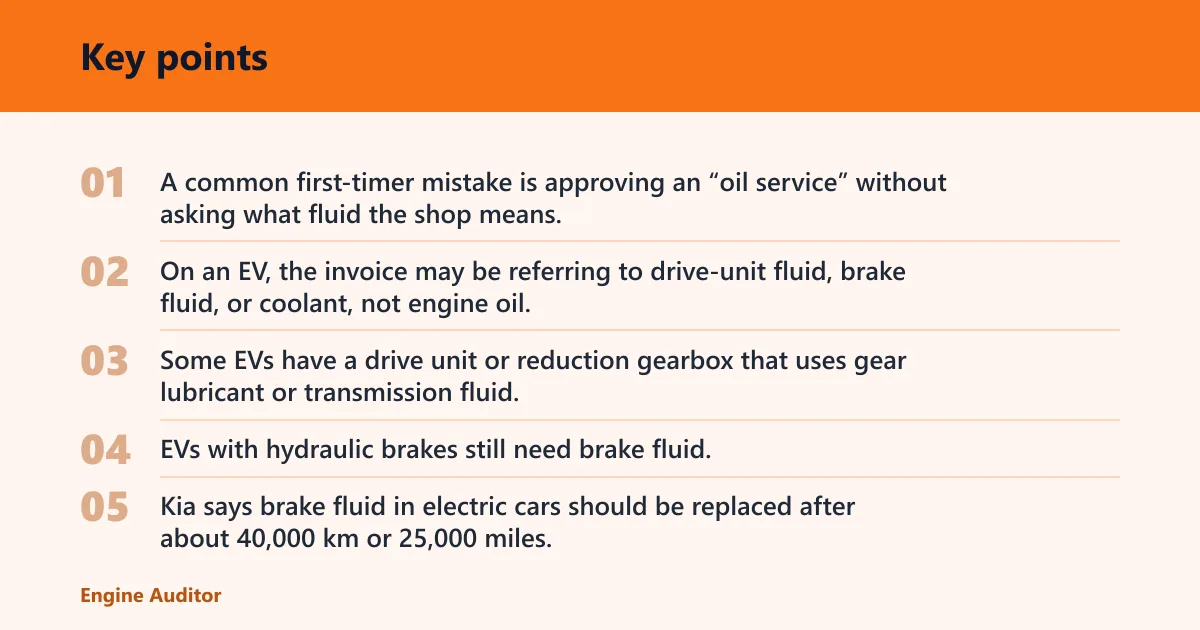
A common first-timer mistake is approving an “oil service” without asking what fluid the shop means. On an EV, the invoice may be referring to drive-unit fluid, brake fluid, or coolant, not engine oil.
Drive-unit or reduction-gear fluid
Some EVs have a drive unit or reduction gearbox that uses gear lubricant or transmission fluid. That fluid is not engine oil. On many models it is a lifetime fill, while on others the interval is model-specific and tied to the maker’s maintenance schedule.
Brake fluid
EVs with hydraulic brakes still need brake fluid. Regenerative braking reduces friction-brake use, which can extend pad and rotor life, but it does not remove brake-fluid maintenance. Kia says brake fluid in electric cars should be replaced after about 40,000 km or 25,000 miles.
Battery and power-electronics coolant
Many EVs use coolant to manage battery pack and power-electronics temperatures. That fluid helps prevent overheating and can be separate from other cooling circuits. Replacement intervals vary by model and market, so the owner’s manual is the only safe place to confirm the schedule.
HVAC and other sealed fluids
Some EV systems also use sealed lubricants or refrigerant-related service items in the climate-control system. Those are not engine oil, and they are usually handled only when the manufacturer calls for a specific inspection or repair.
What maintenance do electric cars actually need?
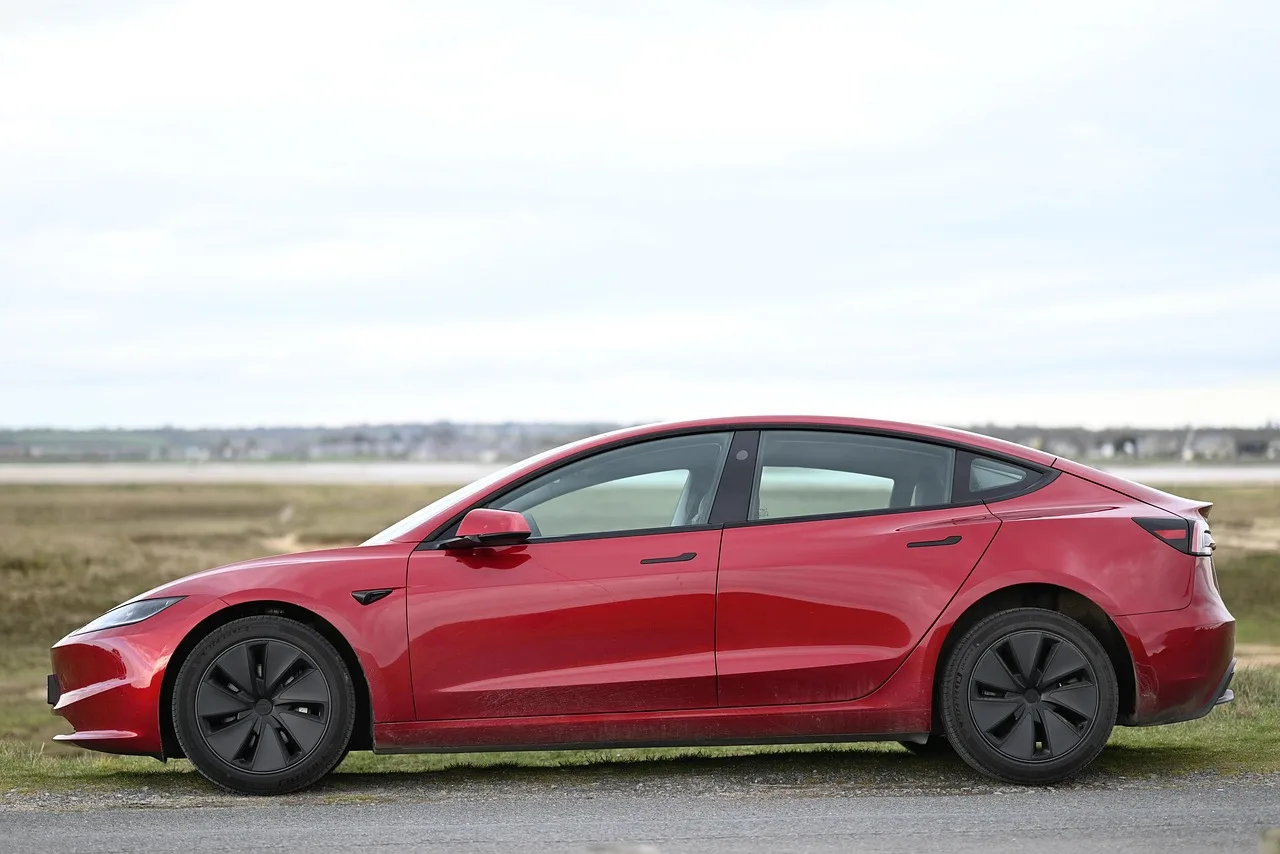
EVs still need routine maintenance. The list is shorter than on a gas car, but it is not empty. Tires, brakes, cabin filters, wipers, coolant, and the 12-volt battery remain part of normal ownership on many models.
Recurrent notes that EVs still use a 12-volt battery for accessory systems such as lights, locks, and infotainment. That battery is recharged by a DC-DC converter, so it still matters even though the car runs on a high-voltage traction pack.
Tires and tire rotation
EVs are often heavier than comparable gas cars, and instant torque can accelerate tire wear. The same source says Tesla recommends rotating tires every 6,250 miles or when tread depth difference reaches 2/32 inch. Recurrent also estimates EV tire replacement often comes every 30,000 to 40,000 miles, with non-performance EV tires at $75 to $300 each.
That is one reason “no oil changes” does not mean “no scheduled service.” Tires still need inspection, rotation, and replacement.
Brakes and regenerative braking
Regenerative braking helps the motor slow the car and reduces the load on friction brakes. That can extend pad and rotor life. It does not eliminate brake fluid maintenance, and it does not mean the brake system can be ignored.
Cabin air filter, wipers, and 12-volt battery
The same source says cabin air filters should be changed around the two-year mark. It also estimates wiper blade replacement should not happen more than every 2 years. Those are simple wear items, and many owners can handle the cabin filter themselves if the access is straightforward.
-
Check the owner’s manual.
Start with the maintenance schedule for your exact model year and trim. EV service intervals vary by manufacturer, by market, and sometimes by operating conditions, so the manual should name the fluid and the interval before money changes hands.
-
Match the line item to the part.
Ask whether the shop means engine oil, drive-unit fluid, brake fluid, or coolant. If the vehicle is a BEV, engine oil should not be on the invoice, but the other fluids may still be legitimate services.
-
Confirm the location and spec.
Ask where the fluid is used, what component it protects, and what specification it must meet. “Oil service” is too vague for an EV, because a reduction gearbox, a brake system, and a cooling loop all use different fluids.
-
Ask for the interval basis.
Request the mileage, time, or inspection trigger in writing. If the shop cannot point to a manual interval or a model-specific requirement, do not approve the work yet.
Electric cars oil changes decision table
| Fluid name | Exists on a BEV? | What it lubricates or cools | Typical interval type | Exact question to ask before approval |
|---|---|---|---|---|
| Engine oil | No | Lubricates internal-combustion engine parts | Not applicable on a BEV | “Show me the engine in this vehicle that uses oil.” |
| Drive-unit or reduction-gear fluid | Sometimes | Lubricates the single-speed reduction gear and related internal parts | Lifetime, inspection, or replacement; model-specific | “Is this for the reduction gearbox, and what interval does the manual specify?” |
| Brake fluid | Yes | Transfers force in the hydraulic brake system | Inspection or replacement; some makers set fixed intervals such as about 40,000 km or 25,000 miles | “Is this a brake-fluid test or replacement, and what schedule does the manufacturer list?” |
| Battery and power-electronics coolant | Often | Cools the battery pack and power electronics | Replacement or inspection; varies by model and market | “Which cooling circuit is this, and what does the owner’s manual call for?” |
| Cabin air filter | Yes | Filters incoming air for the cabin HVAC system | Replacement; commonly around the two-year mark | “Is this the cabin filter, and is replacement due by time or condition?” |
| Windshield washer fluid | Yes | Cleans the windshield | Top-off as needed | “Is this just washer-fluid top-off?” |
| 12-volt battery | Yes | Powers accessories, lights, locks, and infotainment | Inspection or replacement when weak | “Is the 12-volt battery being tested, and what result triggered replacement?” |
Say your EV shop writes “oil service” on the estimate for a model that has no engine. The next question should be, “Which fluid are you actually changing?” If the answer is vague, the line item needs clarification before you approve anything.
How to verify a service recommendation
The safest rule is simple: check the owner’s manual first, then ask the shop to name the exact fluid, the exact location, and the exact interval. A legitimate recommendation should map to a real component on the vehicle. If it cannot, stop and verify before paying.
-
Ask for the exact fluid.
Request the name of the fluid in plain language. “Oil” is too broad on an EV, because the correct answer might be brake fluid, coolant, gear lubricant, or nothing at all.
-
Ask where it goes.
Have the advisor point to the component: reduction gearbox, brake system, battery cooling loop, or cabin HVAC system. That keeps engine oil from being confused with a separate sealed system.
-
Ask for the interval source.
Have them cite the owner’s manual or the manufacturer’s maintenance schedule. If they cannot name the model-specific interval, do not treat the service as automatic.
-
Confirm the vehicle type.
If the car is a plug-in hybrid, an engine oil change may be correct. If it is a pure BEV, engine oil should not be on the bill. That one distinction prevents a lot of bad invoices.
Suppose a service writer tells you a 2024 BEV needs an “oil change” at 10,000 miles. The right follow-up is not “What brand of oil?” It is “Which component uses oil on this car, and where is that schedule in the manual?”
Frequently asked questions
Do electric cars need oil changes?
Pure electric cars do not need engine oil changes because they do not have a combustion engine. They still need other service, including tires, brakes, filters, coolant, and a 12-volt battery on many models. Always check the owner’s manual for the exact schedule before approving any fluid work.
Do fully electric cars need oil changes?
No. Fully electric cars generally do not need engine oil changes. They may still need brake fluid, coolant, tire rotation, cabin filters, and other routine maintenance items that vary by model.
Do all electric cars need oil changes?
No, but the answer changes by vehicle type. A BEV does not need engine oil, while a hybrid or plug-in hybrid still has an engine and still needs oil and filter changes. That is why the exact powertrain matters before you approve service.
Do electric cars need transmission fluid or coolant?
Some do. Many EVs use a single-speed reduction gear instead of a conventional transmission, and that unit may use gear lubricant or transmission fluid with a model-specific interval or a lifetime fill. Many also use coolant for the battery pack and power electronics, with schedules that vary by manufacturer.
Do electric cars need oil?
Pure electric cars do not need engine oil because they do not have an engine with pistons and camshafts. They may still use other fluids for brakes, cooling, and the drive unit. If a shop says “oil,” ask which fluid it means and where that service appears in the manual.
Products related to this article
Sponsored / affiliate links. As an Amazon Associate I earn from qualifying purchases. I may earn additional commission from eligible campaigns.