Delayed Shifting in Automatic Cars: What Usually Causes It
A brief delay only in the first cold shift can be normal; delay once warm, repeated flare to higher RPM, or late engagement often points to low or old fluid, valve-body or solenoid control issues, or clutch wear. Leave it alone and the clutches can burn, fluid can overheat, and a minor repair can turn into a transmission rebuild. This guide shows how to sort cold-start lag from warm shift problems by looking at timing, RPM behavior, and the most likely causes.
What delayed shifting feels like

Delayed shifting means the transmission changes gear later than it should. The pause often shows up during acceleration, between gears, or when moving from Park into Drive, and it is different from a hard shift or a true slip. The key clue is timing: the gear change comes late, not necessarily with a bang.
Delay on acceleration versus delayed engagement
During acceleration, the engine may rev longer than expected before the upshift happens. That points to shift timing, not a simple engagement issue. Delayed engagement is more about the delay before Drive or Reverse takes hold after a selector move, while delayed shifting happens after the vehicle is already moving.
Slipping looks different. In slip, RPM rises faster than road speed because the gear is not holding well. A delayed shift can later become a slip problem if the fluid is low or the clutches are worn, but the symptoms are not the same at the start.
How RPM helps separate the fault
RPM behavior matters. If the engine speed climbs, then the shift arrives late but feels normal once it happens, the transmission may be waiting on hydraulic pressure or a control command. If the shift is late and then harsh, the control system may be compensating for wear or poor pressure control.
If the delay appears only at light throttle, that leans toward control logic, sensor input, or low fluid. If it happens under heavier throttle too, internal wear, valve body problems, or a torque converter issue becomes more likely.
Why does an automatic shift late?
Most delayed shifts come from one of three groups: fluid problems, electronic control problems, or internal wear. Automatic transmissions rely on hydraulic pressure, solenoids, and the TCM to decide when and how to change gears, so a fault in that chain can slow the shift.
Fluid-level and fluid-condition faults
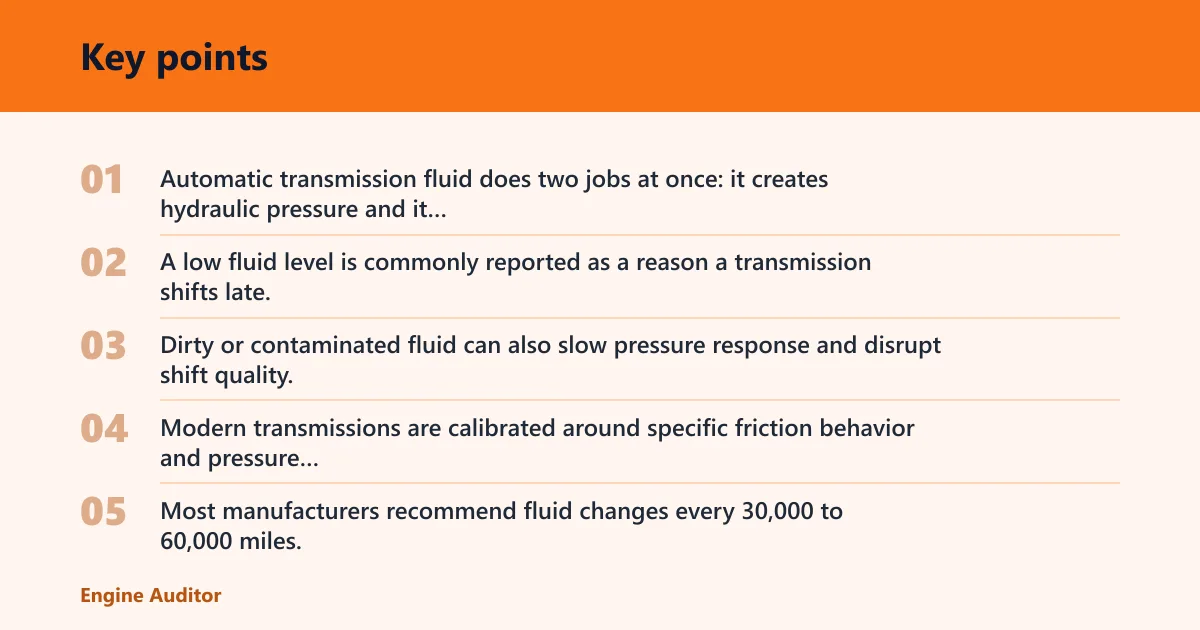
Automatic transmission fluid does two jobs at once: it creates hydraulic pressure and it carries heat away while lubricating moving parts. A low fluid level is commonly reported as a reason a transmission shifts late, and if it is severe it can lead to transmission failure. Dirty or contaminated fluid can also slow pressure response and disrupt shift quality.
Wrong fluid type matters too. Modern transmissions are calibrated around specific friction behavior and pressure response, so the wrong specification can make shifts late, odd, or inconsistent. Most manufacturers recommend fluid changes every 30,000 to 60,000 miles, though the exact interval depends on the vehicle.
Control-module, sensor, and solenoid faults
The Transmission Control Module controls shift timing and uses sensor input to decide when to command each gear change. If it receives bad data, or if it sends incorrect commands, the shift can arrive late even when the fluid looks fine. Diagnosis usually requires a scan for codes, live data, or both.
Vehicle speed sensor and throttle position sensor data are especially important. A bad speed reading can make the module think the car is moving at a different rate, and a bad throttle signal can change load calculations. Solenoids can also cause sluggish or delayed shifts when they do not open and close as they should.
Internal wear in clutches, bands, valve body, or torque converter
Internal wear is the more serious end of the list. Clutch packs and bands provide grip and engagement speed; when they wear, the transmission may take longer to catch or may flare before the gear grabs. A clogged or damaged valve body can also slow or misroute hydraulic fluid.
A malfunctioning torque converter can prevent proper engagement. That can feel like a delay when moving off from a stop or when the gear finally comes in late. These problems usually need more than a fluid service, and they often show up after the easy checks are ruled out.
Fluid checks first
Start with the fluid, then move to codes, then inspect related hardware. That order catches the common faults without guessing. A correct fluid check can point you toward a simple service, while a wrong fluid level or burnt fluid may explain why the transmission is struggling to build pressure.
Low fluid level
Low fluid level is one of the most common causes of delayed shifting. Check it the way the owner’s manual calls for, because some transmissions want the engine running and the fluid hot, while others use a different procedure. If the level is low, look for leaks before adding fluid.
Dirty or contaminated fluid
Dirty fluid often looks dark, smells burnt, or contains fine debris. That condition can slow hydraulic response and reduce lubrication. If the transmission filter is restricted, the pump may not draw fluid cleanly enough to keep shifts quick and consistent.
Wrong fluid specification
Wrong fluid type can create a delayed or abnormal shift because the clutch and valve behavior no longer match the calibration. This is especially important on newer 6-speed and 8-speed automatics, where adaptive shift logic depends on very specific fluid properties. If the service history is unknown, matching the exact spec matters.
Transmission filter service clues
A filter service is usually part of the fix path when the fluid is contaminated or overdue. If the pan shows debris, if the fluid is dark, or if the vehicle has gone well past the maintenance interval, the filter may be restricting flow. A fresh filter alone will not fix worn clutches, but it can restore flow when the problem is service-related.
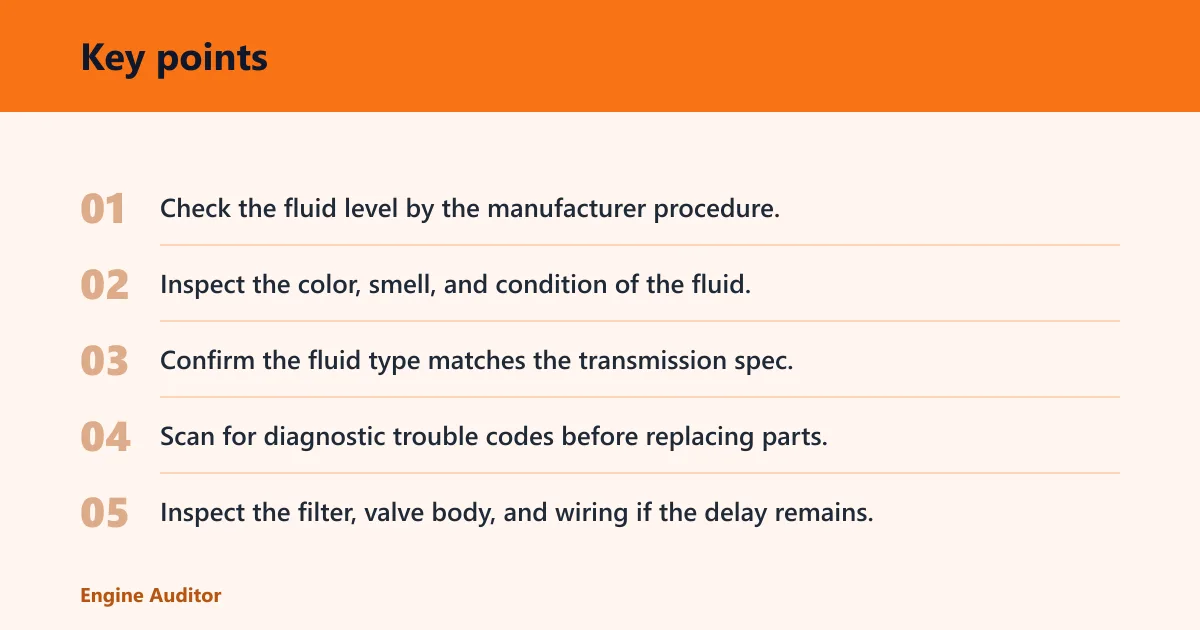
- Check the fluid level by the manufacturer procedure.
- Inspect the color, smell, and condition of the fluid.
- Confirm the fluid type matches the transmission spec.
- Scan for diagnostic trouble codes before replacing parts.
- Inspect the filter, valve body, and wiring if the delay remains.
Say your sedan shifts late only on the first cold morning pull-away, then acts normal after five minutes. That pattern leans toward thick cold fluid, a marginal level, or a valve body that responds slowly before pressure and temperature stabilize. A delay that starts only after the car is fully warm points somewhere else.
When is the TCM or a sensor to blame?
TCM or sensor trouble is more likely when the delay follows a pattern that changes with load, throttle, or temperature, and the fluid check does not explain it. Because the module depends on sensor data and stored strategy, a bad input can create late shifts without a major mechanical failure.
What bad shift commands look like
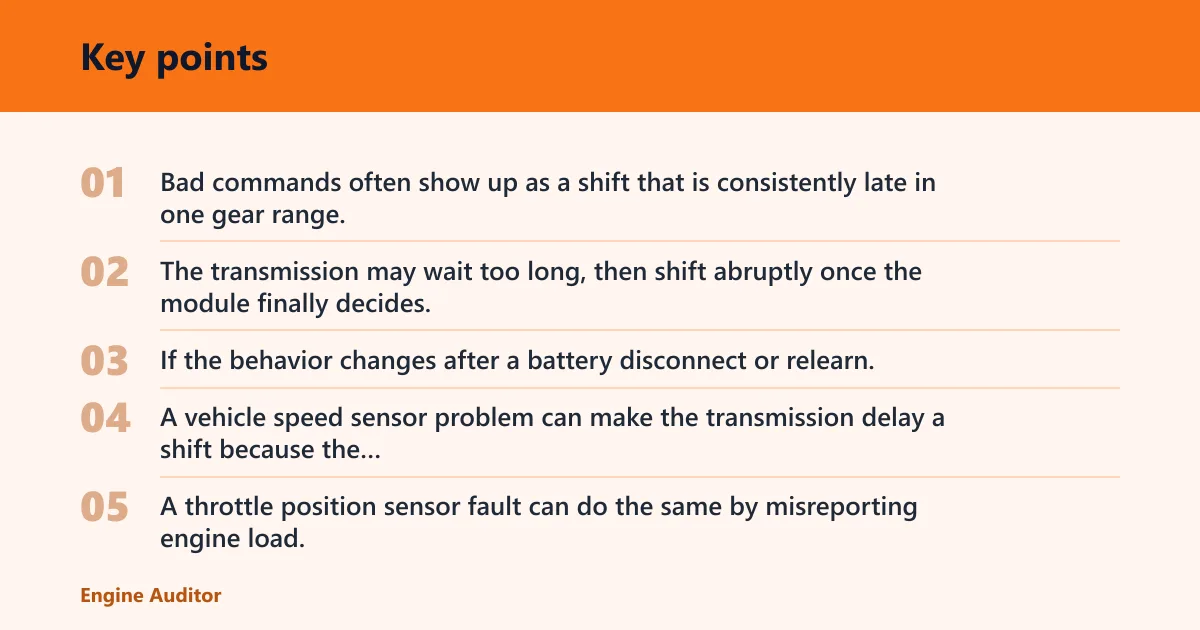
Bad commands often show up as a shift that is consistently late in one gear range, but normal in others. The transmission may wait too long, then shift abruptly once the module finally decides. If the behavior changes after a battery disconnect or relearn, adaptive logic is part of the picture.
Vehicle speed sensor and throttle position sensor clues
A vehicle speed sensor problem can make the transmission delay a shift because the module does not trust the road-speed signal. A throttle position sensor fault can do the same by misreporting engine load. These faults often affect shift timing more than shift feel, especially before the light comes on.
Check Engine Light and scan-code clues
A Check Engine Light raises the odds that the fault is electronic or sensor-related, though it does not rule out hydraulic wear. Scan codes matter because they tell you whether the module sees a circuit, plausibility, or control problem. ECU repair or reprogramming can cost from $100 to $1,000, depending on the issue and the vehicle.
| Symptom pattern | Likely subsystem | Quick roadside check | Scan-code clue | Urgency level |
|---|---|---|---|---|
| Delay only when cold | Fluid level or fluid condition | Check level and fluid appearance after the correct warm or cold procedure | Often no code at first | Monitor closely, service soon |
| Delay after warm-up | Valve body, solenoid, or wear issue | Note whether the delay starts after 15 to 20 minutes of driving | May show shift-solenoid or pressure-related codes | Service promptly |
| Flare with rising RPM | Clutch packs, bands, or pressure loss | Watch for engine speed rising faster than road speed | May show gear-ratio or slip-related codes | High urgency |
| Delay plus harsh shift | Solenoid, valve body, or adaptive control fault | Check whether the shift is late, then abrupt | Often related to command or pressure-control codes | Service soon |
| Delay plus Check Engine Light | TCM, sensor, or electrical fault | Scan codes before replacing parts | Code confirmation is likely | Do not ignore |
What internal wear points
Internal wear becomes more likely when the delay is persistent, gets worse over time, or shows up with flare and poor engagement. At that stage, fluid service alone may not fix it. The parts most often involved are the clutch packs, bands, valve body, and torque converter.
Clutch packs and bands
Clutch replacement can cost between $300 and $800 for some repairs, but that range can rise when the job expands into deeper transmission work. Worn clutches and bands lose grip or engagement speed, so the gear change starts late and may slip before it holds.
Valve body wear or clogging
The valve body directs hydraulic fluid to the right circuits at the right time. If it is clogged or damaged, shifts can come in late, harsh, or inconsistent. This is one reason a delay can feel worse after warm-up, when fluid changes and control demands increase.
Torque converter issues
A torque converter that malfunctions can delay proper engagement, especially from a stop. It transfers engine power to the transmission, so a problem here can feel like a lazy takeoff or a lag before the drivetrain catches. A converter fault is usually not fixed by a simple fluid top-off.
Suppose a crossover begins to flare between second and third gear only after a 25-minute commute, then the shift snaps in hard when you lift off the throttle. That pattern points away from a one-time cold fluid issue and more toward pressure control, valve body wear, or clutch wear that needs diagnosis.
Is delayed shifting serious?
Yes, it can be serious, especially when the delay is persistent, getting worse, or paired with flare, harsh shifts, or a warning light. A short, cold-only delay may be tolerable for a brief drive, but repeated late shifts can overheat the fluid and speed up internal wear.
Safe to drive today versus stop driving
If the delay happens only once when cold and the vehicle otherwise shifts normally, a short drive to a shop may be reasonable. If the delay is present warm, happens in multiple gears, or comes with slipping, harsh engagement, or a Check Engine Light, the risk is higher. Stop driving if the transmission loses drive, bangs into gear, or smells burnt.
When to book service or arrange a tow
Book service promptly if the symptom is repeatable, especially after warm-up. Arrange a tow if reverse disappears, the vehicle will not engage Drive, the flare is severe, or the transmission starts shuddering and slipping. Low fluid that led to overheating can quickly move from a repairable problem to a rebuild-level failure.
Automatic transmission fluid flush and replacement often runs from $150 to $250. That is far less than the cost of internal repair, which is why the diagnosis order matters. A filter service and fluid correction may solve the issue, but only if the transmission has not already been damaged.
Frequently asked questions
What causes delayed shifting in an automatic car?
Delayed shifting is usually caused by low or dirty fluid, the wrong fluid type, sensor faults, solenoid problems, valve body wear, torque converter trouble, or internal clutch wear. Driving habits can contribute, but repeatable delays are more often a mechanical, hydraulic, or control issue that should be checked in order.
Is delayed shifting in an automatic transmission serious?
It can be. A cold-only delay may be minor for a short time, but a warm delay, flare, harsh shift, or warning light raises the risk. Those patterns can point to low pressure or internal wear, and continuing to drive can turn a smaller repair into a much larger one.
Can low transmission fluid cause delayed shifting?
Yes. Low fluid reduces hydraulic pressure, and hydraulic pressure is what the transmission uses to apply clutches and bands on time. A low level can create late shifts, delayed engagement, and in severe cases a complete failure to move. Always check for leaks if the level is low.
Does dirty transmission fluid make shifting slow?
Yes. Dirty or contaminated fluid can slow pressure response, reduce lubrication, and interfere with valve body and solenoid operation. Burnt or debris-filled fluid is a sign that the transmission may have been running hot or under stress. A filter service is often part of the fix path when contamination is found.
Can a bad TCM cause delayed gear changes?
Yes. The Transmission Control Module controls shift timing and depends on sensor input to make the command. If it sends the wrong command, or if it receives bad data from the vehicle speed sensor or throttle position sensor, the transmission may shift late. Scan codes are the first clue.
When should I get a mechanic to inspect delayed shifting?
Get it checked if the delay is repeatable, gets worse when warm, comes with flare or harsh shifting, or appears with a Check Engine Light. Do not wait if the vehicle slips, loses reverse, or smells burnt. Those signs suggest a problem that can spread quickly inside the transmission.
Products related to this article
Sponsored / affiliate links. As an Amazon Associate I earn from qualifying purchases. I may earn additional commission from eligible campaigns.