How Much Does It Cost to Fix a Car Heater That Won’t Get Hot?
A car heater that won’t get hot usually costs about $100 to $1,200 to fix, with coolant top-offs or thermostat swaps at the low end and heater-core replacement at the high end. If you ignore it, the cabin stays cold, defrost output drops, and a low-coolant or overheating fault can turn a small repair into engine damage. This guide starts with the cheapest checks, then moves through thermostat, blend-door, water-pump, and heater-core costs.
Car heater repair cost ladder


The quote usually depends on which system failed. A no-heat complaint can come from low coolant, trapped air, a stuck thermostat, a bad blend door actuator, a failed heater control valve, or a clogged heater core. The deeper the repair goes into the dash or the cooling system, the more labor shapes the bill.
| Cost tier | Likely symptoms | What is usually replaced | What drives the price |
|---|---|---|---|
| DIY checks | Weak heat at idle, cold air after a cold start, low defrost output | Coolant top-off, bleed procedure, basic inspection | Fluid cost only unless a leak is found |
| Low-cost parts | Slow warm-up, heater works weakly after 10 to 15 minutes | Thermostat, coolant, radiator cap, hose clamp | Part price is low; labor varies with engine layout |
| Moderate repairs | Heat only at certain speeds, heat drops at idle, clicking from the dash | Blend door actuator, heater control valve, blower resistor or control module | Diagnostic time and access to HVAC parts |
| High-labor repairs | Heat is weak all the time, one side stays cold, coolant smell inside | Heater core, hoses at the firewall, cooling-system flush | Labor hours, system bleed, and dash access |
| Worst-case dash-removal jobs | No heat after confirmed coolant flow, mixed hot and cold zones, repeated coolant loss | Heater core plus related HVAC seals, actuator checks, and reassembly labor | Dash removal, recharging the system, and vehicle-specific labor time |
Labor rate is a major driver in every tier. A simple part can stay inexpensive on paper, then become a larger repair once the shop adds diagnostic time, cooling-system bleed time, or several hours of dash removal. Vehicle layout matters too. Tight engine bays, rear heaters, and dual-zone climate control usually cost more to diagnose and repair.
- Check coolant first. Open the hood only when the engine is cool, then verify the reservoir is between the marks and the radiator is full if the cap system allows inspection. Low coolant can stop hot coolant from reaching the heater core, but low coolant usually means there is a leak, not just a refill issue.
- Look for airflow problems. Set the fan to high and make sure air volume changes at the vents. If airflow is weak, the issue may be the blower motor, resistor, or control module rather than coolant flow.
- Watch engine temperature. If the needle stays low or takes a long time to rise, the thermostat may be stuck open. That usually points to a lower-cost repair than a heater core.
Why is my car heater blowing cold air?
Cold air usually means the heater is not getting enough hot coolant, or the HVAC box is not routing that heat into the cabin. The first branch is a cooling-system problem, such as low coolant, air trapped in the system, or a stuck-open thermostat. The second branch is an HVAC-door or airflow problem, such as a bad blend door actuator or a control fault.
Coolant-flow problems
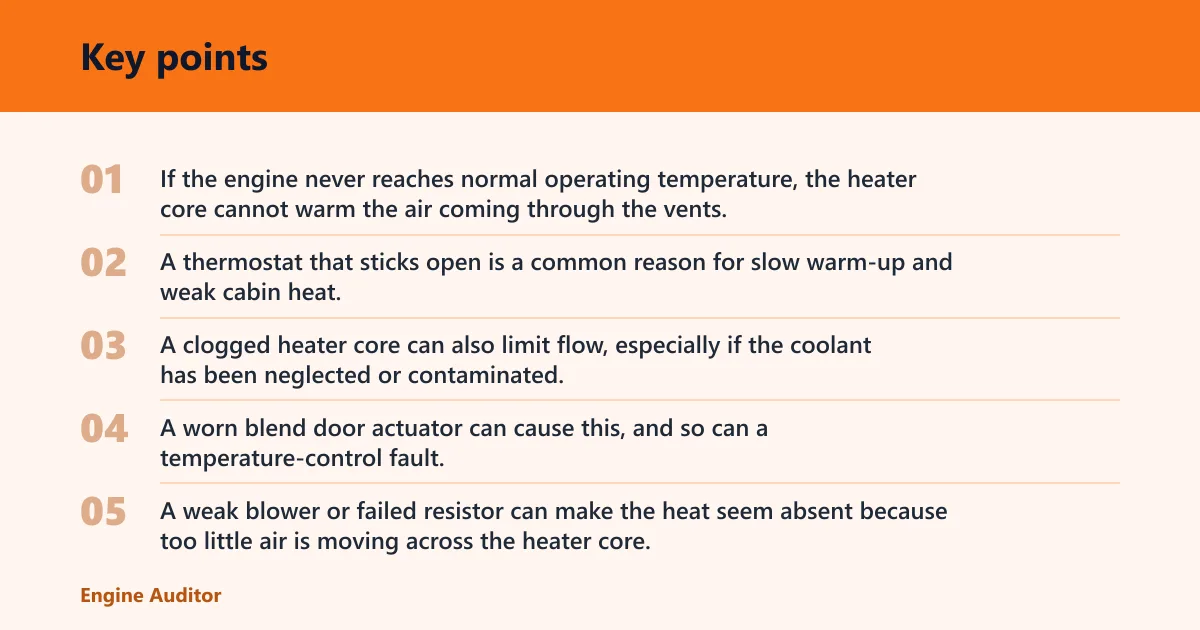
If the engine never reaches normal operating temperature, the heater core cannot warm the air coming through the vents. A thermostat that sticks open is a common reason for slow warm-up and weak cabin heat. A clogged heater core can also limit flow, especially if the coolant has been neglected or contaminated.
HVAC-door and airflow problems
When coolant is hot but the cabin stays cold, the HVAC box may be mixing in outside air or cold air from the evaporator side. A worn blend door actuator can cause this, and so can a temperature-control fault. A weak blower or failed resistor can make the heat seem absent because too little air is moving across the heater core.
Intermittent or one-side-only heat
Suppose the driver side vents blow warm air, but the passenger side stays cold on a dual-zone system. That pattern points more toward a blend door actuator or control issue than a coolant shortage. If heat fades at idle and returns while driving, trapped air, a weak water pump, or a partly restricted heater core becomes more likely.
Can low coolant cause no heat in the car?
Yes. Low coolant can stop hot coolant from circulating through the heater core, so the cabin air stays cold or only warms up after higher engine speeds. But low coolant is usually a sign of a leak, seepage, or another cooling-system fault, so a top-off without finding the cause can leave the problem unsolved.
Low coolant versus a coolant leak
A low reservoir after repeated fills should raise suspicion of a leak at a hose, radiator, water pump, thermostat housing, cap, or heater core. Pressure testing helps find slow leaks that do not drip on the ground. A shop should not quote a heater job without checking whether the cooling system is losing fluid elsewhere.
Correct antifreeze mix ratio for winter
Coolant must be the right antifreeze mix, not plain water or an old mixture that has lost protection. A proper winter mix helps prevent freezing and supports normal heat transfer. Incorrect mix can also leave the system too diluted, which may hurt heater performance in cold weather.
Air trapped in the cooling system
Air pockets can mimic heater failure because the heater core may not stay full of hot coolant. Bleeding the system is part of diagnosis on many vehicles, especially after a coolant change or leak repair. If heat returns briefly after revving the engine, trapped air is one possible reason.
What does a bad thermostat cost?
A thermostat repair is usually much cheaper than a heater core job. Parts are often modest in price, and many vehicles fall roughly in the $100 to $450 range installed, depending on access and engine layout. A thermostat that sticks open often causes slow warm-up, weak heat, and a gauge that never reaches normal temperature.
Parts cost versus labor cost
The thermostat itself is commonly a lower-cost part. The larger swing comes from labor and coolant refill time. On some engines, the thermostat is easy to reach. On others, intake parts or accessory brackets must come off first, which raises the quote even when the part is inexpensive.
Why engine layout changes the quote
Inline engines, V engines, and engines with buried thermostat housings do not pay the same labor time. A compact crossover with limited access can cost more than an older car with a visible housing. That is why two thermostats can have very different installed prices.
Heater core cost and symptoms
The heater core is the heat-exchanger part of the HVAC system, and it is one of the most labor-heavy repairs in this category. A clogged heater core can reduce or remove cabin heat. A leaking heater core can add a sweet coolant smell, fogging windows, damp carpet, or visible coolant loss.
Clogged heater core symptoms
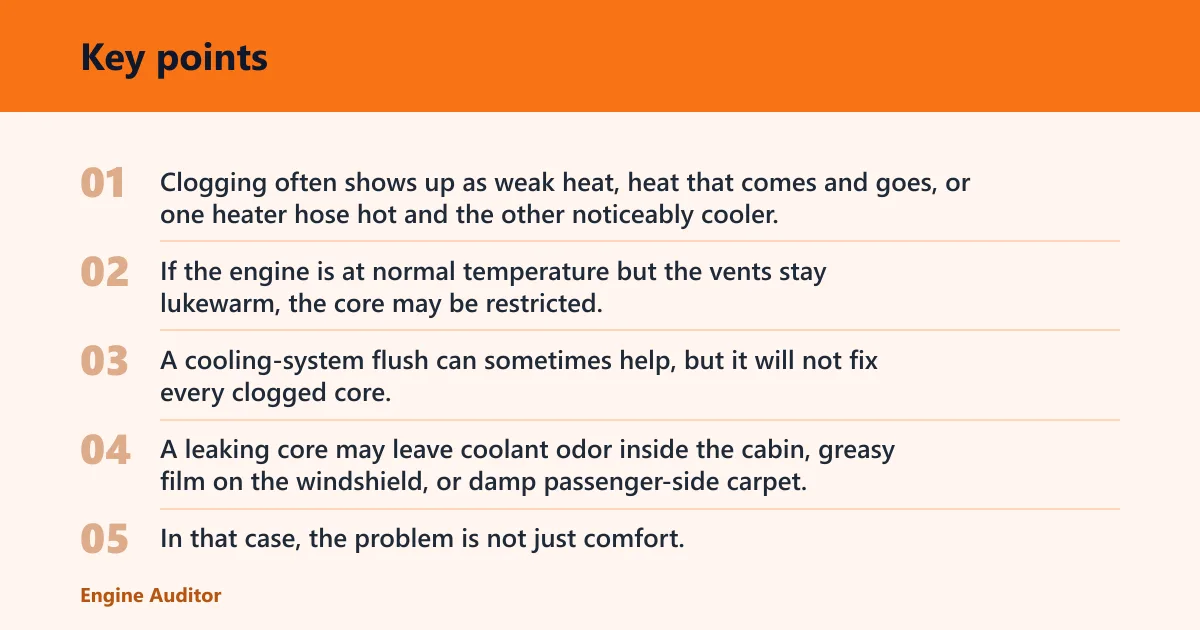
Clogging often shows up as weak heat, heat that comes and goes, or one heater hose hot and the other noticeably cooler. If the engine is at normal temperature but the vents stay lukewarm, the core may be restricted. A cooling-system flush can sometimes help, but it will not fix every clogged core.
Heater core leak symptoms
A leaking core may leave coolant odor inside the cabin, greasy film on the windshield, or damp passenger-side carpet. In that case, the problem is not just comfort. It can also affect visibility and coolant level, which makes the repair more urgent.
Parts price versus dash labor
The heater core part itself is often not the expensive part. Labor can dominate because the core is buried behind the dashboard on many vehicles. Some jobs stay in the hundreds, while dash-removal repairs can climb past about $1,000 once labor, refrigerant recovery if needed, and reassembly time are added.
Picture a sedan that blows lukewarm air after 20 minutes of driving, then loses coolant again a week later. That pattern is more consistent with a heater-core leak or another cooling-system leak than with a simple thermostat problem.
Blend door actuator and controls
A blend door actuator can be expensive to replace when diagnosis takes time, but the part itself is often cheaper than a heater core. The actuator moves the air-mix door inside the HVAC box. If it fails, you can get no heat, wrong-temperature air, or heat on one side only even when the coolant is hot.
One-side-hot, one-side-cold complaints
Dual-zone systems are prone to this complaint. One actuator may still work while the other sticks, so one side gets cabin heat and the other side does not. That points away from the cooling system and toward the HVAC box or controls.
Clicking noises and stuck temperature settings
A repeated clicking behind the dash often means the actuator gears are stripped or the door is binding. A temperature knob or digital setting that does nothing is another clue. These signs usually call for diagnosis before the part is replaced, because a control fault can mimic a failed actuator.
Diagnostic labor before replacement
Some actuators are easy to reach. Others require trim removal, scan-tool checks, or access under the dash. That diagnostic labor can be as important as the actuator price itself, especially when the symptom appears only on one vent zone or only after startup.
What else should you check first?
Before approving a major heater repair, confirm whether the vehicle even uses a heater control valve, whether the blower is moving enough air, and whether the cooling system has another fault. These checks can separate a low-cost fix from a repair that needs real dash time. They also help avoid replacing the wrong part.
Heater control valve and coolant flow
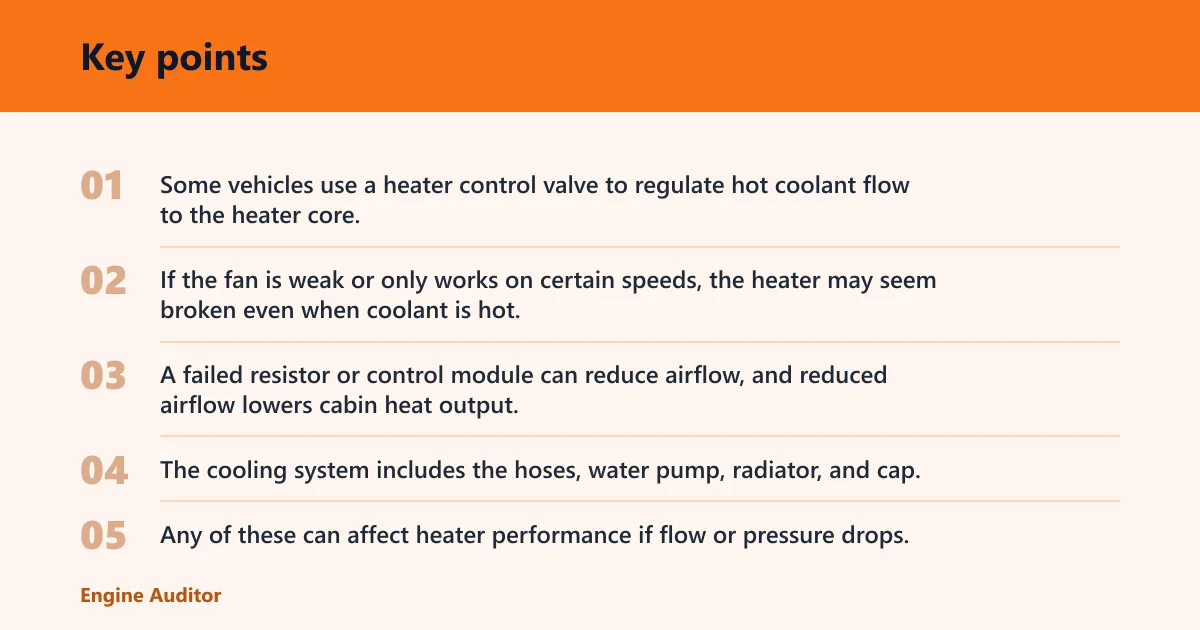
Some vehicles use a heater control valve to regulate hot coolant flow to the heater core. Others do not have one at all. A stuck-closed valve can mimic a bad heater core, so the shop should confirm valve type and operation before quoting the job. Control may be vacuum, cable, or electronic.
Blower motor, resistor, and control module
If the fan is weak or only works on certain speeds, the heater may seem broken even when coolant is hot. A failed resistor or control module can reduce airflow, and reduced airflow lowers cabin heat output. That is a different repair path from coolant-flow diagnosis.
Hoses, radiator, water pump, and cap
The cooling system includes the hoses, water pump, radiator, and cap. Any of these can affect heater performance if flow or pressure drops. A pressure test and bleed procedure should be part of diagnosis when heat is weak, intermittent, or absent only at idle.
A common first-timer mistake is replacing a thermostat because the vents feel cold, then finding out the real issue was a partially collapsed hose or trapped air after a coolant leak repair. The symptom was the same. The repair path was not.
Frequently asked questions
How much does it cost to fix a car heater that won’t get hot?
Most no-heat repairs land between $100 and $1,200, but the spread is wide because labor matters so much. A coolant top-off or thermostat swap sits near the low end, while heater-core replacement, dash removal, or dual-zone HVAC diagnosis can push the bill much higher.
How do I know if my heater core is clogged?
A clogged heater core often shows as weak heat, inconsistent heat, or one heater hose much cooler than the other when the engine is hot. That pattern means flow is restricted. A flush may help in mild cases, but a badly clogged core often needs replacement.
Is a blend door actuator expensive to replace?
It is usually less expensive than a heater core, but diagnosis can add cost. The part is often moderate in price, while labor depends on access and whether the vehicle needs scan-tool calibration or dash trim removal. One-side-only temperature faults are a common clue.
Can a thermostat cause no heat in the car?
Yes. A thermostat stuck open can keep the engine too cool, which leaves little heat for the cabin. This is often a lower-cost repair than heater-core replacement. If the temperature gauge stays low or warms very slowly, the thermostat deserves attention early.
Can I still drive if my heater stops working in winter?
You may be able to drive short distances if the engine temperature is normal and coolant level is stable. Do not keep driving if the car overheats, loses coolant, or fogging makes visibility unsafe. No heat can also hide a deeper cooling-system fault.
What should I check before paying for heater repair?
Check coolant level, look for leaks, confirm the engine reaches normal temperature, and see whether the blower has full speed. Then ask whether the vehicle has a heater control valve or dual-zone HVAC. Those checks help separate a cooling-system repair from an HVAC control issue.
Why does one side of my car blow hot air and the other cold?
That pattern usually points to a blend door actuator or temperature-control fault, especially on dual-zone systems. It can also come from a calibration issue after battery disconnect or HVAC work. If both sides stay cold, look harder at coolant flow and engine temperature first.
Products related to this article
Sponsored / affiliate links. As an Amazon Associate I earn from qualifying purchases. I may earn additional commission from eligible campaigns.