Bad Blower Motor or Blown Fuse? How to Tell Why Cabin Heat Failed
If the blower works on some speeds, the resistor pack or control module is often the likely problem; if it is dead on every speed, start with the fuse, relay, or blower motor. A wrong guess can waste time, cost parts, and leave you with no defrost in cold weather. This guide gives a fast symptom-to-part check for the fuse, relay, resistor/module, and blower motor.
Blower motor decision table


Use the symptom pattern first. Then move to the next check in order. The table below separates fuse, relay, resistor pack, control module, motor, and restriction faults before you buy parts.
| Symptom pattern | Most likely failed part | What to test next | What result confirms the diagnosis |
|---|---|---|---|
| No airflow at any speed | Blower fuse, relay, blower motor, or command loss | Check the blower fuse, then the relay, then power and ground at the motor connector | No battery power at the motor connector, blown fuse, or no relay output with a valid HVAC command |
| Only one fan speed works | Resistor pack on fixed-speed systems, or blower control module on variable-speed systems | Check which speed is missing, then verify module or resistor output | One speed path has output and the others do not, while fuse and motor power remain present |
| Weak airflow with a normal fan sound | Cabin air filter, duct restriction, blower wheel blockage, or slowing motor | Inspect the filter and blower wheel, then check for voltage drop and drag | Filter is clogged, wheel is packed with debris, or the motor draws too much current while spinning |
| Intermittent operation when cold | Worn brushes, loose connector, relay, or control module | Tap-test the connector area, then monitor power and command as the fault appears | The fan cuts in and out with movement, heat, or cooling, or it returns after the part warms up |
| Humming or no spin | Seized blower motor or jammed blower wheel | Inspect the wheel for leaves, twigs, foam, or a torn filter edge; then try to turn the wheel by hand | The wheel is locked, the motor hums without turning, or the circuit overloads and opens |
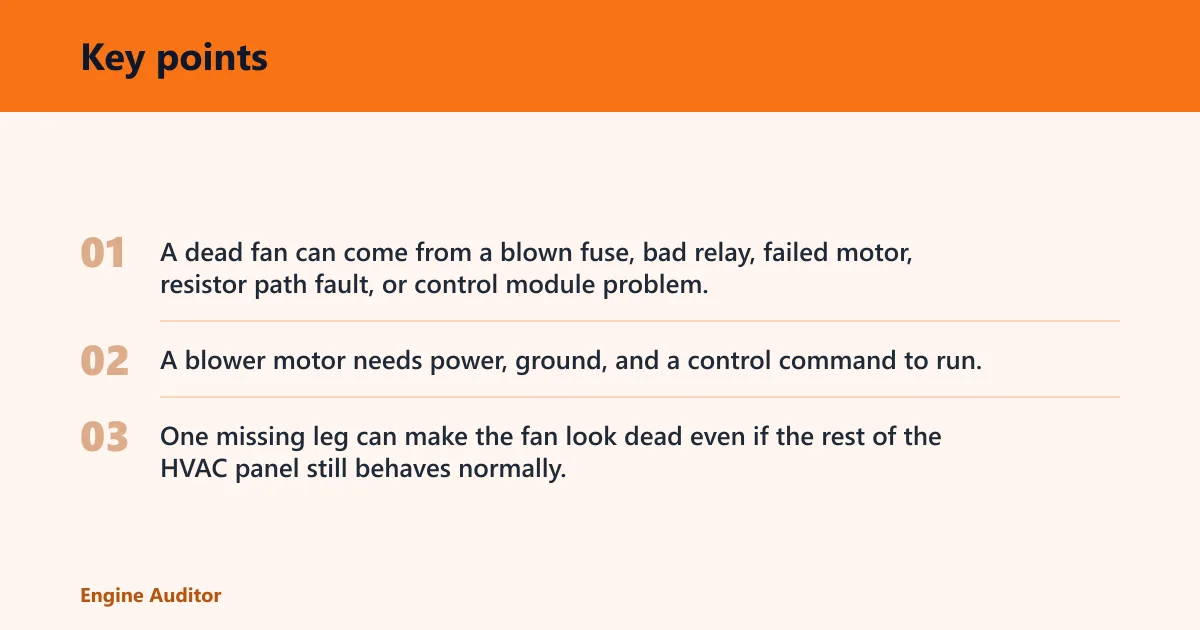
A dead fan can come from a blown fuse, bad relay, failed motor, resistor path fault, or control module problem. A blower motor needs power, ground, and a control command to run. One missing leg can make the fan look dead even if the rest of the HVAC panel still behaves normally.
Why is there no airflow at any speed?
No airflow at every speed usually points to a blown blower fuse, a bad relay, a dead blower motor, or a lost command signal from the HVAC control head. On many vehicles, the fan circuit is the first place to fail when the motor draws excess current or the wheel is jammed.
What usually fails first
A blown blower motor fuse protects the HVAC fan circuit and can open from overcurrent. The fuse should match the vehicle-specific amperage, so a random replacement is not a valid repair. A relay can also stick or fail intermittently, which can create a no-power or no-speed complaint.
If the relay sticks, the blower may act erratically, and in some cases it can run when it should not. If the control head sends no usable command, the motor can look dead even though the dash display, mode buttons, or temperature settings appear normal.
Quick confirmation order
-
Check the blower fuse first.
Remove and inspect the fuse, then confirm the correct amperage from the vehicle label or service information. If the fuse is open, replace it only after you find the overload path, or the new fuse may fail again. -
Test the relay next.
Swap with a known same-type relay only if the vehicle uses an identical spare position. A relay that clicks but does not pass power can still fail under load. -
Measure power and ground.
At the blower motor connector, check for battery voltage on the power side and a solid ground on the return side while the fan is commanded on. No voltage means the fault is upstream, not inside the motor. -
Check the command path.
If power and ground are present, inspect the resistor pack, control module, or HVAC control head output depending on the system design. A missing command signal can keep a healthy motor from running.
Suppose the blower is silent on all speeds, the fuse is good, and the relay has power in but no power out when the fan is commanded on. That pattern points away from the motor itself and toward the relay or command path. The part that stops passing current is the part to target first.
How do you tell a fuse problem from a motor problem?
Start with the fuse, then prove the motor has power, ground, and command. A blown fuse usually means the circuit opened because of overload, while a failed motor often shows heat, drag, noise, or a locked wheel. The connector readings separate those two outcomes fast.
Fuse check and amperage match
Inspect the blower motor fuse visually and with a meter if possible. If the fuse is open, replace it only with the exact amperage listed for that circuit. A higher-rated fuse can hide the fault and allow more heat in the wiring.
Connector power and ground check
With the fan switched on, back-probe the blower connector. A healthy circuit should show battery voltage on the feed side and a complete ground path on the return side. If power is present but the motor does nothing, the motor or wheel is suspect; if power is missing, look upstream.
Motor bench or in-car spin test
If the connector checks out, the motor needs a direct evaluation. A motor that will not spin when power and ground are supplied has failed internally or is jammed by debris. A motor that spins slowly or with rough noise may be worn and drawing too much current.
Why does only one fan speed work?
One working speed often means the speed control path has failed rather than the whole blower motor. On fixed-speed systems, that often points to the resistor pack. On variable-speed systems, it points to the blower control module. The HVAC control head can also lose its output on one speed range.
Fixed-speed systems and resistor packs
The blower resistor pack controls fixed fan speeds on many vehicles. When it fails, you often lose several speeds but keep one high speed, because that circuit may bypass the resistor path. That pattern is a strong clue that the motor itself is still alive.
Variable-speed systems and control modules
Variable-speed HVAC systems use a blower control module instead of a simple resistor pack. A failing module can act like a dead motor, a stuck-low fan, or an intermittent fault when it overheats. If the blower works on some settings but not others, this path deserves attention before the motor.
HVAC control head output
The HVAC control head sends the command signal, but the display can look normal even when the blower circuit is not responding. If the requested speed never reaches the resistor pack or module, the panel can be the problem rather than the motor side. That is why command testing matters.
A common first-timer mistake is replacing the motor because the highest speed still works. That pattern usually means the resistor pack is failing on fixed-speed systems, not that the motor has died.
Why does my cabin heat work sometimes and then stop?
Intermittent blower operation often points to worn brushes, loose connectors, heat-sensitive wiring, or a control module that fails when warm. If the fan dies after 10–20 minutes and comes back after cooling, suspect thermal overload or high current draw. That is a strong sign of a failing motor or a jammed wheel.
Cold and heat related clues
If the fan cuts out when the cabin warms up, the motor windings, brushes, relay, or module may be opening under heat. If it returns after cooling, the failure is not random. It is load related, thermal, or connection related.
Sound changes during the failure
Listen for a brief start attempt, a click, a hum, or a squeak. A brief start attempt with no sustained spin often means the motor is trying to move but cannot overcome drag. A squeak can point to worn bearings, while a click without airflow points more toward relay or command failure.
Picture a fan that runs fine on a cold start, then quits after 15 minutes on low speed while the defrost setting is still selected. That pattern fits a heat-sensitive module, a loose connector, or a motor drawing too much current as it warms up.
What else can mimic a bad blower motor?
A clogged cabin air filter can mimic a dying motor by cutting airflow without killing the fan. Debris in the blower wheel can also jam the motor and overheat the circuit. Duct blockage or a stuck HVAC door can reduce delivered air even when the blower spins normally.
Cabin air filter restriction
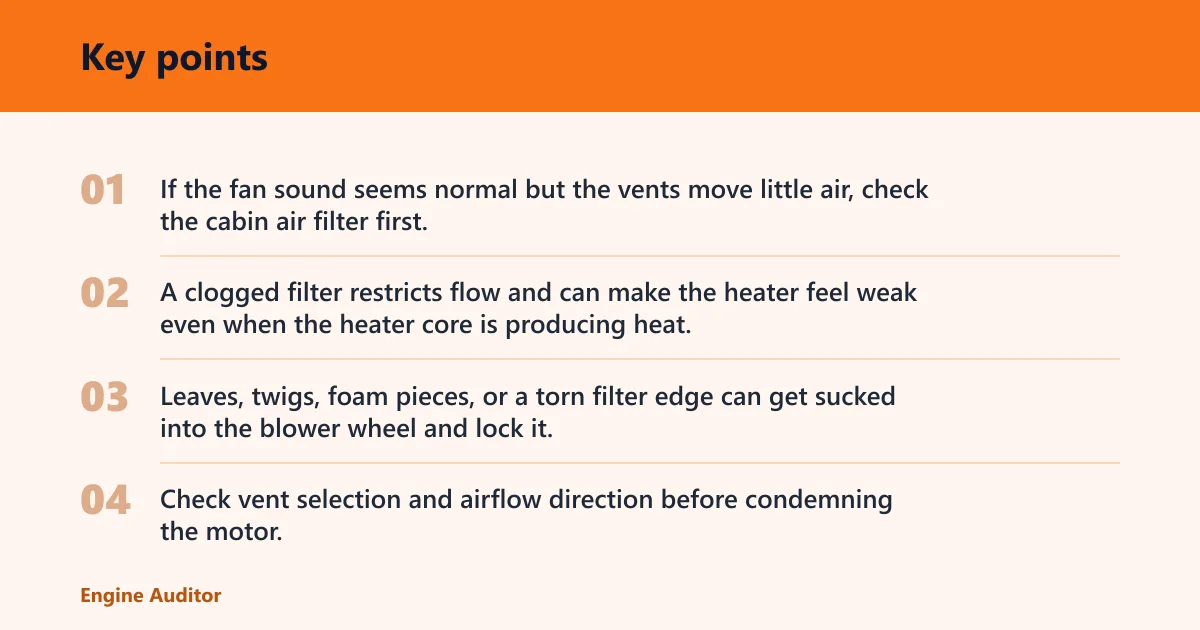
If the fan sound seems normal but the vents move little air, check the cabin air filter first. A clogged filter restricts flow and can make the heater feel weak even when the heater core is producing heat. That means the issue is airflow, not coolant temperature.
Blower wheel debris
Leaves, twigs, foam pieces, or a torn filter edge can get sucked into the blower wheel and lock it. That can create a hum, a brief start, or a no-spin condition. It can also overheat the circuit if the motor keeps trying to turn against a jam.
Duct or door blockage
If the blower sounds strong but the air never reaches the vents, the blockage may be in the ducting or a blend or mode door. That is less common than a motor or filter fault, but it can create the same “weak heat” complaint. Check vent selection and airflow direction before condemning the motor.
Quick checks before you replace parts
Check fuse, relay, power, ground, and command before replacing the blower motor. That order saves time and keeps you from guessing. On many vehicles, the fault is cheap and visible if you test in the right sequence.
-
Listen at the vents.
Turn the fan through every speed and listen for silence, hum, squeak, click, or a brief start attempt. The sound pattern helps separate motor drag, relay switching, and command loss. -
Inspect the filter and wheel.
Pull the cabin filter and look for heavy dirt or collapsed pleats. Then inspect the blower wheel for leaves, foam, or broken filter edges that could lock the fan. -
Verify electrical supply.
Confirm fuse condition, relay output, battery voltage at the blower connector, and a good ground. If one leg is missing, the motor cannot run even if the control panel looks normal. -
Check the speed-control path.
Match the vehicle to either a resistor pack system or a variable-speed module system. That choice changes where the fault lives and prevents part swapping that does nothing.
From a triage standpoint, fuse and relay checks are the quickest and cheapest. Filter and wheel checks are still fast, but they may require glove box or under-dash access. Motor or control module replacement usually takes more time because the part is buried near the HVAC case and may need tighter access.
Frequently asked questions
Is my blower motor bad or is it just a blown fuse?
If the fan is dead on every speed, start with the fuse, then the relay, then power and ground at the motor connector. A blown fuse points to an electrical overload; a bad motor usually shows noise, drag, or no spin even when power reaches it.
Why does my heater fan not work on any speed?
No speed at all usually means the blower circuit has lost power, ground, or command. That can be a fuse, relay, wiring fault, dead motor, or a control head issue. The blower can look dead while other HVAC functions still appear normal.
Can a bad blower motor cause no defrost in winter?
Yes. A failing cabin fan can become a visibility and safety issue when defrost cannot clear the windshield. If air does not move across the glass, the heater core cannot help much, even if coolant heat is present.
How do I check a blower motor fuse and relay?
Check the blower fuse first and confirm the correct vehicle-specific amperage. Then verify the relay passes power when the fan is commanded on. If the relay clicks but no voltage reaches the motor, the relay or command path is a better suspect than the motor.
What does a failing blower motor sound like?
Common clues are humming, squeaking, clicking, silence, or a short start attempt. A hum without spin often means the wheel is jammed or the motor is seized. A squeak often points to worn bearings, while a click with no airflow can point upstream.
Why is my heater blowing weak air but not cold air?
Weak airflow with a normal fan sound often means the motor is spinning but air cannot move freely. A clogged cabin filter, blower wheel debris, or duct restriction can cause that. The heater core may be fine; the problem is air delivery, not heat production.
Could debris or a cabin filter make it seem like the blower motor failed?
Yes. A clogged cabin filter can mimic a dying motor, and leaves, twigs, foam pieces, or a torn filter edge can jam the blower wheel. That can create weak flow, humming, or no spin. Check those items before assuming the motor is bad.
Products related to this article
Sponsored / affiliate links. As an Amazon Associate I earn from qualifying purchases. I may earn additional commission from eligible campaigns.