Why Your Car Has Heat at Idle but Blows Cold While Driving
If a vehicle has heat at idle but blows cold while driving, that can point to coolant flow dropping under load or a cabin blend-door fault; if the engine stays at normal temperature, a common place to start is those two checks. Ignoring it can leave you with no cabin heat in traffic, can bring back overheating, or can turn a small cooling problem into a costly repair. This guide shows a no-special-tools path to separate engine-side heat loss from HVAC-mix problems.
-
Gauge drops at speed. Start with thermostat behavior, coolant level, trapped air, and water-pump flow.
-
Gauge stays stable but vents change. Focus on blend doors, HVAC controls, and recirculation behavior.
-
One side is cold. Suspect a dual-zone air-mix door, actuator, or calibration issue.
-
Coolant loss or sweet smell. Check for leaks, heater-core seep, or a cap seal problem.
-
Problem started after coolant service. Recheck cold level and bleed air using the correct vehicle procedure.
Why heat can change with road speed

Road speed changes how much air passes through the radiator and condenser. At idle, the system depends on the electric cooling fan for airflow; at speed, ram air does more of that work. If coolant temperature falls on the road, the heater core gets cooler feed and cabin heat drops even though the engine may still seem normal.
How weak coolant flow shows up at highway speed
A pattern of heat at idle and cold air while driving often means the cooling system can keep up when airflow is low, then loses heater output when road airflow, thermostat position, or circulation changes. That can happen with low coolant, trapped air, a thermostat that is partially closed, a weak water pump, or a heater core that may not be passing enough flow.
Picture a sedan that blows warm at a long stoplight, then turns cool on the freeway. If the temperature gauge also drops while cruising, the engine is likely shedding too much heat or moving too little coolant through the heater circuit. If the gauge stays steady but the cabin changes from warm to cold, look harder at the HVAC air-mix doors.
Car heater symptom matrix
Use the pattern, not the guess. The same complaint can come from a coolant problem or an HVAC air-mix fault, and the first check is different for each one.
| Symptom pattern | Most likely cause | First check | Do-not-drive threshold |
|---|---|---|---|
| Idle-only heat | Weak coolant flow at road speed, thermostat issue, or blend-door fault | Check the cold overflow reservoir at MIN/MAX, then note whether the gauge drops at speed | Stop if the gauge rises toward hot or heat vanishes with any overheating sign |
| Heat at speed only | Fan airflow loss at idle, low coolant, or air pocket | Test the fan with AC on at operating temperature; both fans should run at full speed in that test | Do not continue if it overheats in traffic |
| One-side cold | Blend-door fault or a heater core flow imbalance | Compare driver and passenger temp settings; if one side changes and the other does not, suspect HVAC doors | Drive only if the engine temperature is stable and there is no sweet smell or coolant loss |
| Gauge drops on the highway | Thermostat stuck open or cooling system overcooling | Watch whether the gauge climbs again in town or at idle | Not an immediate stop unless the gauge later swings hot or the heater quits entirely |
| Sweet smell or coolant odor | Coolant leak, heater core seep, or cap seal loss | Check reservoir level cold and inspect for damp carpet or fogging | Stop if the level keeps falling or the windshield fogs with a coolant film |
| Upper hose hot, lower hose cool | Thermostat not opening fully or radiator flow restriction | Confirm the gauge and heater behavior together, not alone | Do not drive hard if the gauge climbs above normal |
| Fan cycling changes the symptom | Fan motor, relay, fuse, wiring, or control module failure | Repeat the AC-on fan test and listen for both fans at full speed | Stop if the car overheats at idle |
| Recirculation changes cabin temperature | Blend-door or HVAC control issue | Switch between fresh and recirculate at steady engine temperature | Okay to drive if coolant level and temperature are stable |
Could low coolant or trapped air be the cause?
Yes. Low coolant can cause heat at idle and no heat on the road, especially if the heater core is the high point in the circuit and air collects there. A cold-engine reservoir check at the MIN/MAX marks is the safest first move, because low fill and air pockets can mimic bigger failures.
Cold-engine reservoir check
With the engine fully cold, check the overflow reservoir against the MIN/MAX marks. Do not open a hot pressure cap. If the level is below MIN, the system may be low enough to let air into the circuit, which reduces heater output and can make the cabin go cold once road speed changes the coolant path.
-
Park and cool completely. Let the engine sit until it is cold enough to touch nearby plastic parts comfortably. That avoids burns and gives the reservoir a trustworthy reading.
-
Read the reservoir marks. Compare the level to MIN and MAX, not to the shape of the tank. If it is below MIN, top off only with the correct coolant mix for that vehicle.
-
Watch for repeat loss. Recheck after a normal drive and another full cool-down. A level that keeps dropping points to a leak, cap problem, or heater core seep.
Air pockets after coolant service
Air left in the system after a coolant service can block heater flow. The engine may warm normally at idle, then the heater core loses circulation when the vehicle is moving and the bubble shifts. That is why bleeding air after coolant service matters when the symptom starts soon after work was done.
A common first-timer mistake is topping the reservoir once and assuming the job is finished. If the level falls again after a drive, the system may still be purging air. That can leave the heater weak on the road even though the tank looked fine in the driveway.
When to bleed the system
Bleeding is worth considering if the heat problem began right after a coolant drain, hose replacement, thermostat job, or any service that opened the cooling system. Use the vehicle-specific bleed point or procedure if the maker provides one, and never crack open a hot system to chase air.
-
Confirm a cold fill. Set the reservoir to the proper cold mark first. A system that is already low cannot be bled correctly.
-
Run the heater on hot. With the engine warmed to operating temperature, set the cabin heat to full hot so coolant is directed through the heater circuit when the design allows it.
-
Recheck after cooldown. After the engine cools, verify the reservoir again. A stable level and stable heat suggest the air is gone; repeated loss suggests a leak or cap issue.
What the electric cooling fan can tell you
An electric cooling fan must run at idle when the car needs low-speed heat rejection. At speed, ram air does more work through the radiator and condenser, so a bad fan can hide until traffic or a driveway test. That is why a fan problem usually shows up as worse heat or overheating at idle or in traffic, with improvement at speed.
Fan, relay, fuse, wiring, and module faults
If the fan does not run, the engine can overheat at idle while running normally at speed. Failures often come from the fan motor itself, a bad relay, a blown fuse, damaged wiring, or a control module that does not command the fan correctly. Some vehicles use dual fans, and some may not command both fans or full speed in a simple AC-on test.
-
Warm the engine fully. Bring it to normal operating temperature, then switch the AC on. This is the basic fan test recommended in many service guides.
-
Check both fans. If one stays still or both run weakly, inspect the fuse, relay, wiring, motor, and module before replacing bigger parts.
-
Note the symptom change. If heat improves only when road speed rises, fan airflow at idle is probably part of the issue. If the problem remains unchanged at any speed, move to coolant level, thermostat, water pump, or blend-door checks.
Could a thermostat or water pump be behind it?
Yes. A thermostat stuck open can keep coolant too cool on the road, while a thermostat that is partially closed can limit flow and cause erratic heat under load. A water pump can also cause poor circulation when the cooling system is no longer moving coolant well enough.
Stuck-open thermostat clues
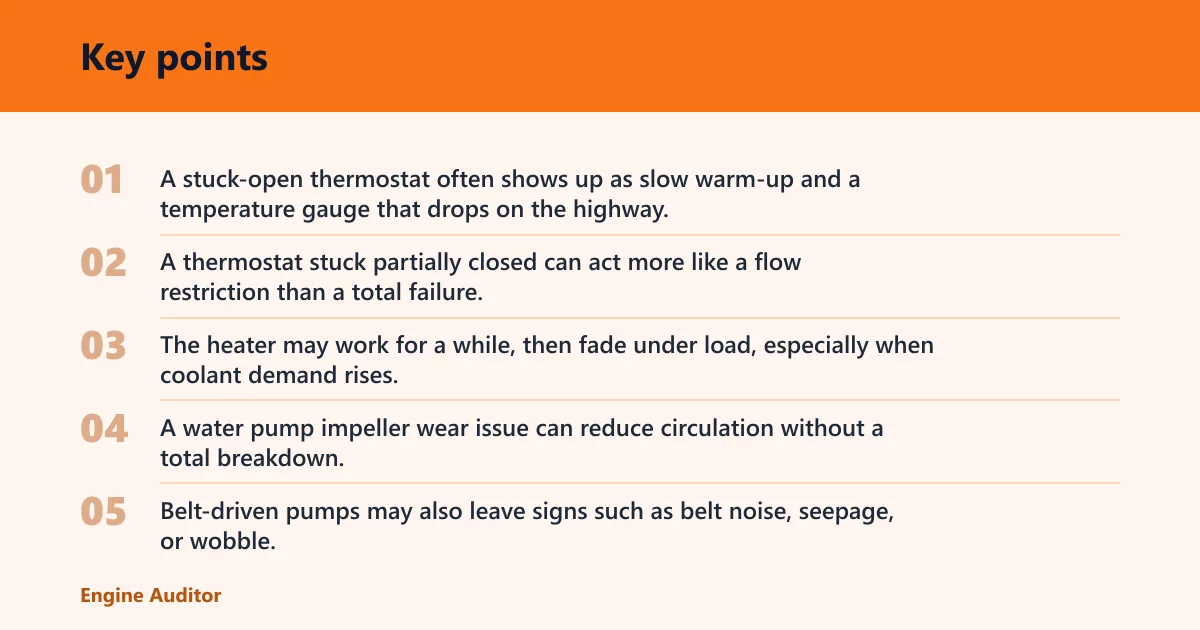
A stuck-open thermostat often shows up as slow warm-up and a temperature gauge that drops on the highway. The cabin may lose heat at speed because the coolant is being overcooled by ram air and never stays hot enough for strong heater output. That is different from a fan fault, which usually hurts idle more than highway driving.
Partially closed thermostat clues
A thermostat stuck partially closed can act more like a flow restriction than a total failure. The heater may work for a while, then fade under load, especially when coolant demand rises. If the upper hose is hot and the lower hose stays cool, the thermostat or radiator flow path deserves attention before you blame the heater core alone.
Water pump flow loss and belt-driven signs
A water pump impeller wear issue can reduce circulation without a total breakdown. Belt-driven pumps may also leave signs such as belt noise, seepage, or wobble. If the pump cannot keep coolant moving when demand rises, heater output can fade because the heater core is sensitive to reduced flow.
Suppose the heater is warm in a driveway but turns cool after ten minutes at 60 mph. If the gauge also starts to dip below normal, a thermostat that stays open or a worn pump that cannot keep the heater circuit hot are stronger suspects than the blend door.
Heater core or blend door fault
The heater core and blend doors sit on different sides of the problem. The heater core needs coolant flow. The blend door controls how much of that heat reaches the vents. If the engine stays hot but the cabin changes from warm to cold, the fault may be in the HVAC air-mix system instead of the cooling circuit.
Restriction versus low flow in the heater core
A clogged or restricted heater core usually shows a temperature difference between the inlet and outlet hoses. Low flow can feel different: both hoses may be warm, but not hot enough, or the heat changes with RPM. Sediment, old coolant, or trapped air can all reduce heater-core performance.
Blend-door symptoms that do not match engine temperature
Answer: A blend-door fault often changes cabin temperature without changing engine temperature. The vents may flip from hot to cold when you move the temperature knob, change recirculation, or select another zone.
Single-zone versus dual-zone clues
Single-zone systems usually change the whole cabin together. Dual-zone systems can leave one side cold while the other stays warm, which points toward an air-mix door, actuator, or calibration issue. Rear heaters can add another branch, so a front-only complaint does not always prove the heater core is at fault.
Coolant heat matrix
This matrix turns the common symptom combinations into the next best check and shows what each pattern tends to rule out. Use it after the cold-level and fan checks, because those two steps eliminate the most common false leads quickly.
| Pattern | Most likely cause | Next check | What this tends to rule out |
|---|---|---|---|
| Idle heat, cold on the road | Thermostat stuck open, weak pump flow, or blend-door fault | Compare gauge behavior at idle and at cruise, then verify cold reservoir level | Rules out a simple fan-only failure if the fan is already working at idle |
| Cold at idle, warm at speed | Fan airflow loss, low coolant, or air pocket | Run the AC-on fan test at operating temperature and check for repeat coolant loss | Rules out thermostat overcooling if the gauge stays normal at speed |
| One side cold, one side hot | Blend-door or actuator fault | Change temperature settings side to side and note whether only one zone responds | Rules out a total heater-core failure if the other side still has heat |
| Gauge drops at highway speed | Thermostat stuck open or overcooling | Watch whether the gauge recovers in traffic or after slowing down | Rules out a fan-only fault when the complaint happens mainly at road speed |
| Sweet smell with weak heat | Coolant leak, heater core seep, or cap seal loss | Check cold reservoir level and look for damp carpet or fogging | Rules out a purely mechanical blend-door issue if coolant loss is present |
| Upper hose hot, lower hose cool | Thermostat or radiator flow restriction | Confirm with gauge movement and heater output together | Rules out a normal, fully open cooling path if the lower hose never warms |
| Heat changes with recirculation | HVAC air-mix fault | Switch fresh/recirc and see whether engine temperature stays unchanged | Rules out coolant flow loss when the engine gauge is steady |
| Heat comes and goes after service | Air pocket after coolant work | Verify cold level, then bleed air using the correct procedure for the vehicle | Rules out a long-term thermostat issue if the symptom began right after service |
Frequently asked questions
Why does my car heater work at idle but blow cold while driving?
Answer: This usually means the problem changes with road speed. Start by checking whether the engine temperature changes too; if it does, look at coolant flow first. If it does not, the HVAC air-mix system moves higher on the list.
What to check next if the heater only fails on the road
Start with the cold reservoir level and then watch the temperature gauge at cruise. If the gauge drops, the thermostat or circulation path is more likely. If the gauge stays steady but the air changes, move to the blend doors and HVAC controls.
Can low coolant cause heat at idle and no heat on the road?
Answer: Yes. Check the reservoir only when cold and look at the MIN/MAX marks first. Repeat loss points to a leak or trapped air.
How to tell low coolant from a blend-door problem
If the engine temperature changes with the symptom, coolant is the more likely path. If the engine stays steady and only the cabin changes, the blend door is more likely. A sweet smell, damp carpet, or fogging also pushes the diagnosis toward coolant loss rather than HVAC controls.
Why does my car heater get cold when I speed up?
Answer: Speed changes airflow through the radiator and condenser, so a marginal cooling system can start shedding too much heat on the road. That can drop heater-core temperature. If the gauge also falls, think thermostat or overcooling; if only the cabin changes, look at the blend door and HVAC controls.
When highway airflow points to the thermostat
A thermostat that stays open can let the engine run too cool once ram air rises. That often shows up as a gauge drop on the highway and weaker cabin heat. A fan problem usually shows up more at idle or in traffic than at road speed.
Is a bad heater core what causes heat only at idle?
Answer: It can, but it is not the only cause. A restricted heater core can still pass enough coolant at idle and then fall short under road load. A blend-door fault can also create the same symptom with no coolant issue at all. Hose temperature difference helps sort those two apart.
How heater-core restrictions usually show up
A restriction often brings uneven hose temperatures, slow heat recovery, or heat that fades as demand rises. If both hoses feel similarly warm and the air still changes with vent settings, the HVAC side deserves more attention than the coolant side.
Could a stuck thermostat make heat disappear while driving?
Answer: Yes. A thermostat stuck open can let coolant cool too much once road airflow rises, so the heater output fades at speed and the gauge may drop on the highway. A thermostat that is partially closed can also disturb flow and create uneven heat, especially under load.
Why thermostat problems can feel like a heater problem
The cabin heater depends on hot coolant. If coolant temperature or flow changes, the heater changes too. That is why thermostat faults can feel like HVAC problems even when the vents and controls are working normally.
Can a weak water pump cause no heat while driving but some heat at idle?
Answer: Yes. A worn impeller can reduce circulation enough to affect heater output. If the belt-driven pump also shows noise, seepage, or wobble, it deserves close inspection.
What water-pump clues matter most
Noise, seepage, wobble, and a changing gauge all matter more than one symptom by itself. If the pump cannot keep coolant moving when demand rises, heater output often fades first because the heater core is sensitive to reduced flow.
Do I need to bleed air out of the cooling system if heat changes with driving?
Answer: If the symptom started after coolant service, bleeding air is a smart next step. Use the vehicle’s bleed procedure and recheck the cold reservoir after cooldown to confirm the level stays stable.
Why bleeding matters after coolant service
Air can migrate through the system after a drain, hose replacement, or thermostat job. That can make the heater act normal one minute and cold the next. A stable cold level after cooldown is the best sign that the system is finally full and purged.
Products related to this article
Sponsored / affiliate links. As an Amazon Associate I earn from qualifying purchases. I may earn additional commission from eligible campaigns.