How to Clean a Steering Wheel Without Making It Slippery
Clean the wheel with a microfiber towel and a mild cleaner used sparingly, then dry it right away; finish with no sheen, no tack, and no residue. If cleaner, conditioner, or moisture stays on the surface, the wheel can feel slick and collect more grime. This guide shows how to clean leather, faux leather, plastic, wood, and perforated wheels without soaking them or making them slippery.
What you’ll need


- Microfiber cloths: one for cleaning, one clean and dry for finishing.
- Mild soap and water in a bowl or bucket for most sticky wheels.
- Leather cleaner mild for leather and worn or scratched black steering wheels.
- All-purpose cleaner for suitable interior surfaces with light residue.
- Soft cotton rag or sponge for controlled application.
- Vacuum cleaner with a small nozzle for seams and grooves.
- Non-scratch scrub pad for stubborn spots only.
- Gloves if the cleaner dries your skin or if you are handling a leather kit.
- Leather conditioner or leather shield for the final protection step only.
Which cleaner should you use?
Start with the mildest option that matches the wheel material. For many sticky wheels, mild soap and water is a safe first pass. Use a leather cleaner for leather or worn black leather; for other suitable interior surfaces with light residue, an all-purpose cleaner may be more appropriate.
-
Identify the material first.
Check for leather, faux leather, plastic, wood, or perforated leather before you choose a cleaner. Common steering wheel materials include plastic, natural wood, synthetics, faux leather, and real leather, and each one handles moisture differently. -
Choose the least aggressive cleaner.
Use mild soap and water for most sticky steering wheels. Use leather cleaner mild on a sponge or cloth for leather, including worn or scratched black steering wheels, and use all-purpose cleaner only on suitable interior surfaces. -
Test a hidden spot.
Try the product on the back side or another inconspicuous area first. This matters most on delicate surfaces, stitched sections, and perforated leather, where color change or residue shows quickly.
What is the safest cleaner for each wheel material?
The safest cleaner depends on the surface. Leather and perforated leather do best with a mild leather cleaner used sparingly; faux leather and plastic can usually handle mild soap and water; wood should stay dry; and any product should be applied to the cloth, not sprayed onto the wheel.
What should you avoid on each material?
Avoid soaking wood, flooding perforated leather, and using abrasive pads on delicate finishes. Skip heavy conditioners unless the material needs them and the wheel is already clean and dry. If a surface feels slick after cleaning, the problem is usually too much liquid or leftover residue, not a need for more product.
When should you condition a wheel?
Condition only after the surface is clean, fully dry, and free of film. On leather, the goal is protection without adding shine or slip. If the wheel still feels tacky after cleaning, do not condition yet; remove the residue first and let the wheel dry completely.
How do you clean without leaving residue?

Use a microfiber cloth that is damp, not soaked, and keep the wheel dry as you work. Spray cleaner onto the cloth or sponge, never onto the wheel, so you control the amount and avoid flooding seams, stitching, and perforations. The goal is clean skin-contact surfaces with no film left behind.
-
Remove loose dirt first.
Vacuum the rim, spokes, seams, and groove edges before wiping if you see grit. That lifts hidden dirt so you do not drag it across the finish. -
Apply one spray to cloth.
Put cleaner on the microfiber cloth or sponge, not on the steering wheel. About one or two sprays is enough for a small section; the cloth should feel damp, not wet or dripping. -
Wipe one section at a time.
Clean about a 6 to 8 inch section, then turn the cloth to a fresh side. This keeps body oils from spreading around the rim and helps the wheel dry evenly. -
Lift residue immediately.
Follow with a clean, dry microfiber cloth until the surface feels dry to the touch. If you still feel drag or slickness after one pass, repeat with less cleaner rather than adding more liquid. -
Use light pad pressure only.
On stubborn spots, use a non-scratch scrub pad in a circular motion and keep the touch light. Do not use it on delicate leather unless the spot is stubborn and the pad stays barely damp.
What can I use to clean a leather steering wheel safely?
Use a mild leather cleaner on a sponge or microfiber cloth, then wipe it off with a dry cloth right away. That gives leather a clean base before any conditioning or sealing step. For worn or scratched black steering wheels, a leather steering wheel set with Leather Cleaner mild and Leather Shield is the right type of kit.
Picture a black leather wheel that feels shiny at the top after commuting. A single light pass with leather cleaner on a cloth is the right response; a soaked rag is not. The clean side of the cloth should pick up the grime without leaving a slick film.
Can I use soap and water on a steering wheel?
Yes, for many sticky steering wheels, mild soap and water is the starting point. Keep the cloth barely damp and dry the wheel fully after each section. Do not soak wood, and keep water use limited on stitched, perforated, or foam-backed surfaces where moisture can sit in the openings.
For wood steering wheels, avoid water or soap because they can damage the wood. For plastic steering wheels, a soap solution sprayed onto a cloth and wiped with a dry rag is the safer approach. For leather, use mild leather cleaner on a sponge when soap alone is not enough.
How do you get sticky residue off a steering wheel?
Sticky residue usually comes from body oils, old cleaner, conditioner, or a mix of all three. Remove it with controlled cleaning, not more product. If the wheel still feels tacky after drying, stop adding conditioner and re-clean the area with a damp cloth and a milder cleaner.
-
Re-clean the tacky area.
Use a fresh microfiber cloth with just enough mild soap solution or leather cleaner to dampen it. Work the sticky patch once, then dry it immediately with a separate cloth. -
Check for over-conditioning.
If the wheel looks glossy but feels slick, the residue is likely on the surface. Wipe it again with a clean damp cloth, then dry it fully before deciding whether any protection step is needed. -
Escalate only if needed.
If soap does not clear the film on a suitable interior surface, switch to all-purpose cleaner on the cloth, not the wheel. Keep the amount low and recheck grip after the surface dries.
What if grime is stuck in the seams and grooves?
Use a vacuum cleaner first, then a lightly damp cloth wrapped around your finger or a soft cotton rag. A few careful passes remove dirt from seams, stitching, grooves, and perforations without flooding the openings. On perforated leather, do not push liquid into the holes.
Say your wheel has grime packed beside the stitched seam at 12 o’clock. A vacuum clears loose grit, then a damp microfiber cloth reaches the line without soaking it. That order keeps debris from turning into muddy residue.
Slip-safe steering wheel cleanup matrix
Use this matrix to match the wheel material, cleaner, and finish check. The target is always the same: clean, dry, and tack-free with no residue that changes grip.
| Wheel material | Safest cleaner | Application method | What not to use | Dry-time / finish check | Final pass/fail grip test |
|---|---|---|---|---|---|
| Leather | Leather cleaner mild applied to a sponge or cloth; use a dry microfiber cloth to finish. | Put cleaner on the cloth, wipe one section at a time, then follow with a dry cloth. | Do not spray onto the wheel, and do not leave conditioner or cleaner film behind. | Finish should be dry to the touch with no sheen, tack, or residue. | Pass if the rim feels dry rather than glossy, and your hand does not slide on the top arc. |
| Faux leather | Mild soap and water on a damp microfiber cloth; use all-purpose cleaner only if residue remains and only on the cloth. | Wipe gently in small sections, then dry with a second cloth right away. | Do not soak seams, and do not use heavy cleaner or excess liquid. | Finish should be evenly dry with no tack, sheen, or cleaner smell on the palm. | Pass if the wheel feels clean and controlled, not slick or filmed. |
| Plastic | Soap solution sprayed onto a cloth, then wiped with a dry rag. | Apply to the cloth first and wipe the surface with light pressure. | Do not spray directly onto the wheel or let liquid pool around buttons. | Finish should dry quickly with no soft spots or gloss from leftover moisture. | Pass if the surface feels dry and controlled, not shiny or slippery. |
| Wood | Dry microfiber cloth for dust; avoid water and soap because they can damage the wood. | Dust only, then buff lightly with a clean dry cloth. | Do not use water, soap, or a wet cloth on the wood surface. | Finish should stay dry and uncoated, with no haze or softening. | Pass if the wood keeps its dry finish and your hand does not drag. |
| Perforated leather | Leather cleaner mild on a sponge or cloth with very light passes. | Use the least liquid possible and work across the surface without flooding the holes. | Do not spray directly or push liquid into the perforations. | Finish should be dry in the holes and on the surface, with no trapped moisture. | Pass if the perforations feel dry and no liquid remains in the holes. |
How do you know the matrix result is safe?
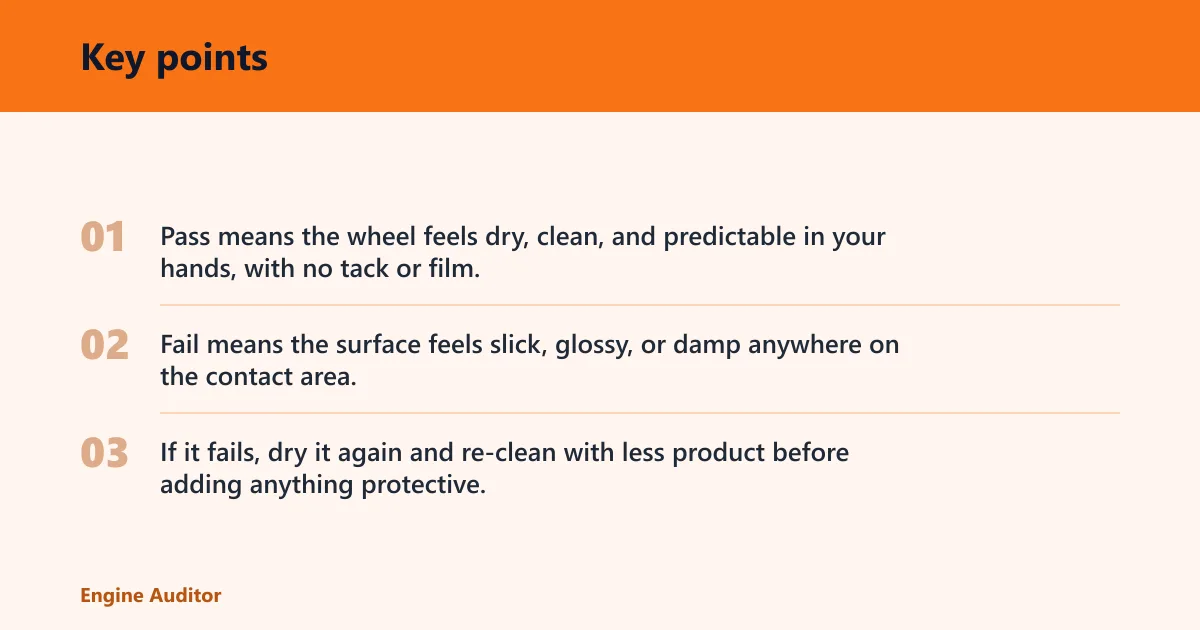
Pass means the wheel feels dry, clean, and predictable in your hands, with no tack or film. Fail means the surface feels slick, glossy, or damp anywhere on the contact area. If it fails, dry it again and re-clean with less product before adding anything protective.
What if the wheel still feels slick?
If the wheel still feels slick after drying, the likely cause is leftover cleaner, conditioner, or moisture in the surface texture. Dry it fully, then re-clean with less product. A wheel should feel clean and tack-free before any conditioner or leather shield goes on.
-
Dry it completely.
Wipe the wheel with a clean microfiber cloth and let it sit until the surface feels fully dry. For a leather sealing step, the leather must be dry for at least 24 hours, clean, and free of residue. -
Repeat with less product.
Use one light pass on the slick area, then stop. If the wheel still feels greasy, switch to a fresh cloth and a milder cleaner rather than increasing the amount. -
Delay protection products.
Do not apply leather conditioner or leather shield until the surface is clean and dry. If the wheel still grabs grime after conditioning, the protection step went on too early.
Suppose a leather wheel feels fine at the lower spokes but slick at the top after an earlier wipe. That often points to residue left in the contact zone, not a bad material choice. A second dry pass usually fixes the problem faster than more cleaner.
Prevention: clean high-touch wheels more often than other interior parts, because steering wheels are the part drivers touch most often. For heavily used leather surfaces, a practical maintenance interval is every 3 months; for normal use, every 6–12 months works better.
Common mistakes
Most slip problems come from too much liquid, too much conditioner, or poor drying. A wheel should not feel coated when you finish, and a cleaner that stays wet in seams will keep the rim slick longer.
- Spraying cleaner directly on the wheel instead of on the cloth.
- Using a dripping cloth that pushes liquid into stitching and perforations.
- Applying conditioner before the wheel is fully clean and dry.
- Using water or soap on wood steering wheels.
- Scrubbing leather with an abrasive pad instead of a light scrub pad on stubborn spots only.
- Skipping the grip test and assuming dry-looking means dry-to-the-touch.
Frequently asked questions
How do I clean a steering wheel without making it slippery?
Use a microfiber cloth that is damp, not wet, and apply cleaner to the cloth rather than the wheel. Wipe one section at a time, then dry it with a second clean cloth until there is no sheen, tack, or film. A final grip test should feel dry and controlled.
Should I spray cleaner directly on the steering wheel?
No. Spray cleaner onto the microfiber cloth or sponge so you control how much reaches the surface. Direct spraying makes it easier to soak stitching, grooves, and perforations, which is one of the fastest ways to leave a slippery film behind.
How often should I clean my steering wheel?
Clean it more often than other interior parts because it gets the most hand contact. For heavily used leather surfaces, every 3 months is a practical interval. For normal use, every 6–12 months is a reasonable schedule, with spot cleaning sooner if the rim feels sticky.
What should I do if grime is stuck in the seams and grooves?
Vacuum the seams first, then use a lightly damp microfiber cloth or soft cotton rag to lift the grime from the edges. If the spot is stubborn, use a non-scratch scrub pad with light circular motion and stop as soon as the residue lifts. Do not flood the seam.
Do I need to condition a steering wheel after cleaning?
Only after the surface is fully clean and dry. Conditioning or sealing too early can trap residue and make the wheel feel slick. If the wheel is leather, wait until it is dry for at least 24 hours before sealing, and make sure the surface is free of cleaner film first.
Products related to this article
Sponsored / affiliate links. As an Amazon Associate I earn from qualifying purchases. I may earn additional commission from eligible campaigns.