What Does It Mean When a CV Joint Clicks?
A CV joint click usually means the outer joint on the noisy side is worn if it clicks in tight turns; a straight-line acceleration click points more to the inner joint or a similar fault. If you ignore it, grease can escape, the axle can fail, and the car may stop pulling that wheel. This guide shows how to match sound pattern, steering angle, and boot damage to the likely side and when to inspect now.
How to tell which joint is clicking
A repeatable click on tight turns most often points to outer CV joint wear on that side. A click that shows up with acceleration in a straight line points more toward the inner joint, axle damage, or another fault that can mimic CV noise. One isolated pop is less useful than a repeatable pattern.
Outer versus inner joint symptoms
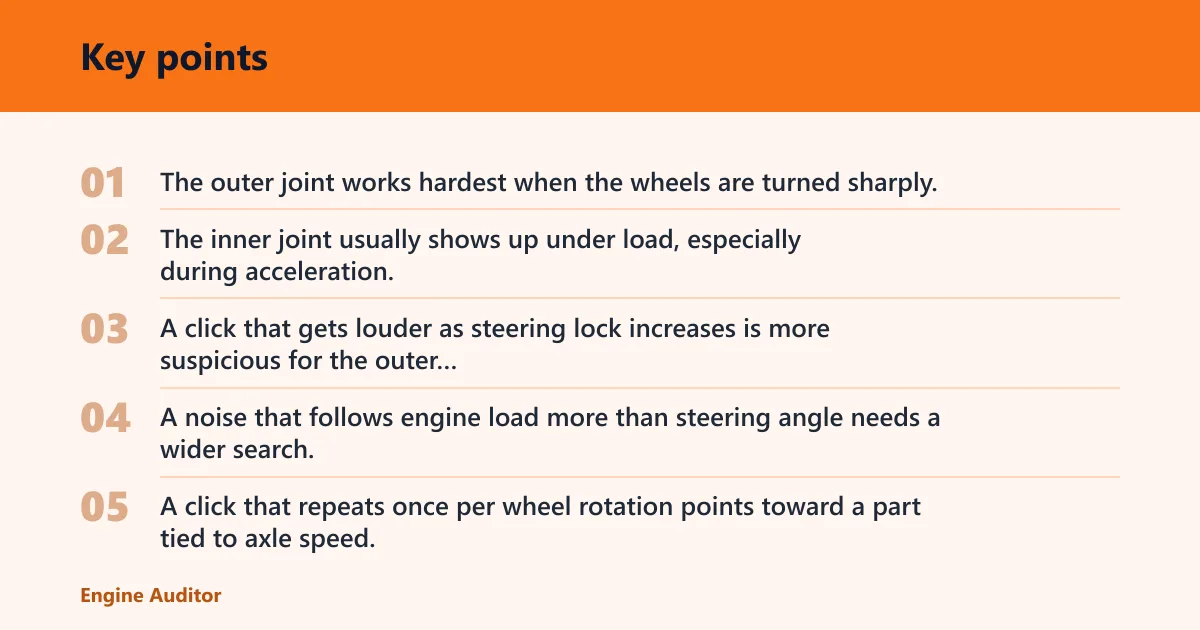
The outer joint works hardest when the wheels are turned sharply, so wear there is often heard most clearly in parking-space maneuvers or driveway turns. The inner joint usually shows up under load, especially during acceleration, and it may feel like vibration or shudder instead of a sharp turn click.
Sound location matters. A click that gets louder as steering lock increases is more suspicious for the outer joint. A noise that follows engine load more than steering angle needs a wider search, because brake parts, steering joints, suspension joints, wheel damage, wheel bearings, and differential trouble can all sound similar.
What the click cadence tells you
A click that repeats once per wheel rotation points toward a part tied to axle speed. If the cadence speeds up as the car goes faster, that supports a rotating source. If it changes mostly with throttle, the inner joint or a drivetrain lookalike moves higher on the list.
Repeatable rhythm beats a random pop. A single clunk can come from brake pads, a sway-bar link, or a loose wheel component. A steady click that returns at the same steering angle deserves a closer CV inspection.
CV joint click diagnosis matrix
Use this matrix to sort common patterns before you start taking parts apart. It helps separate outer joint clicks from inner joint symptoms and from lookalike faults that can send you down the wrong path.
| Symptom pattern | Likely source | Quick at-home check | Next action |
|---|---|---|---|
| Tight-turn clicking | Outer CV joint wear | Drive slow circles in both directions with full steering lock and listen for a repeatable click | Inspect boot, grease loss, and joint play; plan axle replacement if the click repeats |
| Acceleration vibration | Inner CV joint, bent axle, or imbalance-like driveline fault | Hold a steady line and accelerate gently, then repeat under light and moderate throttle | Check axle runout, inner joint play, and nearby drivetrain parts |
| Grease sling | Torn CV boot with contamination risk | Look for dark grease on the wheel, splash shield, or suspension parts | If the joint is still quiet and clean, boot repair may still be possible; if dirt has entered or clicking has started, replacement is often more practical |
| Clunk on shifting | Excess play in the axle or inner joint | Shift from Reverse to Drive with the brake held and note any clunk | Inspect for looseness at the shaft, splines, and inner joint; replacement is more likely if play is present |
| Noise that changes with steering lock versus speed | Outer joint if steering lock dominates; inner joint or lookalike fault if speed or load dominates | Compare a slow full-lock circle with a straight-line acceleration run | Use the stronger trigger as the lead clue, then confirm on the lift |
How does a CV joint work?
A constant-velocity joint transfers power through a changing angle while keeping wheel speed steady. That lets the axle send torque to a wheel that steers and moves up and down with suspension travel. The joint has to flex without binding, which is why wear often shows up during turns or load changes.
Why the axle can turn and flex at once
The axle does two jobs at once: it carries drive force and tolerates movement from steering and suspension travel. The outer joint handles large steering angles. The inner joint handles plunge and shaft movement as the suspension cycles. Both depend on clean grease and intact boots.
Wear starts to matter when clearances grow. As the joint surfaces pit or dry out, the rolling parts no longer move smoothly through the same angle. That can produce clicking, vibration, or a clunk under power.
Why wear shows up during turns and load changes
A sharp turn puts the outer joint at a greater angle, which is why the click often shows up in parking-lot maneuvers or when turning into a driveway. Acceleration loads the shaft differently, so inner joint wear is more likely to show as shudder or vibration.
How to tell an outer CV joint from lookalikes
An outer CV joint is only one possible source of a turn-related click. Brake hardware, steering and suspension joints, wheel damage, wheel bearings, and differential issues can all make similar noises. The clue is not just the sound. It is where, when, and how the sound changes.
Brake hardware and pad noise
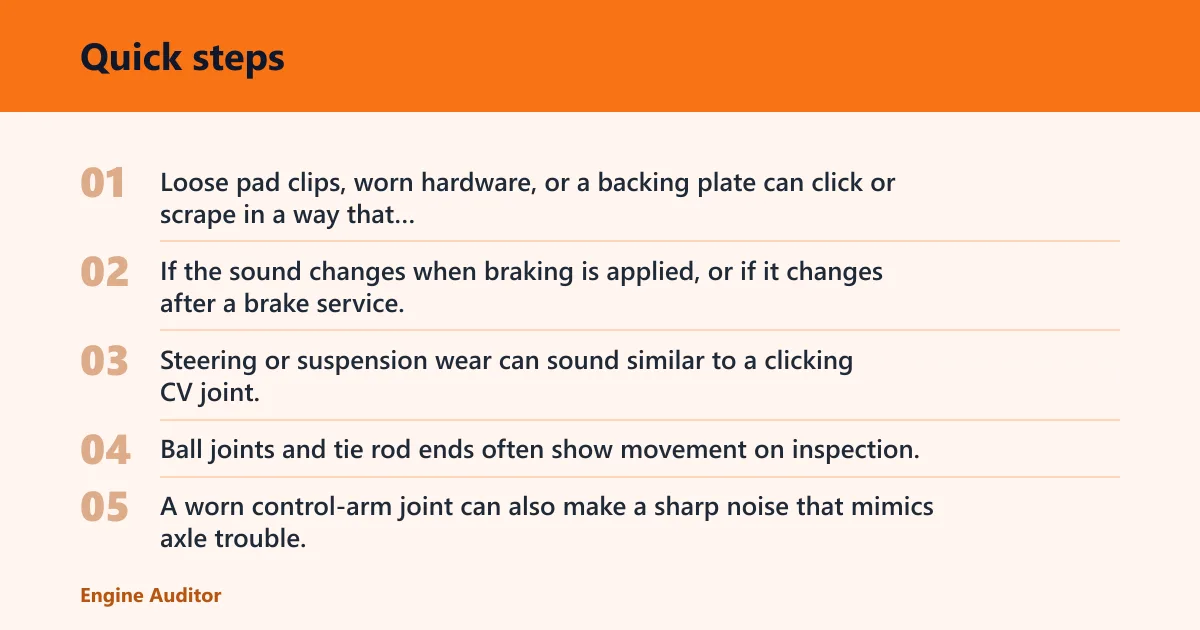
Loose pad clips, worn hardware, or a backing plate can click or scrape in a way that seems tied to wheel rotation. If the sound changes when braking is applied, or if it changes after a brake service, put the brake system on the list before condemning the CV axle.
Ball joints, tie rods, and control arms
Steering or suspension wear can sound similar to a clicking CV joint. Ball joints and tie rod ends often show movement on inspection, and they may click or clunk during steering input or over small bumps. A worn control-arm joint can also make a sharp noise that mimics axle trouble.
Wheel bearings and hub noise
Wheel damage can sound similar to a clicking CV joint, and a worn bearing can add growl, rumble, or a change in noise when you steer left or right. A bearing usually does not make the same sharp, repeating click that an outer CV joint makes on a tight turn, but the overlap is real.
Differential and driveline clunks
Differential trouble can sound similar to a clicking CV joint, especially if the noise changes with load instead of steering angle. A clunk when taking off or shifting can also come from driveline lash, not the axle. AWD systems add more parts to the list, so front, rear, and center driveline noise all deserve consideration.
Say your front-wheel-drive car clicks only on full-lock left turns and stays quiet in a straight line. That pattern fits an outer joint on the right side better than a brake or differential problem. If the same car also shudders on acceleration, the inner joint or bent shaft moves higher on the list.
Start with a road test, then move to a lift inspection. A road test can reproduce the noise, but it does not prove the joint is the only fault. Physical inspection is what helps separate a CV problem from brake, steering, suspension, wheel, or differential noise.
Road test steps
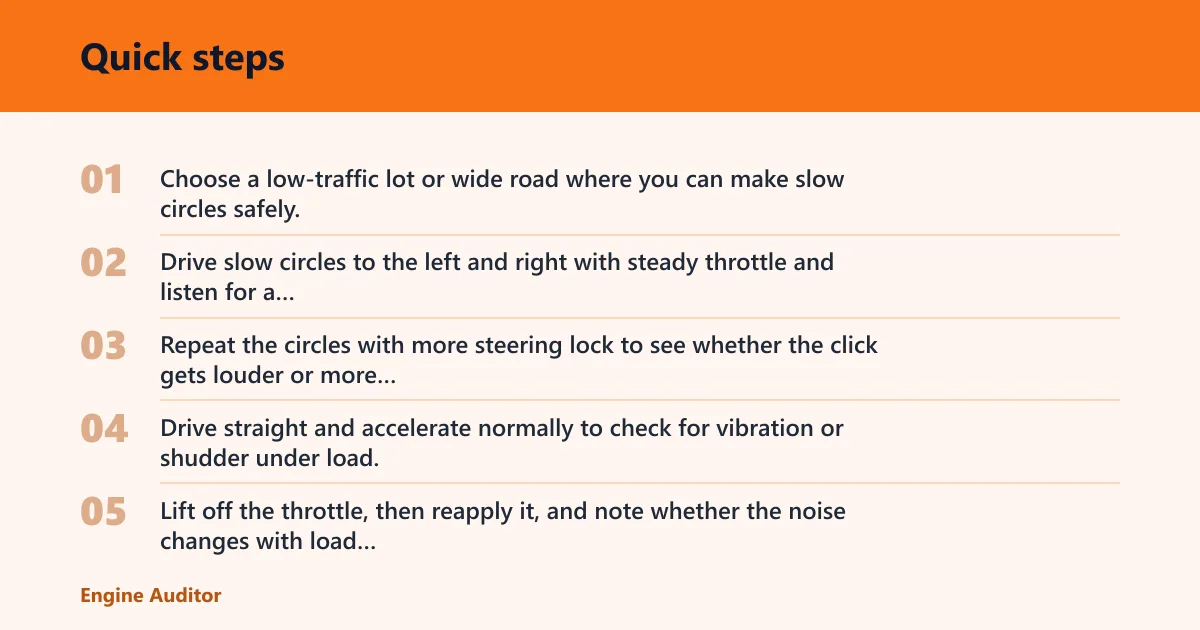
- Choose a low-traffic lot or wide road where you can make slow circles safely.
- Drive slow circles to the left and right with steady throttle and listen for a repeatable click.
- Repeat the circles with more steering lock to see whether the click gets louder or more frequent.
- Drive straight and accelerate normally to check for vibration or shudder under load.
- Lift off the throttle, then reapply it, and note whether the noise changes with load more than with steering angle.
- Shift between Reverse and Drive with the brake held and listen for any clunk.
A controlled road test may include slow circles and normal acceleration. Direction, throttle, and steering lock all matter. If the noise appears only on a tight turn, the outer joint rises to the top. If it shows up mainly under acceleration, think inner joint, bent axle, or another load-related source.
Lift inspection steps
- Inspect both CV boots for splits, loose clamps, and wet grease.
- Look for dark grease near the wheel, inside the wheel well, and on nearby suspension parts.
- Check joint play by moving the shaft and watching for looseness at the joints.
- Inspect the shaft, splines, and seals for damage or leakage.
- Check the wheel-end parts nearby, including brake hardware, steering joints, suspension joints, and wheel components.
- Compare both sides, since one damaged side often stands out against a clean one.
On the lift, inspectors check CV boots, joint play, shafts, splines, seals, and grease loss. Lost grease lets water and grit enter. That contamination can turn a repairable boot problem into a worn joint problem much faster than many drivers expect.
Grease sling is a major clue. A split CV boot may sling dark grease inside the wheel or onto nearby suspension parts. If the joint is still quiet and clean, a boot service may still make sense. If dirt has entered or clicking has started, axle replacement is often more practical.
When a CV axle needs replacement
A CV axle may need replacement when the joint is clicking or loose, when vibration is present under load, or when contamination has already reached the joint. A torn boot alone does not automatically condemn the axle, but once the joint clicks or has measurable play, replacement becomes the more likely repair.
Play, contamination, and repeat clicking
Excess play is not a small warning. If the shaft or joint moves loosely by hand, or if the click returns every time you repeat the same turn, the joint has moved beyond a simple noise concern. Contamination makes that decision harder to reverse because grit accelerates wear inside the joint.
When a boot repair still makes sense
A quiet joint with a fresh boot tear and no visible contamination may still be serviceable if the grease is intact and the joint has no play. That call depends on how long it has been open and whether dirt has entered. The cleaner the joint, the better the odds of a boot-focused repair.
A common first-timer mistake is replacing the boot after months of driving with a torn one and assuming the joint is fine. If the grease is dark, the joint feels loose, or the click has already started, the safer path is usually the axle assembly.
What happens when a CV joint breaks?
When a CV joint breaks, the noise often gets worse before driveability fails. A click can turn into a louder clack, vibration can spread, and the axle may lose its ability to transmit power cleanly. In severe cases, the car can stop pulling that wheel.
Stop driving now if the joint is loose, the noise is rapidly worsening, or grease loss suggests contamination that is already inside the joint. A failing outer joint can separate. A failing inner joint can leave you with heavy vibration or a driveline that no longer feels secure under load.
AWD and rear-axle setups need special care. On many vehicles the front axles still steer, so the classic tight-turn click points to a front outer joint. Rear axles and center driveline parts can still clunk or vibrate, but the steering-angle clue is weaker there, so load and shaft inspection matter more.
Frequently asked questions
What does it mean when a CV joint clicks?
A clicking CV joint usually means wear in the outer joint if the noise shows up on tight turns. A click under straight-line acceleration points more toward the inner joint or a lookalike fault. The key clues are repeat pattern, steering angle, and whether grease loss or play is present.
How do I know CV joints are bad?
Look for a repeatable click on tight turns, vibration under acceleration, grease thrown around the wheel area, or a clunk under power. A single pop is not enough. A pattern that repeats under the same steering or load condition is much more convincing.
CV joint vs ball joint
A CV joint usually changes noise with steering angle or axle load, while a ball joint more often shows movement at the suspension or steering knuckle and may clunk over bumps or during steering input. A visual and hands-on inspection is needed because both can sound similar.
Products related to this article
Sponsored / affiliate links. As an Amazon Associate I earn from qualifying purchases. I may earn additional commission from eligible campaigns.