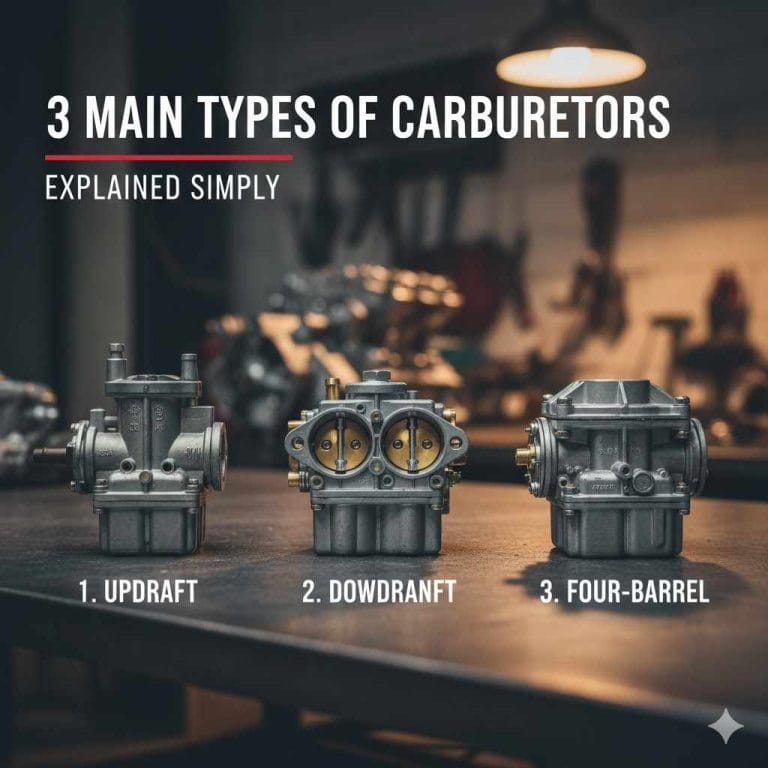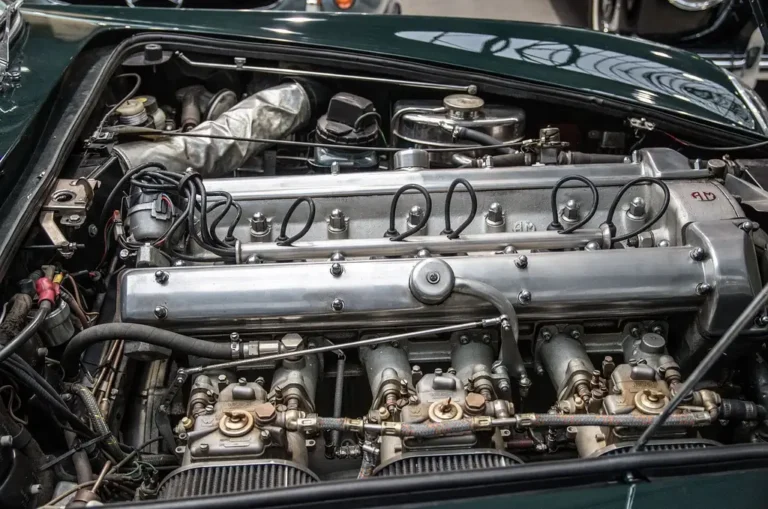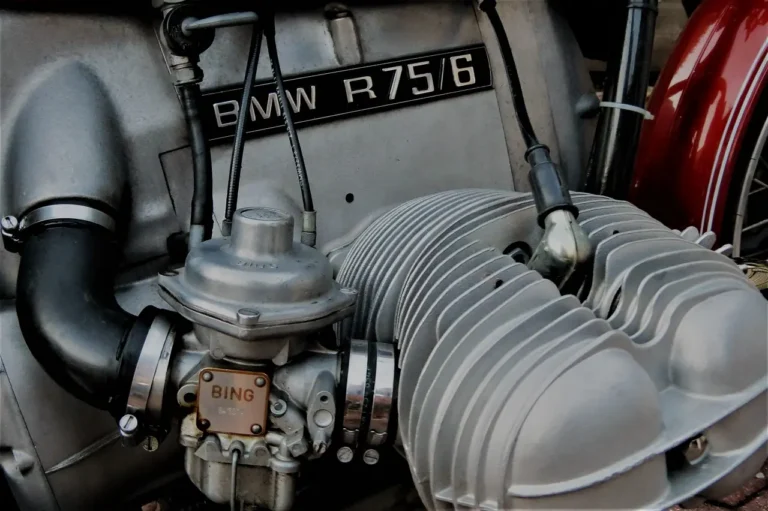
Carburetor Accelerator Pump Problems and Fixes
An accelerator pump problem usually shows as a sharp bog or flat spot right off idle; If the pump shot starts immediately and lasts about 0.5 to 1 second, another cause should usually be checked first. Miss that check and you can replace parts, pull the carb, and still keep the hesitation. This guide gives a symptom tree for carburetor accelerator pump problems and fixes, with tests that separate pump faults from air leaks, jetting issues, ignition trouble, and linkage problems.
What the accelerator pump does


The accelerator pump sends an extra shot of fuel when the throttle opens fast. It covers the short moment when airflow rises faster than fuel can move through the rest of the carburetor.
Fuel leaves the pump circuit through a small jet into the venturi, where the pressure drop helps draw that fuel into the airflow. The pump links mechanically to the throttle linkage, so throttle movement should move the pump arm and stroke at once.
Why sudden throttle opening needs an extra fuel shot
When you snap the throttle open, airflow rises fast and manifold vacuum changes fast. The main metering circuit does not always keep pace, so the pump briefly enriches the mixture and prevents a lean stumble. If that extra shot is missing, late, or too small, you get hesitation, a stumble, or a bog on acceleration.
How the pump shot enters the venturi
Discharge nozzles are precisely sized, and their spray pattern matters. A single-barrel carburetor normally squirts a single stream. Two- or four-barrel carburetors normally squirt 2 streams. That output should be visible at the nozzle when the throttle is opened with the engine warm and the choke fully open.
Why a carb can bog even when the pump is not the cause
A bog from a stop is often misread as a bad accelerator pump. Idle mixture, throttle plate clearance, float level, flooding, and transfer slot exposure can all create the same complaint. If you open the carb too soon, you can chase the wrong circuit.
Accelerator pump diagnosis matrix
| Symptom | Likely cause | First test |
|---|---|---|
| No squirt | Dry fuel bowl, stuck linkage, failed diaphragm, stuck check valves, clogged discharge nozzle | Check for bowl fuel first, then move the throttle by hand and watch the nozzle |
| Weak squirt | Low bowl fuel, worn diaphragm, partial nozzle clog, weak stroke, leaking check valve | Verify float level and then confirm full linkage travel |
| Squirt but still bogs | Idle mixture too lean or too rich, throttle plate clearance too small, transfer slot exposure, wrong nozzle pattern, flooding | Check idle setting and plate position before opening the carburetor |
| Bog from idle only | Idle circuit issue, throttle plates set too far closed, puddling from too little throttle plate clearance, pump shot too late | Set base idle and confirm transfer slot exposure |
| Bog from cruise only | Secondary opening too soon, fuel delivery issue, ignition weakness, main circuit problem, poor pump timing on some carbs | Compare light-throttle roll-in to a quick stab and watch if the bog appears only after cruise |
| Fuel overflow | Float level too high, needle and seat issue, debris, flooding that masks pump behavior | Check bowl level and look for raw fuel at the boosters or throat |
Why does it hesitate when you open the throttle?

A hesitation right as you open the throttle usually means the mixture goes lean for a moment, but that does not automatically point to the accelerator pump. If the pump shot appears immediately and keeps spraying for about 0.5 to 1 second, the cause is often elsewhere: idle circuit setup, float level, ignition timing, or a vacuum leak.
What the hesitation pattern says about the problem
A dead spot only at the first crack of the throttle often points to pump linkage, nozzle clogging, or a dry bowl. A bog that gets worse with a bigger throttle tip-in can point to pump shot volume or timing. A stumble that appears after the engine starts to move off idle can point to transfer slot exposure or a bad base idle setting.
Cold engine versus hot engine clues
Cold engines often need a richer mixture and can hide marginal pump output. Hot engines can show a lean stumble more clearly because fuel vaporizes faster and there is less room for error. If the problem appears only hot, do not assume the pump is bad; check float level, idle mixture, and signs of percolation or flooding.
When a stored carb points to varnish instead of wear
Stored engines and ethanol fuel can leave varnish in the pump circuit, nozzle, or check valves. A carb that sat with old fuel may have a diaphragm that is still intact but passages that are partly blocked. That can create a delayed shot, a weak squirt, or no squirt at all without any major hard-part failure.
Say your 2-barrel carb starts cleanly after a rebuild but stumbles only after months of storage. If the bowl is dry, the first pump test can look dead even though the real issue is stale fuel and a dry circuit. Fill the bowl, warm the engine, open the choke, and test again before pulling the carb apart.
Check linkage, stroke, and bowl fuel first
The first checks are mechanical and simple: throttle linkage travel, fuel in the bowl, and pump stroke. That order prevents false diagnosis. A dry bowl can make a good pump look failed, and a linkage that does not move through full travel can shorten the shot even when the diaphragm is fine.
Inspect throttle linkage travel and return
The pump is mechanically linked to the throttle linkage, so the arm should begin moving as soon as the throttle opens. Watch for bent rods, binding return springs, worn holes, or missing clips. The linkage should return fully without hanging up, because incomplete return can leave the pump short on its next stroke.
Confirm the fuel bowl contains fuel before testing
A false pump test can happen if the carburetor bowl is dry. Before any judgment, confirm that the fuel bowl contains fuel. If the engine has been sitting, crank it long enough to refill the bowl or use the normal prime method for that carburetor, then retest the nozzle output.
Set pump cam and stroke to the maker’s spec
Modern accelerator pump carburetors may have adjustable pump shots and timing mechanisms. Set the pump cam and stroke to the maker’s specification before blaming the nozzle. Too little stroke gives a weak shot; too much can flood the throat and hide other problems.
- Check bowl fuel first.
- Move the throttle by hand and watch the pump arm.
- Verify a clean, immediate squirt at the nozzle.
- Confirm the linkage returns fully.
- Set stroke and timing to spec.
How do you tell pump failure from lookalikes?
Separate the pump circuit from idle and fuel-level problems before you remove the carburetor top. Idle mixture, throttle plate clearance, and float level can all mimic a bad pump. A vacuum gauge helps here, because a low or unstable idle vacuum reading can point to an idle circuit or base setting issue rather than a pump fault.
Idle mixture and throttle plate clearance
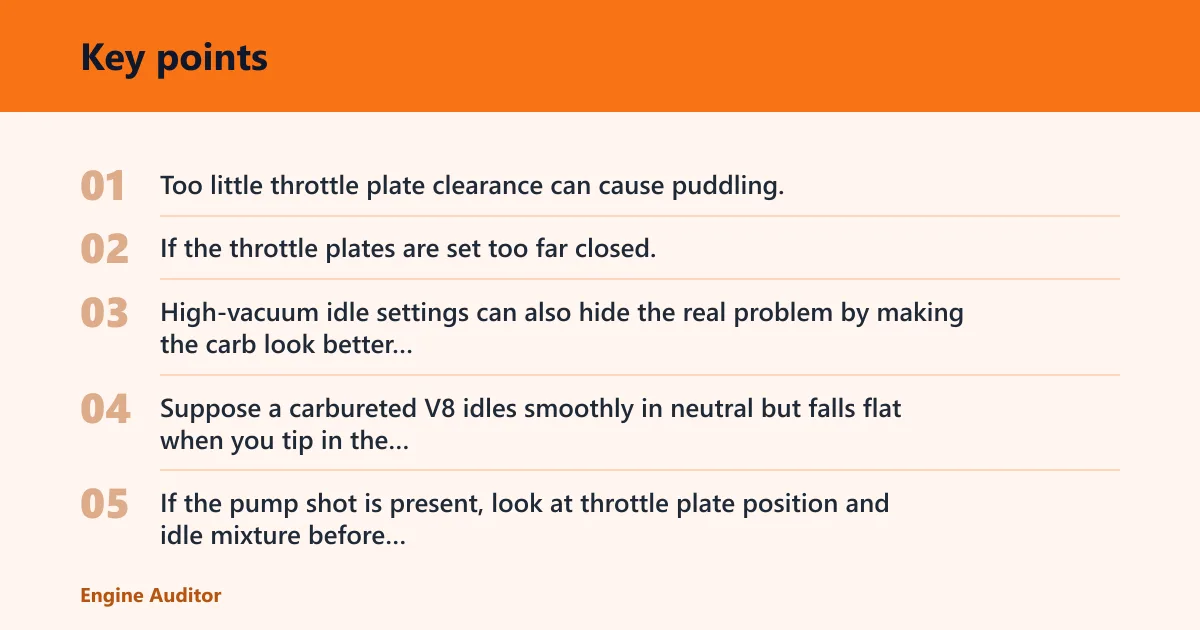
Too little throttle plate clearance can cause puddling. If the throttle plates are set too far closed, the transfer slot can be exposed the wrong way and the engine can stumble as soon as you open the throttle. High-vacuum idle settings can also hide the real problem by making the carb look better at idle than it is on tip-in.
Suppose a carbureted V8 idles smoothly in neutral but falls flat when you tip in the throttle from a stop. If the pump shot is present, look at throttle plate position and idle mixture before touching the pump circuit. The wrong base idle setting can make the accelerator pump look guilty when it is not.
Float level and flooding clues
Float level affects bowl fuel level, and it should be set to the manufacturer’s specification. Too high a level can enrich the mixture and cause bog, fuel smell, or overflow. Too low a level can starve the pump circuit and weaken the shot, especially on a quick throttle opening.
Using a vacuum gauge to separate idle issues from pump issues
A vacuum gauge is useful when the symptom is confusing. If idle vacuum is unstable or lower than expected, the problem may be in the idle circuit, a vacuum leak, or ignition timing. If vacuum is steady at idle but the engine stumbles only on a quick throttle opening, then the pump circuit deserves closer attention.
What if it squirts but still bogs?
If the carburetor squirts fuel but the engine still hesitates, the pump is not cleared by that test alone. You still need to check nozzle pattern, nozzle size, check valves, float level, and the idle circuit. A visible shot proves only that fuel reaches the discharge point, not that the mixture is correct under load.
Nozzle size and spray pattern by carb type
The discharge nozzles are precisely sized, and the spray must match the carburetor layout. A single-barrel carb should show a single stream. Two- or four-barrel units should normally show 2 streams. A weak, dribbling, or delayed pattern can mean a clogged passage or an internal restriction even when some fuel appears at the nozzle.
Check valves that stick or leak back
The system may include spring-loaded check valves that help prevent fuel backflow. If one sticks open or leaks, the pump may lose prime, drain back, or deliver a weak shot. That can create a bog that looks like a bad diaphragm even though the hard part is still usable.
Transfer slot exposure and idle circuit puddling
Idle circuit puddling can cause a bog even with a strong pump shot. If the throttle plates are set incorrectly, fuel can collect instead of atomizing cleanly through the venturi. Check the base idle setting, throttle plate clearance, and transfer slot exposure before blaming the accelerator pump.
What parts to clean, repair, or replace
Focus rebuild work on the parts that fail most often in the accelerator pump circuit: the diaphragm or cup, the return spring, check valves, discharge nozzle, and any clogged passages. If the bowl fuel is dirty or varnished, clean the fuel system too, or the new parts can fail early or keep acting up.
Pump diaphragm, cup, and return spring
Replace the pump diaphragm or cup if it is hard, cracked, swollen, or torn. Replace the return spring if it no longer pushes the pump back positively. A weak spring can leave the shot short and slow, even when the diaphragm looks acceptable at a glance.
Discharge nozzle, passages, and check valves
Clean the discharge nozzle and passages carefully. If debris has collected in the jet or the spring-loaded check valves, the pump may squirt late or not at all. Do not force wire through a precisely sized nozzle unless the maker allows it; damage there changes the spray pattern fast.
Float level setting and contaminated fuel cleanup
Correct the float level before final tuning. Then drain stale fuel, remove varnish from passages, and replace any fuel-filter elements that are loaded with debris. If the carb sat with ethanol fuel, cleaning alone may not be enough unless the bowl and passages are fully flushed.
Frequently asked questions
Why does my carburetor hesitate when I open the throttle?
A throttle-tip hesitation usually means the engine goes lean for a moment, but that can come from the accelerator pump, idle mixture, float level, ignition, or a vacuum leak. If the pump shot is immediate and visible, look at idle settings and fuel level before replacing pump parts.
How do I tell if the accelerator pump is bad or if something else is causing the bog?
Start with bowl fuel, linkage travel, and nozzle output. If you see a healthy squirt but the engine still bogs, the problem often lies in idle mixture, throttle plate clearance, transfer slot exposure, or float level. A vacuum gauge can help separate idle issues from pump issues.
What are the symptoms of a weak or failed accelerator pump?
Common signs are hesitation, stumble, bog on acceleration, delayed throttle response, or no visible squirt at the nozzle. A weak pump may still spray, but the shot can be short, late, or uneven. Stored fuel varnish often creates the same symptoms as worn parts.
How do I test an accelerator pump on a carburetor?
Warm the engine, open the choke fully, and check for a visible shot at the discharge nozzle while you open the throttle by hand. Make sure the bowl has fuel first. Then confirm linkage travel and return, because a dry bowl or short stroke can fake a bad pump.
Can a carburetor bog be caused by float level or idle adjustment instead of the pump?
Yes. Float level that is too high can flood the carb, while too little throttle plate clearance can cause puddling and expose the transfer slot wrong. Idle mixture set too lean or too rich can also create a bog that feels like a pump failure, especially from a stop.
What parts do I replace in an accelerator pump rebuild?
Replace the pump diaphragm or cup, the return spring if it is weak, and any worn or leaking check valves. Clean or replace the discharge nozzle if it is clogged or damaged. If fuel has varnished the bowl or passages, clean those too before final adjustment.
How do pump nozzle size and stroke affect acceleration?
Nozzle size sets how the shot is delivered, and stroke sets how much fuel the pump moves. Too little stroke gives a weak shot; the wrong nozzle pattern can dribble instead of spray. Single-barrel carbs normally show a single stream, while two- or four-barrel carbs normally show 2 streams.
What should I check if the carburetor squirts fuel but the engine still hesitates?
Check idle mixture, throttle plate clearance, float level, and transfer slot exposure before opening the carburetor again. A healthy squirt only proves that fuel reaches the nozzle. If the bog remains, the real fault may be in the idle circuit, flooding, or the main fuel path rather than the pump.
Products related to this article
Sponsored / affiliate links. As an Amazon Associate I earn from qualifying purchases. I may earn additional commission from eligible campaigns.
 4150 Carburetor Gasket Rebuild Kit Fit for Holley 4150 Carb Renew Kits for Model 4150,600,650,700,750,800,850 CFM
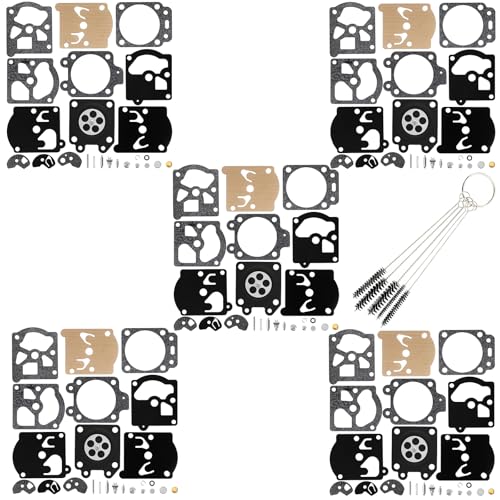 QAZAKY Pack of 5 Carburetor Rebuild Repair Kit Compatible with K10-WAT WA WT 2-Cycle Carb String Trimmer Leaf Blower Chainsaw Poulan Weedeater Ryobi Ryan IDC Homelite Lawnboy Toro McCulloch Craftsman