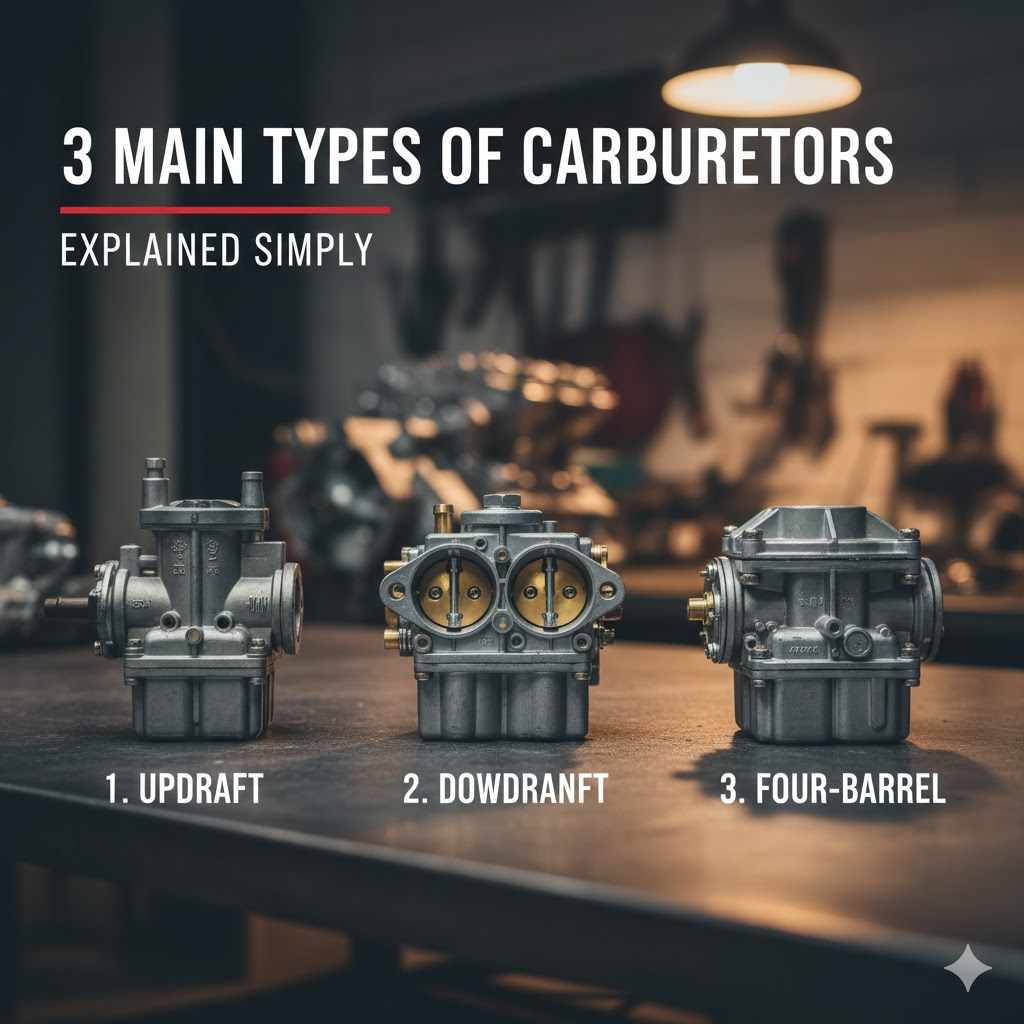
3 Main Types of Carburetors: Downdraft, Updraft, Sidedraft
A carburetor mixes air and fuel using the Venturi effect, and the 3 main types, downdraft, updraft, and sidedraft, differ in which direction air flows through them and where they fit on the engine. Picking the wrong type for a build means poor throttle response or a carburetor that will not physically fit under the hood. This guide covers how each type works, where each is commonly used, and basic maintenance.
Understanding Carburetor Basics
Best Carburetor Rebuild Kit Pick
Holley Renew Kit – $62.24
Holley is one of the most common downdraft carburetor brands this guide covers, and a rebuild kit is the standard fix for tuning issues.
- Best for: Restoring a worn float bowl and gaskets this guide discusses
- Why we picked it: Holley is the most common downdraft carburetor brand on classic V8s
- Main drawback: Requires disassembly and careful reassembly, not a quick fix
Compare more carburetor maintenance products
 Option 1 Gumout Carb Cleaner – $23.28
|
 Option 2 Valvoline Cleaner – $12.44
|
 Option 3 Edelbrock Rebuild Kit – $21.80
|
As an Amazon Associate we earn from qualifying purchases.
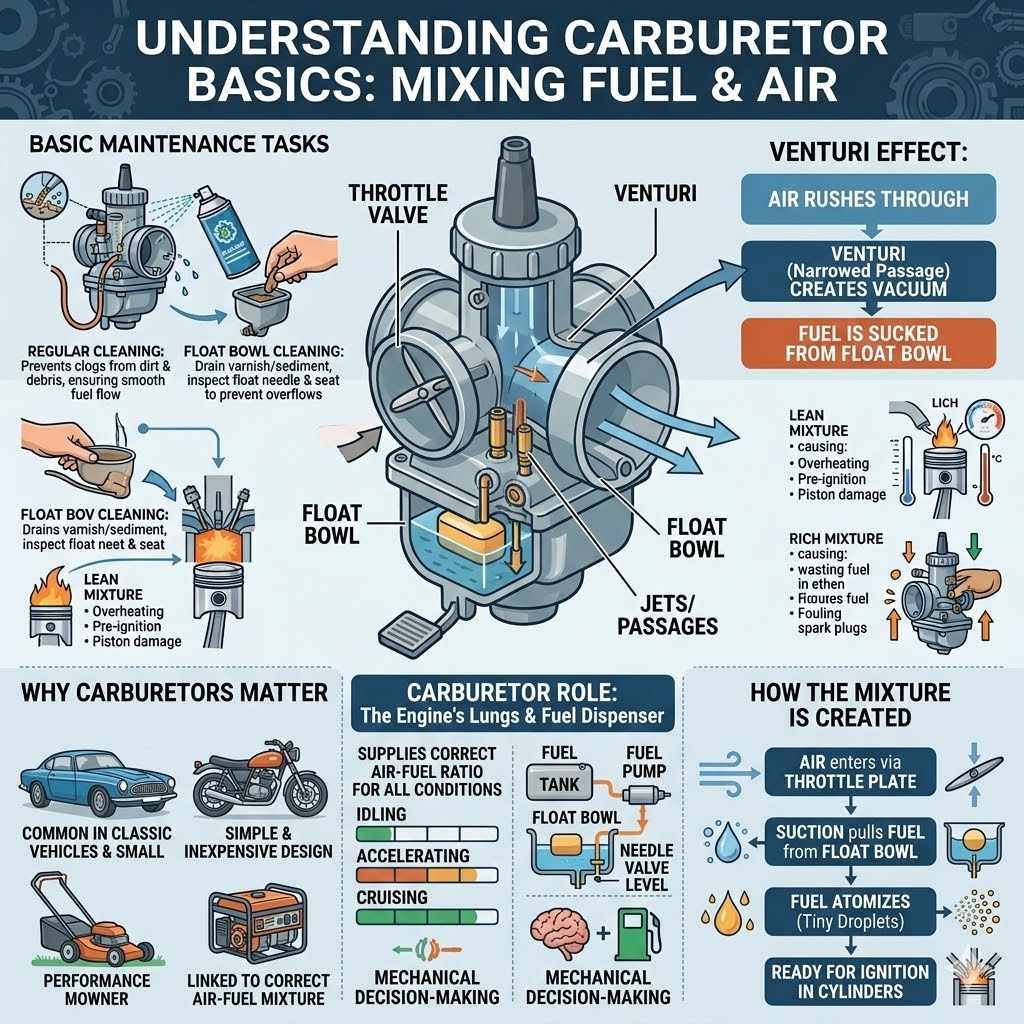
A carburetor is a vital component in many older gasoline engines. Its main job is to mix air and fuel in the right amounts for combustion. Think of it like the engine’s lungs and a tiny fuel dispenser all in one.
Without a properly working carburetor, your engine won’t run efficiently, or it might not run at all. This section will cover what a carburetor is, why it’s important, and how it generally functions before we look at the specific types.
What Is a Carburetor
At its core, a carburetor is a mechanical device. It uses a simple principle called the Venturi effect. As air rushes through a narrowed passage in the carburetor, its speed increases, and its pressure drops.
This lower pressure sucks fuel from a small reservoir, called a float bowl, into the air stream. The fuel then mixes with the air, creating a combustible vapor that is sent to the engine’s cylinders. The precise mixture is crucial for smooth engine operation and good fuel economy.
The main goal of any carburetor is to provide the engine with the correct air-fuel ratio under various operating conditions. This ratio changes depending on whether the engine is idling, accelerating, or cruising. Different types of carburetors are designed to manage these changes in different ways, some more effectively than others.
Understanding this fundamental role sets the stage for appreciating the variations among them.
Why Carburetors Matter
Carburetors were the standard fuel delivery system for gasoline engines for many decades. While modern cars use fuel injection, carburetors are still found in many classic vehicles, motorcycles, lawnmowers, and other small engines. They are relatively simple and less expensive to manufacture than fuel injection systems.
For mechanics and hobbyists working on these engines, knowing how carburetors function is essential for maintenance and repair.
The performance of an engine is directly linked to the carburetor’s ability to deliver the correct air-fuel mixture. If the mixture is too rich (too much fuel) or too lean (too much air), the engine can run poorly, stall, overheat, or even suffer damage. This is why proper adjustment and maintenance of a carburetor are so important for the longevity and efficiency of the engine it serves.
How Carburetors Work Together
The process begins with the fuel pump sending gasoline to the carburetor’s float bowl. A float inside the bowl rises and falls with the fuel level, controlling a needle valve. This valve opens and closes to maintain a constant fuel level in the bowl, ensuring a steady supply.
When the engine needs fuel, the throttle plate, controlled by the accelerator pedal or lever, opens. This allows more air to enter the carburetor. As air rushes through the Venturi, it creates suction.
This suction pulls fuel from the float bowl through small jets and passages. The fuel atomizes, meaning it breaks into tiny droplets, mixing with the incoming air. This air-fuel mixture then travels into the engine’s intake manifold and cylinders, ready to be ignited.
The amount of air entering the carburetor is controlled by the throttle valve. The amount of fuel entering is controlled by various jets and circuits within the carburetor. Achieving the ideal air-fuel ratio is a balancing act managed by the carburetor’s design.
Exploring the 3 Main Types of Carburetors Explained Simply
Now that we know what a carburetor does, let’s look at the main types. Understanding these differences will help you identify them and know their basic operation. We will cover the most common designs: downdraft, updraft, and sidedraft carburetors.
Each has a unique way of getting the air and fuel to mix and enter the engine, making them suitable for different applications and engine designs.
Downdraft Carburetors
Downdraft carburetors are very common in many cars and trucks. Their name comes from the direction the air-fuel mixture flows. In a downdraft carburetor, air enters from the top and flows downwards into the engine.
This design is straightforward and works well with engines that have a vertical intake manifold. The mixture naturally falls into the manifold due to gravity, which can help with a smoother entry into the cylinders.
This type is often chosen for its simplicity and cost-effectiveness. They are generally easy to tune and maintain, making them a popular choice for mass-produced vehicles. Many classic American V8 engines, for instance, used downdraft carburetors, often in multi-carburetor setups for added performance.
The design allows for a relatively compact package on top of the engine.
How Downdraft Carburetors Work
Air enters the carburetor through an air cleaner, usually located on top. It then passes through the Venturi, where fuel is drawn from the float bowl through various jets. The throttle plate is located at the bottom of the carburetor, controlling the flow of the air-fuel mixture into the intake manifold below.
As the throttle opens, more air is drawn in, increasing the suction and pulling more fuel.
The float bowl maintains a consistent fuel level. Idle circuits provide a rich mixture for low-speed operation, while main jets and power circuits deliver fuel for higher speeds and loads. Accelerator pumps add a squirt of fuel when the throttle is suddenly opened to prevent a lean stumble.
Advantages of Downdraft Carburetors
- Simplicity and CostDowndraft carburetors are generally simpler in design compared to some other types. This simplicity often translates into lower manufacturing costs and makes them easier for home mechanics to work on and repair. Fewer complex parts mean fewer potential points of failure.
- Gravity AssistanceThe downward flow of the air-fuel mixture benefits from gravity. This can help ensure that the fuel remains well-mixed with the air as it travels into the intake manifold, potentially leading to more consistent combustion and a smoother engine idle.
- Wide Availability and SupportDue to their widespread use in popular vehicles, parts for downdraft carburetors are usually easy to find. There is also a wealth of information and technical support available for these common designs, making troubleshooting and rebuilding a more accessible task for enthusiasts.
Real-Life Example: Ford Mustang Carburetors
Many classic Ford Mustang models, especially those from the 1960s and 1970s, commonly featured downdraft carburetors, such as the Autolite or Motorcraft 2100 and 4100 models. These were often 2-barrel or 4-barrel carburetors. They were chosen for their ability to provide adequate fuel delivery for the V8 engines of the time, offering a good balance of performance and drivability for everyday use.
The sheer volume of these cars on the road means that many mechanics and hobbyists have extensive experience with these specific downdraft carburetor systems.
Updraft Carburetors
Updraft carburetors are less common in modern automotive applications but were historically significant, especially in early automotive and motorcycle designs. In an updraft carburetor, air enters from the bottom and flows upwards through the Venturi before reaching the engine. The fuel mixture is drawn upwards against gravity.
This design often required careful calibration to ensure fuel was drawn effectively into the air stream.
These carburetors were often used when an engine had an intake manifold positioned below the carburetor. This was sometimes done to simplify engine packaging or to achieve a lower center of gravity for the engine. While effective, they could be more sensitive to engine vibration and altitude changes.
How Updraft Carburetors Work
Air enters the carburetor from the bottom and passes through a Venturi. As the air speed increases, the pressure drops, drawing fuel from the float bowl. The fuel then mixes with the air and is carried upwards into the intake manifold.
The throttle plate is typically located at the top of the carburetor, controlling the overall flow.
Due to the upward flow of fuel, some updraft carburetors featured designs to help prevent fuel from flooding the engine during startup or when the engine was shut off. They often relied on precise jetting and sometimes a small fan or air bleed to ensure proper atomization and delivery against gravity.
Challenges with Updraft Carburetors
- Gravity’s InfluenceThe biggest challenge for updraft carburetors is working against gravity. Fuel needs to be lifted upwards, which can make it harder to draw the correct mixture, especially at lower engine speeds or when the engine is cold. This can sometimes lead to leaner mixtures if not perfectly calibrated.
- Sensitivity to VibrationThe upward flow of fuel could make these carburetors more sensitive to engine vibration. Excessive shaking could disrupt the fuel level in the float bowl or affect the fuel flow, leading to inconsistent performance or stalling.
- Less Common in Modern VehiclesUpdraft carburetors are rarely found in cars made in the last 50 years. This means that finding replacement parts, expert repair services, or detailed information can be more difficult compared to downdraft or sidedraft designs.
Sample Scenario: Early Motorcycle Carburetion
Imagine an early 1920s motorcycle. The engine is mounted quite low, and the intake manifold points upwards towards the cylinder. An updraft carburetor is mounted beneath the engine.
When the rider kicks the engine to life, air is drawn upwards through the carburetor. This suction pulls fuel from the float bowl, and the air-fuel mixture then travels up the manifold to be burned. The rider might have to manually operate a choke to help draw a richer mixture when the engine is cold, as the updraft system struggles more in those conditions.
Sidedraft Carburetors
Sidedraft carburetors are prevalent in performance-oriented vehicles, particularly European sports cars and motorcycles. In this design, air enters the carburetor from the side and flows horizontally into the engine’s intake manifold. This setup is ideal for engines with intake manifolds that run along the side of the cylinder head.
Sidedraft carburetors are known for their responsiveness and ability to deliver precise fuel mixtures.
A key feature of many sidedraft carburetors is their use of a “constant velocity” or “CV” slide. This slide is controlled by engine vacuum and adjusts the airflow dynamically, ensuring a smooth and consistent air-fuel ratio across a wide range of engine speeds. This precise control is what makes them favored for performance applications.
How Sidedraft Carburetors Work
Air enters the carburetor from the side, passing through the Venturi. Fuel is drawn from the float bowl. In CV sidedraft carburetors, a diaphragm is connected to engine vacuum.
When vacuum increases, the diaphragm lifts a slide, which opens a barrel, allowing more air to pass. This system aims to keep the air velocity through the Venturi constant, which helps maintain a stable air-fuel ratio.
In some performance sidedraft carburetors, especially those with multiple barrels or for racing, mechanical linkage controls the throttle plates. These offer quicker response but require more careful tuning. The fuel delivery is managed by carefully selected jets and circuits that match the engine’s requirements.
Benefits of Sidedraft Carburetors
- Performance and ResponsivenessSidedraft carburetors, especially CV types, excel at providing a smooth and consistent air-fuel mixture. This leads to excellent throttle response, making the engine feel more alive and eager to accelerate. They are highly favored for their ability to provide crisp performance.
- Adaptability for Multi-Cylinder EnginesTheir horizontal design makes them well-suited for mounting on engines with multiple cylinders. It’s common to see two or even three sidedraft carburetors mounted side-by-side on the intake manifold of a four or six-cylinder engine, with each carburetor serving a pair of cylinders.
- Tuning PotentialWhile they can be more complex to tune than simple downdraft carburetors, sidedraft carburetors offer significant tuning potential. Enthusiasts can fine-tune them for specific engine modifications or driving conditions, optimizing power output and fuel efficiency.
Real-Life Example: Weber Carburetors on Sports Cars
The legendary Weber DCOE sidedraft carburetors are iconic in the world of performance cars. Brands like Ferrari, Alfa Romeo, Lotus, and many others have used them extensively on their sporty engines. For example, a classic Alfa Romeo Twin Cam engine often came equipped with two Weber 40 DCOE sidedraft carburetors.
This setup provided the sharp throttle response and high-RPM power delivery characteristic of these Italian sports cars, allowing them to perform exceptionally well on winding roads and race tracks.
Comparing Carburetor Types
To make things even clearer, let’s quickly compare the three main types of carburetors. Each has its place and purpose. Understanding these differences helps in identifying what you might be working with or what’s best suited for a particular engine setup.
We’ll look at flow direction, common uses, and general complexity.
Carburetor Flow Comparison
The most obvious difference is the direction the air-fuel mixture travels. Downdraft flows down, updraft flows up, and sidedraft flows horizontally. This flow direction is dictated by the engine’s intake manifold design and how the carburetor is mounted.
- Downdraft: Air enters from the top, mixture flows down.Gravity helps move the mixture. It’s often mounted on top of the engine’s intake manifold.
- Updraft: Air enters from the bottom, mixture flows up.Works against gravity. Historically used when intake manifolds were below the carburetor.
- Sidedraft: Air enters from the side, mixture flows horizontally.Ideal for side-mounted intake manifolds, common on inline engines and performance applications.
Common Applications and Complexity
Each type has found its niche. Downdraft carburetors are the workhorses for many general automotive applications due to their balance of simplicity and effectiveness. Updrafts are mostly historical, found in very early vehicles or specific industrial engines.
Sidedrafts are typically associated with performance and higher-end applications where precise control is paramount.
| Carburetor Type | Flow Direction | Common Applications | General Complexity |
|---|---|---|---|
| Downdraft | Top to Bottom | Cars Trucks SUVs (older models) | Moderate |
| Updraft | Bottom to Top | Early Automobiles Motorcycles | Moderate to High (due to gravity challenges) |
| Sidedraft | Side to Side | Sports Cars Motorcycles Performance Engines | High (especially CV types) |
As you can see from the table, the complexity can vary. Sidedraft carburetors, particularly those with constant velocity slides, involve more moving parts and vacuum-operated systems, making them more intricate. Downdraft carburetors tend to be more mechanically straightforward.
Updrafts can be complex due to the need to overcome gravity effectively.
Example Scenarios and Performance
Consider a classic pickup truck. It likely uses a downdraft carburetor mounted on top of its V8 engine. This setup is robust and provides enough fuel for hauling and general driving.
Now think of a sporty motorcycle like a Yamaha R6. It would use multiple sidedraft carburetors, likely CV types, mounted to the side of the engine. This allows for quick throttle response and smooth power delivery needed for spirited riding.
An example of an updraft might be found on a very old tractor where the engine block design dictated an intake below the carburetor. While functional, it might not offer the same responsiveness as other types. The choice of carburetor type is always a balance between engine design, intended use, and manufacturing constraints.
Carburetor Maintenance and Tuning
Regardless of the type, carburetors require periodic maintenance and tuning to perform their best. This section will touch on common maintenance tasks and the importance of proper adjustments for optimal engine performance. Keeping your carburetor in good shape ensures your engine runs smoothly and efficiently.
Basic Maintenance Tasks
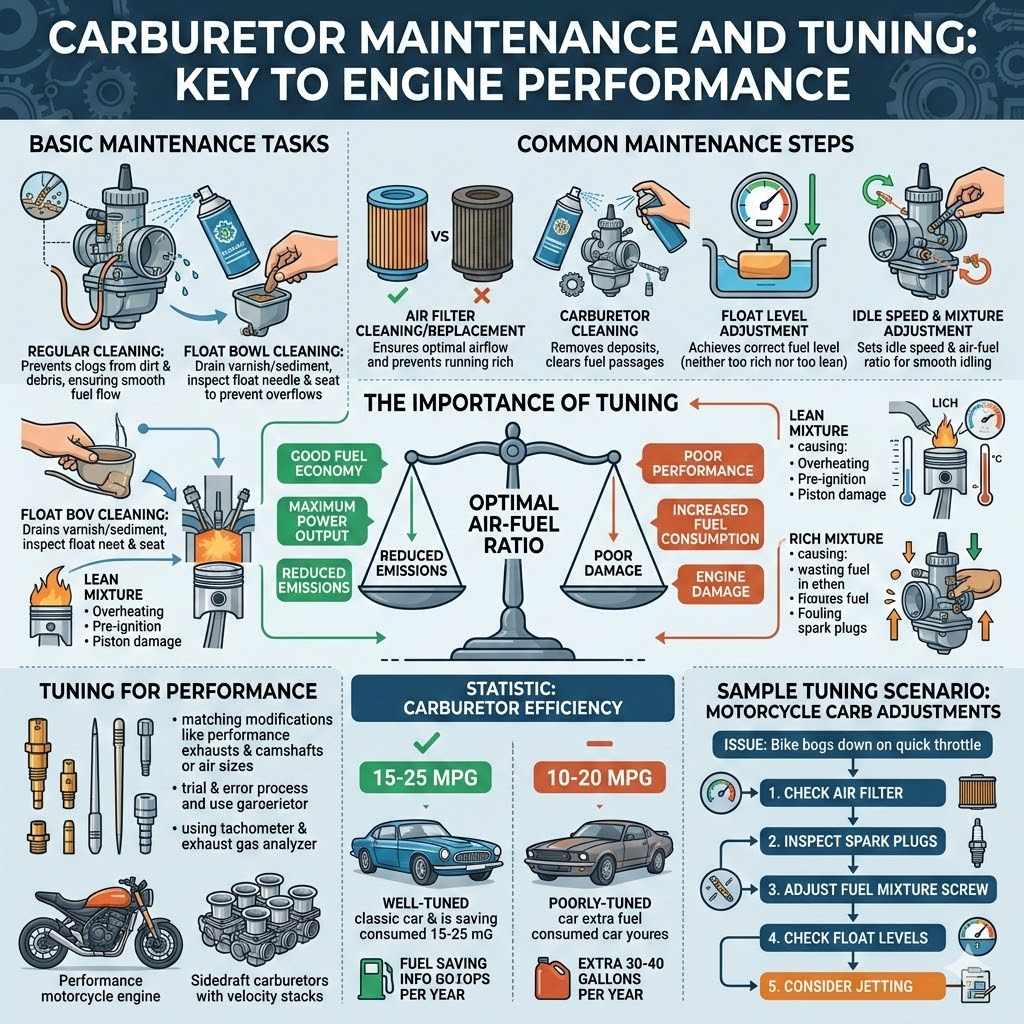
Regular cleaning is key. Over time, dirt and debris can clog the small jets and passages inside a carburetor, disrupting fuel flow. This can lead to rough idling, poor acceleration, or the engine stalling.
The float bowl can also accumulate varnish or sediment. Periodic draining and cleaning of the float bowl can prevent fuel delivery issues. Inspecting the float needle and seat for wear is also important, as a worn seat can cause fuel to overflow.
Common Maintenance Steps
- Air Filter Cleaning/ReplacementThe air filter protects the carburetor from dust and debris. A clogged air filter restricts airflow, causing the engine to run rich and lose power. Always ensure your air filter is clean and in good condition.
- Carburetor CleaningUsing a specialized carburetor cleaner spray or a full disassembly and cleaning with carb cleaner fluid can remove stubborn deposits. Ensure all fuel passages are clear by using compressed air or a fine wire.
- Float Level AdjustmentThe fuel level in the float bowl is critical. If it’s too high, the mixture will be too rich. If it’s too low, the mixture will be too lean.
Adjusting the float level ensures the correct amount of fuel is available.
- Idle Speed and Mixture AdjustmentMost carburetors have adjustment screws for idle speed and air-fuel mixture. Properly setting these is crucial for smooth idling and efficient engine operation at low RPMs.
The Importance of Tuning
Tuning a carburetor involves adjusting various components to achieve the optimal air-fuel ratio for your specific engine and operating conditions. This isn’t just about making the engine run; it’s about making it run well.
A correctly tuned carburetor ensures good fuel economy, maximum power output, and reduces emissions. Incorrect tuning can lead to a variety of problems, from poor performance and increased fuel consumption to engine damage. For example, a lean mixture can cause an engine to run hot, potentially leading to pre-ignition and piston damage.
A rich mixture wastes fuel and can foul spark plugs, leading to misfires.
Tuning for Performance
For those looking to maximize performance, carburetor tuning becomes even more critical. Enthusiasts often change jet sizes, needle profiles, and air bleeds to match modifications like performance exhaust systems, upgraded camshafts, or higher compression pistons.
This process often involves trial and error, using a tachometer and exhaust gas analyzer (if available) to fine-tune the mixture for peak power. For sidedraft carburetors, adjusting the velocity stacks or air filters can also impact performance.
Statistic: Carburetor Efficiency
While precise figures vary greatly based on engine design and specific carburetor model, a well-tuned carburetor in a classic vehicle can offer fuel efficiency in the range of 15-25 miles per gallon. In contrast, a poorly tuned or worn carburetor might reduce this by 5-10 MPG, leading to significant wasted fuel over time. For example, a vehicle rated at 20 MPG could consume an extra 30-40 gallons of fuel per year if its carburetor is not performing optimally.
Sample Tuning Scenario: Motorcycle Carb Adjustments
A motorcycle rider notices their bike is bogging down when they open the throttle quickly. They suspect a lean condition.
- Check air filter: Ensure it’s clean and not restricting airflow.
- Inspect spark plugs: Look for signs of a lean burn (white or grayish deposits).
- Adjust fuel mixture screw: Gently turn the idle mixture screw in or out while the engine is idling to find the highest idle speed or smoothest idle.
- Check float levels: If adjustments don’t help, the float levels might be incorrect.
- Consider jetting: If the problem persists, the main jets might be too small, requiring
Frequently Asked Questions
Question: What is the main difference between downdraft and sidedraft carburetors
Answer: The main difference is the direction of air-fuel mixture flow. Downdraft carburetors direct the mixture downwards from the top, while sidedraft carburetors direct it horizontally from the side.
Question: Are updraft carburetors still used today
Answer: Updraft carburetors are rarely found in modern cars. They were more common in early automotive and motorcycle designs and are now mostly seen in vintage vehicles or some small industrial engines.
Question: How do I know which type of carburetor my vehicle has
Answer: You can usually tell by looking at how the carburetor is mounted on the engine and the direction the intake manifold connects. Downdraft is on top, sidedraft is on the side, and updraft is typically below.
Question: Can I convert my car from fuel injection to a carburetor
Answer: Yes, it is possible, but it often requires significant modifications to the engine’s intake system and electrical components. It’s a complex project typically undertaken by experienced mechanics or enthusiasts.
Question: What are the signs of a carburetor problem
Answer: Common signs include rough idling, difficulty starting, poor acceleration, engine stalling, increased fuel consumption, or black smoke coming from the exhaust. If cleaning does not fix it, see our 13-step carburetor replacement guide.
Summary
We explored the 3 main types of carburetors explained simply: downdraft, updraft, and sidedraft. Each type offers a unique approach to mixing fuel and air for your engine. Understanding their basic functions and applications helps in appreciating how engines work.
With this knowledge, you can better identify, maintain, and tune these essential components for optimal performance.