Why Does My Car Make a Noise When Turning?
If your car makes noise only when the steering wheel is turned, the key clue is when it happens: parked or low-speed turning points to power steering, EPS, or suspension; noise only at full lock often points to a worn CV joint or steering stop. Ignoring it can turn a small fault into loss of steering assist, tire wear, or a damaged axle. This guide breaks down parked-turn, moving-turn, and full-lock noises so you can narrow the likely cause fast.
What the noise means
Start with three questions: does the noise happen while parked, only while moving, or only at full lock? Then match the sound itself. A whining or groaning noise points first to hydraulic assist issues. Clicking, clunking, or popping points more toward joints and linkages. Grinding needs faster attention. These patterns line up with common steering and suspension failure modes described in service guidance from manufacturers and safety organizations, including NHTSA warnings that steering and suspension faults can affect control and stopping distance.
Sound type first
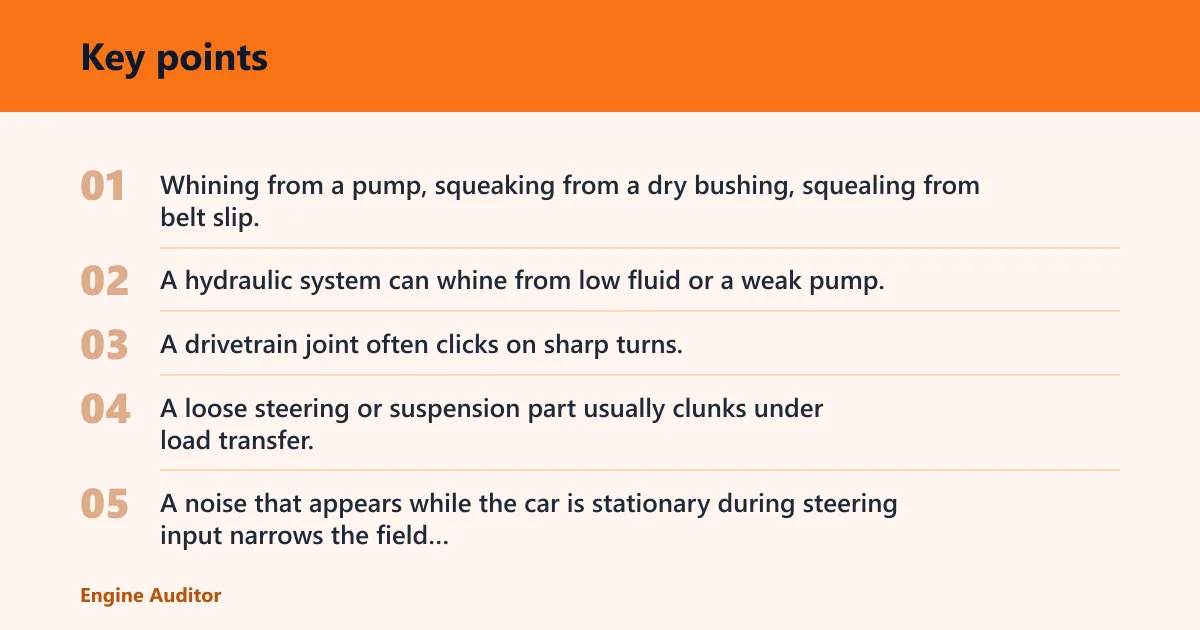
Whining from a pump, squeaking from a dry bushing, squealing from belt slip, clunking from loose steering parts, clicking from a CV joint, popping from a worn ball joint, grinding from a bearing or rack fault, rubbing from tire contact, and groaning from loaded hydraulics do not point to the same part. A hydraulic system can whine from low fluid or a weak pump. A drivetrain joint often clicks on sharp turns. A loose steering or suspension part usually clunks under load transfer.
Parked or moving
A noise that appears while the car is stationary during steering input narrows the field fast. That pattern often points to hydraulic steering load, a steering rack or gearbox issue, or wear in tie rod ends, strut bearings, or bushings. A noise that appears only while moving shifts attention to CV joints, wheel bearings, brake drag, or tire contact.
Full lock or partial turn
A sound that appears only near full lock often points to a CV joint, steering stop contact, or a part that binds at maximum angle. A sound that begins with any steering input is more consistent with pump effort, low fluid, belt slip, or looseness in the steering linkage. Do not assume the sound alone proves one part.
Why does it happen while parked?
When the noise happens while parked, steering effort is the load test. Hydraulic assist systems can whine or groan at idle if fluid is low, aerated, contaminated, or if the pump is worn. EPS systems change the diagnosis because many 2010-and-newer vehicles are commonly equipped with EPS, and vehicles with EPS do not use power steering fluid. Industry service data and repair references commonly show EPS adoption rising sharply across the 2010s, with many late-model passenger vehicles using electric assist rather than hydraulic pumps.
Hydraulic steering load at idle
On hydraulic systems, turning the wheel while parked puts heavy demand on the pump. That is why a turning noise while parked is often caused by low power steering fluid, air in the system, or a weak pump. If the sound grows as you hold the wheel against resistance, the pump, fluid level, or belt drive becomes more suspicious. Low or aerated fluid can whine because the pump is moving compressible air bubbles instead of a solid fluid column, which creates cavitation and noisy, inconsistent pressure.
Electric power steering clues
Most vehicles from 2010 onward use Electric Power Steering, and vehicles with EPS do not have power steering fluid. If there is no reservoir, a fluid check will not explain the noise. That shifts suspicion toward the steering motor, rack assembly, or a front-end joint or bushing that loads up during steering. On many EPS systems, the assist motor is integrated with the column or rack, so noise may track with electrical assist engagement rather than hydraulic pressure.
Tie rod, ball joint, and bushing checks
Clunking while stationary and turning the wheel can point to a tie rod end, steering rack inner joint, or strut bearing plate. Dry control arm bushings can also creak or squeak because they sit in the suspension load path. These parts may sound worse when the wheel is turned side to side at low speed or at rest. Steering and suspension wear is safety-critical because looseness can reduce directional stability and increase the chance of rapid handling changes.
Picture a sedan that makes a short groan every time the wheel is turned in a parking space, but only when cold. That pattern fits hydraulic effort much better than a wheel-speed problem. Now suppose the same car also has a dry, sharp clunk over the first inch of steering travel. That extra clue raises the odds of a worn linkage joint.
Why is it louder while driving?
Noise that shows up only while moving is usually load plus rotation, not steering effort alone. That is where CV axles, wheel bearings, tire contact, and brake drag enter the picture. The turn shifts weight to one side, changes axle angle, and changes how the wheel bearing carries load. That can make a fault much louder. Wheel-bearing diagnostics often depend on load shift: the sound can increase when the car’s weight transfers to the bad side during a turn, which is why left-right comparison is so useful.
CV axle clicking on turns
Clicking during sharp turns at low speed points to a CV joint or CV axle. The outer CV joint is commonly implicated because it works hardest at a sharp steering angle. A torn boot can let grease escape and dirt enter, which speeds wear. The click often comes in a steady rhythm as the wheel rotates, and that repeated cadence is one of the most useful clues for separating CV joint noise from a one-time clunk. A sharp-turn clicking pattern is especially suspect when it repeats on the same direction of turn.
Wheel bearing noise under load shift
A wheel bearing can create humming or grinding, and the sound may change with turn direction because weight shifts onto one side of the car. That is one reason wheel bearing noise gets confused with tire noise. Grinding only when turning with no brake input is more likely a wheel bearing or CV joint. If the noise gets louder when the vehicle loads the outside wheel in a sweeping turn, that load-shift pattern strongly supports a bearing diagnosis.
Brake drag and tire contact clues
Do not mix turn-input noise with brake drag. If the noise appears when turning and braking together, treat that as a brake problem first. If the tire rubs a liner, splash shield, or fender edge at full lock, the sound may be more of a scrape than a steering fault. That clue changes the diagnosis path. A bent dust shield can mimic a bearing or steering noise because it contacts the rotor only when the wheel angle or suspension position changes.
How to tell if it’s CV joint, wheel bearing, or power steering
Use the rhythm, speed dependence, and steering feel together instead of chasing one clue in isolation. CV joints usually click in a regular pattern during tight turns. Wheel bearings usually hum, growl, or grind and change with load shift rather than steering angle alone. Power steering problems usually whine, groan, or squeal and are most obvious while parked or at low speed under high steering effort.
| Noise clue | CV joint | Wheel bearing | Power steering |
|---|---|---|---|
| Noise rhythm | Steady click or pop that repeats with wheel rotation | Low growl, hum, or grind that builds with load | Whine, groan, or squeal that rises with steering effort |
| Speed dependence | Usually strongest at low speed and tight angle | Often increases with road speed and wheel load | Most noticeable at idle or low speed, especially while parked |
| Parked vs moving | Usually moving only | Usually moving only | Often parked, but can also show up at low speed |
| Left-vs-right effect | May worsen on the side with the worn outer joint during the tighter turn | Often changes when turning one direction and loading the bad side | Usually less dependent on turn direction than on steering effort |
| Brake involvement | Usually no direct brake link | Usually no direct brake link | Usually no direct brake link, unless belt or accessory load is involved |
| Steering feel | Often normal steering feel unless the joint is badly worn | Usually steering still feels normal early on | May feel heavy, notchy, or inconsistent if assist is failing |
What the sound pattern points
Sound pattern matters because each noise family maps to a different failure set. Whining and groaning lean toward hydraulic assist or internal rack friction. Clicking and popping lean toward joints. Clunking suggests looseness. Grinding needs prompt attention because it can signal rack damage, contaminated fluid, or bearing wear.
Whining or groaning
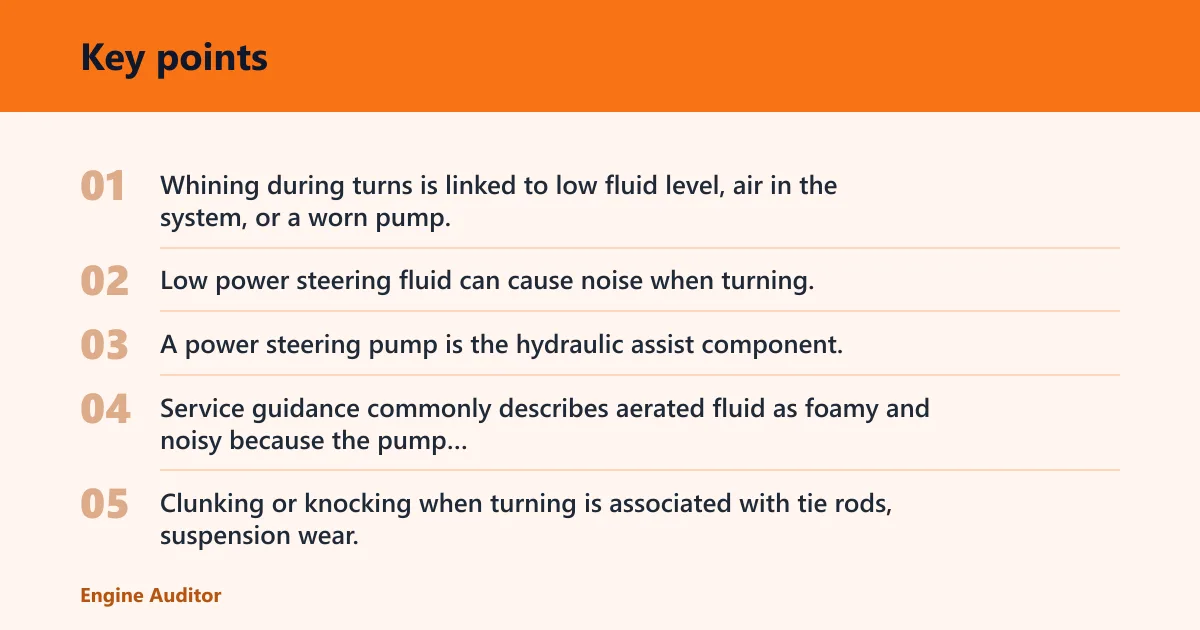
Whining during turns is linked to low fluid level, air in the system, or a worn pump. Low power steering fluid can cause noise when turning, and the fluid may be contaminated or aerated. A power steering pump is the hydraulic assist component, and pump wear usually makes the noise worse as steering effort rises. Service guidance commonly describes aerated fluid as foamy and noisy because the pump cannot maintain smooth pressure flow.
Clicking, popping, or clunking
Clunking or knocking when turning is associated with tie rods, suspension wear, or loose parts. Clicking or popping under steering load transfer can point to a ball joint, and that wear item deserves high urgency because it is safety-critical. A tie rod end can clunk even while stationary during steering input. Ball-joint or tie-rod looseness can also create a repeated knock over bumps if the joint shifts under suspension travel.
Grinding, rubbing, squealing, or squeaking
Grinding or rubbing noises can indicate rack damage, contaminated fluid, or bearing wear. Squealing during turn initiation can come from belt slip, especially on vehicles where the serpentine belt drives the hydraulic pump. Dry or worn control arm bushings can squeak or creak because of friction as the suspension loads and unloads. Belt-driven steering systems often squeal briefly when the steering load spikes, which is why a belt squeal at the start of a turn is a useful clue.
Turn noise diagnostic matrix
| Sound type | Parked | Moving | Full lock | Braking | Bumps | Likely component | Urgency | First check |
|---|---|---|---|---|---|---|---|---|
| Whine | Yes | Sometimes | Often louder | No direct link | No direct link | EPS motor/rack or power steering pump/fluid | Medium to high | Confirm EPS vs hydraulic, then check fluid if equipped |
| Groan | Yes | Sometimes | Can worsen near stop | No direct link | No direct link | Power steering fluid, pump, or steering rack/gearbox | High if steering effort rises | Look for low, foamy, dark, or leaking fluid |
| Clicking | No | Yes | Yes, especially sharp turns | Usually no | Usually no | CV joint | Medium to high | Inspect outer CV boot for grease loss or tears |
| Clunking | Yes | Yes | Sometimes | Possible if loose parts shift | Yes | Tie rod end | High | Check for steering play and looseness at the wheel |
| Pop or knock | Yes | Yes | Sometimes | Possible | Yes | Ball joint | High | Look for joint play, torn boot, or uneven tire wear |
| Growl or grind | No | Yes | Sometimes changes with angle | Possible if brake shield is involved | Sometimes changes with load | Wheel bearing | High | Compare left and right turns for load-shift noise change |
| Rubbing or scrape | Possible | Yes | Often near full lock | Possible if shield flexes | Sometimes | Brake shield or tire rub | Medium | Check liner, shield, tire sidewall, and fender clearance |
| Creak or squeak | Yes | Yes | Sometimes | Usually no | Yes | Strut mount | Medium to high | Listen while slowly turning the wheel at rest and over small bumps |
How do you check it safely?
Use no-lift checks first. You can narrow the cause with fluid, belt, and steering-input checks in a driveway or parking space. Keep clear of moving belts and tires. If the car feels hard to steer, makes repeated clunks, or leaks fluid quickly, stop and arrange inspection instead of pushing farther.
Stop driving now
Severity: high.
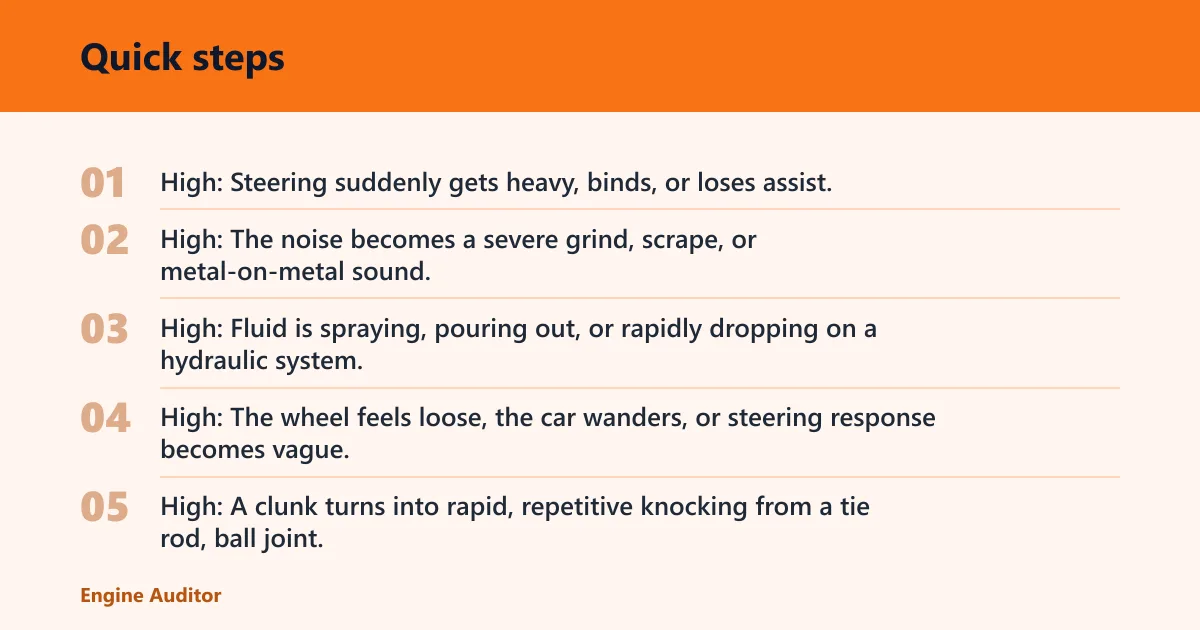
- High: Steering suddenly gets heavy, binds, or loses assist.
- High: The noise becomes a severe grind, scrape, or metal-on-metal sound.
- High: Fluid is spraying, pouring out, or rapidly dropping on a hydraulic system.
- High: The wheel feels loose, the car wanders, or steering response becomes vague.
- High: A clunk turns into rapid, repetitive knocking from a tie rod, ball joint, or rack area.
- High: Smoke, burning smell, or a hot-wheel smell appears with the noise.
Safe at-home checks
Severity: low to moderate.
- Low: Confirm whether the car has EPS or a hydraulic reservoir.
- Low: Check the fluid level and look for foam, dark fluid, or leaks if hydraulic assist is fitted.
- Low: Inspect the serpentine belt for slip damage, glazing, cracks, or slack.
- Low: Listen while parked, then repeat at low speed and at full lock.
- Moderate: Note whether the sound changes with left turns, right turns, braking, or bumps.
- Moderate: Check for tire rub and obvious suspension looseness without placing hands near moving parts.
Fluid reservoir and leak check
Open the hood and look for a power steering reservoir. If the car has EPS, there may be no reservoir at all. On hydraulic systems, check fluid level, color, and bubbles or foam. Look for wet hoses, pump seepage, rack boot wetness, and fluid under the car after parking.
Belt and pulley check
Inspect the serpentine belt for glazing, cracks, fraying, or slack. If the belt drives the hydraulic pump, slip can mimic steering noise during turn initiation. A belt that squeals only when the wheel is turned deserves attention, even if it looks serviceable from a distance.
Static steering test
With the engine running and the car stationary, turn the wheel slowly left and right. Note whether the sound appears near center, grows with effort, or gets louder near full lock. A pump or fluid issue usually follows steering load. A tie rod end or strut bearing may clunk even without vehicle motion.
Full-lock clue check
At low speed in an open area, ease toward full lock for only a moment. A click at sharp steering angle points more toward a CV joint. A groan that appears right at the end of travel may be normal steering stop contact, but a loud grind or heavy steering feel is not. Do not hold full lock for long.
- Confirm whether the car has EPS or a hydraulic reservoir.
- Check the fluid level and look for foam, dark fluid, or leaks.
- Inspect the serpentine belt for slip damage or slack.
- Listen while parked, then repeat at low speed and at full lock.
- Note whether the sound changes with left turns, right turns, braking, or bumps.
- Check for tire rub and obvious suspension looseness.
When should you stop driving?
Stop driving if the steering becomes hard, the noise turns into severe grinding, a clunk becomes sharp and repetitive, fluid is pouring out, or the wheel feels loose. Those are not “watch it” signs. They point to parts that can fail under load, including the steering system, axle, or suspension joints. Safety guidance from vehicle manufacturers and federal road-safety sources treats steering and suspension warning signs as urgent because they can affect control, lane keeping, and braking stability.
Stop-driving-now triggers
Do not keep driving if steering assist drops suddenly, the wheel binds, the car pulls hard after a turn, or the noise is accompanied by burning smell, smoke, or visible leak spray. Rapid fluid loss is an immediate problem on hydraulic systems. Severe clunking from a tie rod or ball joint is also a stop-now condition.
Still drivable for now
A light squeak from a dry bushing, a mild belt chirp on turn initiation, or a faint groan that has not changed can sometimes wait for prompt service. That said, the vehicle should be checked soon, especially if the sound is new or getting louder. Do not let a small symptom drift for weeks.
When to schedule inspection
Schedule inspection quickly if the noise is one-sided, repeats every turn, changes with speed or steering angle, or comes with hot wheel smell, steering effort changes, or tire wear. Those patterns help a technician separate steering, suspension, brake, and drivetrain causes without guesswork.
Frequently asked questions
Why does my car make a noise only when I turn the steering wheel?
That pattern means the noise is tied to steering load, steering angle, or both. Parked noise points toward hydraulic assist, EPS, or loose steering parts. Noise only while moving points more toward CV joints, wheel bearings, tire rub, or brake drag. The exact sound and timing decide the likely source.
Why does my steering wheel make noise when I turn it while parked?
Parked steering noise often comes from hydraulic power steering fluid issues or a weak pump because the system is under load without vehicle motion. On EPS vehicles, there is no fluid reservoir, so the cause shifts away from hydraulic noise and toward the steering motor, rack, or worn linkage parts.
What does a whining noise when turning the steering wheel mean?
Whining during turns is linked to low fluid level, air in the system, or a worn pump. If the sound grows as steering effort rises, that leans toward hydraulic assist trouble. If the car has EPS, do not chase fluid problems, because EPS vehicles do not have power steering fluid.
What does a clicking noise when turning mean?
Clicking during sharp turns at low speed points to a CV joint or CV axle. The outer joint is the usual suspect, especially if the boot is torn and grease has escaped. A steady click that repeats with wheel rotation is the classic clue. A single click can mean looseness instead.
What does a clunking noise when turning mean?
Clunking or knocking when turning is associated with tie rods, suspension wear, or loose parts. If it happens while stationary, a tie rod end, steering rack inner joint, or strut bearing plate becomes more likely. Because these are safety-critical parts, repeated clunking deserves prompt inspection.
Is it safe to drive if my car makes noise only when turning?
Sometimes, but only if the noise is mild and steering still feels normal. Do not keep driving if the sound is a grind, the steering is heavy, the car pulls, fluid is leaking, or the wheel feels loose. Those signs can point to failure in the steering, axle, or suspension system.
Products related to this article
Sponsored / affiliate links. As an Amazon Associate I earn from qualifying purchases. I may earn additional commission from eligible campaigns.