Engine Horsepower Calculator: Choose the Right Method
An engine horsepower calculator only works when you match the formula to the data you have: use displacement, RPM, and torque for engine-spec estimates, or weight, trap speed, and elapsed time for quarter-mile estimates. Bad inputs can produce neat-looking numbers that miss by hundreds. This guide shows you how to choose the right method, run the math, and sanity-check the result before you trust it.
How is this calculated?
Press Calculate to see the math with your numbers.
How horsepower is defined
Engine horsepower is engine power output, and it is often quoted as peak horsepower at a specific RPM. That peak matters because an engine does not make the same power at every speed, and a number taken at one operating point may not describe the full curve.
The historical link to James Watt matters only because it explains the unit. Horsepower was used to compare steam engines to draft horses, and the common engineering reference is 33,000 foot-pounds per minute. For modern use, the practical point is simpler: horsepower is a rate of doing work, not torque by itself.
Peak horsepower and peak torque often occur at different RPM values. That is normal. An engine can feel strong at low RPM from torque, then show its highest horsepower higher in the rev range where RPM rises enough to multiply the torque figure.
What horsepower measures
Horsepower tells you how fast an engine can do work over time. That is why power figures matter most for acceleration, sustained speed, and comparing one build to another at a known operating point. For vehicle tuning, always label whether the figure is crank horsepower or wheel horsepower.
Which horsepower method should you use?
Use the method that fits your inputs. If you have engine specs, use RPM and torque. If you have drag-strip results, use the quarter-mile method that matches the data you recorded. If you are planning a boosted build, treat the result as a spec-based estimate and sanity-check it against airflow, fuel, and drivetrain losses.
If you have engine specs
Use the RPM-and-torque formula when you know torque at a specific RPM. It is the cleanest route for engine data sheets, dyno curves, and build sheets that list torque and RPM together. Do not try to infer horsepower from displacement alone.
If you have quarter-mile results
Use elapsed time or trap speed, but keep the two methods separate. Elapsed time needs vehicle weight and ET. Trap speed needs vehicle weight and finish speed at the quarter-mile mark. Both are estimates, not dyno readings.
If you have boosted-build targets
Use boost only as one input to a spec-based estimate. Boost changes airflow potential, but the final number depends on volumetric efficiency, fuel, timing, intercooling, and the drivetrain. A pressure target by itself does not equal horsepower.
How do you calculate engine horsepower?
The cleanest engine-spec calculation is horsepower = (RPM × torque) / 5,252. Torque is usually in pound-feet, and the formula needs the torque value at the RPM where you want to estimate power. This is the standard engine-power path when you have measured or published torque data.
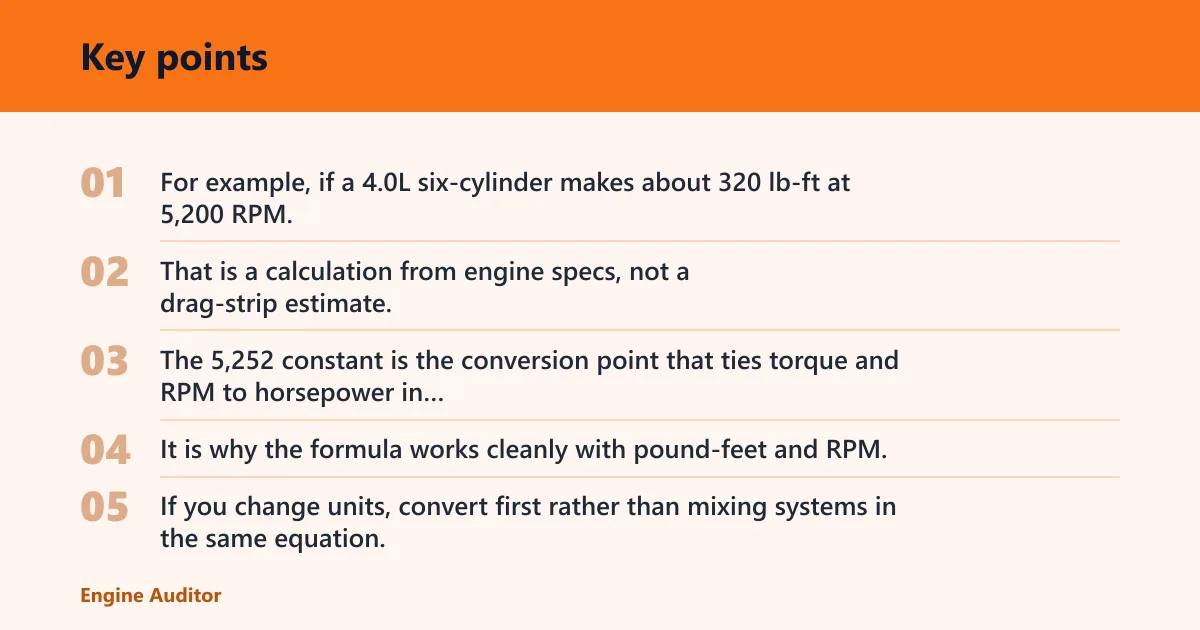
For example, if a 4.0L six-cylinder makes about 320 lb-ft at 5,200 RPM, the estimate is (5,200 × 320) / 5,252, or about 317 HP. That is a calculation from engine specs, not a drag-strip estimate.
The 5,252 constant
The 5,252 constant is the conversion point that ties torque and RPM to horsepower in imperial units. It is why the formula works cleanly with pound-feet and RPM. If you change units, convert first rather than mixing systems in the same equation.
Units you need to keep straight
Use RPM and pound-feet together for this formula. If torque is listed in newton-meters, convert it before calculating. If the data sheet lists wheel torque instead of engine torque, the result is not crank horsepower unless you also account for drivetrain losses.
Why peak torque and peak horsepower differ
Peak torque is the highest twisting force at one RPM point. Peak horsepower is usually higher in the rev range because RPM multiplies torque. A motor can peak torque early and peak horsepower later, which is why both numbers matter on a build sheet.
How do you estimate horsepower from quarter-mile elapsed time?
The quarter-mile elapsed-time method estimates power from vehicle weight and ET over a quarter mile, about 402 meters. The common formula uses a 5.825 divisor constant. It gives an estimate only, so treat it as a rough power check rather than a dyno-equivalent figure.
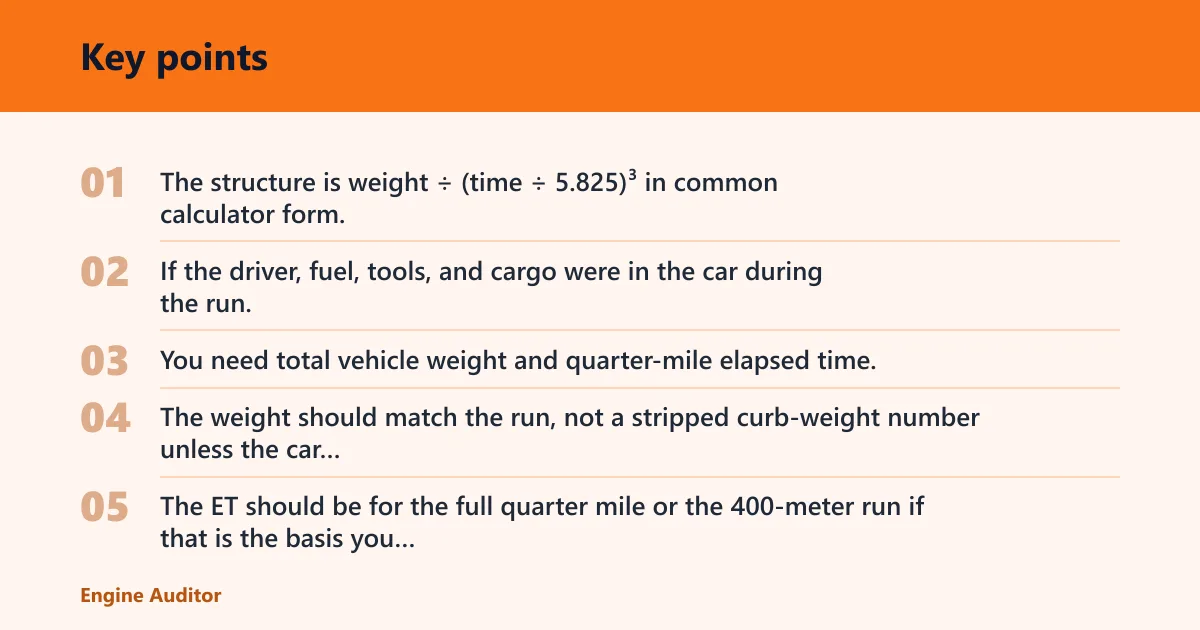
The structure is weight ÷ (time ÷ 5.825)³ in common calculator form. Keep the vehicle weight honest. If the driver, fuel, tools, and cargo were in the car during the run, the weight input should reflect that run condition, not a brochure number.
Required inputs: weight and ET
You need total vehicle weight and quarter-mile elapsed time. The weight should match the run, not a stripped curb-weight number unless the car actually ran that light. The ET should be for the full quarter mile or the 400-meter run if that is the basis you are using.
The 5.825 formula constant
The 5.825 divisor is the fixed constant used in this estimate path. It is the reason calculators can turn weight and ET into a power estimate quickly. It does not make the result exact, and it cannot correct for traction issues, gearing, or launch technique.
Common ET input errors
A common first-timer mistake is using curb weight without the driver. Another is using a shortened run, a partial pass, or a number from a different vehicle configuration. If the car spun hard on the launch, ET may look weaker than the engine really is because traction hurt the run.
How do you estimate horsepower from quarter-mile trap speed?
The trap-speed method estimates horsepower from vehicle weight and finish speed at the quarter-mile mark. Use the trap speed, not average speed or an interpolated terminal speed. The common formula uses a 234 divisor constant, and the result is still an estimate rather than an exact dyno match.
The common calculator form is weight × (speed ÷ 234)³. This method often gives a useful power check because trap speed is less sensitive than ET to launch quality. It still depends on correct weight and on the right speed reading.
Required inputs: weight and trap speed
Use the car’s weight at the time of the run and the finish speed recorded at the quarter-mile point. Do not substitute a rolling road speed, a half-mile number, or an average speed across the pass. The math only fits quarter-mile trap speed.
The 234 formula constant
The 234 divisor constant is the common factor in this estimate path. It converts the speed and weight combination into an estimated horsepower value. Like the ET method, it gives a useful approximation, not a direct dyno reading.
Why trap speed beats average speed
Trap speed reflects how fast the car is moving at the end of the quarter mile. Average speed does not. If you use average speed, the result will usually be too low and may hide a strong top-end pull.
Horsepower method decision table
This table helps you pick the correct estimation path before you calculate anything. Match the input set to the method, then check the output units and the common mistake column before you trust the number.
| Input set you have | Correct method | Example inputs | Expected output units | Common input mistakes |
|---|---|---|---|---|
| Quarter-mile ET and vehicle weight | Quarter-mile elapsed-time estimate | 3,600 lb and 11.80 s | Estimated engine horsepower | Using curb weight only; using a half-mile time; forgetting driver and fuel |
| Quarter-mile trap speed and vehicle weight | Quarter-mile trap-speed estimate | 3,600 lb and 118 mph trap speed | Estimated engine horsepower | Using average speed; using finish line split speed; mixing mph and km/h without converting |
| RPM and torque | RPM and torque formula | 5,200 RPM and 320 lb-ft | Engine horsepower at that RPM | Using newton-meters without conversion; using wheel torque as crank torque; wrong RPM point |
| Boosted build plan with spec data | Spec-based boosted estimate | Known displacement, boost target, airflow, and torque goal | Estimated crank horsepower, then wheel horsepower after losses | Treating boost pressure alone as horsepower; ignoring intercooling and fuel; skipping drivetrain losses |
Common mistakes and sanity checks
Run a sanity check before you trust any result. Mixed units, weight errors, and crank-versus-wheel confusion can all produce numbers that look polished but do not fit the build. A good estimate should agree with the engine’s airflow, fuel system, and track performance.
Wheel horsepower vs engine horsepower
Wheel horsepower is the power available at the drive wheels. Engine horsepower is measured at the crank or flywheel. Wheel horsepower is lower because some power is lost through the transmission, differential, driveshaft, and gearbox.
If a dyno sheet says WHP, do not compare it directly to a crank horsepower spec without conversion. Drivetrain efficiency varies by layout, so the gap is not fixed. A manual transmission, automatic, all-wheel-drive, and rear-wheel-drive setup can all lose different amounts before power reaches the tires.
Gross horsepower vs net horsepower
Gross horsepower was measured without the usual accessories, while net horsepower includes belt-driven accessories and other losses. Net numbers can be considerably lower than gross numbers, so an older gross rating should not be compared straight across with a modern net rating.
Drivetrain loss and efficiency checks
Drivetrain efficiency is the fraction of engine power that reaches the wheels after transmission, differential, driveshaft, and gearbox losses. If you have a wheel-horsepower number and need a crank estimate, use an efficiency assumption that fits the drivetrain layout, then label the result clearly as an estimate.
Boost, displacement, and airflow limits
Engine capacity affects horsepower only indirectly. More displacement can move more air, but actual power depends on airflow, boost, volumetric efficiency, fueling, cam timing, and heat control. A larger engine with poor airflow can make less power than a smaller engine with a better combination.
Say your turbo four-cylinder has a 2.0L displacement and a boost target that looks aggressive on paper. If the intercooler is undersized or the fuel system cannot support the air mass, the calculated number will be too optimistic even if the pressure gauge looks strong.
Suppose a V8 build is quoted at 650 HP at the crank but the dyno shows 540 WHP. That gap may be normal once drivetrain losses are accounted for, but only if the measurement source is labeled correctly and the comparison stays crank-to-crank or wheel-to-wheel.
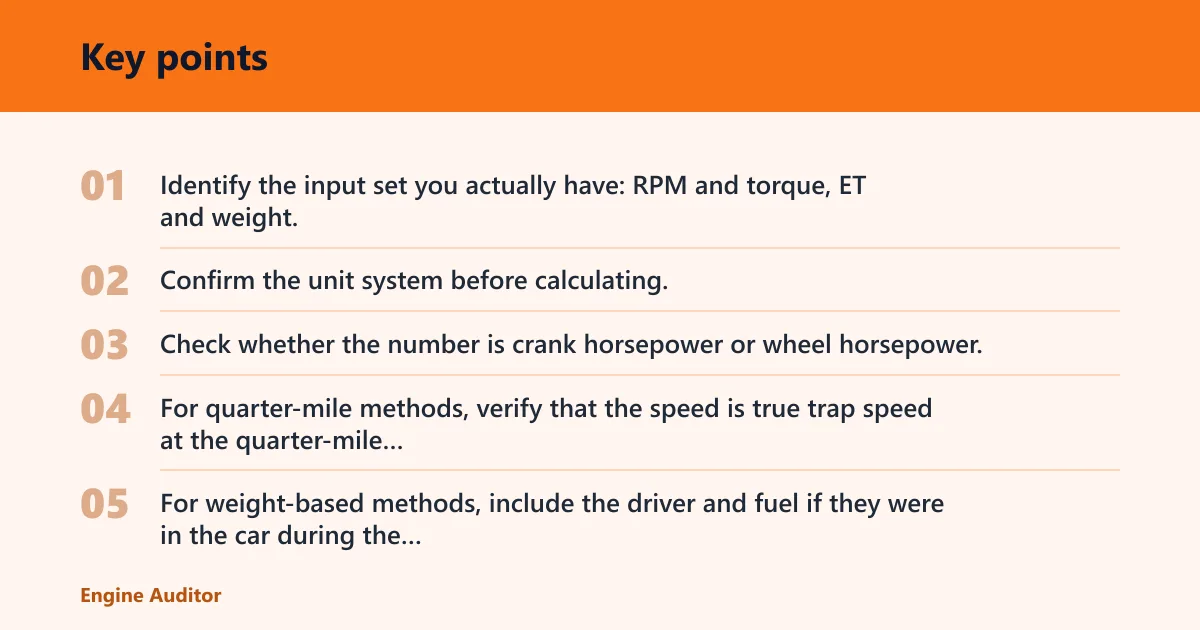
- Identify the input set you actually have: RPM and torque, ET and weight, trap speed and weight, or build specs with boost and airflow data.
- Confirm the unit system before calculating. Convert metric inputs first if the formula uses imperial units.
- Check whether the number is crank horsepower or wheel horsepower.
- For quarter-mile methods, verify that the speed is true trap speed at the quarter-mile point.
- For weight-based methods, include the driver and fuel if they were in the car during the run.
- For boosted estimates, compare the result with the engine’s airflow, fuel, and drivetrain limits.
Frequently asked questions
What is the formula for engine horsepower from RPM and torque?
The formula is horsepower = (RPM × torque) / 5,252. That gives engine horsepower at a specific RPM point when torque is measured in pound-feet. If torque is listed in another unit, convert it first so the result stays meaningful.
What is the difference between wheel horsepower and engine horsepower?
Wheel horsepower is measured at the drive wheels, while engine horsepower is measured at the crank or flywheel. Wheel horsepower is lower because drivetrain losses absorb power in the transmission, differential, driveshaft, and gearbox. Do not compare WHP and crank HP without converting or labeling the source.
How does engine capacity affect horsepower?
Engine capacity affects horsepower indirectly by changing how much air the engine can move. Displacement alone does not determine power. Boost, airflow, volumetric efficiency, fuel, timing, and heat management all shape the final number, so a larger engine is not automatically a stronger one.
Products related to this article
Sponsored / affiliate links. As an Amazon Associate I earn from qualifying purchases. I may earn additional commission from eligible campaigns.