How Do I Know If a Rattle Is Heat Shield or Converter?
If the rattle changes with light tapping or a heat-cycle cooldown and sounds like thin sheet metal, it is usually the heat shield; if it is a deeper metallic clatter that gets louder with engine rpm or comes with lost power or sulfur smell, suspect a broken catalytic converter. Picking the wrong part can waste money, or leave a failing converter hot enough to clog and cause a no-start. This guide gives a sound-and-condition decision tree, quick checks, and a repair-urgency guide.
This guide is part of our Car Noise Diagnosis by Symptom: Where the Sound Comes From and How Serious It Is series.
Heat shield vs catalytic converter
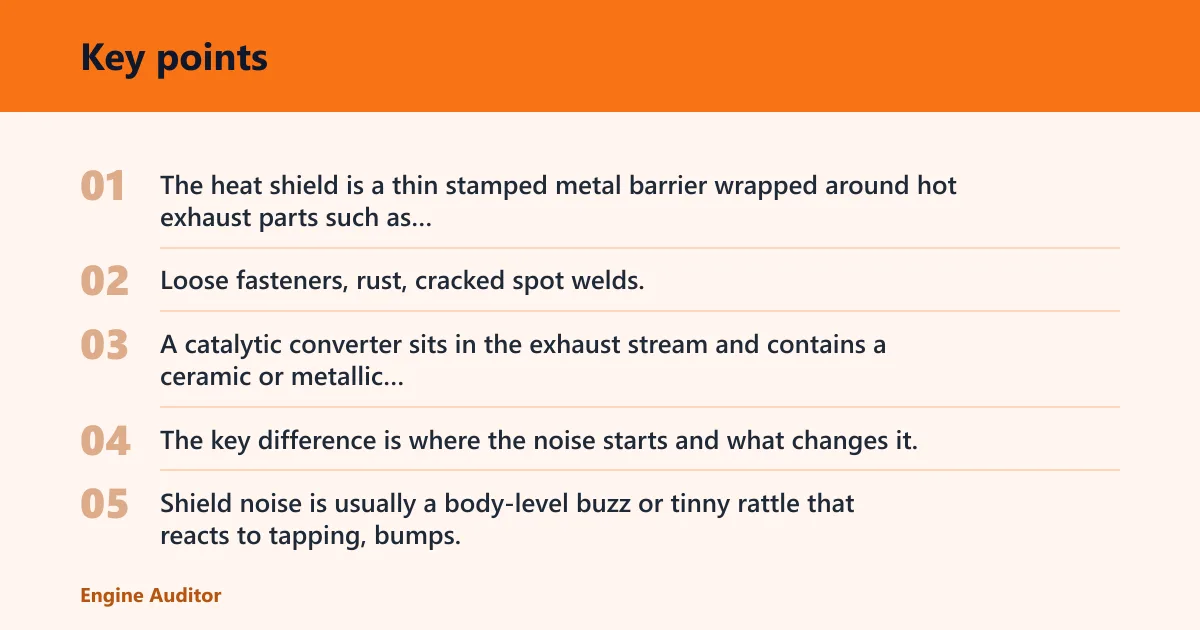

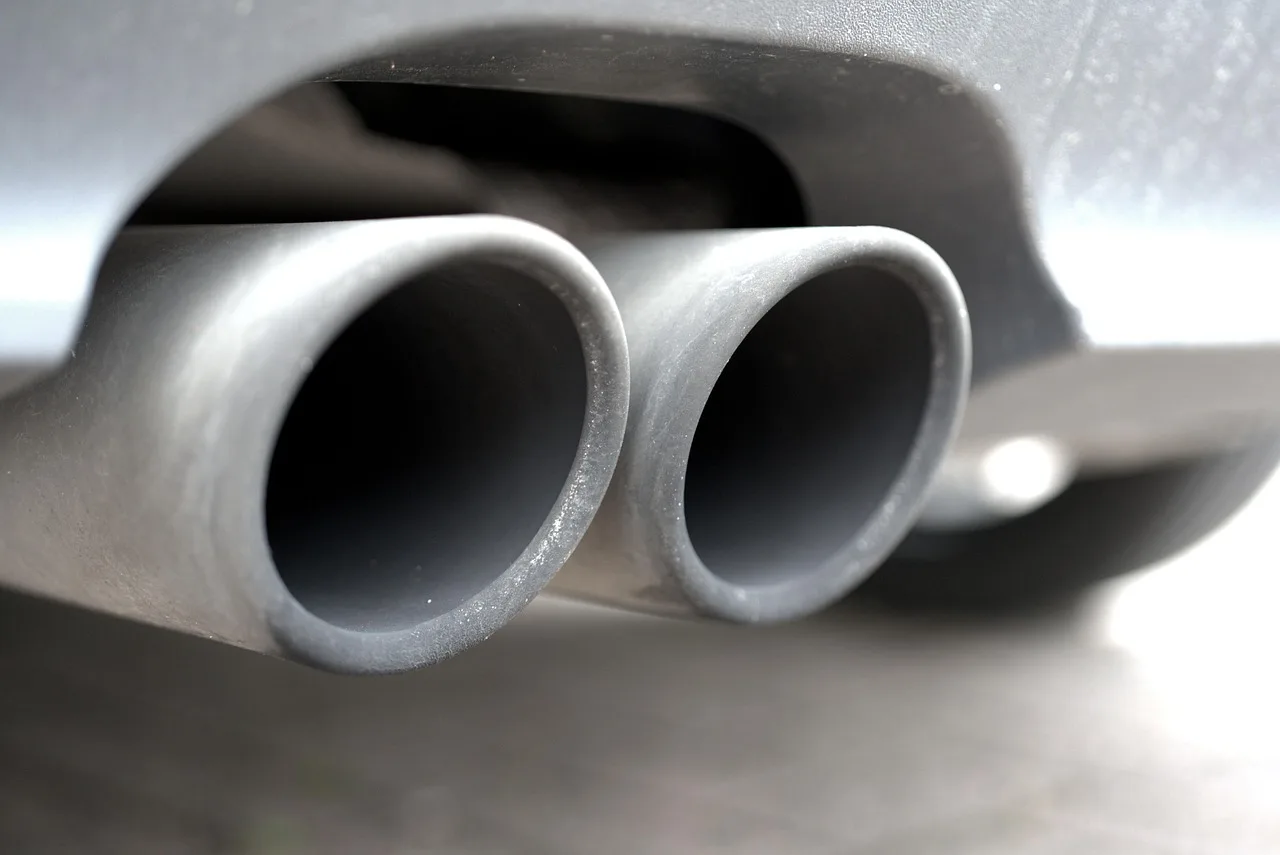
The heat shield is a thin stamped metal barrier wrapped around hot exhaust parts such as the converter, muffler, turbo, or floorpan. Loose fasteners, rust, cracked spot welds, and bent tabs let it buzz against the pipe or body. A catalytic converter sits in the exhaust stream and contains a ceramic or metallic honeycomb substrate that can break apart and rattle inside the shell.
The key difference is where the noise starts and what changes it. Shield noise is usually a body-level buzz or tinny rattle that reacts to tapping, bumps, or idle vibration. Converter noise is more often a deeper metallic clatter from the canister itself, and it may get louder with engine speed or exhaust flow.
What each part does
Heat shields protect nearby parts from exhaust heat. They are common around the converter, muffler, manifold, and underbody panels. Because they are thin, any corrosion at a mounting point can make them chatter long before they fail completely.
The catalytic converter treats exhaust gas through its internal substrate. When that substrate cracks or breaks loose, pieces can shift inside the shell and strike the case. That is why a converter rattle often sounds heavier than a shield buzz.
Where the noise usually starts
Shield noise usually seems to come from one spot under the floor or near the rear of the engine bay. Converter noise usually seems to come from the converter canister itself, often near the front half of the exhaust on many cars. Underbody heat shields near the floorpan are common trouble spots in salt-belt vehicles.
Why rust and broken fasteners matter
Rust at attachment points weakens shields first. A loose nut, broken clip, cracked weld, or bent tab gives the shield room to vibrate. Exhaust movement from bad hangers or a flex pipe leak can make the same shield sound worse than it really is.
What the rattle sounds like
Sound behavior matters more than the word “rattle.” A loose shield often makes a light, sheet-metal buzz at idle or over bumps. A converter with broken substrate more often makes a metallic clatter that tracks engine speed or changes with exhaust flow. The same car can make both noises if there is more than one fault.
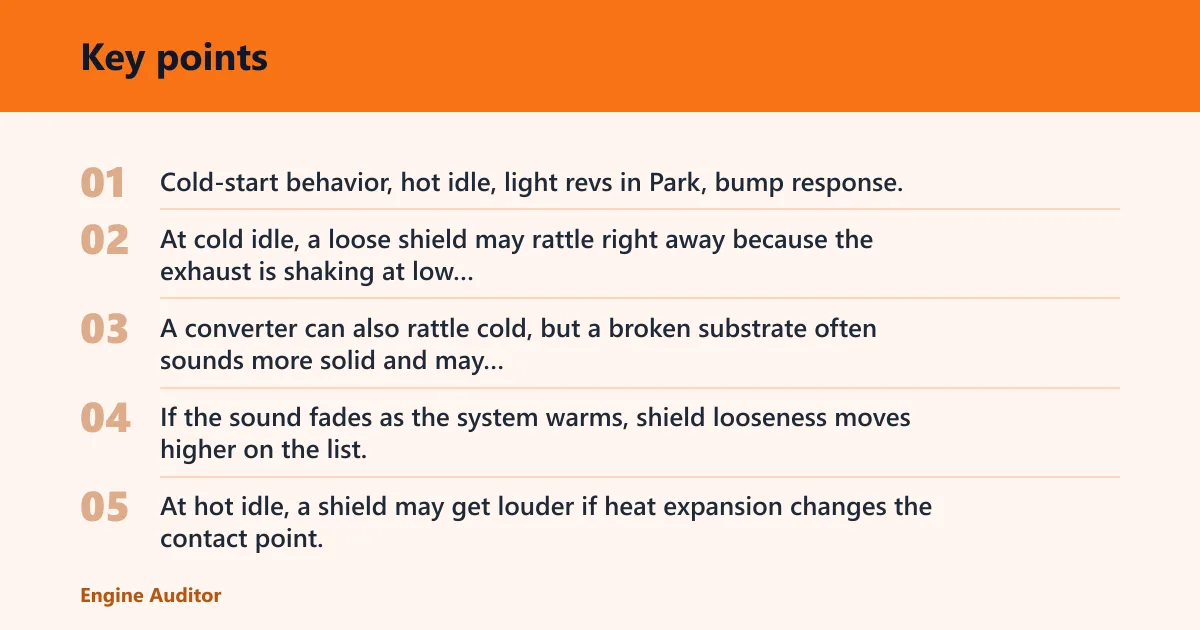
A quick pattern check helps separate them. Cold-start behavior, hot idle, light revs in Park, bump response, acceleration under load, and deceleration each point in a different direction. That is the fastest way to avoid guessing.
Cold idle
At cold idle, a loose shield may rattle right away because the exhaust is shaking at low speed and the metal is still contracted. A converter can also rattle cold, but a broken substrate often sounds more solid and may be easier to hear as the shell vibrates. If the sound fades as the system warms, shield looseness moves higher on the list.
Hot idle and light revs
At hot idle, a shield may get louder if heat expansion changes the contact point. A converter rattle may change with a quick blip to about 1,500 to 2,500 rpm because exhaust flow can move a loose substrate. If the sound clearly rises and falls with rpm, do not stop at the shield theory.
Bumps, acceleration, and deceleration
A shield often rattles over bumps because body movement makes the loose edge strike its mount or the pipe. Under load, a broken hanger, flex pipe crack, or exhaust-to-body contact can join the noise. During deceleration, a converter with broken material may clatter as exhaust flow drops and shifts the loose pieces inside the shell.
Catalyst rattle signs
A broken catalytic converter usually brings more than a noise. Look for reduced power, a lazy throttle feel, a sulfur or rotten-egg smell, and an OBD-II check engine light with catalyst-efficiency faults such as P0420 or related performance codes. The code is a clue, not a verdict.
A converter can rattle without a check engine light. Mechanical break-up and efficiency faults do not always happen at the same time. That is why sound, smell, power, and scan data need to be read together.
Broken substrate clues
Inside a failed converter, the honeycomb core can crack into pieces and move around in the shell. That can create a dry metallic shake on start-up, a clatter when the engine is revved, or a scraping sound after a sharp deceleration. If the noise seems to come from within the canister rather than against it, suspect the substrate.
Power loss and smell clues
Exhaust restriction from a collapsed substrate can reduce power, especially on hills or during highway passing. A sulfur smell can appear when the converter is not working correctly or is overheating. If those symptoms join the rattle, the converter rises above a simple shield problem.
Why a code helps but does not prove it
P0420 points to catalyst efficiency, not the exact internal failure. A leak, aging sensor, or exhaust issue can also affect readings. Use the code as one input, then confirm with sound, road behavior, and inspection.
Shield rattle signs
A loose heat shield often sounds like thin metal buzzing against the exhaust or body. It commonly shows up at idle, over bumps, or with a quick change in engine vibration. If the noise can be duplicated by tapping the shield when the car is cold, the shield is the leading suspect.
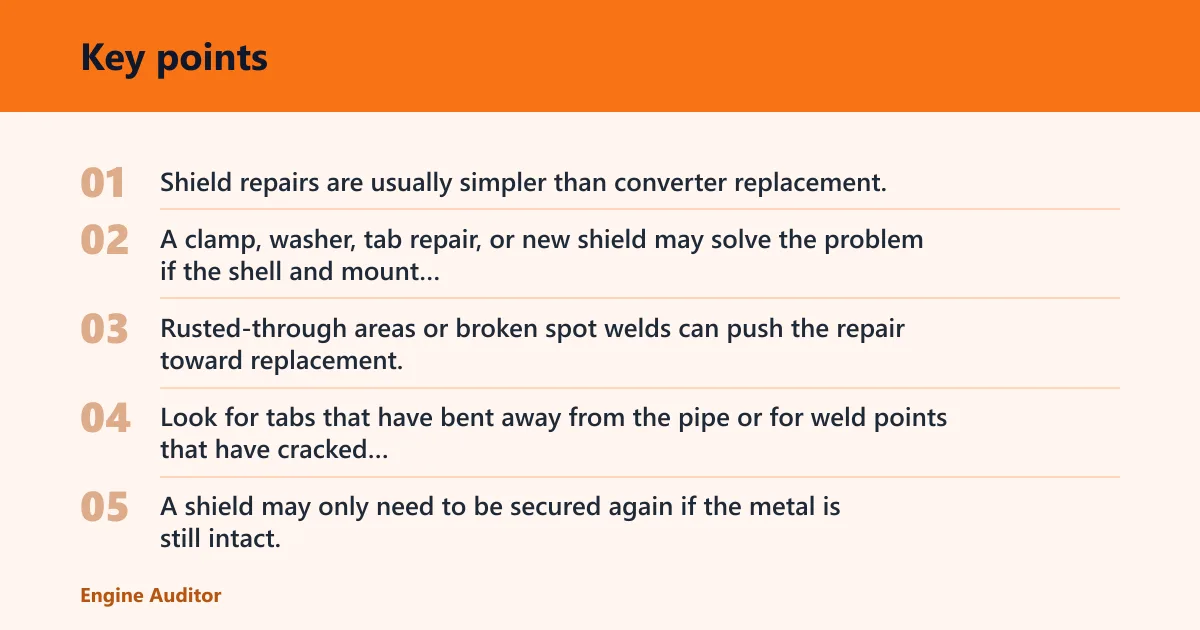
Shield repairs are usually simpler than converter replacement. A clamp, washer, tab repair, or new shield may solve the problem if the shell and mount points are still serviceable. Rusted-through areas or broken spot welds can push the repair toward replacement.
Loose tabs and spot welds
Look for tabs that have bent away from the pipe or for weld points that have cracked loose. A shield may only need to be secured again if the metal is still intact. If the edge is torn or the mounting hole has rotted out, a patch is less dependable.
Tap test when cold
With the engine off and cold, gently tap the shield by hand or with a rubber mallet. If it reproduces the same tinny buzz, that is a common sign of a loose shield. A converter should not be struck hard, and a solid tap on the shell should not be used to force a diagnosis on its own.
Common false positives around the exhaust
Loose hangers, a cracked flex pipe, broken clamps, or exhaust contact with the body can mimic a shield buzz. Movement under load can make those faults sound intermittent. A leak near a joint can also make a sharp tick or buzz that gets mistaken for a loose shield.
Rattle diagnosis matrix
This matrix gives a sound-and-condition decision tree. Start with the easiest pattern match, then confirm it with a safe inspection. If the noise shifts with rpm and road load, do not assume it is only a shield.
| Noise condition | Likely source | Confirming test and urgency | Common false positives |
|---|---|---|---|
| Cold idle | Loose heat shield or broken hanger | Tap the shield by hand when cold; inspect fasteners. Low urgency if no leak or power loss. | Exhaust clamp, hanger, flex pipe |
| Hot idle | Heat shield or converter shell contact | Compare cold versus hot. If heat makes it louder, inspect shield tabs and clearance. Moderate urgency if the sound grows quickly. | Body contact, loose clamp, pipe touch point |
| Light rev in Park | Catalytic converter substrate break-up or loose shield | Hold 1,500 to 2,500 rpm briefly. A noise that rises with rpm suggests internal converter break-up. Higher urgency if power drops or a code appears. | Flex pipe, exhaust hanger, heat shield |
| Driving over bumps | Loose shield, hanger, or exhaust contact | Road-test carefully. If bumps trigger the sound more than rpm does, inspect mounts and clearance. Low to moderate urgency. | Suspension contact, undertray, spare tire hardware |
| Acceleration under load | Converter restriction or flex pipe problem | Watch for loss of power, smell, or louder clatter under throttle. High urgency if acceleration feels weak. | Leak at flange, cracked flex pipe, loose heat shield |
| Deceleration | Loose converter substrate or pipe contact | If the noise changes as exhaust flow drops, inspect the converter and nearby joints. High urgency if the sound is sudden or harsh. | Exhaust clamp, hanger, rear shield |
How to inspect safely underneath
Listen first, then inspect underneath only with jack stands or a lift. Do not rely on a jack alone for diagnosis. Once the car is secure, inspect shields, hangers, clamps, pipes, and the converter shell for looseness, rust, or contact marks.
Use a mechanic’s stethoscope or a length of hose to localize noise near a safe, stationary vehicle. That can help separate a shield buzz from a shell rattle. Do not place hands near hot exhaust parts.
- Start with the engine cold and listen at idle, then with a brief light rev in Park.
- Raise the vehicle safely with jack stands or a lift.
- Check for rusted shield fasteners, broken tabs, and cracked welds.
- Inspect hangers, clamps, flex pipe sections, and any spots where the exhaust touches the body or suspension.
- Tap suspect shields lightly and compare the noise to the original rattle.
- If the converter shell itself rattles or the car has power loss or smell, plan for professional diagnosis.
Say your compact sedan rattles only when you back out of a driveway, and a cold hand-tap on the rear shield reproduces the same buzz. That pattern points to a loose shield or hanger, not a broken converter. The next step is a safe underbody check for a missing fastener or rusted tab.
Suppose a 120,000-mile crossover makes a heavier clatter that gets louder at 2,000 rpm and also feels weak on a hill. That pattern is more consistent with internal converter break-up, especially if a P0420 code and sulfur smell show up with it.
Can you drive with it?
You may be able to drive for a short time with a loose heat shield if the noise is mild, the shield is not touching a rotating part, and there are no leak or power-loss signs. A converter rattle needs more caution because internal break-up can clog exhaust flow and worsen quickly.
If the noise changes suddenly, the car loses power, the smell becomes sharp or sulfur-like, or the exhaust starts contacting the body or suspension, stop driving and get it checked. That is the point where noise has become a symptom of a larger problem.
Low-risk shield cases
A shield that rattles only at idle or over bumps, without exhaust leak sounds or loss of power, is often a repair-priority issue rather than an emergency. It still deserves attention because the looseness can spread and the metal can break away further.
Higher-risk converter cases
A rattling converter with weak acceleration, a code, or a strong smell should move up the repair list. If the substrate is breaking apart, delay can turn a repair into a restriction problem. In severe cases, the engine may struggle to breathe through the exhaust.
Signs that mean do not keep driving
Do not keep driving if the exhaust is touching moving parts, the rattle turns into a harsh clunk, power drops sharply, the check engine light flashes, or the vehicle starts to stall. Those signs point beyond a simple buzz and need prompt diagnosis.
Frequently asked questions
How can I tell if the rattle is the heat shield or the catalytic converter?
Use sound and trigger. A heat shield usually buzzes like thin metal at idle or over bumps and can often be duplicated with a cold tap. A catalytic converter more often makes a deeper internal clatter that changes with rpm, load, or deceleration, especially if power loss or smell appears.
What does a loose heat shield sound like compared with a bad catalytic converter?
A loose heat shield usually sounds lighter and more tinny, almost like a washer or sheet metal vibrating against the exhaust. A bad catalytic converter usually sounds heavier, like stones or broken pieces moving in a metal can. The converter sound is more likely to track engine speed than road bumps alone.
Does a catalytic converter rattle only when I accelerate or also at idle?
It can rattle at idle, during light revs, under load, or on deceleration. A broken substrate often shifts as exhaust flow changes, so the noise may come and go with rpm. If it only appears over bumps, a shield or hanger is more likely than the converter.
Can I drive with a rattling heat shield?
Sometimes, for a short period, if the shield is loose but not contacting a moving part and there is no leak or power loss. Do not treat it as harmless if the noise changes suddenly, gets much louder, or the shield is close to the driveshaft, axle, or suspension.
Can a catalytic converter rattle without causing a check engine light?
Yes. A converter can break up mechanically before it sets an efficiency code, and a code such as P0420 is not guaranteed. That is why sound, power, odor, and road behavior matter. A silent scan tool is not proof that the converter is fine.
How much does it cost to fix a rattling heat shield versus a catalytic converter?
A shield repair is usually the cheaper path because it may need only a clamp, washer, tab repair, or replacement shield. A catalytic converter replacement is usually much more expensive because the part is built into the emissions system and often needs new hardware and labor as well.
When is a rattle from the exhaust dangerous?
It becomes dangerous when the noise is paired with power loss, a flashing check engine light, strong smell, exhaust contact with moving parts, or a sudden change in volume. Those signs can point to restriction, leaks, or a part that may break free. That is the point to stop driving and inspect or call a mechanic.
Products related to this article
Sponsored / affiliate links. As an Amazon Associate I earn from qualifying purchases. I may earn additional commission from eligible campaigns.