What Does a Bad Ball Joint Sound Like?
A bad ball joint often makes a dull clunk, knock, pop, creak, squeak, or rattle that may change as the suspension loads and unloads. If the noise shows up over bumps, during braking, or while turning, and it seems to come from one corner, the joint is a strong suspect. Bad joints can also wear tires unevenly and make steering feel vague.
The ball joint sits between the control arm and the steering knuckle, and it lets the wheel move up and down while still turning left or right. Wear can start at the socket, the stud, or the boot, and each one changes the sound in a slightly different way. A torn boot can lose grease, which speeds wear and often turns a quiet joint into one that pops or creaks.
When to stop relying on sound alone

- Fine resolution for checking small movement
- Magnetic base helps hold it in place
- Includes multiple test tips and storage case
You cannot diagnose this from sound alone. Tie rod ends, control arm bushings, and strut mounts can make similar noises. The key is when the sound appears. A lower joint often complains under load transfer. An upper joint on a double-wishbone or older suspension may react more to steering angle changes and small bumps.
Common sound words
Clunk and knock usually point to play in the joint or a nearby mount. Pop often shows up when the suspension shifts as the wheel moves up or down. Creak and squeak suggest a dry or worn joint, especially if the boot has split. Rattle and thump often mean loose movement that repeats over rough pavement.
How load transfer changes the noise
Load transfer matters because the joint does not carry the same force in every moment. Braking pushes weight forward. A bump unloads and reloads the suspension quickly. Turning moves force to one side. A worn ball joint may stay quiet in a parking spot, then clunk the moment the suspension is loaded on the road.
Suppose a compact SUV makes a single clunk from the right front only when it rolls through a 2-inch driveway lip. That pattern points more toward a worn lower joint or control arm bushing than a wheel bearing, which usually grinds or hums instead of clunking once per impact.
Why sound alone is not enough for diagnosis
Many failures overlap. A loose tie rod end can clunk and make steering feel vague. A worn control arm bushing can thump under braking. A strut mount can creak at the top of the suspension tower. Use the noise as a clue, then confirm with a safe lift, a pry bar check, and, if needed, a dial indicator.
What a bad ball joint sounds like on bumps?
On bumps, a bad ball joint often sounds like a sharp clunk, a muted pop, or a repeated thump from one corner. Lower joints tend to be louder because they often carry more load on many vehicles. Upper joints, where fitted, may add a creak or squeak when the suspension moves through its travel.
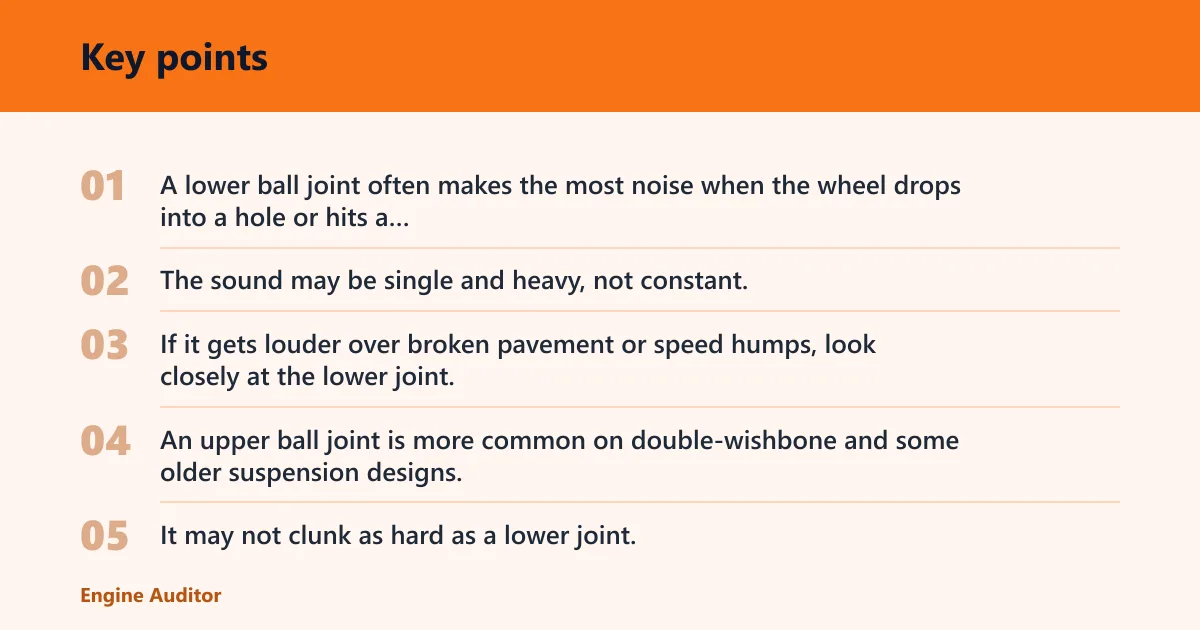
Lower ball joint clues over sharp bumps and expansion joints
A lower ball joint often makes the most noise when the wheel drops into a hole or hits a sharp edge. The sound may be single and heavy, not constant. If it gets louder over broken pavement or speed humps, look closely at the lower joint, the boot, and nearby bushings.
Upper ball joint clues on double-wishbone front ends
An upper ball joint is more common on double-wishbone and some older suspension designs. It may not clunk as hard as a lower joint, but it can creak or pop when the wheel moves through travel. If the noise appears with small bumps and steering input together, the upper joint deserves attention.
Why repeated thumps often point to play, not a squeak only
A squeak by itself can come from a dry boot or bushing. A repeated thump usually means movement in the joint or mount. If the same bump produces the same sound on every pass, that repeatability is useful. It helps separate a worn joint from a random interior rattle or loose cargo.
A common first-timer mistake is blaming any front-end thump on the strut. If the sound changes when one wheel loads harder than the other, the lower joint or control arm bushing is often a better lead than the shock absorber alone.
What a bad ball joint sounds like when turning?
When turning, a bad ball joint can click, creak, pop, or clunk as the steering angle changes. Slow steering input in a parking lot may bring out a dry creak. A faster turn over uneven pavement may bring out a sharper pop. If the sound follows steering effort more than road roughness, suspect a steering or joint issue.
Slow steering input versus parking-lot turns
Slow input helps reveal wear that a quick turn can hide. A worn upper joint may creak as the knuckle rotates. A lower joint may clunk when the wheel shifts under load. If the sound appears as you ease the wheel left or right, not just when the tires hit a bump, the joint is more likely involved.
Why turning noise can overlap with tie rod end symptoms
Tie rod ends are a common lookalike. They can clunk, click, or make the steering feel loose. The difference is that tie rod issues often show up more directly in steering play and toe instability, while ball joint noise may change more with vertical wheel movement and load transfer.
What a bad ball joint sounds like when braking?
Under braking, a worn ball joint can clunk or thump as weight moves forward and the suspension settles. That forward load transfer can make a loose lower joint sound louder than it does on smooth cruising. Braking noise also overlaps with control arm bushing wear, so the symptom needs a careful check.
Forward weight transfer and a louder clunk
When the brakes apply, the front suspension compresses. A worn lower ball joint often reacts here because many designs load the lower joint heavily. If the noise appears right as the nose dips, then fades as speed drops, that pattern fits a joint or bushing that has too much movement.
Why control arm bushings can mimic this symptom
Control arm bushings can create a clunk or thump that sounds close to a bad ball joint. Rubber or hydraulic bushing wear can let the arm shift under braking, which changes alignment on the fly. If the steering wheel seems to move slightly as the vehicle noses down, the bushings need inspection too.
What braking noise means for urgency
Braking-related clunking is more urgent than a mild squeak because it often means the suspension is moving more than it should under load. That can affect camber and toe stability. Schedule inspection soon, and do not ignore a sound that becomes louder with each stop.
Ball joint symptom table
| Sound | When it happens | Likely source | Quick check | Urgency |
|---|---|---|---|---|
| Dull clunk, knock, or thump | Over bumps, braking, or load transfer | Lower ball joint | Lift the wheel, support the vehicle on jack stands, and check for vertical play with a pry bar | Inspect soon; higher urgency if the clunk is getting louder |
| Creak, squeak, light pop | Turning or small bumps | Upper ball joint | Check for movement while steering slowly lock to lock with the wheel lifted | Inspect soon; urgency rises if steering feel changes |
| Clunk, click, loose steering feel | Turns, lane changes, rough roads | Tie rod end | Check for side-to-side play at the tire and inspect the joint boot | Inspect soon; do not ignore steering looseness |
| Thump or shift | Braking and bumps | Control arm bushing | Watch for arm movement under brake application and pry carefully at the bushing area | Inspect soon; can affect alignment geometry |
| Knock or clack near the top of the wheel opening | Turning, road crowns, low-speed maneuvers | Strut mount | Listen near the strut tower while someone turns the wheel slowly | Inspect soon; usually less urgent than a loose joint |
| Any sound with visible looseness after lift inspection | Any driving condition | Joint or related steering part | Do not drive until the play is confirmed and the part is repaired | Do not drive if the wheel or steering feels unstable |
How to check for play safely
Do the inspection with the vehicle safely supported. Use a jack to lift the corner, then place jack stands under a proper support point before any wheel-off check. Do not rely on the jack alone. With the wheel off, the joint and nearby parts are easier to inspect, but safety comes first.
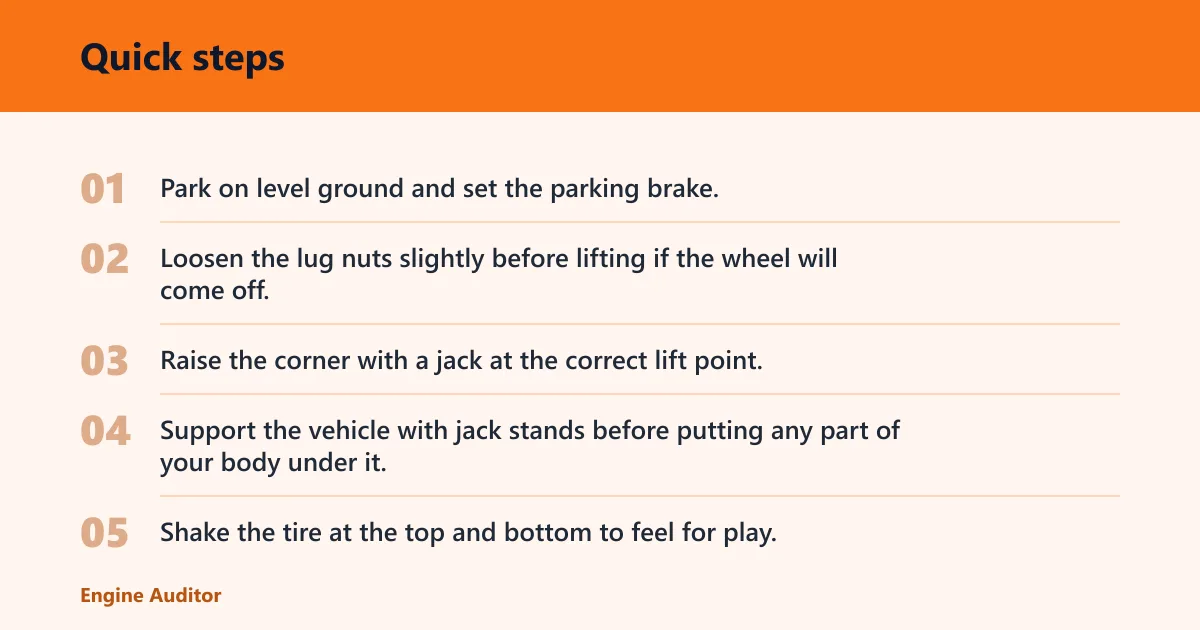
- Park on level ground and set the parking brake.
- Loosen the lug nuts slightly before lifting if the wheel will come off.
- Raise the corner with a jack at the correct lift point.
- Support the vehicle with jack stands before putting any part of your body under it.
- Shake the tire at the top and bottom to feel for play.
- Use a pry bar or suspension pry tool to check vertical and lateral movement at the joint.
- Inspect the boot for tears, grease loss, or obvious looseness.
- If the result is unclear, use a dial indicator to measure movement more precisely.
Use a pry bar carefully
A pry bar helps load the joint so hidden play shows up. Place it carefully under or beside the control arm, then move it just enough to see whether the joint shifts. The goal is to reveal movement, not to force the part. Too much force can damage a weak joint or hide a subtle problem.
Use a dial indicator for precise confirmation
A dial indicator gives a more exact reading than a feel test. It is useful when a joint seems suspicious but not obviously loose. The tool can confirm excess wheel-end or suspension movement, which is helpful when noise is intermittent or when another part makes the diagnosis uncertain.
Use a suspension load test when the noise is dynamic
Some failures show up only under load. A suspension load test can reproduce a clunk that a static check misses. That matters when the vehicle sounds fine on the lift but clunks during braking or turning. If the noise disappears with the wheel hanging free, load is the clue you need.
How to tell it from tie rod or bushing noise
Tie rod end noise usually comes with steering looseness, wandering, or a clunk when the wheel changes direction. Control arm bushing noise usually shows up as a thump or shift under braking and over bumps. Ball joint noise is more likely to change with vertical suspension motion and steering angle together.
Tie rod end clues
A tie rod end can sound like a ball joint, but the steering feel is often the bigger clue. If the wheel feels vague, the car drifts, or the toe seems unstable, the tie rod deserves a close look. The joint may also show play when the tire is rocked side to side with the wheel lifted.
Control arm bushing clues
Control arm bushings can make the front end thump under braking as the arm shifts in its mount. Rubber and hydraulic bushings wear in ways that change geometry, so the vehicle may pull or feel inconsistent on rough roads. If the sound is more of a body shift than a metal clunk, start here.
Strut mount clues
A strut mount usually makes noise near the top of the suspension, not low at the knuckle. The sound can be a groan, click, or knock during steering. If the noise seems to come from above the spring seat rather than from the wheel hub area, the mount is a stronger suspect than the ball joint.
What a bad ball joint looks like
A bad ball joint may show a torn dust boot, grease loss, rust around the stud, or visible looseness at the socket. The wheel may also sit at a slightly odd angle if wear has progressed far enough to affect alignment. Look for uneven tire wear too, since bad joints can disturb camber and toe stability.
Picture a pickup that clunks over driveway aprons and wears the outer edge of the front tires. If the lower joint boot is split and grease has thrown onto nearby parts, that visual clue plus the noise pattern is enough to move the inspection from “watch it” to “schedule repair now.”
Can I keep driving with a bad ball joint?
Do not keep driving if the joint has obvious looseness, the steering feels unstable, or the noise is getting worse fast. A worn ball joint can let the wheel move out of alignment under load and can make handling unpredictable. If the vehicle feels unsafe, the right answer is a tow, not a longer test drive.
If the symptom is only a light creak and the inspection shows no meaningful play, the vehicle may be drivable short term, but it should be repaired soon. Once there is clunking, steering wander, or repeatable movement in the joint, the risk rises enough that continued driving is a bad idea.
Repair and alignment after replacement
Replacing a worn ball joint is only part of the job. The suspension geometry can change when the part is renewed, and alignment is often needed afterward. That matters because bad ball joints can affect camber and toe, and a fresh alignment helps protect the new parts and the tires.
Frequently asked questions
What does a bad ball joint sound like when driving?
When driving, a bad ball joint usually sounds like a dull clunk, knock, pop, or thump that changes with road load. The noise is often louder over bumps, during braking, or while steering through a corner. If one front corner repeats the sound, the joint is a strong suspect.
What does a bad ball joint sound like when turning?
When turning, a worn ball joint can creak, squeak, click, or pop as the suspension changes angle. Slow steering input often reveals upper joint wear, while lower joint play may clunk more sharply when the wheel is loaded. If turning changes the sound more than road roughness does, inspect the joint.
What does a bad ball joint sound like when braking?
Under braking, a bad ball joint often sounds like a clunk or thump as weight shifts forward. That forward load can make a worn lower joint stand out, but control arm bushings can sound similar. If the nose dips and the noise appears at the same moment, inspect both areas.
What does a bad lower ball joint sound like?
A bad lower ball joint usually sounds like a heavier clunk or thump than an upper joint. It may be most noticeable over bumps, on braking, or when the suspension compresses. On many vehicles, the lower joint carries more load, so wear there often shows up as louder, more obvious noise.
What does a bad upper ball joint sound like?
A bad upper ball joint often sounds like a creak, squeak, or light pop, especially on double-wishbone or older suspension designs. It may also clunk when the wheel hits a bump at steering angle. If the noise appears during slow turns and small vertical movement, the upper joint is worth checking.
How can I tell if the noise is a ball joint or a tie rod?
Ball joint noise usually tracks with vertical wheel movement and load transfer, while a tie rod end more often shows steering looseness and toe-related wandering. Both can clunk. The best check is a safe lift, then a careful play test with the wheel supported and the steering motion observed separately.
Products related to this article
Sponsored / affiliate links. As an Amazon Associate I earn from qualifying purchases. I may earn additional commission from eligible campaigns.