How to Check If a Wheel Is Truly Bent
A wheel is bent when it shows measurable runout or a wobble that follows the wheel, not the tire. On many passenger cars, wheel runout limits are often published in the OEM service information and are commonly tighter than the roughly 0.030–0.060 inch range that can become noticeable at the road. Tire and wheel industry guidance from organizations such as SAE, TIA, and major vehicle makers also treats visible cracks, active air loss, and severe wobble as stop-driving conditions. This guide shows how to inspect the rim, measure runout, and separate a bent wheel from tire, hub, or bearing faults.
Wheel check checklist

- Identifies imbalance by finding the heaviest point
- Adjustable centering cones fit solid/hollow wheels
- Includes fine weights for precise correction
| Symptom | Likely cause | Best check | What you’ll see while spinning | Next action |
|---|---|---|---|---|
| Steering shake at 50–70 mph | Wheel balance issue or radial runout | Rotate the wheel and measure runout, then compare with a known-good tire if available | Steady hop or vibration that repeats every revolution, or a shake that changes with speed | Clean and remount first, then balance or compare with a known-good wheel-tire assembly |
| Wobble that appears once per revolution | Bent wheel rim or barrel | Watch the rim lip spin and measure lateral and radial runout with a dial indicator | Rim lip or barrel moves side to side or up and down in a repeatable pattern | Clean the hub face, rotor hat, and wheel mounting pad, torque lug nuts in sequence, then re-measure before calling the wheel bent |
| Thump or hop at low speed | Tire out-of-round or tire bead damage | Inspect the tread and bead area, then check radial runout at the tire sidewall | Tread or sidewall rises and falls while the rim may stay comparatively true | Check tire condition first; if needed, swap front-to-rear / use known-good wheel-tire assembly |
| Grinding or humming that changes in corners | Wheel bearing play or roughness | Lift safely and check for looseness and rough rotation by hand | Rough, dry, or growling rotation; wobble may change when loaded in a turn | Inspect the bearing, hub, and suspension before condemning the wheel |
| Slow air loss after impact | Crack, bead leak, or bent rim at the bead seat | Look for bubbles in soapy water at the bead area and inspect the wheel lip for damage | Bubbles at the bead, valve area, or crack line; wheel may look only slightly bent | Stop driving if the leak is active or the crack is visible; arrange repair or replacement |
| Visible crack, strong wobble, or air leak | Unsafe wheel damage | Stop driving and arrange towing or immediate repair assessment | Obvious fracture, repeated bubble formation, or dramatic hop/wobble | Stop driving now and use a tow or spare per OEM guidance |
| After cleaning and remounting, runout still exceeds spec | True wheel deformation or tire/wheel assembly issue | Repeat the measurement with a known-good assembly if available | Movement persists in the same location despite clean mounting surfaces and proper torque | Swap front-to-rear / use known-good wheel-tire assembly to isolate the fault, then replace or repair as needed |
How to check if a wheel is truly bent at home
A true bend shows repeatable movement in the wheel itself, not just a shake from balance or a tire defect. Start by sorting the symptom: vibration at speed points to runout or balance, while a growl or rumble points more toward a bearing. If the wheel has a visible crack, leak, or severe wobble, stop driving in line with OEM and road-safety guidance.
- Park on level ground, set the parking brake, and chock the opposite wheels.
- Raise the car and support it on jack stands before you inspect a wheel with the tire mounted.
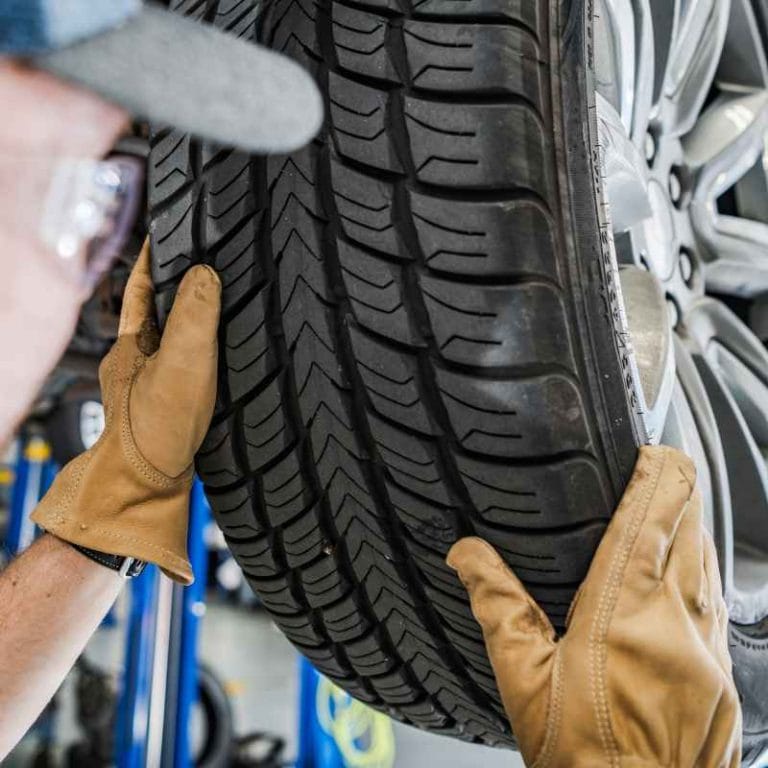
- Spin the wheel slowly and watch the rim edge, not the tread, for side-to-side or up-and-down movement.
- Check the hub face and mounting surface for rust, scale, or debris before you judge the wheel.
- If the movement repeats once per turn, measure runout next.
Say your front wheel hits a curb and the car starts shaking at 60 mph. If the same shake stays with that wheel after rotation and the rim lip shows a repeatable hop, the wheel is a stronger suspect than balance alone. If the problem follows the tire, a tire bulge or out-of-round tire becomes the more likely cause than a bent rim.
Can you spot a bent wheel by eye?
Sometimes, yes. A bent wheel often shows a flat spot, crease, dent, or crack on the rim lip or barrel. Alloy wheels tend to crack or chip more readily, while steel wheels more often show a visible bend or dish change. Eye checks help you find obvious damage, but they do not replace runout measurement or a proper mounting-surface inspection.
Inspect the rim lip
Look at the outer edge where the tire bead seals. A flat spot, sharp dent, or scuffed crease at the lip can mean impact damage. If the lip is distorted, the tire may still hold air for a while, but the seal can fail later.
Inspect the barrel
Rotate the wheel and inspect the inner barrel for ripples, dents, and hairline cracks. A barrel bend can create runout without obvious damage on the outside face. This is common after a hard pothole strike.
Note steel versus alloy patterns
Steel wheels often show a more obvious bend and can sometimes be straightened if the damage is limited and the bead seat still seals well. Alloy wheels are more likely to crack or leak at the bead seat or spoke-to-rim area, which pushes the decision toward replacement sooner. If a crack appears, especially on an alloy wheel, see when to replace a cracked alloy wheel.
How do you measure wheel runout?
Runout is how far the wheel moves away from true as it turns. Lateral runout is side-to-side wobble. Radial runout is up-and-down movement. A dial indicator reads in thousandths of an inch or hundredths of a millimeter, which lets you compare the wheel to the vehicle maker’s tolerance instead of guessing. OEM service data is the right reference here, because runout limits can vary by vehicle and by whether you are measuring the bare wheel or the assembled wheel-and-tire.
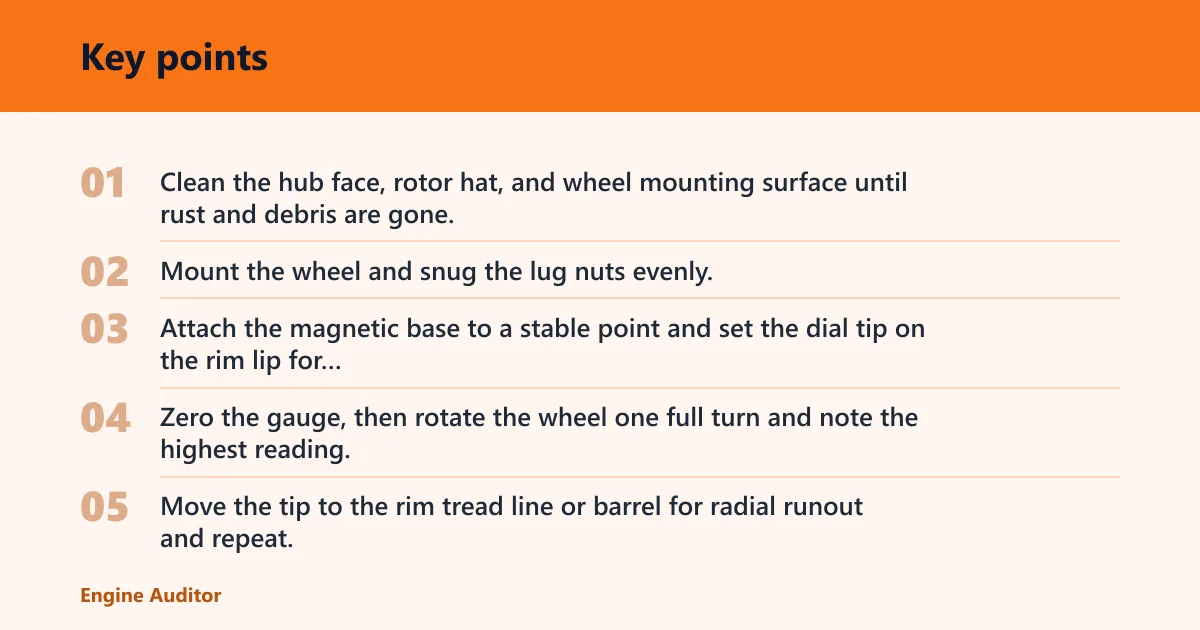
- Clean the hub face, rotor hat, and wheel mounting surface until rust and debris are gone.
- Mount the wheel and snug the lug nuts evenly.
- Attach the magnetic base to a stable point and set the dial tip on the rim lip for lateral runout.
- Zero the gauge, then rotate the wheel one full turn and note the highest reading.
- Move the tip to the rim tread line or barrel for radial runout and repeat.
- Compare both numbers to the vehicle spec; many manufacturers publish a maximum allowed runout for the wheel and the assembled tire.
If a wheel shows about 0.018 inch lateral runout and about 0.052 inch radial runout, and the wheel spec is about 0.020 inch max, the radial value is the one that appears to be out of spec, even if the rim looks only slightly off. That is why both readings matter, and why the exact limit should come from the OEM service information for that vehicle.
How do you rule out lookalikes?
Several faults copy a bent-wheel symptom. A tire can be out of round, a wheel can be out of balance, and a bearing can be loose or rough. The fix changes depending on which one you confirm, so check the likely mimic before paying for wheel work. A clean, correctly torqued mounting setup matters here because corrosion or a trapped burr can make a good wheel read as bent.
Check for tire out-of-round
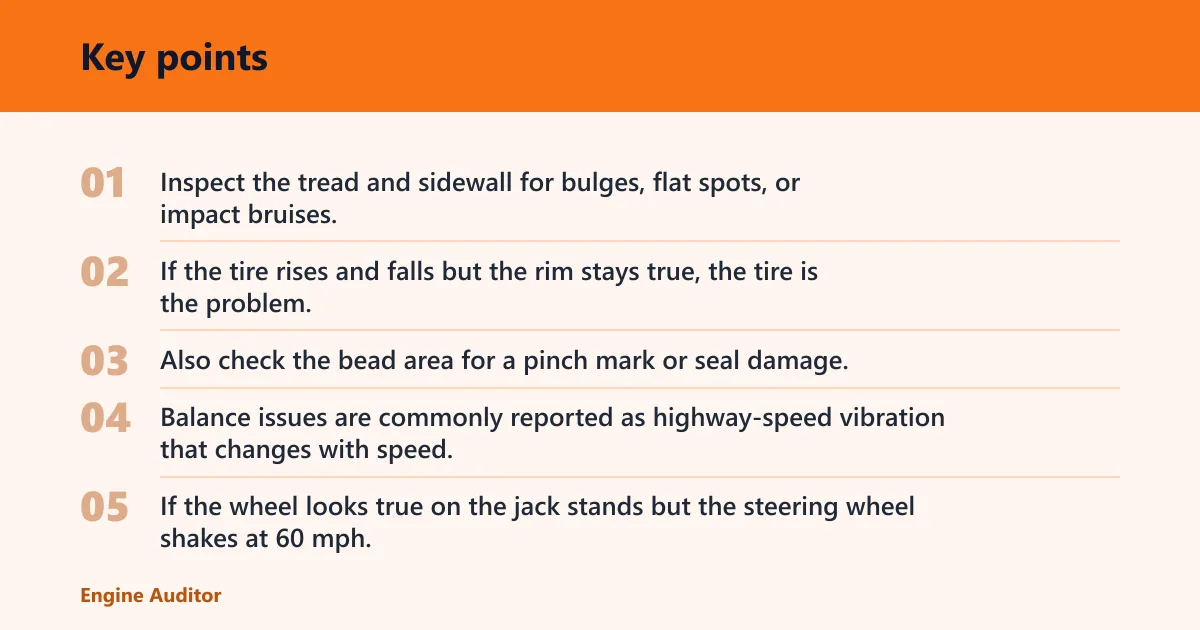
Inspect the tread and sidewall for bulges, flat spots, or impact bruises. Watch the sidewall as the wheel turns. If the tire rises and falls but the rim stays true, the tire is the problem, not the wheel. Also check the bead area for a pinch mark or seal damage.
Check wheel balance symptoms
Balance issues are commonly reported as highway-speed vibration that changes with speed, not as a fixed wobble in one wheel position. Balance does not create a bent rim shape. If the wheel looks true on the jack stands but the steering wheel shakes at 60 mph, balance is a strong suspect. For a deeper comparison, see wheel balance vs alignment.
Check wheel bearing play and roughness
Grab the tire at 12 and 6 o’clock, then rock it. Any looseness may point to a bearing, hub, or suspension joint. Spin the wheel by hand and listen for grinding or roughness. Bearing noise often changes when the car is loaded in a corner; a bent wheel usually does not. If you suspect hub noise, compare the pattern with wheel bearing symptoms.
Clean the hub face and mounting surface
Rust flakes or debris between the hub and wheel can fake runout and make a good wheel look bent. Clean the hub face, rotor hat, and wheel mounting pad before measurement. A dirty hub face can also prevent proper seating, which changes the reading and can create vibration on the road.
Repair or replace?
Minor bends on a steel wheel may be repairable if the bead seat is intact, the crack risk is low, and the wheel does not lose air. Alloy wheels need a stricter call because cracks and repeat leaks are more common. If the bend is at the bead area, the barrel, or the spoke junction, replacement is often the safer choice. Tire and wheel makers generally treat a cracked wheel, a distorted bead seat, or a wheel that cannot return to spec as a replacement candidate rather than a cosmetic fix.
- Measure runout first; do not judge only by appearance.
- Inspect the bend location. Damage at the bead seat or barrel is more serious than a shallow outer-lip dent.
- Check for repeat air leaks after inflation and soapy-water testing at the bead area.
- Replace the wheel if you find a crack, a large deformation, or severe wobble that exceeds spec.
How to fix a bent wheel rim depends on material and severity. A straightening shop may repair a limited steel-wheel bend, but a cracked alloy wheel or one with a distorted bead seat usually needs replacement. If the wheel will not hold air consistently, replacement is the better answer.
Common mistakes
Do not measure runout on a dirty hub face, since contamination can affect the reading. That can create a false reading and send you after the wrong part.
Do not confuse balance problems with structural damage. Balance can shake at speed, but it does not make a wheel visibly wobble when spun on stands.
Do not ignore bead-area damage. A wheel can still hold air for a short time and still be unsafe.
Do not drive if there is a visible crack, an active leak, or severe wobble. At that point, the risk is no longer worth the trip, and major safety organizations advise against continuing on a compromised wheel.
Frequently asked questions
How do I tell if my wheel is bent or just out of balance?
A bent wheel produces visible wobble or measured runout at the rim, while a balance problem usually shows as vibration at a specific road speed. If the shake changes with speed but the wheel spins true on stands, balance is more likely. If the rim lip moves side to side, the wheel is bent.
How can I check if a wheel is truly bent at home?
Lift the car on jack stands, spin the wheel by hand, and watch the rim lip and barrel for repeatable movement. Then use a dial indicator with a magnetic base to measure lateral and radial runout. Clean the hub face first, or rust can make the reading look worse than it is.
What does a bent wheel look like when spinning?
It often looks like a hop, wobble, or egg shape as the rim turns. The motion may be side to side at the lip or up and down at the tread line. If the tire body moves but the rim stays true, the tire is more likely the source.
Can a bent wheel be repaired or does it need replacement?
Limited bends on steel wheels are sometimes repairable, but cracks, bead-seat damage, and repeat leaks point to replacement. Alloy wheels need extra caution because hidden cracking is more common. If runout stays above spec after cleaning and remounting, replacement is usually the safer choice.
How do I check for a bent wheel without a lift?
You can do a basic visual check with the car parked, but you should not put your body under the vehicle without support. If you need the wheel to spin freely, raise the car and use jack stands on level ground. A floor jack alone is not enough for safe inspection.
Can a bent rim still hold air?
Yes. A wheel can hold air for days or weeks and still be bent enough to cause vibration or a poor seal. The concern rises if the bead area is dented, because a slow leak can appear later. Check with soapy water around the bead and valve area after impact.
Should I drive on a wheel that might be bent?
Do not keep driving if the wheel has a visible crack, active air leak, or severe wobble. If the symptom is mild and you must move the car a short distance, keep speed low and avoid highway use until the wheel is measured. Any worsening wobble is a stop-driving sign.
Products related to this article
Sponsored / affiliate links. As an Amazon Associate I earn from qualifying purchases. I may earn additional commission from eligible campaigns.