Can Air in the Clutch Line Cause Shifting Problems?
Yes. Air in a hydraulic clutch line can cause hard shifting, a low or spongy pedal, and incomplete clutch release. If a proper bleed does not restore pedal height and shift quality, a leaking master or slave cylinder is suspected. Ignoring it can turn a cheap bleed into gearbox wear or a tow. This guide shows the symptom patterns, quick checks, and when to bleed first versus replace parts.
Hydraulic clutch behavior


A hydraulic clutch system depends on incompressible fluid to move the master cylinder, hydraulic line, and slave cylinder with enough travel to release the clutch. Air compresses, so part of the pedal stroke goes into squeezing bubbles instead of moving the release mechanism. The result is reduced pedal travel at the slave, a changing engagement point, and incomplete disengagement.
That matters because a clutch that does not release fully can make gears hard to select even when the transmission itself is fine. The pedal may feel soft, or it may feel almost normal while the release travel is still short. Either way, air changes how pressure reaches the slave cylinder.
Check the clutch fluid reservoir first. Low level, dark fluid, or moisture-contaminated fluid points to a leak or neglected service, and the system should use the fluid type specified by the manufacturer, often DOT 3 or DOT 4. Old fluid can also hold more dissolved moisture, which makes diagnosis less clean.
Can air in the clutch line cause hard shifting?
Yes. Air in the clutch line can make shifting difficult because the clutch may not disengage fully, which leaves the transmission input shaft spinning when it should slow down. That creates gear clash, hard-to-select gears, and reverse gear grinding, especially on first engagement after startup or at a stop.
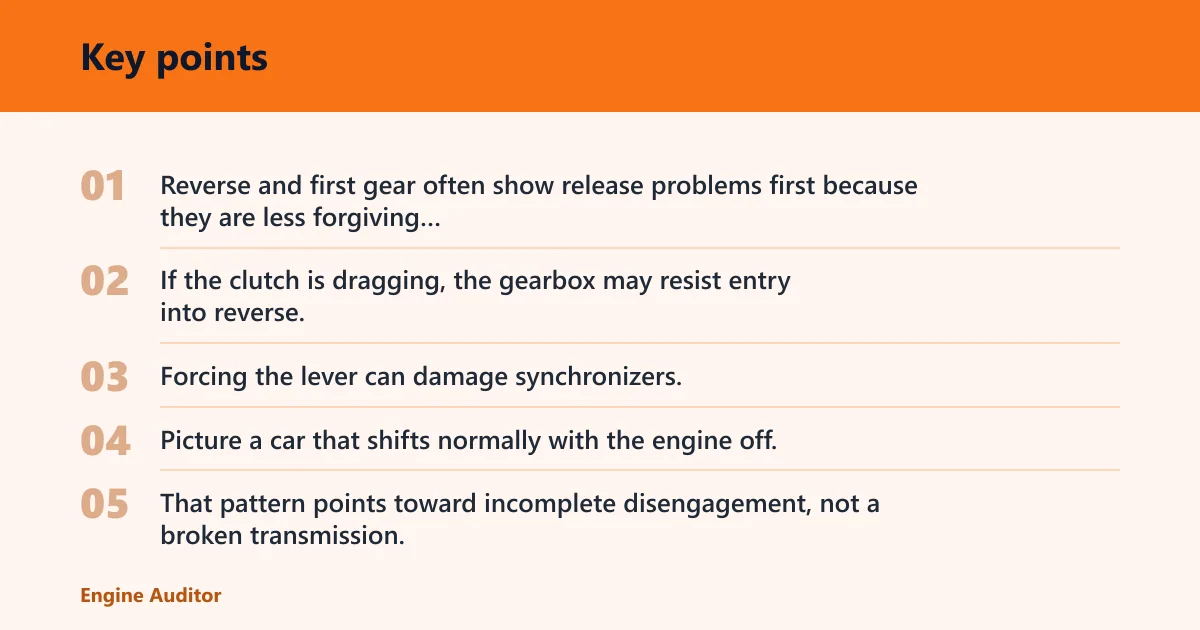
Reverse and first gear often show release problems first because they are less forgiving during a partial clutch release. If the clutch is dragging, the gearbox may resist entry into reverse, or a forward gear may feel like it hits a wall. Forcing the lever can damage synchronizers, so do not muscle the shifter when the clutch is still loading the gears.
Picture a car that shifts normally with the engine off, but grinds reverse with the engine running. That pattern points toward incomplete disengagement, not a broken transmission. The engine-off test is useful because the gears stop spinning when the engine is not driving the input shaft.
Clutch faults decision table
| Symptom pattern | Most likely cause | Next best test |
|---|---|---|
| Soft pedal + shifting improves after pumping | Air in the line or a weak master cylinder seal | Bleed the system, then repeat the pump test and watch pedal height |
| Pedal sinks slowly while held down | Master cylinder internal seal bypass | Hold steady pressure for 20 to 30 seconds and check for pedal drop |
| Reverse grinds first | Incomplete disengagement from air, low fluid, or slave stroke loss | Try engine-off gear selection, then check reservoir level and slave movement |
| No external leaks found after bleeding | Trapped air at a high point or internal master/slave failure | Re-bleed with the correct sequence and inspect for hidden seepage at fittings |
What symptoms point to air versus a bad cylinder?
Air usually shows up as a spongy pedal, shifting that changes from one stoplight to the next, and a release point that moves higher or lower without warning. A failing master cylinder more often shows pedal sink, inconsistent release, or fluid loss at the pushrod area. A bad slave cylinder more often shows external leakage or weak stroke at the fork.
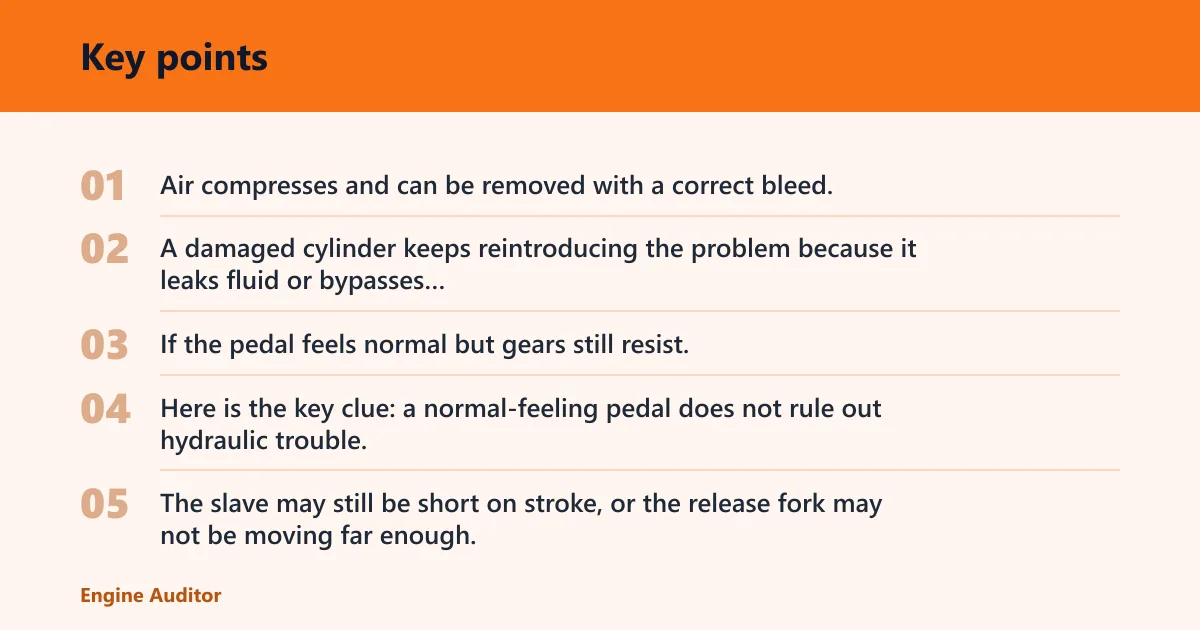
The difference matters. Air compresses and can be removed with a correct bleed. A damaged cylinder keeps reintroducing the problem because it leaks fluid or bypasses pressure internally. If the pedal feels normal but gears still resist, the clutch may be moving enough to fool your foot but not enough to separate the disc from the flywheel.
Here is the key clue: a normal-feeling pedal does not rule out hydraulic trouble. The slave may still be short on stroke, or the release fork may not be moving far enough. The driver feels a pedal that seems acceptable, while the transmission sees a clutch that is still dragging.
Clutch master cylinder signs
A clutch master cylinder that is failing often shows internal seal bypass. The pedal can sink while held, the engagement point can drift, and release can be inconsistent from one pedal press to the next. Fluid may also appear low in the reservoir without a clear external drip near the wheels.
Check the firewall area, the reservoir, and the pushrod end of the master cylinder for wetness. If the seal bypasses internally, the fluid may move inside the cylinder instead of feeding pressure to the line. In that case, bleeding may help only briefly or not at all.
Clutch slave cylinder signs
A slave cylinder problem often shows as an external leak, reduced fork movement, or a release that worsens as the leak grows. On systems with an external slave, look for fluid around the body, dust boot, and bleeder screw. On a concentric slave cylinder, the leak may be inside the bellhousing, so there may be no puddle on the ground or visible fork to inspect.
Stroke loss is the clue. If the pedal motion looks normal but the fork moves too little, the slave may be leaking or bypassing pressure. With a concentric unit, that failure can also contaminate the clutch assembly and usually means more work than a simple external slave swap.
How do you bleed a clutch line with air in it?
Bleeding removes trapped air by pushing fresh fluid through the master cylinder, hydraulic line, and slave cylinder until only fluid exits the bleeder screw. Manual bleeding, vacuum bleeding, and pressure bleeding can all work. The important part is the correct fluid purge sequence and keeping the reservoir from running dry during the process.
Do not assume one quick bleed is enough if the system has a high point that traps bubbles or a leak that keeps drawing air back in. A bleed that fails to change pedal feel usually means air is still trapped or a component is leaking under pressure. Some systems also need bench-bleeding of the master cylinder, scan-tool bleed procedures, or care to avoid over-stroking the pedal on worn seals.
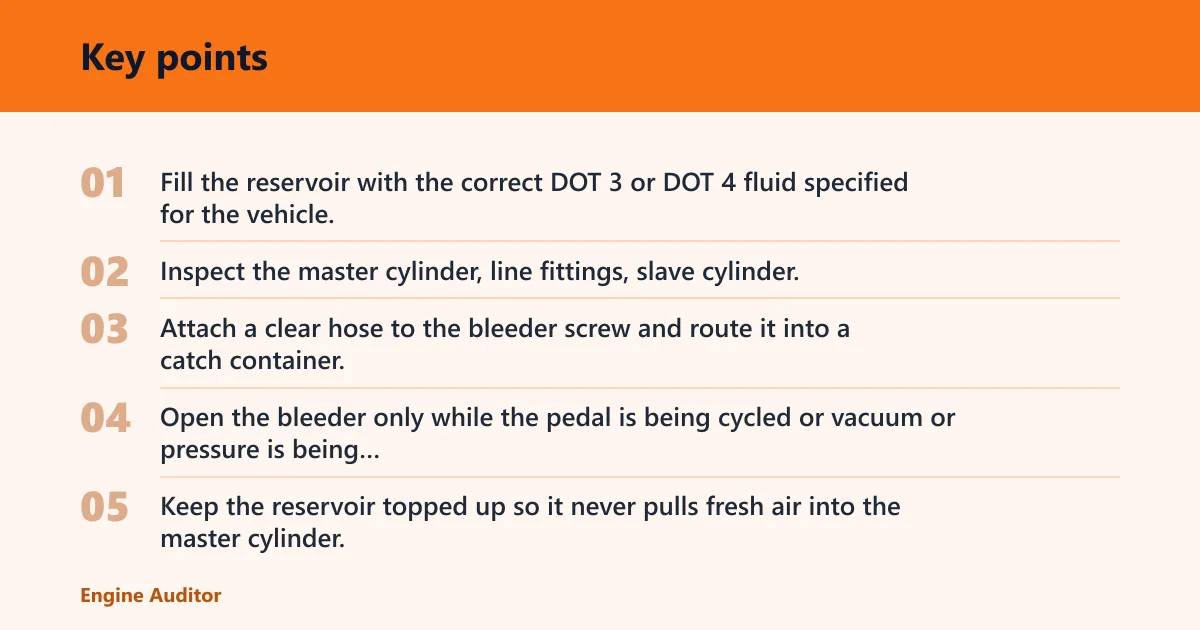
- Fill the reservoir with the correct DOT 3 or DOT 4 fluid specified for the vehicle.
- Inspect the master cylinder, line fittings, slave cylinder, and bleeder screw for dampness.
- Attach a clear hose to the bleeder screw and route it into a catch container.
- Open the bleeder only while the pedal is being cycled or vacuum or pressure is being applied, then close it before releasing the pedal according to the chosen method.
- Keep the reservoir topped up so it never pulls fresh air into the master cylinder.
- Close the bleeder, check pedal height, and repeat until the pedal is firm and the shift quality returns.
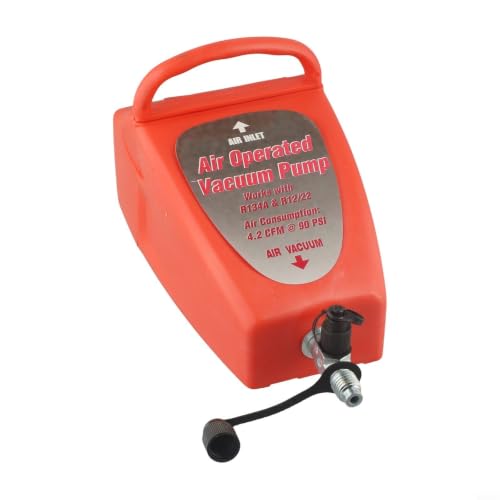
Manual bleeding is common on simple systems, but it can leave bubbles behind if the slave sits lower than the line or if the system holds air at a high point. Vacuum bleeding can pull fluid through quickly, while pressure bleeding can help move stubborn air out of the master cylinder and line. Use the method that fits the layout.
Suppose the pedal improves for two presses after bleeding, then turns soft again by the next start. That pattern often means a small leak remains or a trapped pocket is moving back to the high point. A temporary improvement is not the same as a fix.
Can low clutch fluid make shifting difficult?
Yes. Low clutch fluid can make shifting difficult because the master cylinder cannot move enough fluid volume to the slave cylinder. That lowers release travel, changes the engagement point, and can leave the clutch partly engaged. Low level is often the first sign of a leak somewhere in the hydraulic system.
Start at the reservoir. If the level is below the mark, top it up only with the correct fluid type and then inspect the master cylinder, hydraulic line, fittings, slave cylinder, and bleeder screw for wet spots or residue. Dark fluid and moisture contamination point to overdue service, but they do not prove a leak by themselves.
If the level keeps dropping, look for the source before driving much farther. Fluid loss means pressure loss, and pressure loss means the clutch may stop releasing cleanly. That can leave you with hard shifting or a no-shift condition at the worst time.
When should you replace the master or slave cylinder?
Replace the master or slave cylinder when bleeding no longer restores normal pedal height and release travel, or when a leak is visible. Air is the first suspect, but persistent symptoms after a correct bleed usually mean a seal is bypassing or fluid is escaping. At that point, replacement is often the sounder path than repeated bleeding.
Master cylinder replacement threshold
A clutch master cylinder should move from “bleed and recheck” to replacement when the pedal sinks, release stays inconsistent, or fluid bypasses internally even though the outside looks dry. A master that leaks into the cabin or at the firewall is also beyond simple service. Repeated air return after bleeding is another sign.
If the pedal feels firmer after pumping but then fades again, the master may be bypassing pressure instead of holding it. That is not an air problem alone. It is a sealing problem.
Slave cylinder replacement threshold
Replace the slave cylinder when it leaks externally, loses stroke, or leaves the clutch fork with too little movement even after a proper bleed. On a concentric slave cylinder, leakage may be hidden inside the bellhousing, so a falling fluid level or repeated air intrusion may be the only visible clue.
Do not overlook the bleeder screw and line fitting. A loose fitting can draw air back in, and a damaged bleeder can mimic a bad cylinder. If the system will not hold a firm pedal after a complete bleed, the fault is still present somewhere in the circuit.
How long can you drive with air in the clutch line?
Short answer: not long if the clutch is already dragging. You may still be able to move the vehicle, but every hard shift, grind, or forced engagement adds wear. The risk is not only discomfort; repeated gear clash can wear synchronizers and make the transmission harder to shift later.
Stop driving if reverse grinds repeatedly, first gear will not engage cleanly, or the pedal sinks and the clutch may not release properly. An engine-off test that shifts easily, followed by grinding with the engine running, is a strong reason to inspect the hydraulic system immediately rather than continue forcing gears.
A common first-timer mistake is trying to “muscle through” a stop-and-go commute with a dragging clutch. That can turn a bleed job into a bigger repair. If the pedal is soft, the reservoir is low, or the pedal keeps changing, the safer move is to inspect and repair before more driving.
Frequently asked questions
What are the symptoms of air in a hydraulic clutch line?
The common signs are a spongy pedal, a low or changing engagement point, hard-to-select gears, gear clash, and intermittent shifting symptoms that come and go. If the pedal improves after pumping, air is likely in the circuit or a seal is bypassing pressure.
How can you tell if the clutch master cylinder is failing?
Watch for pedal sink, inconsistent release, and a pedal that changes feel without a matching change at the reservoir. Internal seal bypass is the usual fault. If bleeding helps only briefly, or not at all, the master cylinder may no longer hold pressure.
Why does the clutch pedal feel spongy after bleeding?
Most often, air is still trapped in a high point, the wrong bleed order was used, or fluid level dropped during the process and pulled more air into the master cylinder. A spongy pedal after bleeding can also mean a leak remains at the master, slave, line, or bleeder screw.
Will air in the clutch line damage the transmission?
Air itself does not damage the transmission, but the dragging clutch it causes can. Hard shifting and gear clash wear synchronizers and can make reverse and first gear more difficult to engage over time. If the clutch is not fully disengaging, avoid forcing the shifter.
Products related to this article
Sponsored / affiliate links. As an Amazon Associate I earn from qualifying purchases. I may earn additional commission from eligible campaigns.