Can Any Footswitch Be Used For An Amp? What You Must Know
Understanding Amp Footswitch Compatibility
So, can any footswitch work with any amp? The short answer is no. It’s a bit like trying to use a remote control from one TV brand on another.
They might look similar. They might even have buttons. But the signals they send are different.

HQRP
HQRP Multi-purpose 2-Button Guitar Amp Footswitch compatible…
- HQRP® Multipurpose Two-button Footswitch; Replaces Peavey OEM P/N: # 03022910 / 03008010 / 03330850.
- QUALITY: HQRP Footswitch is made of quality metal components (buttons, the interior parts and plugs). The molded housing guarantee…
- ERGONOMICAL: The footswitch has the inclined top which facilitates the push. The convenient disposition of the buttons ensures the…
As an Amazon Associate I earn from qualifying purchases.
Guitar amps are built with specific communication methods in mind. They expect certain signals from their footswitches. Not all footswitches send those same signals.
Think about your amp’s brain. It has little wires. These wires wait for a specific message.
A footswitch sends a message. It tells the amp to do something. This could be changing from a clean sound to a distorted sound.
Or turning on a reverb effect. If the footswitch sends the wrong message, the amp just won’t understand. It’s like speaking two different languages.
The amp hears noise. It doesn’t get the command.
The way these signals are sent is key. It’s often about simple electrical connections. Some footswitches use a momentary switch.
This means it only makes contact when you press it. When you let go, it breaks the connection. Other footswitches might use a latching switch.
This type stays on or off until you press it again. This changes how the amp behaves.
The type of connector matters too. Many amps use a standard 1/4-inch jack. But even then, what the amp does with that signal is unique.
It depends on the amp’s internal design. Some amps might need a simple on/off switch. Others might need two switches for different functions.
Some might even need a more complex setup. They might use different wiring within that same 1/4-inch jack.
It all comes down to the amp’s circuitry. The engineers who designed your amp decided how it would talk to its footswitch. They chose the electrical signals.
They chose the connector type. Your footswitch needs to match this specific design. If it doesn’t, you’re out of luck.
That’s why a universal footswitch is rare for amps.
Why Amp Footswitches Aren’t Universal
Let’s dig a little deeper. Why isn’t there a one-size-fits-all footswitch for guitar amps? It’s all about specialization.
Each amp manufacturer makes their gear with specific features. They often have proprietary systems. This is especially true for higher-end or feature-rich amps.
They want their footswitch to control their amp’s unique functions.
Imagine an amp with three channels. It also has a built-in reverb and a tremolo effect. You’d need a footswitch with at least five buttons.
Each button would need to send a unique signal to control these five functions. A generic footswitch probably only has one or two buttons. It can’t send the specific codes your amp needs.
Some amps use what’s called a “tip-ring-sleeve” (TRS) jack. This is a 1/4-inch plug with three connection points. A regular guitar cable uses a “tip-ring” (TS) plug, which has two.
The extra connection on a TRS plug allows for more complex signals. It can send multiple commands through one cable. A simple footswitch might only use two of these connections.
A more advanced one uses all three. Even then, how those connections are wired is up to the amp maker.
For example, one amp might wire the “tip” to control channel switching. The “ring” might control reverb. Another amp could use the “tip” for channel one and the “ring” for channel two.
The “sleeve” is usually a ground. See how a generic switch wouldn’t know which wire to connect to which function?
This is why many amp manufacturers sell their own branded footswitches. They are designed specifically for their amps. They guarantee that the electrical signals will match.
They ensure the buttons control the right features. It’s an extra piece of gear. But it’s often necessary for full amp functionality.
It’s not just about the amp having a footswitch jack. It’s about what the amp expects to receive through that jack. If you plug in the wrong thing, it might do nothing.
It might do the wrong thing. In rare cases, it could even cause minor issues. Though this is less common, it’s good to be aware.
Manufacturers also do this for brand identity. Their footswitch might have a specific look or feel. It might match the amp’s aesthetic.
It reinforces their brand. It also ensures you get the best possible experience with their product. This attention to detail is why compatibility is so important.
Types of Footswitches for Guitar Amps
When you start looking for a footswitch, you’ll see different kinds. They aren’t all the same. Understanding these differences will help you know what to look for.
1. Single-Button Footswitches
These are the simplest. They have one button. They are usually for very basic amps.
Think of an amp with just one channel. You might use this to turn a built-in effect like reverb on or off. Or, for some amps, it might switch between two main channels.
They often use a simple momentary switch. Press it, the effect is on. Press it again, it’s off.
2. Dual-Button Footswitches
These are more common. They have two buttons. This is great for amps with two distinct channels, like “Clean” and “Lead.” Or perhaps one button for channel switching and another for an effect.
Many amps designed for a bit more flexibility come with or recommend these.
3. Multi-Button Footswitches
These can have three, four, or even more buttons. They are for amps with many channels and features. For example, an amp might have a Clean, Crunch, and Lead channel.
It could also have Reverb, Tremolo, and an FX Loop button. A footswitch with four or five buttons would be needed to control all of these.
4. Channel Selectors vs. Effect Switches
It’s important to know what a footswitch is designed to do. Some are specifically for changing amp channels. Others are for turning built-in effects like reverb, delay, or tremolo on and off.
Some footswitches can do both. You need to check the amp’s manual and the footswitch’s description.
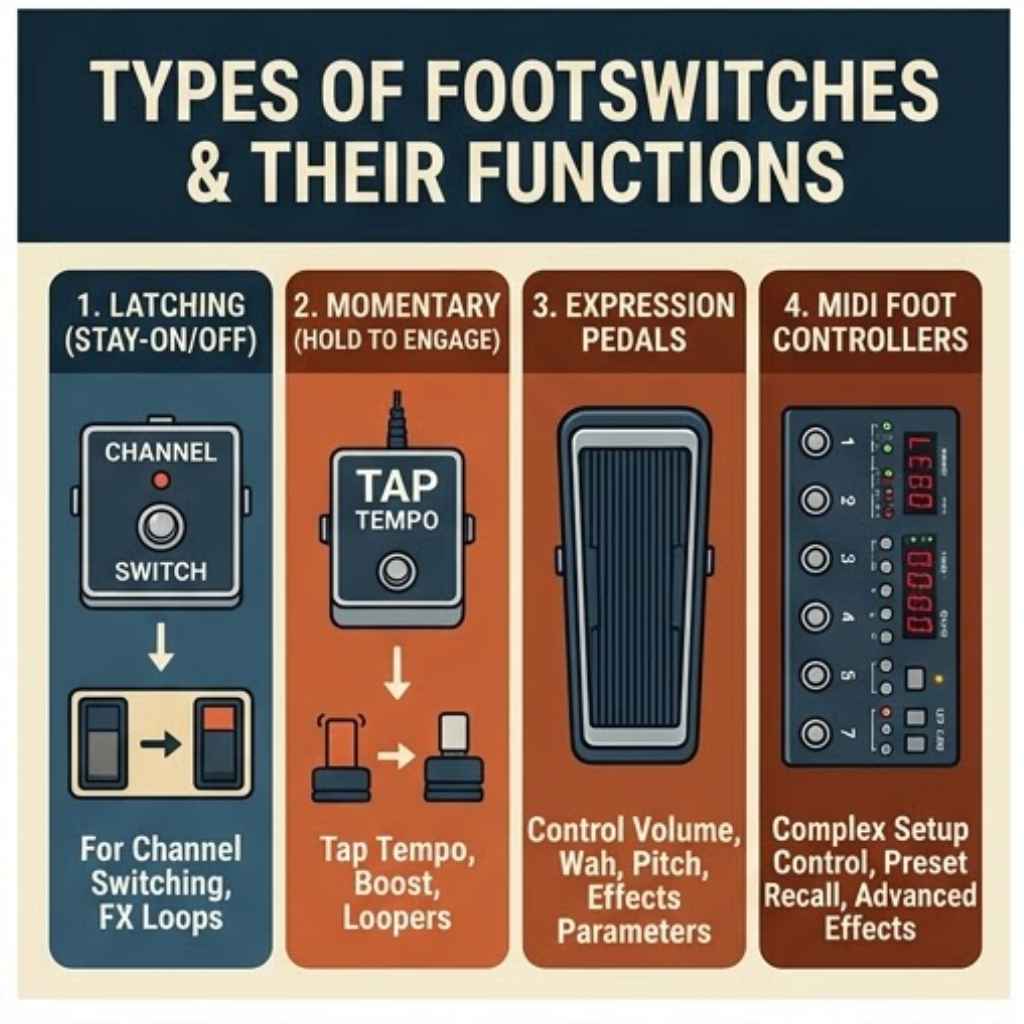
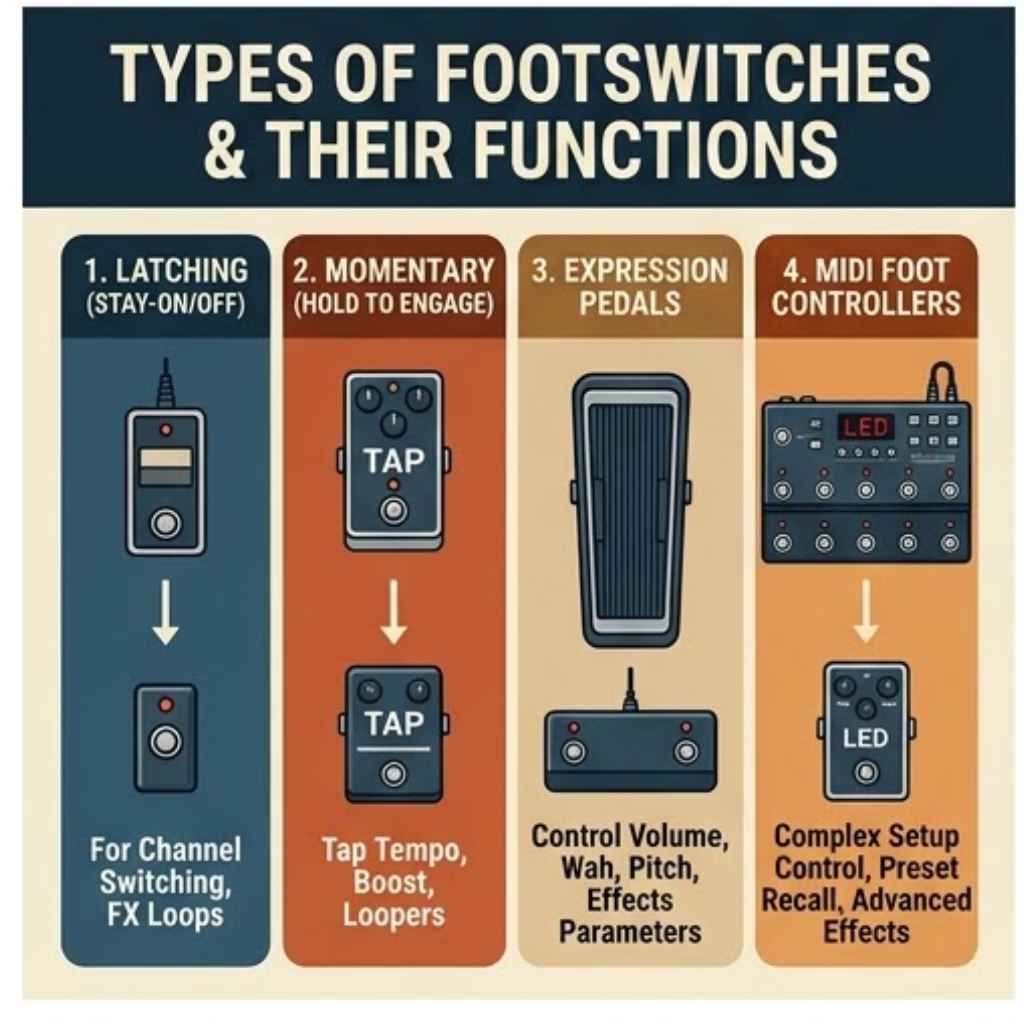
5. Latching vs. Momentary Switches
This is a key difference. A latching switch works like a light switch. You press it, and it stays on.
You press it again, and it turns off. Most channel-switching footswitches are latching. A momentary switch only makes contact while you’re pressing it.
When you release it, the connection breaks. These are often used for effects. Think of a delay pedal; you step on it to start the effect, and step off to stop it.
Some amps use momentary switches for certain functions. It’s crucial to know which type your amp needs.
6. MIDI Footswitches
These are for very advanced setups. MIDI (Musical Instrument Digital Interface) is a communication protocol. It allows different pieces of gear to talk to each other.
A MIDI footswitch can send complex commands to an amp that supports MIDI. This offers a lot of control. But it’s overkill for most standard guitar amps.
When you look at a footswitch, check its description carefully. Does it say which amp models or brands it’s designed for? Does it list the functions it controls?
This information is your best guide. If it says “universal,” be very skeptical. It likely means it works with a wide range of amps from one specific brand or works for a very basic function across many amps.
I remember looking for a footswitch for a mid-range amp I had. The shop had a generic one that looked perfect. It had two buttons and a 1/4-inch jack.
I plugged it in. Nothing happened. The salesperson was baffled.
They said it should work. I took it home, read the amp manual again. It needed a specific type of footswitch with a certain wiring.
The generic one just wasn’t built for it. It was a frustrating lesson in amp-footswitch specificity.
How to Check If a Footswitch Will Work
So, how do you avoid buying the wrong thing? There are a few reliable ways to check. This saves you time, money, and a lot of headaches.
1. Check Your Amp’s Manual (Most Important!)
This is your first and best resource. Your amp’s user manual will tell you exactly what kind of footswitch it needs. It will list the specific model number of the recommended footswitch.
It will also often describe the type of connection (e.g., 1/4-inch TS or TRS) and what functions each button controls. Some manuals even have diagrams of the wiring. Never skip this step.
2. Look for the Manufacturer’s Recommended Footswitch
Most amp makers sell their own branded footswitches. They are guaranteed to work with their amps. While they might be more expensive, they offer peace of mind.
Search for ” footswitch” or ” footswitch.” This will usually bring up the official option.
3. Examine the Connector and Cable Type
Look at the jack on your amp where the footswitch plugs in. Is it a standard 1/4-inch jack? Does it look like it has one ring on the connector (TRS) or just the tip and sleeve (TS)?
Most footswitches come with their own cable, but the connector type is a clue. If your amp uses a TRS jack, you’ll need a footswitch designed for that. A standard TS cable and footswitch won’t work correctly for advanced functions.
4. Research Online Forums and Communities
Guitarist communities online are goldmines of information. Search forums for your specific amp model. See what other users have reported.
Often, someone has already asked the same question about footswitch compatibility. You can find out which third-party footswitches work and which ones don’t. Just remember that user advice can vary, so cross-reference if possible.
5. Contact the Amp Manufacturer’s Support
If you’re still unsure, reach out to the customer support for your amp brand. They can confirm the exact specifications for a compatible footswitch. They are experts on their own products.
6. Understand “Programmable” or “Multi-Function” Footswitches
Some footswitches are designed to be programmable. This means you can assign their buttons to control different functions on various amps. These are often more expensive and require a setup process.
They might use MIDI or a specific protocol to communicate. For most standard amps, these are not necessary.
When I bought my first tube amp, it had a complex footswitch. It controlled channel, reverb, and a boost function. I wanted a simpler one.
I found a really cool-looking one online. It was from a different brand. It had two buttons.
I assumed it would control the channel and reverb. I was so wrong. The buttons controlled completely different things on that amp.
My amp just ignored them. I felt so silly. That’s when I learned to always check the amp’s manual first.
It’s the real authority.
What you’re looking for is a footswitch that speaks the amp’s language. It needs to send the right electrical “words.” The connector is the mouth. The wiring is the grammar.
The amp’s internal circuit is the ear and brain. Everything has to align.
Here’s a quick comparison to keep in mind:
Footswitch Compatibility Checklist
- Amp Manual: Does it specify a footswitch model?
- Manufacturer Part Number: Can you find the official part number?
- Connector Type: Does the footswitch match the amp’s jack (TS vs. TRS)?
- Number of Buttons: Does it have enough buttons for your amp’s features?
- Functionality: What specific functions does the footswitch control (channel, reverb, etc.)?
- Brand Compatibility: Is it listed as compatible with your amp brand/model?
Common Footswitch Connector Types
The physical connection is a huge part of footswitch compatibility. Most guitar amp footswitches use a 1/4-inch (6.35mm) audio jack. But how that jack is wired inside the footswitch and the amp makes all the difference.
Let’s break down the common types.
1. Tip-Sleeve (TS) Connector
This is the most basic 1/4-inch connector. It has two contact points: the tip and the sleeve. The tip usually carries the signal.
The sleeve is typically the ground. Many simpler amps use this. A footswitch designed for a TS connection will often have two wires connecting to the internal switch.
One wire goes to the tip contact, and the other to the sleeve.
Example Use: Basic channel switching on older amps, or simple on/off for a single effect.
2. Tip-Ring-Sleeve (TRS) Connector
This connector has three contact points: tip, ring, and sleeve. The sleeve is still ground. But now, the tip and the ring can each carry separate signals.
This allows for more complex control through a single cable. For instance, the tip might control channel switching, and the ring might control reverb.
This is very common for amps with multiple channels and built-in effects. A footswitch with two buttons, if wired for TRS, will use the tip and ring for its two functions. A single-button footswitch might use the tip for its function and leave the ring unconnected, or vice versa.
Example Use: Channel switching AND effect control on a single footswitch for many modern amps.
3. Stereo vs. Mono Footswitch Cables
This can get a bit confusing. When we talk about stereo cables, we usually mean for audio signals like from a stereo guitar or headphones. However, in the context of footswitches, “stereo” often refers to a TRS plug.
So, a “stereo footswitch cable” is usually a TRS cable. A “mono footswitch cable” is usually a TS cable.
An amp that needs a TRS connection will have a TRS jack. You must use a TRS cable and a footswitch wired for TRS. Plugging a TS cable into a TRS jack might work for some basic functions if the amp’s internal wiring is clever.
But it won’t engage all the features. Conversely, plugging a TRS cable into a TS jack will likely only use the tip and sleeve connections, ignoring the ring. This is why the amp’s jack type is critical.
4. Specific Manufacturer Connectors
While less common now, some manufacturers in the past used non-standard connectors. These could be different sizes or pin configurations. Thankfully, this is rare in modern amps.
Most stick to the standard 1/4-inch TS or TRS.
5. Custom Wiring
Some adventurous players might even modify their own footswitches. They might rewire a generic footswitch to match their amp’s specific needs. This requires understanding electronics and the amp’s internal wiring.
It’s not for beginners.
I once met a guy who swore he could use any footswitch. He had an old, beat-up footswitch from a PA system. It had a big, chunky connector.
He’d managed to get an adapter made. It worked for basic channel switching on his amp. But it looked ridiculous.
And it was prone to crackling. It was a prime example of a forced solution. It wasn’t ideal.
It was just making it work.
The key takeaway is to match the electrical signal type and the physical connector to what your amp expects. The manual is your best friend here. It will tell you if it needs a TS or TRS connection and what the functions are.
Here’s a quick reference:
Connector Type Guide
| Connector | Contacts | Typical Use | Common Cable |
|---|---|---|---|
| TS (Tip-Sleeve) | 2 (Tip, Sleeve) | Basic channel/effect control | Mono |
| TRS (Tip-Ring-Sleeve) | 3 (Tip, Ring, Sleeve) | Multi-channel/effect control | Stereo (often labeled as such for footswitches) |
The Difference Between Footswitches and Pedals
Sometimes people confuse footswitches with guitar pedals. They both get stepped on. They both affect your sound.
But they are very different tools.
Guitar Pedals
A guitar pedal is a standalone effects unit. Think of a delay pedal, a distortion pedal, or a wah pedal. These pedals take your guitar signal, process it with an effect, and then send it out.
They have their own power supplies. They have input and output jacks for your guitar and amplifier. You can use multiple pedals together in a chain.
They have their own switches, but these switches control the effect within the pedal itself.
Amp Footswitches
An amp footswitch, on the other hand, is designed to control functions of your amplifier. It doesn’t process your guitar’s signal directly. Instead, it sends electrical commands to the amplifier.
These commands tell the amp to change its settings. It might tell it to switch channels, turn on reverb, or engage a boost. The footswitch’s built-in switch simply completes or breaks a circuit.
This action is then interpreted by the amp’s internal electronics.
So, while a pedal has a switch to turn its own effect on or off, an amp footswitch has switches that act as remote controls for the amp’s built-in features. You can’t plug your guitar into an amp footswitch and expect it to create distortion. That’s what a distortion pedal is for.
The wiring is another key difference. Guitar pedals typically use TS cables for both input and output. Amp footswitches, as we’ve seen, can use TS or TRS cables, depending on the amp’s needs.
And the internal workings are totally different. A pedal has circuits for delay or overdrive. A footswitch has simple switches and wires to send signals.
I’ve seen beginners get confused by this. They might have a cool-looking pedal with a big switch. They try to plug it into their amp’s footswitch jack.
It’s a common mistake when you’re just starting out. Your amplifier’s footswitch jack isn’t designed for the audio signal of a guitar pedal. It’s designed for control signals.
The best way to think about it:
Footswitch vs. Pedal: Key Differences
- Purpose: Pedals create/modify sound; Footswitches control amp functions.
- Signal Path: Guitar signal goes through a pedal; Amp signal goes to the amp, footswitch controls amp settings.
- Connection: Pedals use TS for input/output; Footswitches use TS or TRS to connect to the amp.
- Internal Build: Pedals have complex effect circuits; Footswitches have simple switches and wiring.
Always use the right tool for the job. If you want a new effect, get a pedal. If you want to control your amp’s channels or effects remotely, get an amp footswitch.
When a Generic Footswitch Might Work
We’ve stressed that most generic footswitches won’t work. But there are some niche situations where they might be useful. This is rare, but it’s good to know.
1. Very Simple Amps with Basic Switching
Some older or very basic amplifiers might have extremely simple footswitch requirements. They might just need a simple contact closure to ground for a single function. If a generic footswitch provides this basic function, it could work.
This is more common for amps that only have one or two channels and no extra effects control.
2. Using Footswitches for MIDI Control
As mentioned, some advanced amps use MIDI. There are generic MIDI foot controllers. These are not “amp footswitches” in the traditional sense.
They are programmable devices that send MIDI messages. If your amp has MIDI input and you can program the MIDI controller to send the right messages for channel switching or effects, then a generic MIDI foot controller could work. This is a complex setup.
It requires an amp that supports MIDI control.
3. DIY Projects and Modifications
If you’re comfortable with electronics, you can modify almost anything. You could take a generic footswitch and rewire it to match your amp’s specific needs. This involves understanding the amp’s footswitch jack and the required switching logic.
This is a true DIY approach and not for most players.
4. Specific “Universal” Footswitches for Certain Brands
Sometimes, a company will make a footswitch that is designed to work with a range of amps from one specific brand. For example, a company might make a footswitch that works with many Fender amps, or many Marshall amps. These aren’t truly universal for all amps, but they offer broad compatibility within a brand.
They are still designed with that brand’s specific switching logic in mind.
I once saw a friend use a footswitch from an old Hammond organ for his amp. It was a bulky, heavy thing with multiple large buttons. It did manage to switch channels.
But it was an awkward fit. The buttons were hard to hit precisely while playing. It was a testament to some flexibility in amp design, but it wasn’t an elegant or reliable solution.
Most of the time, these exceptions highlight how specific the requirements are. Even when something “works,” it might not be ideal. It might lack certain functions or feel clumsy.
The core reason for incompatibility remains: different amps use different electrical signals and wiring schemes for their footswitch functions. A generic footswitch is like a blank slate. It needs to be programmed or wired correctly for your specific amp.
It’s usually much safer and more effective to stick to footswitches designed for your amp or a compatible series.
The Importance of E-E-A-T in Amp Gear
When you’re choosing gear for your guitar, especially something as specific as a footswitch, thinking about Experience, Expertise, Authoritativeness, and Trustworthiness (E-E-A-T) is really important. It helps you make smart choices and avoid disappointment.
Experience
This is about real-world use. Have other guitarists used this footswitch with this amp? What was their experience?
Reading reviews and forum posts from people who have actually used the gear is incredibly valuable. They can tell you if it worked smoothly, if there were any quirks, or if it failed entirely. When I bought my first amp, I spent hours reading about what kind of footswitch people used.
It showed me the common pitfalls.
Expertise
Who is making this footswitch? Is it a reputable company that specializes in guitar gear? Or is it a no-name brand that just slaps things together?
Companies with a long history in the music industry usually have a deep understanding of how amps and footswitches work together. They have the technical know-how to design compatible and reliable products. Look for brands known for quality.
Authoritativeness
This comes into play when you look at official recommendations. Amp manufacturers are the ultimate authorities on what works with their products. When Fender says you need footswitch X for your Twin Reverb, that’s authoritative advice.
Likewise, if a respected music equipment reviewer or technician confirms that a certain third-party footswitch is a good alternative, that carries weight.
Trustworthiness
This means the product does what it says it will do, reliably. A trustworthy footswitch will consistently switch channels or effects without glitches. It won’t suddenly stop working mid-gig.
It also means the seller or manufacturer is reliable. If something goes wrong, can you get support? Buying from established music stores or directly from reputable brands builds trust.
When you’re faced with a choice between a cheap, generic footswitch and a slightly more expensive one made by a known brand or recommended by the amp maker, lean towards the latter. The potential savings from a generic one are rarely worth the frustration and risk of incompatibility.
I remember a time when I bought a cheap “universal” pedal power supply. It claimed to power everything. It didn’t.
It fried one of my favorite pedals. That experience taught me to value trustworthiness and expertise. For amp footswitches, it’s the same principle.
You’re not just buying a piece of plastic. You’re buying a way to control your sound. You want that control to be reliable and correct.
Here’s a quick way to think about it:
E-E-A-T for Footswitch Buyers
- Experience: Read user reviews and forum discussions.
- Expertise: Choose brands with a history in guitar gear.
- Authoritativeness: Rely on amp manufacturer recommendations.
- Trustworthiness: Buy from reputable sources and expect reliable performance.
What This Means for Your Amp Setup
So, what’s the bottom line for you and your guitar rig? Knowing this information is crucial. It saves you from buying the wrong gear.
It ensures your setup works the way you want it to.
1. Always Prioritize Your Amp’s Manual
I can’t say this enough. The manual is your ultimate guide. It tells you exactly what your amp needs.
Don’t guess. Don’t assume. Check the manual.
If you don’t have it, search online for ” manual PDF.”
2. Stick to Manufacturer-Recommended Accessories (If Possible)
The footswitch designed by your amp’s manufacturer is almost always the safest bet. It will work perfectly. While it might cost a bit more, the guarantee of compatibility is worth it.
Think of it as an investment in your playing experience.
3. Research Third-Party Options Carefully
If you want to explore third-party footswitches (which can be great!), do your homework. Look for brands known for making compatible accessories. Read reviews specifically mentioning your amp model.
Check forums. Confirm the connector type (TS vs. TRS) and the intended functions.
4. Understand What Functions You Need
Do you just need to switch between two channels? Or do you need to control channels, reverb, and a master effect loop? Your needs will determine the type and number of buttons you require on a footswitch.
Don’t buy a five-button monster if a two-button switch will do.
5. Consider the Cable Length
Sometimes, manufacturer footswitches come with specific cable lengths. If you have a large stage setup, you might need a longer cable than what comes standard. Some third-party footswitches offer different cable lengths.
6. Don’t Be Afraid to Ask
If you’re buying from a local guitar shop, ask the staff. They often have a lot of experience with different amp brands and accessories. Online retailers often have customer support you can contact with questions.
Trying to force a generic footswitch to work is usually a path to frustration. It can lead to unreliable performance, unexpected behavior, or even just a complete lack of function. Your amp is a finely tuned instrument.
It deserves accessories that are made to work with it.
I remember playing a gig once where my amp’s channel switch failed. It was a disaster. I had to finish the set without being able to change my tone.
That was the day I learned how vital reliable accessories are. A good footswitch is part of that reliability. It lets you focus on playing, not on wrestling with your gear.
Ultimately, the goal is a seamless playing experience. You want your tools to help you, not hinder you. Knowing about footswitch compatibility ensures your setup supports your creativity.
Frequently Asked Questions About Amp Footswitches
Can I use a footswitch from a different brand of amplifier?
Generally, no. Footswitches are designed to send specific electrical signals that an amplifier is programmed to understand. These signals and wiring schemes vary significantly between different amp brands and even different models within the same brand.
It’s best to use a footswitch made for your specific amp or one explicitly listed as compatible.
What does TRS mean for a footswitch cable?
TRS stands for Tip-Ring-Sleeve. It refers to a 1/4-inch connector with three contact points. This allows for sending multiple signals through one cable, which many modern amps use for channel switching and effect control simultaneously.
A footswitch with a TRS plug needs to be compatible with an amp that has a TRS jack.
How do I know if my amp uses a TS or TRS footswitch jack?
The most reliable way is to check your amp’s user manual. You can also often tell by looking at the jack on the amp. A TS jack looks like a standard guitar cable jack.
A TRS jack will appear similar but is designed to accept a plug with an extra ring, often indicated by two black bands on the plug itself (as opposed to one on a TS plug).
My amp has multiple effects. Do I need a footswitch with many buttons?
Yes, usually. If your amp has several built-in effects (like reverb, tremolo, boost, etc.) and multiple channels, you will likely need a multi-button footswitch. Each button on the footswitch typically corresponds to a specific function on the amp.
Check your amp’s manual to see how many functions it has and what type of footswitch is recommended.
What if my amp’s footswitch jack is broken? Can I still use a footswitch?
If the footswitch jack on your amp is broken, you will need to have it repaired by a qualified technician. A footswitch relies on a working connection to send its signals. Without a functional jack, the footswitch cannot communicate with the amp, regardless of compatibility.
Are there any “universal” footswitches that actually work?
True universal footswitches that work with all amps are extremely rare and usually very basic. Some footswitches are designed to be compatible with a wide range of amps from a single brand (like many Fenders or Marshalls). Others might work for a single, simple function across many amps.
Always check specifications and compatibility carefully rather than relying on a “universal” claim.
Conclusion
So, can any footswitch be used for an amp? We’ve seen that the answer is a clear no. Amp footswitches are highly specific.
They depend on the amp’s internal design and communication methods. Always check your amp’s manual. Use manufacturer-recommended accessories when possible.
Research third-party options thoroughly. This ensures you get the right tool for seamless control of your sound.
See also how much does pedal weight matter for cycling real answer.
Related pick: Check today's price on Amazon See also can pedal bone rotation be corrected in horses answered.