Why Is My Ford F-150 Making a Ticking Noise?
A Ford F-150 ticking noise is often normal injector or valvetrain sound at idle, but a sharp tick that gets louder with RPM, comes from one bank, or appears with low oil pressure needs quick diagnosis. Ignored faults can turn into exhaust leaks, damaged lifters, or engine wear. This guide shows how to tell normal ticking from front-end, exhaust, and dash clicks, and what to check first.
What the tick sounds like
Start by separating a light tick from a knock or a rattle. A fast, even tick near the top of the engine often points to injectors or valvetrain parts. A deeper knock, a metallic tick that changes with load, or a sound that appears only from one side needs faster attention.
Tick, click, knock, or rattle?
A tick is usually sharp and repetitive. A click is often lighter and may come from an accessory, relay, or dash actuator. A knock is deeper and more concerning because it can mean combustion, bearing, or internal mechanical trouble. A rattle usually points to loose shielding, brackets, or exhaust parts.
When the sound changes with RPM
If the noise follows engine speed, the source is usually tied to something the engine is turning. That includes fuel injectors, valvetrain parts, serpentine belt components, and some exhaust leaks that open wider under load. A sound that rises and falls with RPM tells you more than the noise description alone.
When the sound comes from inside the cab
Noise inside the cab often leads owners to blame the engine too soon. Under-dash clicking is commonly a separate issue, such as an HVAC actuator, blend door motor, or another interior part. If the sound is clearly behind the dash and does not change with hood-open listening, start inside the cab first.
When does it happen?
Timing is the fastest way to sort normal F-150 noise from a fault. Cold start, idle, acceleration, and shutdown each point toward different systems. Use that timing before you replace parts, because the same tick can mean injector noise in one situation and an exhaust leak in another.
Cold start only
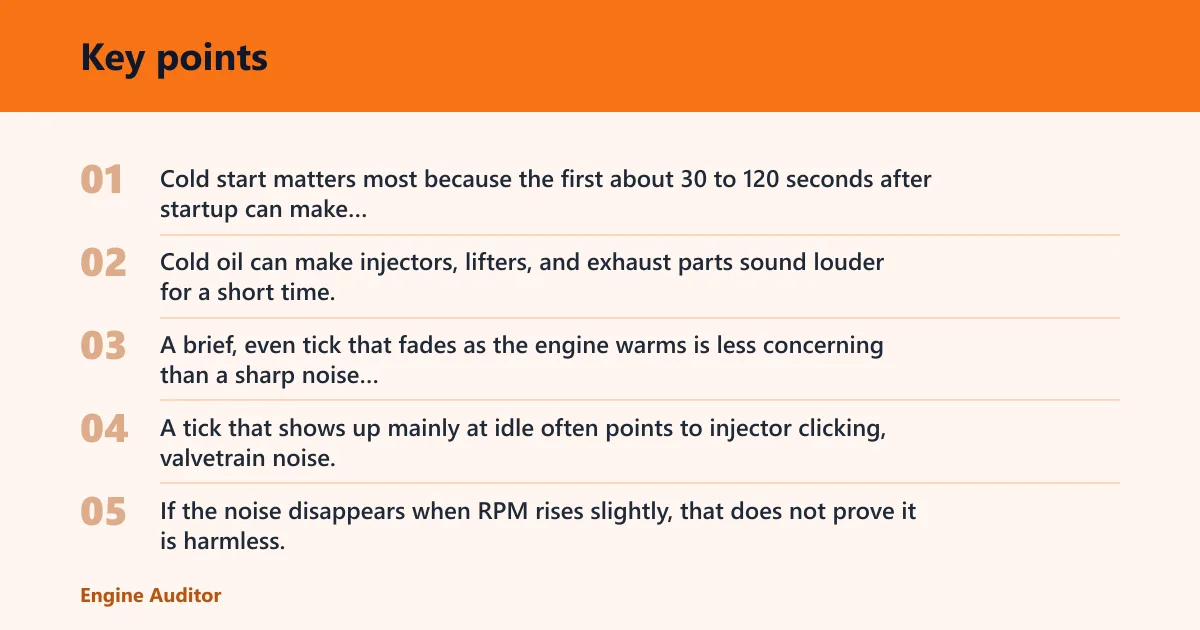
Cold start matters most because the first about 30 to 120 seconds after startup can make normal and abnormal ticking easier to separate. Cold oil can make injectors, lifters, and exhaust parts sound louder for a short time. A brief, even tick that fades as the engine warms is less concerning than a sharp noise that stays loud.
Idle only
A tick that shows up mainly at idle often points to injector clicking, valvetrain noise, or a small exhaust leak that is easiest to hear when the engine is quiet. If the noise disappears when RPM rises slightly, that does not prove it is harmless. It does mean you should check location and volume before assuming damage.
Acceleration and load
A tick or metallic clicking that gets louder on acceleration often points to exhaust manifold leakage, heat shield contact, or a front accessory that changes under engine load. Under boost or heavy throttle, turbo-related noise can also become easier to hear on EcoBoost engines. A sound that grows under load deserves prompt inspection.
Shutdown after a drive
Some exhaust and heat-shield noises show up after shutdown when hot metal contracts. That can sound like ticking from the engine bay or the firewall area. If the noise is brief and only appears during cooldown, it may be heat-related. If it gets louder over time, treat it as a hardware problem.
F-150 ticking diagnosis matrix
Use this table as a first pass. It separates common patterns by timing, likely source, a quick check you can do without tools, and the point where you should stop driving and get help.
| When it happens | Likely source | Quick owner check | Stop-driving threshold |
|---|---|---|---|
| Cold start, first 30 to 120 seconds | Injectors, cold oil noise, exhaust manifold tick, heat shield movement | Listen with the hood open, then repeat the start after the engine sits overnight | Stop if the tick becomes a knock, oil pressure warning appears, or the noise stays loud after warm-up |
| Idle only | Fuel injectors, valvetrain, small exhaust leak, accessory pulley noise | Lightly raise RPM and see whether the sound changes, fades, or follows engine speed | Stop if idle becomes rough, a misfire appears, or the engine shakes more than usual |
| Acceleration or load | Exhaust manifold, heat shield, turbo-related noise, front accessory drive | Compare light throttle with moderate throttle on a short, safe road test | Stop if the sound gets sharper fast, power drops, or a warning light comes on |
| Shutdown after driving | Heat shield, exhaust cooling, loose bracket, turbo heat-related ticking | Listen for a brief cooldown tick near the front or rear of the engine bay | Stop if the tick turns into repeated clanging, fuel smell, or smoke |
| Under-dash clicking | HVAC actuator, blend door motor, relay, other dash parts | Change temperature, mode, and fan settings to see whether the click changes | Stop driving only if the noise comes with electrical faults, loss of defrost, or other system failure |
Which engine is in your F-150?
Engine type changes the shortlist. Ford’s F-150 is offered with a 3.5L EcoBoost V6, a 5.0L V8, and a 2.7L EcoBoost V6. The 2021 F-150 also offers a 3.5-liter hybrid twin-turbo V-6, and MotorTrend says all 2021 F-150 engines use a 10-speed automatic transmission.
3.5L EcoBoost V6
The 3.5L EcoBoost V6 is a twin-turbo V6 used in high-torque F-150 configurations. It can produce direct-injection tick, and turbo-related noises may stand out more during cold start or load. MotorTrend lists the 3.5-liter EcoBoost V-6 as capable of up to 14,000 pounds of towing, which fits the truck’s heavier-duty use case.
5.0L V8
The 5.0L V8 is naturally aspirated, so its ticking pattern is often easier to hear near the top of the engine and around the exhaust side. Common sources include injector click, exhaust manifold noise, and valvetrain ticking. A sharp tick on this engine is worth tracing by bank and by temperature.
2.7L EcoBoost V6
The 2.7L EcoBoost V6 has its own cold-start and idle noise profile because it is a smaller-displacement twin-turbo engine. Normal direct-injection clicking can be audible, especially with the hood open. A sudden change in tone, or a tick that gets louder with boost, deserves more attention than a steady light click.
What is normal engine noise?
Not every tick means failure. Fuel injectors, cold oil, and even the 10-speed automatic transmission can create sounds that owners describe as clicking or ticking. The key is whether the noise is even, repeatable, and tied to a known operating condition rather than a new symptom.
Injector clicking
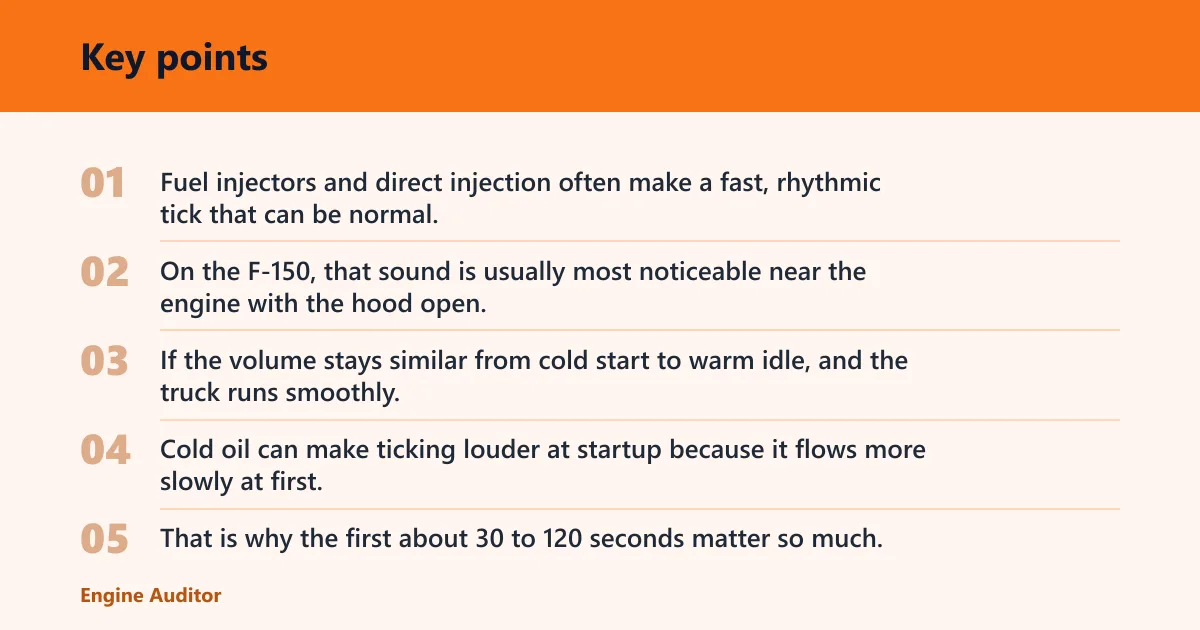
Fuel injectors and direct injection often make a fast, rhythmic tick that can be normal. On the F-150, that sound is usually most noticeable near the engine with the hood open. If the volume stays similar from cold start to warm idle, and the truck runs smoothly, injector noise is a likely explanation.
Cold oil noise
Cold oil can make ticking louder at startup because it flows more slowly at first. That is why the first about 30 to 120 seconds matter so much. A short-lived startup tick that fades as oil pressure stabilizes is less alarming than a tick that persists, grows sharper, or changes into a knock.
Transmission clicks that sound like engine noise
The 10-speed automatic transmission can create clicks during shifts or startup checks that sound engine-related from the driver seat. That is especially true when the truck is cold or shifting at low speed. If the sound seems to come from below the cab rather than under the hood, do not assume it is an engine fault.
If a truck makes a fast tick for about 20 seconds after a cold start, then quiets down at idle, That pattern fits normal cold oil or injector noise better than an exhaust leak. The next step is to repeat the start the next morning with the hood open and listen for the same rhythm.
Where is the noise coming from?
Location narrows the diagnosis faster than volume. Front-of-engine clicking points to belts or pulleys. Ticking from the exhaust side points to manifolds or heat shields. A sound from behind the dash usually has nothing to do with combustion, injectors, or valve train parts.
Front of engine and accessory drive
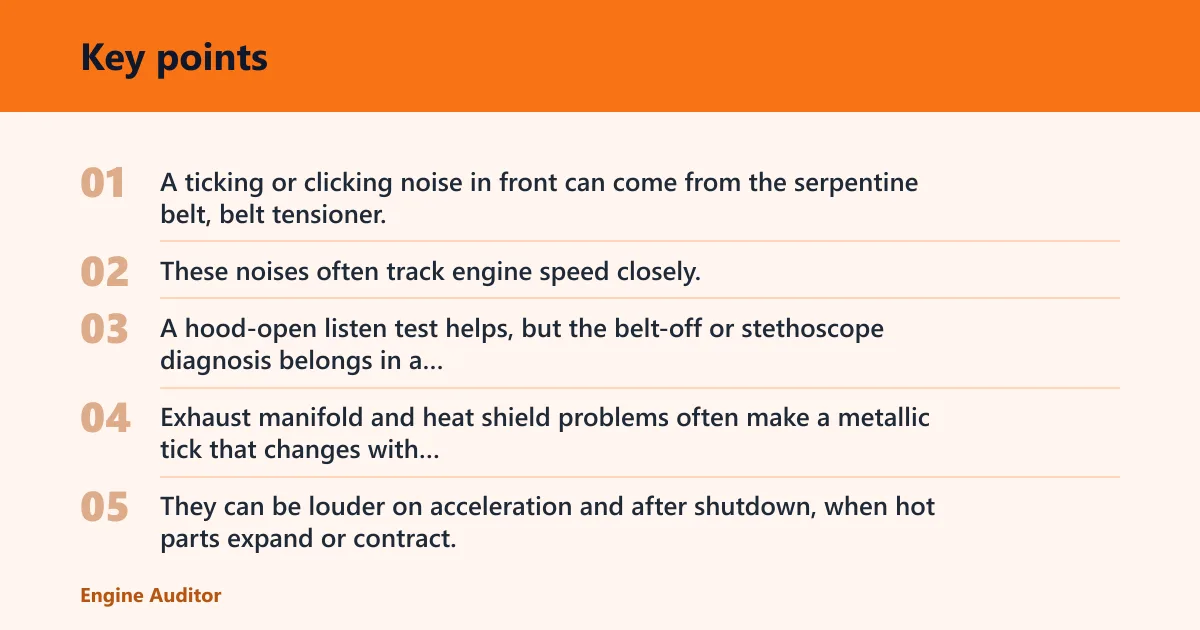
A ticking or clicking noise in front can come from the serpentine belt, belt tensioner, idler pulley, alternator, or another accessory. These noises often track engine speed closely. A hood-open listen test helps, but the belt-off or stethoscope diagnosis belongs in a shop if the sound is not obvious.
Exhaust manifold and heat shield
Exhaust manifold and heat shield problems often make a metallic tick that changes with RPM and load. They can be louder on acceleration and after shutdown, when hot parts expand or contract. A small exhaust leak can mimic injector ticking at idle, but it often sounds harsher and more side-specific.
Under the dash
Dashboard clicking can come from HVAC actuators or other under-dash parts and may be unrelated to the engine. If the sound changes when you move the temperature knob, switch vents, or cycle the fan, start with the cabin side. A 2014 F-150 that clicks in the dash is often pointing to an interior actuator rather than a motor fault.
Suppose the truck clicks behind the glove box every time the temperature setting changes, but the engine bay stays quiet with the hood open. That pattern points away from the engine. A common first-timer mistake is replacing engine parts for a dash-only noise that follows HVAC commands.
When should you stop driving?
Stop driving when the noise is new and severe, changes into a knock, or comes with warning lights, oil pressure concerns, misfire, rough idle, or loss of power. A brief tick without drivability symptoms is often less urgent than a sound that gets louder each mile. New warning signs move the problem into same-day territory.
Warning lights or low oil pressure
An oil pressure warning, a check engine light with rough running, or a message about engine protection usually needs immediate attention. Low oil pressure can turn a harmless-sounding tick into engine damage quickly. Shut the truck down and confirm oil level only if it is safe to do so.
Loud knock or rapid worsening
A loud knock is a different problem from a light tick. If the sound gets louder fast, changes from one bank to the other, or starts sounding like hammering, do not keep driving. That is especially true if the truck loses power, runs hotter, or shakes at idle.
Misfire, rough idle, or loss of power
If the tick comes with stumbling, rough idle, or weak acceleration, the issue is no longer just a noise complaint. Exhaust leaks, ignition faults, injector problems, or internal engine wear can all show up this way. The truck should be checked before further driving, especially if the symptom appears under load.
Frequently asked questions
Why is my ford f 150 making a clicking noise?
A clicking noise in a Ford F-150 often comes from normal injectors, a belt-driven accessory, or an HVAC actuator rather than a major engine fault. The best clue is location. If it is under the hood and follows RPM, look at the engine and front accessory drive first.
Why is my ford f 150 making a knocking noise?
A knocking noise is generally more serious than a light tick because it can point to internal engine trouble, low oil pressure, or a severe combustion issue. If the sound is deep, gets louder with throttle, or comes with a warning light, stop driving and have it checked right away.
Why is my ford f 150 making a ticking sound?
A ticking sound can be normal on some F-150 engines, especially at cold start or idle. The usual suspects are injectors, exhaust manifold leakage, heat shields, or valvetrain parts. The answer depends on whether the sound fades warm, follows RPM, or appears only in one area.
Why is the ford f150 making a clicking noise under dash?
Clicking under the dash is often unrelated to the engine and may come from an HVAC actuator, blend door motor, or relay. If changing the temperature or vent mode affects the sound, start inside the cab. If the engine bay stays quiet, the dash side is the better lead.
Why do my ford f150 make a clicking sound in front?
A front-of-engine click often points to the serpentine belt system, accessory pulleys, alternator, or a heat-related engine-side tick that seems to come from the front. If the sound tracks engine speed closely, the accessory drive is high on the list and deserves a close inspection.
Why does my truck make a ticking noise when I start it?
A ticking noise at startup is often tied to cold oil, injectors, or exhaust parts contracting and expanding as the engine warms. If the noise fades within the first 30 to 120 seconds and the truck runs normally, it may be expected. If it persists or worsens, look deeper.
Why is my truck making a ticking noise?
A truck that keeps ticking may have a normal engine sound, but the source matters. On an F-150, start by separating engine bay noise from dash noise, then check whether it happens at cold start, idle, acceleration, or shutdown. That pattern usually points to the right system fast.
Products related to this article
Sponsored / affiliate links. As an Amazon Associate I earn from qualifying purchases. I may earn additional commission from eligible campaigns.