Why Does My Car Make a Grinding Noise When Starting?
A grinding noise only during starting often points to low battery voltage under load, a starter drive that may not be engaging fully, or worn flywheel or flexplate ring gear teeth; if it happens only while cranking, inspect the starter first, and if it happens after the engine is running, look elsewhere. Ignoring it can leave you with a no-start and damage the starter or ring gear. This guide shows how to identify the noise by exact timing and separate starter, flywheel/flexplate, battery, and belt/accessory causes.
What the noise timing tells you
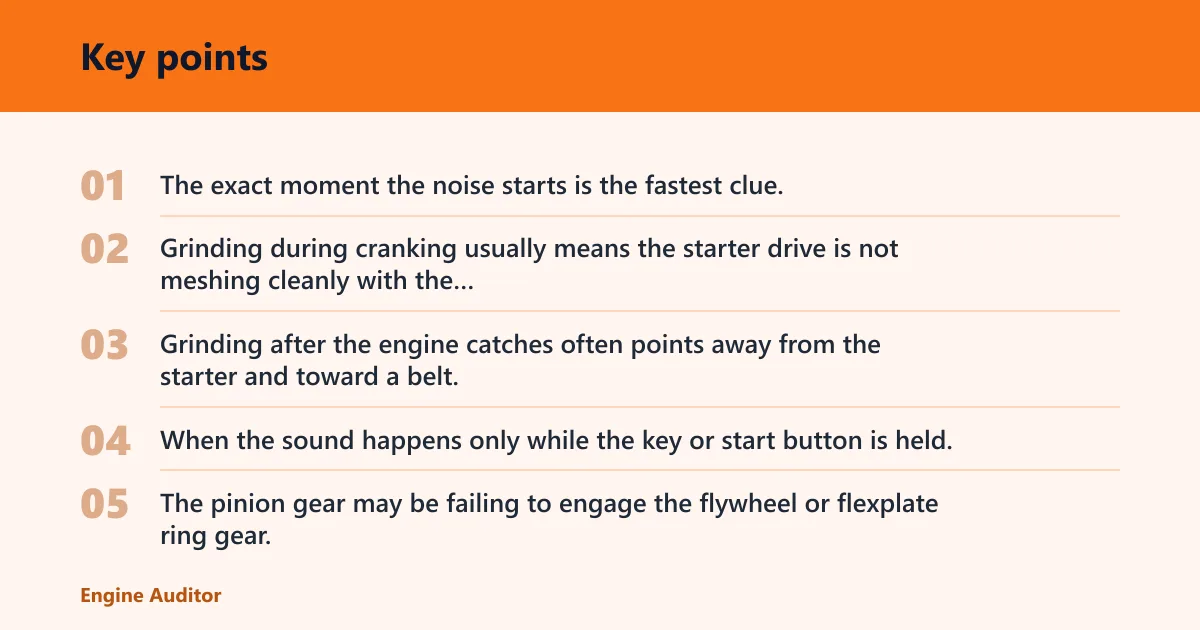


The exact moment the noise starts is the fastest clue. Grinding during cranking usually means the starter drive is not meshing cleanly with the ring gear. Grinding after the engine catches often points away from the starter and toward a belt, pulley, or accessory that changes speed as the engine fires.
Grinding during cranking only
When the sound happens only while the key or start button is held, the starter motor system is the first place to look. The pinion gear may be failing to engage the flywheel or flexplate ring gear, or the solenoid may be pushing it in only partway. Weak battery voltage can make that partial engagement more likely.
Grinding after the engine starts
If the noise stops with cranking and begins once the engine is running, look beyond the starter. A serpentine belt, belt tensioner, idler pulley, alternator overrunning pulley, or A/C compressor can make a brief scrape or grind as speed changes. That timing matters because the starter is no longer driving the engine at that point.
Grinding only in cold weather
Cold starts put more load on the starter because engine oil is thicker and the crankshaft turns with more resistance. A battery that seems acceptable in warm weather may drop too far under load in the cold, so the starter pinion may chatter or half-engage. Seasonal noise often points to a weak electrical or mechanical margin.
Intermittent no-start with grinding
Intermittent grinding with occasional no-crank symptoms often means the fault is in the start signal path or the starter solenoid. The ignition switch, relay, wiring, and fuses can deliver an inconsistent command. A starter can also fail only sometimes, which is why intermittent symptoms are common early on.
Why does my car make a grinding noise when I start it?
A grinding noise on startup usually comes from one of three places: the starter drive, the ring gear on the flywheel or flexplate, or a battery and control-circuit problem that keeps the starter from engaging fully. If the sound appears after the engine catches, a belt or pulley issue becomes more likely than a starter fault.
Starter drive and ring gear engagement
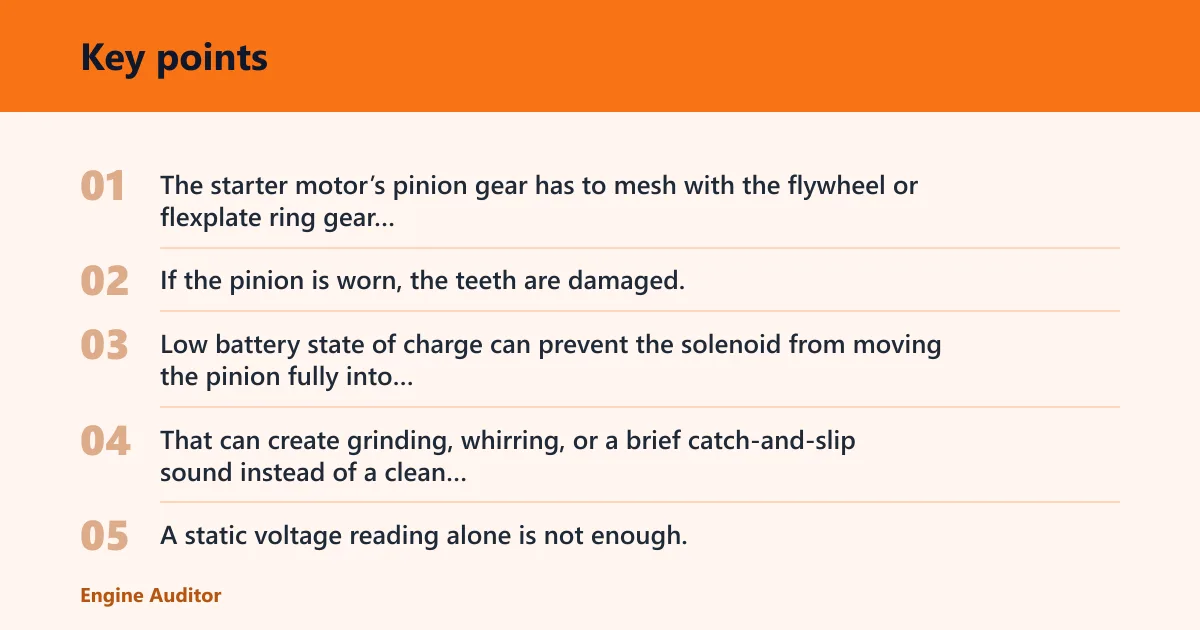
The starter motor’s pinion gear has to mesh with the flywheel or flexplate ring gear before the engine can crank. If the pinion is worn, the teeth are damaged, or the solenoid does not push the gear in far enough, the teeth can scrape instead of lock together. That is the classic crank-time grind.
Weak battery and partial starter engagement
Low battery state of charge can prevent the solenoid from moving the pinion fully into the ring gear. That can create grinding, whirring, or a brief catch-and-slip sound instead of a clean crank. A static voltage reading alone is not enough; a load test matters because the battery needs to hold voltage under starter demand.
Solenoid, relay, and start-signal faults
The starter solenoid is the electrical and mechanical switch that moves the pinion into position and closes the high-current circuit. If it sticks, chatters, or gets a weak start signal from the ignition switch, relay, wiring, or fuses, the starter may engage late or only partly. That can sound like a brief grind.
Say your sedan starts fine on mild days but grinds for one second on a 15-degree morning. The battery may still show a reasonable open-circuit voltage, yet drop too far under load for the starter to mesh cleanly. That pattern fits a load problem better than a dead battery reading at rest.
Startup noise decision table
| When the noise occurs | Most likely source | Quick driveway check | Urgency level |
|---|---|---|---|
| During cranking only | Starter drive, solenoid, or ring gear teeth | Listen for whirring, clicking, or a brief grind while holding the key; check battery terminals and start signal response | High; stop repeated cranking |
| After the engine catches | Serpentine belt, belt tensioner, idler pulley, alternator overrunning pulley, or A/C compressor | See whether the noise continues with the engine running and whether it changes with engine speed | Medium to high, depending on duration |
| Only in cold weather | Weak battery, thick oil, or a starter near its limit | Compare cold starts with warm starts; note slower cranking and longer engagement time | Medium; test before winter use |
| Intermittent no-start cases | Start switch, relay, wiring, fuse, solenoid, or starter motor | Check for inconsistent start response, dash lights, and repeatable failure at the same key position | High if the vehicle is becoming unreliable |
Starter motor and solenoid failures
Starter-related grinding usually means the pinion gear is not engaging the ring gear cleanly. That can come from worn starter teeth, a tired solenoid, or a starter motor that spins without fully driving the engine. Common symptoms include whirring, clicking, and intermittent no-crank, not only a harsh grind.
Pinion gear wear
The starter pinion takes repeated high-load hits every time the engine starts. As its teeth wear, the gear can skip across the ring gear instead of meshing. The result may be a crunching sound, a brief grind, or a starter that spins but does not catch. In many vehicles, replacement needs access from under the hood or from the bellhousing area.
Sticking solenoid
A sticking solenoid may push the pinion in too slowly or not far enough. It can also chatter if voltage is weak or the control circuit is unstable. That partial motion creates the timing window for grinding because the gear is in contact, but not fully aligned, when the motor starts to turn.
Intermittent no-crank symptoms
Intermittent starter faults can be misleading because the car may start normally one time and grind or do nothing the next. That pattern often points to heat-sensitive solenoid wear, worn brushes inside the starter, or a control-circuit issue. If repeated attempts make the sound worse, the starter drive or ring gear may already be damaged.
Flywheel or flexplate teeth wear
Worn or missing ring-gear teeth can produce the same startup grind you would expect from a bad starter. Automatic transmissions use a flexplate, while manuals use a flywheel, but both carry the ring gear that the starter pinion engages. If the damaged teeth sit in the same spot, the noise may appear only at certain crank positions.
Ring gear damage
The ring gear is the toothed outer edge that the starter turns first. If several teeth are chipped or missing, the starter may catch, slip, and grind at the same engine position. That is why the noise may repeat every few starts or only when the engine stops in a particular spot.
Why automatic and manual transmissions differ
On an automatic, the flexplate is the thin plate that connects the engine to the torque converter and carries the ring gear. On a manual, the flywheel is the heavier rotating part behind the clutch. The failure can look similar from the driver’s seat, but the access points and surrounding parts are different.
Why starter removal may be needed
Inspection often begins by removing the starter so the ring gear can be viewed through the opening. That gives a direct look at missing teeth, shiny scrape marks, or uneven wear. In many layouts, especially manuals, a full view of the damaged section may still require deeper disassembly.
Picture a manual-transmission hatchback that grinds only when the engine stops on the same cylinder position. That repeating pattern can point to a damaged patch on the flywheel ring gear, not a random battery fault. If the starter noise seems tied to one exact crank position, ring-gear wear moves higher on the list.
Could the battery be the problem?
Yes. A weak battery can cause grinding without failing completely. If voltage drops too far while the starter is trying to engage, the solenoid may not throw the pinion all the way into the ring gear. Cold weather raises cranking load, so a battery that seems fine in summer can act weak in winter.
Low voltage versus weak cranking load
A battery can show acceptable static voltage and still fail under starter demand. That is why a load test matters more than a quick voltage check. The starter needs current, not just stored charge, and low available current can cause a half-engaged grind before the engine ever turns.
Why cold weather makes it worse
Thicker engine oil increases cranking resistance. That extra load slows the engine, stretches the engagement time, and makes a weak starter or weak battery more obvious. A startup grind in winter can still be a mechanical starter problem, but cold conditions often expose an electrical weakness first.
Why a load test matters
A load test checks how the battery behaves when the starter demands current. That is more useful than reading battery voltage with the engine off, because a weak battery can look normal at rest. If the battery passes, move to the starter, solenoid, and start-signal circuit.
Could a belt or pulley be making the sound?
Yes. If the noise appears after the engine starts, or only for a second as the engine fires, a belt or accessory pulley may be the source. Serpentine belt noise often changes with engine speed and location, while starter noise usually comes from the bellhousing area and stops once cranking ends.
Serpentine belt and tensioner noise
A slipping belt can squeal, scrape, or chirp during startup as the tensioner reacts to changing load. The alternator, tensioner, idler pulley, and A/C compressor all share the belt path. If the noise comes from the front of the engine rather than the transmission area, the belt system deserves attention.
Alternator overrunning pulley faults
The alternator overrunning pulley can seize or freewheel incorrectly. When it fails, it may create a short chirp or grind right as the engine fires and the belt speed changes. That sound is easy to mistake for starter grinding because it happens at the same moment in the start sequence.
A/C compressor and idler pulley checks
An idler pulley with worn bearings can grind briefly, and an A/C compressor clutch or bearing can scrape on startup. A simple check is to note whether the sound fades as the engine settles into idle. Starter noise usually ends when cranking ends; accessory noise often continues or changes with RPM.
Belt-driven starter-generator and start-stop systems
Some vehicles do not use a conventional starter layout. Belt-driven starter-generator systems and start-stop setups can create a different startup sound path, and the noise may come from integrated electrical-mechanical components rather than a traditional starter pinion. Model-specific diagnosis matters here because the failure points are not the same.
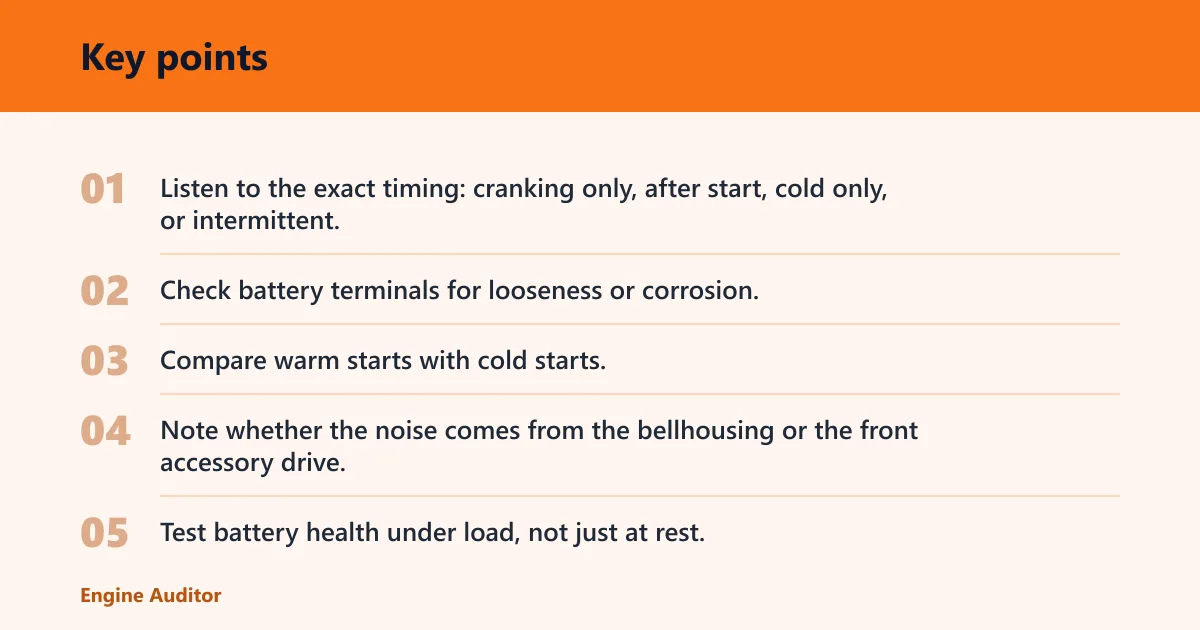
- Listen to the exact timing: cranking only, after start, cold only, or intermittent.
- Check battery terminals for looseness or corrosion.
- Compare warm starts with cold starts.
- Note whether the noise comes from the bellhousing or the front accessory drive.
- Test battery health under load, not just at rest.
- If the noise is during cranking, stop repeated attempts before more parts may be damaged.
Frequently asked questions
Why does my car make a grinding noise when I start it up?
If the grind appears only while the key is turned or the button is held, the starter circuit is the main suspect. If it continues after the engine catches, look at belt-driven accessories instead. Timing matters more than the word grinding itself, because the same sound can come from different parts.
Why does my car make a scraping noise when I start it?
A scraping sound can come from the starter pinion touching the ring gear without full engagement, or from a belt, pulley, or shield contacting a rotating part. A brief scrape that stops with cranking often points to starter engagement. A scrape that continues with the engine running usually points elsewhere.
Why did my car make a grinding noise when I started it?
A single startup grind can happen when the starter hits a worn spot on the ring gear, or when the battery is too weak to drive the pinion fully into place. If it happened once and not again, keep watching for repetition. Intermittent symptoms often become more frequent before a failure becomes obvious.
Why does my car make a loud grinding noise when I start it?
A loud grind usually means hard metal-to-metal contact, which can damage the starter drive or ring gear quickly. Stop repeated cranking. If the sound is violent and immediate, the starter may be misaligned, the solenoid may be hanging up, or teeth may already be missing from the ring gear.
Why does my car make a grinding noise after I start it?
Noise after the engine starts usually points away from the starter and toward the accessory drive. Check the serpentine belt, tensioner, idler pulley, alternator overrunning pulley, and A/C compressor. Those parts can scrape or grind as engine speed rises, which is different from a cranking-only starter grind.
Why does my car make a grinding noise when starting?
The most useful clue is timing. Grinding during cranking usually points to starter engagement, ring gear wear, or low battery voltage under load. Grinding after the engine starts points more toward belts or pulleys. Cold weather and intermittent no-starts can blur the picture, so test under the same conditions when possible.
Why does my car make a grinding noise when I start it up: if the grind happens right?
If the grind happens right as you start the car up, the starter and its control circuit are the first things to check. If it is brief and only in cold weather, battery load and oil viscosity may be part of it. If it keeps going with the engine running, look at the front accessories.
Products related to this article
Sponsored / affiliate links. As an Amazon Associate I earn from qualifying purchases. I may earn additional commission from eligible campaigns.