How Often Should You Change Coolant Before Winter?
Change coolant before winter if it is due by age, or test it now if service history is unknown; many systems need replacement every 2 to 5 years, depending on coolant chemistry. Old or weak coolant can freeze, lose corrosion protection, and leave you with poor cabin heat or foggy windows. This guide shows how to decide whether to change it now, test it first, or wait until the next service interval.
Use coolant age, chemistry and condition as a guide
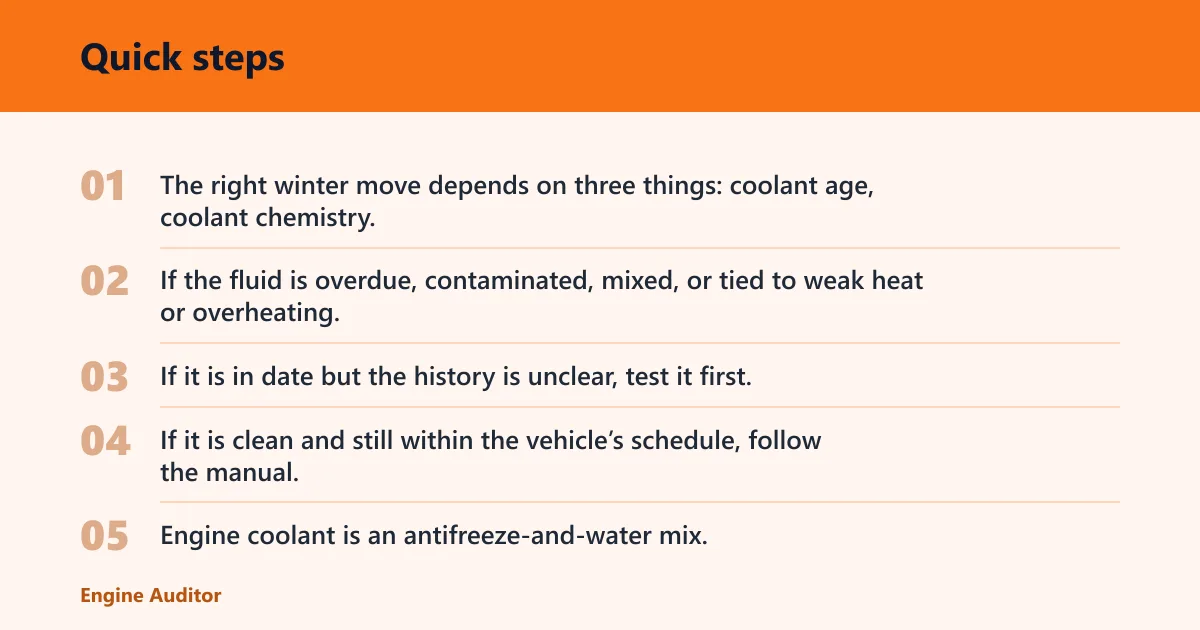


The right winter move depends on three things: coolant age, coolant chemistry, and current condition. If the fluid is overdue, contaminated, mixed, or tied to weak heat or overheating, replace it now. If it is in date but the history is unclear, test it first. If it is clean and still within the vehicle’s schedule, follow the manual.
Engine coolant is an antifreeze-and-water mix. It protects against freezing, overheating, and corrosion inside the cooling system. That system includes the radiator, water pump, thermostat, heater hoses, heater core, and the blend door that directs cabin air.
Use winter prep as a decision tree, not a flush on autopilot. Age matters. Mileage matters. Chemistry matters. So does what the coolant looks like and how the heater behaves on a cold morning.
Why coolant matters in cold weather
Coolant does more than stop freeze-up. It also raises boil protection, carries heat away from the engine, and carries warm fluid through the heater core so the cabin can warm up. If the fluid has weakened or loaded up with rust and scale, that job gets harder right when you need heat and defrost the most.
Freezing and boil protection
A refractometer can check freeze-point protection and give a read on boil-over margin. That matters before winter because coolant that has lost protection can gel or freeze in cold weather, while weak boil margin can still matter on long climbs, towing days, or extended idling.
Corrosion control and flow
Coolant also carries corrosion inhibitors. As they age, those inhibitors can drop off, which allows rust, scale, and debris to build up. That material can narrow passages in the radiator and heater core. When flow drops, heat transfer drops with it.
Do you follow the manual or a mileage rule?
Use the owner’s manual first, because it sets the replacement timing and the correct coolant spec for your vehicle. A generic mileage rule can be wrong for your car, especially if the system uses IAT, OAT, or HOAT coolant and the service interval differs by chemistry.
Traditional green IAT coolant often needs changes around 2 years or 30,000 miles, while OAT and HOAT coolants can last 5 years or 100,000 to 150,000 miles.
Do not use color alone to identify the type. Match the manufacturer spec. Mixing chemistries can shorten inhibitor life and create compatibility problems even if the coolant still looks normal at the filler neck.
What mileage should coolant be replaced at?
Mileage is only part of the answer. A high-mileage car with clean, correctly matched coolant may still follow the manual. A lower-mileage car used for short trips, towing, or extreme cold may need earlier service or yearly inspection because the fluid ages faster under severe service driving.
Does coolant need to be changed every 2 years?
No. Some conventional IAT coolants fit that timeline, but many OAT and HOAT formulas last much longer. The right interval depends on chemistry and the vehicle schedule. A universal 2-year rule is too short for many long-life coolants and too blunt for winter decisions.
Coolant decision table
| Condition | Age / mileage | Coolant type or history | Test result or symptom | Winter action |
|---|---|---|---|---|
| On schedule, clean appearance | Within the manual’s interval | Known IAT, OAT, or HOAT that matches spec | Normal color for that fluid, good freeze protection, pH in range | Follow schedule |
| Traditional green IAT at age limit | About 2 years or 30,000 miles | IAT | No warning signs, but the interval is due | Replace now |
| Long-life OAT or HOAT still in date | Below the listed interval | Known OAT or HOAT | Good refractometer reading and no contamination | Test first, then follow schedule if results stay good |
| Weak heat | Any age | Any type | Poor cabin heat, slow warm-up, or weak defrost | Test first; replace now if fluid is degraded or restricted |
| Unknown history | Any mileage | Used car, no service records | No proof of last change, no chemistry record | Test first; replace now if results are poor or mixed |
| Mixed coolant | Any age | Different coolant types may have been added | Cloudy fluid, odd color shift, or service uncertainty | Replace now |
| Rust-colored coolant | Any age | Possible corrosion or scale | Rust tint, debris, or sludge | Replace now |
| Severe service use | Short trips, towing, heat, or cold extremes | Any type | More frequent heat cycling and possible fluid stress | Test yearly; replace sooner if results slide |
| Freeze protection weak | Any age | Known or unknown | Refractometer shows poor protection margin | Replace now |
| Acidic coolant | Any age | Known or unknown | Test strips show pH trending acidic | Replace now |
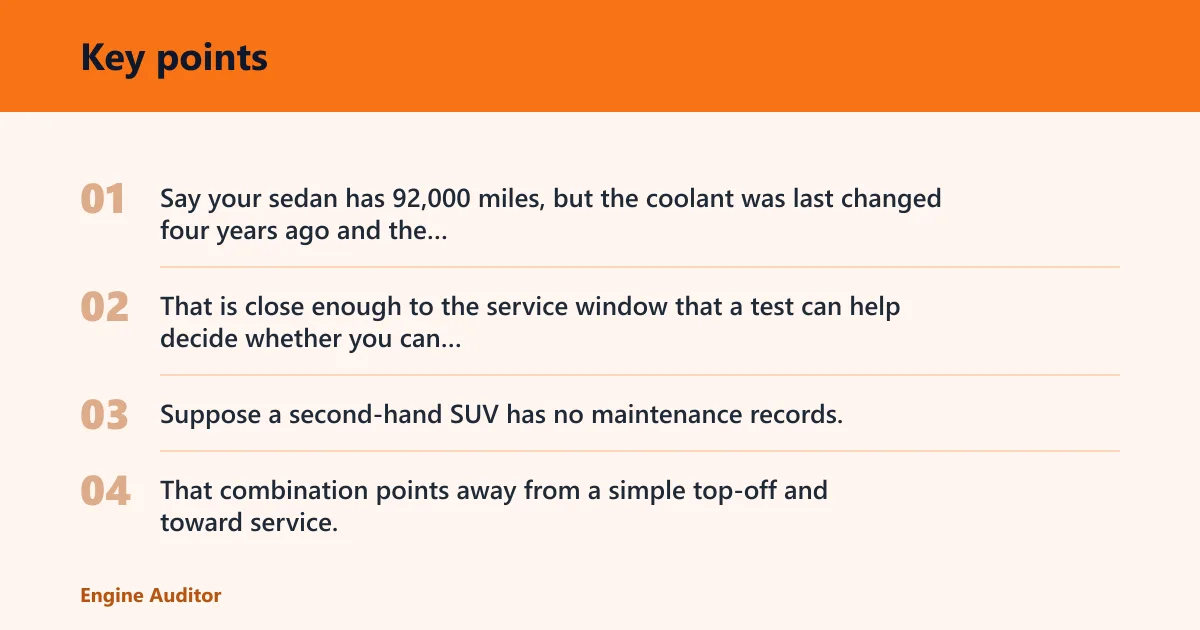
Say your sedan has 92,000 miles, but the coolant was last changed four years ago and the manual calls for HOAT. That is close enough to the service window that a test can help decide whether you can wait or should replace it before the first hard freeze.
Suppose a second-hand SUV has no maintenance records, a faint brown tint in the reservoir, and weak cabin heat at idle. That combination points away from a simple top-off and toward service, because the history is unknown and the heater core may already be restricted.
How do you know coolant needs service?
Visual checks and simple tests work together. Rust-colored coolant, debris, sludge, a low level, or a mixed appearance can point to contamination or corrosion. A refractometer checks freeze-point protection. Test strips check pH and can help spot acidic coolant that has used up its corrosion inhibitors.
How to read the tests
If the refractometer shows weak freeze protection, the fluid has lost margin for winter. If it also looks weak on boil-over protection, replace it now rather than trying to stretch the service. If test strips show acidic coolant, that is a sign the fluid is no longer healthy enough to keep protecting metal parts and seals.
Use the tests as a workflow. First, confirm the coolant type and service history if you can. Then check freeze-point protection. Then check pH. If either result is poor, or if the fluid is dirty or mixed, winter service should move from “later” to “now.”
What if the coolant just looks old?
Color alone is not proof of failure, but color change matters when it appears with sediment, rust, or mixed fluid. A clean-looking reservoir does not guarantee good chemistry either. That is why testing matters before winter, especially when the manual interval has not yet arrived but the history is unclear.
Can old coolant cause weak heater performance?
Yes. The heater core uses hot coolant to warm cabin air, and its tiny passages can clog when coolant ages or picks up debris. When flow drops, you can get weak heat, slow warm-up, or poor defrost performance even if the engine still runs at normal temperature.
The engine coolant temperature sensor also matters here. If the engine reaches temperature but the cabin stays cool, the issue may be coolant flow, heater-core restriction, thermostat behavior, low level, or blend-door trouble. Do not assume one symptom has only one cause.
Can low or old coolant cause no heat in the car?
Yes. Low coolant can leave the heater core short of flow, and old coolant can leave it restricted. Either problem can reduce heat output enough that the vents blow cool air, especially at idle or in very cold weather. That also means defrost performance can fall when you need it most.
What warning signs should you treat as winter service triggers?
Overheating, slow warm-up, weak heat, no heat, foggy windows that do not clear well, rust-colored coolant, or visible debris all point to service sooner rather than later. If the vehicle also has severe-service use, the case for testing or replacement gets stronger.
Drain-and-fill or full flush?
A drain-and-fill replaces a portion of the old coolant. It fits best when the fluid is still relatively clean and the system has the correct coolant type. A full flush removes more old fluid and debris, which is better when coolant is degraded, mixed, contaminated, or rust-colored.
When a drain-and-fill is enough
If the coolant is on schedule, looks clean, and tests well, a drain-and-fill can be a sensible routine service. It is a maintenance move, not a rescue move. It works best when the goal is to renew part of the fluid before winter, not to clean out a damaged system.
When a full flush fits better
If the fluid is mixed, acidic, sludgy, or full of rust, a partial change leaves too much bad coolant behind. A full flush is the better fit after contamination, repairs, or evidence of corrosion, because the system needs more than a top-up style refresh.
What if service history is unknown?
Unknown coolant history is a reason to test first and may be a reason to service sooner. If tests are borderline or the coolant type cannot be confirmed, a professional inspection is the safer move. That is especially true for used cars, where previous topping-off with the wrong coolant can create compatibility problems.
Winter prep checklist
- Check the owner’s manual for the exact coolant type and replacement timing.
- Confirm whether the fluid is IAT, OAT, or HOAT and match the manufacturer spec.
- Inspect for rust, debris, sludge, mixed color, or a low level.
- Use a refractometer to check freeze-point protection and boil-over margin.
- Use test strips to check pH and spot acidic coolant.
- Pay attention to weak heat, slow warm-up, or poor defrost.
- Service sooner if the vehicle sees towing, extreme temperatures, or short trips.
Frequently asked questions
How often should you change coolant before winter?
Use the owner’s manual first, then decide from age, mileage, chemistry, and condition. If the coolant is due, mixed, contaminated, or tied to weak heat, change it before winter. If it is still within the correct interval and tests well, you can usually stay on schedule.
Should I change coolant if I don’t know the service history?
At minimum, test it first. Unknown history raises the chance of mixed coolant, weak freeze protection, or acidic fluid. If the tests are poor, the fluid is dirty, or the vehicle already has heating problems, replacement is the better winter move.
What coolant type lasts the longest?
Even so, the correct answer is the one listed in the owner’s manual for your vehicle. Long life only helps if the fluid matches the spec.
Products related to this article
Sponsored / affiliate links. As an Amazon Associate I earn from qualifying purchases. I may earn additional commission from eligible campaigns.